International Law
Authors
News Type
Commentary
Date
Paragraphs

There are a lot of changes happening in the world, from the "rupture" in the global order to a new host of the World Class podcast.

For almost a decade, Michael McFaul, a senior fellow at the Freeman Spogli Institute for International Studies at Stanford University, has helped listeners understand what's happening in the world, and why, by bringing them in-depth conversations with scholars working across FSI's nine research centers. Now Colin Kahl, the new director of FSI, is taking on the role of podcast host to carry on the tradition.

In this episode, Kahl and McFaul discuss how institutions like FSI can better study and contribute understanding about the rapidly changing world and how alliances and partnerships — whether across academic departments or between nations — create better, stronger outcomes.

Listen to the episode below. World Class is also available on Apple Podcasts, Spotify, and other major podcast platforms.

TRANSCRIPT


McFaul: Hey everyone, you're listening to World Class from the Freeman Spogli Institute for International Studies at Stanfo rd University. I'm your host, or maybe I should say I'm your co-host, or maybe I should say this is the last time I'll be hosting World Class from Stanford University. Because as listeners and followers of FSI’s news may know, after eleven years, I just stepped down as the director a few weeks ago and I've handed the baton to my guest today, Colin Kahl, who's the brand new director of the Freeman Spogli Institute.

And it is fantastic, Colin, that you agreed to take on this assignment. This is another form, I consider, of public service just like what you've done for the U.S. government and the United States of America.

Colin, as you're going to hear in a few minutes, is the perfect mix of scholar and practitioner that we so value here at FSI. And we are really lucky that you are taking up this assignment.

So Colin, welcome to World Class where everybody will be listening to you forthcoming for, I hope, many, many years.

Kahl: Thanks Mike, it's a real pleasure to be with you and most especially thank you for your tremendous decade plus—eleven years—of service to FSI and the Stanford community. And I look forward to continuing to work with you as you transition to the next thing. And we should talk about that too. But it's great to be on the pod with you.

McFaul: Glad to be here. And just so everybody knows, I stepped down from FSI, but I'm not retiring from Stanford. I still have my various day jobs here. We can come back to that a little bit later.

But Colin, why don't you just tell our listeners and our viewers a little bit about your road to this present position.

Kahl: Yeah, sure. So I grew up in the Bay Area. I grew up in the East Bay in Richmond, California. I applied to Stanford as an undergrad, didn't get in. Applied again as a graduate student, didn't get in. So I got educated elsewhere. I went to the University of Michigan, which is a great school.

McFaul: Very fine institution.

Kahl: And then I went to Columbia University where I got my PhD in political science, focused on international relations and conflict studies. I did my PhD work in the 90s when the field of international relations was trying to figure out what the field even meant after the end of the Cold War.

So it was an exciting and very kind of plastic moment to be doing scholarly work.

I then started my first teaching job at the University of Minnesota in 2000. And of course, a year after that, 9/11 happened. And it was a terrible event for the United States and for the world. For those of us who lived in New York City—I did my graduate work there—it was especially painful.

And it really drove me to want to figure out a way to both do the academic side of understanding the world, but also see if there was a way to engage in public service. So my fifth year at the University of Minnesota, I actually got a fellowship through the Council on Foreign Relations . . .

McFaul: Right.

Kahl: . . . that put me at the Pentagon for a year and a half. This was during the George W. Bush administration. Don Rumsfeld was still the Secretary of Defense. I worked there for a year and a half. I kind of caught the bug, the Washington bug.

McFaul: What was your portfolio back then, Colin? Just remind everybody.

Kahl: So I worked in a small office called the Stability Operations Office. It was only 24 of us. worked within the office of the Undersecretary of Defense for Policy. It had historically been called the Peacekeeping and Humanitarian Affairs Office

McFaul: Right, right, I remember that. They changed it, right.

Kahl: But Rumsfeld was not a fan of peacekeeping, so they changed it to ‘stability operations.’

But at the time, most of what our office did was try to help the U.S. military reform itself in the face of the struggles that the U.S. military was facing in Iraq and Afghanistan with the stabilization missions there.

There's a lot of dark humor at the Pentagon, but we sometimes joked that the 24 of us were doing stability operations while the other 24,000 people in the building were doing instability operations.

McFaul: [laughing] Instability operations, yeah, that’s right.

Kahl: But anyway, it was totally exciting. You know, we were there when when U.S. counterinsurgency doctrine was being revised and a bunch of other things.

So that was 2005, 2006. I kind of caught the bug and decided to try to stay in Washington. So I actually took a job at the Georgetown School of Foreign Service where they were kind enough to give me tenure and I taught in the security studies program there for a decade.

McFaul: Let's just . . . hold on, hold on. Let's be clear. They were not ‘kind enough’ to give you tenure; you earned tenure. Nobody gives tenure anywhere. Congratulations that you landed that job.

Kahl: So, I was in the security studies program there for ten years, about a half that time I served in the Obama administration. We served together . . .

McFaul: Together, yes!

Kahl: . . . in the first few years. I was back at the Pentagon as the deputy assistant secretary of defense for the Middle East during the drawdown of our forces from Iraq during the Arab Spring.

McFaul: Right.

Kahl: During the first flare up of Israel-Iran tensions over Iran's nuclear program. By the way, none of that was my fault, but I was there when all that stuff happened.

And then I went back to Georgetown for a few years and then I got pulled back into the Obama administration at the end to work at the White House as a deputy assistant to the president and as then-vice president Biden's national security advisor. So I was there for Russia's first invasion of Ukraine . . .

McFaul: Right.

Kahl: . . . and the Central American migration crisis and tensions in the South China Sea and the campaign against the Islamic State and the Iran nuclear deal. A lot of interesting things.

And then, when Trump was elected the first time, Mike, you reached out to me with this amazing opportunity at Stanford, the Steven C. Házy Senior Fellow chair that I currently occupy. Applied for the job and got it. It was an opportunity to come back to Stanford. I’ve sat at CISAC, the Center for International Security and Cooperation here at FSI. And I was the co-director of CISAC for a couple of years.

And then last but not least, when Biden was elected president, he asked me to serve as the undersecretary of defense for policy back at DoD, which is essentially the number three civilian and senior policy advisor to the secretary. And I did that for the two first two and a half years of the Biden administration.

Also also very interesting times: fall of Afghanistan . . .

McFaul: Yes.

Kahl: . . . Russia's further invasion of Ukraine, rising tensions with China, dealing with the aftermath of COVID, lot of changes in the world.

So anyway, I'm glad to be back at Stanford. I've been back since the summer of 2023, and I'm excited to try to fill the very big shoes that you've left at FSI after eleven years.

McFaul: Well, let's talk about the future in a minute, but just two follow-up questions on your history. You've had lots of government jobs you just described. I can't think of anybody that's had a more diversified set of experiences in national security. We are lucky to have you here.

Tell us about the best day of any of those jobs and tell us about the worst day and maybe reverse that. Worst day first, best day second.

Kahl: So first of all, I'm fortunate to have had the opportunity to serve my country. I believe in it strongly. I've served in Republican administrations and Democratic administrations. I've worked for two Republican secretaries of defense and two Democratic secretaries of defense. So I think I've demonstrated my nonpartisan bona fides in how I've served my country.

And I just want to mention that because I think it's important.

McFaul: Yes, it is important.

Kahl: Because, of course, FSI is a nonpartisan place.

Worst day and best day: in a sense, it's almost the same. There was no more harrowing experience than the collapse of Kabul.

I was actually at the NIH getting a medical treatment when I got a text message from the secretary's chief of staff that I needed to hurry back to the Pentagon. So I literally pulled an IV out of my arm and raced back to the Pentagon because Kabul fell.

And obviously that was a tremendously terrible event for Afghanistan. It was a particularly harrowing way for the 20-year U.S. involvement in Afghanistan to end. But it also put us on the clock. You know, we had basically 17 days before the deadline for all American forces to be out of Afghanistan, and we suddenly had to do a lot of things.

We had to flood forces back into the country to occupy an airport that was now in hostile Taliban territory when the Taliban took over Kabul. We had to secure that airport. We sent five or six thousand soldiers and Marines to that airfield. We had postured them in the region previously to be able to do that, but we had to get them there.

McFaul: Right.

Kahl: And then we then had to oversee the evacuation of 125,000 human beings in two weeks, which had never happened in human history and no other country in the history of the world would have been capable of doing. And it was pretty horrible.

McFaul: Yeah.

Kahl: A lot of terrible human tragedies. Obviously, we got a lot of people out. A lot of people weren't able to get out. There was the terrible ISIS bombing that killed 13 of our brave service members. Toward the end of the evacuation, there was an errant U.S. strike on what we thought was an ISIS operator that turned out to be an aid worker and his kids. It was horrible.

But I'm also incredibly proud of what we were able to do. I mean, in the macro sense, because we were able to project our power back into Afghanistan, lock down that airfield and get all of those people to safety, including the family members of some Afghans who worked for me. We were able to get a lot of people out.

We were able to bring them to bases and facilities that didn't even exist when the crisis . . . I mean the bases existed, but the facilities to house these people in the Gulf and in Europe and back here in the continental United States . . . the amount of diplomacy that required, the amount of logistics by the U.S. military that it required. It was an unbelievable operation.

And so it was terrible. But it was also an extraordinary demonstration of what the United States was capable of doing even at these dark moments.

McFaul: That's a great way to put it together. I would guess we would not have been able to do that if we did not have NATO allies and bases in that part of the world, or is that incorrect? I don't know the logistics of that part of the world.

Kahl: If anything, it's an understatement. I think one of the things that distinguishes the United States from every other superpower or global power in history is the depth and breadth of our network of allies and partners. At the heart of that are our treaty allies in the NATO alliance, but also in the Indo-Pacific region, so think South Korea, Japan, Australia.

McFaul: All of them, right.

Kahl: But we also have very close security partnerships in the Middle East. And so literally it would not have been possible to fly aircraft into Afghanistan, fly people out from Afghanistan into places like Qatar, Bahrain, UAE, Saudi Arabia. But then we brought them to Germany and Spain and other U.S. bases in Europe. And then we brought them back to bases here in the United States.

And that network, literally that network made it possible. And had we not had those allies and partners when that happened, we couldn't have done what we did. We couldn't have done any of it. We couldn't have gotten any of our people out.

And so that really is like some of the secret sauce to America's power and influence in the world. And it remains the case that we have more allies and partners than any other country in history.

But it's also the case that those alliances and partnerships are probably more strained than they've been in my lifetime.

McFaul: So, one other historical question about you. Why did you come to Stanford? I mean, you've got this great job at Georgetown. You obviously are connected to the policy community. We're far away out here. Tell us about that decision.

Kahl: Part of it is I grew up in the Bay Area. Part of it is that, mean, Georgetown is a remarkable place, but Stanford's one of the two or three best universities in the world. We had a great community of scholars out here. And a lot of the issues that I'm particularly passionate about now—especially the intersection of technology and geopolitics— I mean, this is ground zero for a lot of that.

And so it was for a mix of kind of lifestyle reasons and professional reasons. And it's been awesome.

McFaul: Well, that's a great segue to what I wanted to ask you next, which is about the big agenda items. I mean, FSI has a lot going on: we have lots of centers here, as our listeners know, because we've had many guests from all, I think all of our centers over the time I've been here.

But you've got some particular things that you want to focus on. I know, because I talked to people that were part of the selection committee, that that was what was most impressive about you, is that you have a big agenda. Tell us about that agenda, Colin.

Kahl: As your longtime listeners undoubtedly know, FSI is an interesting place because FSI Central, where you were the director until three weeks ago, and now I sit, essentially sits over nine main research centers that cover everything from democracy to international security to regions like Asia and Europe to issues like technology and defense innovation, food security, global health.

And the breadth of this place is extraordinary. But it's also a highly decentralized place. Yes, we oversee the centers, but in many respects, the centers are kind of quasi-autonomous nation states.

McFaul: Exactly, exactly.

Kahl: So this isn't about trying to micro-manage our centers; that would be a fool's errand. It is actually, though, trying to look for ways to have the whole of FSI add up to more than the sum of its parts. And to look for synergies across our centers on really big questions.

You took the helm of FSI, I believe, back in 2015?

McFaul: Yes.

Kahl: To state the obvious, the world in 2026 is a lot different than it was in 2015. And so, FSI has to adapt to that world. And I think there are four really big questions of the moment that I think FSI really needs to be impactful on.

One is that we're in this new age of geopolitics. And it's become kind of trite to note that, you know, we have a resurgence of great power politics and competition between the United States and China and Russia and other major powers. But it actually runs deeper than that.

The distribution of power in general across the world is fundamentally different than it was 15, 20 years ago, let alone 50 years ago. The United States remains the world's most consequential actor, but China is nipping at our heels as a global superpower. And while Russia can't dominate the world, Russia can blow up the world. And we also know that countries like China, Russia, North Korea, Iran are working more closely together.

At the same time, the traditional role that the United States has played in the world since World War II or since the end of the Cold War is changing. And our relationship with our traditional allies is changing. And I think anybody who kind of paid attention to the World Economic Forum in Davos over the last few days heard speeches from the Prime Minister of Canada referring to the rupture in the international order.

And there's just the sense that things are fundamentally changing. And some of that may be a direct reaction to some of the policies of President Trump. But frankly, I think a lot of it is structural, that the policies of the current administration are as much an artifact as they are a cause even if they are accelerating some of the structural dynamics.

And then of course, there's big chunks of the world that doesn't want to be on anybody's team.

McFaul: Right.

Kahl: That wants to be non-aligned and multi-aligned. A lot of countries in the so-called ‘global south’ fall in that category. So we should be studying this new era of geopolitics

I would encourage you to say more about how you plan to study it, because I know you have a really fascinating project in this space that brings FSI and Hoover scholars together on some of these questions.

Kahl: So, one issue is the new geopolitics. The other though is what I call the new techno politics. It's actually a term I think Ian Bremmer coined.

But it's not just the notion that technologies like AI, biotech, quantum, space, clean energy are transforming our world, but also that the actors at the heart of these innovations are these multinational corporations that if their market cap was translated into GDP,

they would rank as G20 nations, right? When you're Nvidia and you have $5 trillion

McFaul: That's a great point.

Kahl: Like that would be the top half of the G20. But it's not just that. They have global presence. And for a lot of these companies, they have near sovereign control over the environments through which we live our lives.

McFaul: That's a great point.

Kahl: So, think cloud service providers, social media platforms, but also the infrastructure: undersea cables, low earth orbit constellations. And all of these things are under regulated spaces. So, it's not just that the technology is changing the world, but the companies are international actors. And again, where else should we be studying that but here at Stanford?

McFaul: Right.

Kahl: The third thing is there's a broader category of what people might refer to as existential risk. Nuclear weapons and the salience of nuclear weapons are back with a vengeance. For the first time, we're entering a world in which there are not two but three nuclear peers as China quadruples its nuclear arsenal. India and Pakistan are at loggerheads. They both have nuclear weapons. Israel and Iran are at loggerheads over Iran's quest for nuclear weapons. North Korea is expanding its arsenal. And arms control is breaking down.

So we know that the nuclear age is back with a vengeance. Simultaneously, we're facing the climate crisis. We all lived through COVID. It won't be the last pandemic, unfortunately, I think, in our lifetimes. There are other biosecurity risks emanating from emerging technologies. And then there's also the possibility that technologies like AI will produce their own existential externalities in the form of things like rogue super intelligence or other things.

So we should be studying those things. And then lastly, I think we have to be studying the future of global democracy because democracy is under siege around the world from revisionist authoritarian powers like Russia and China. But it's also eroding in many traditional democracies that are becoming increasingly illiberal.

And advanced democracies no longer agree on what democracy is. A big divide between the United States and Europe at the moment is both laying claim to being democratic, but in fundamentally different ways.

And so the point just is, we have 150 researchers at FSI, 50 of them are tenured faculty, many of them were working at the intersection of these issues. I want to support that and I also want them to do more together.

McFaul: That sounds fantastic. That is the agenda for our moment. And I think you're right that we have some people that work on some of those things, but we have holes to fill. And I wish you success in doing that to compliment what we have here, but also to try to get these different scholars that work on these different pieces to understand how they are intertwined, right?

The future of global democracy is also highly impactful on geopolitics and vice versa. I think that is a great agenda for FSI for the future.

I mean, on my own piece: I would just say in terms of what I want to work on, I have a lot of interests, but the main research one is I just did finish this book, as listeners will know, called Autocrats vs. Democrats, China, Russia . . .

Kahl: Available now!

McFaul: Available now! Available while you're listening on your phone. You can get it, and it's highly discounted now. And I'm going to tell you a little story about that actually, Colin. I don't think we've talked about it. The original title was ‘American Renewal.’ That was like two or three years ago. Then it switched the title to ‘Autocrats vs. Democrats.’ But the subtitle, until just a few months ago was ‘China, Russia and the New Global Order.’ The now title is ‘China, Russia, America and the New Global Disorder,’ reflecting a year ago what I thought was going to be a pretty tumultuous time. And I think I underestimated how tumultuous it is and your agenda is addressing that.

But I would say two things that I want to do here at FSI. One is, when I was working on this book, I knew a lot about the Cold War, so there's a debate, are we in the Cold War or not? And I addressed that. My answer is yes and no.

But I knew a lot about the Cold War. I know quite a bit about Russia. I know a fair bit about America and America's place in the world, both from teaching and being in the government. But I had to learn a lot about China. And I've been going to China for three decades, but I'm not an expert. It took me a long time. That's why it took me eight years to finish this book

But there were two big gaps that I saw at the end of it. One is we have a lot of great people working on capabilities of these various great powers. We have a really great literature on intentions of America, Russia, and China. And big debates, by the way, on the intentions, especially on the China side. I would say comparing the debate in the Russia field to China field, there's a lot more consensus in the Russia field about intentions of Putin's Russia than there is of Xi's China, and that's a good thing. I think that debate is unsettled and we should keep interrogating our hypotheses.

But what I was really struck by is very little examination. And with some exceptions, I'm looking at my shelf. There's some really great books. But there's not that many books that look at impact of this competition on other countries in the world. And when you do find great books—there's a great one on China and Zambia, for instance—it's just China and its impact on Zambia. There's no Europe in that story. There's no Russia in that story. There's no America in that story. So that's the academic kind of research project that I want to do here with Liz Economy from the Hoover Institution, Jim Goldgeier—he's going to cover the European part. And that'll take many, many years because we want to really get into the nitty gritty of these countries. And we want to find country experts to be the main people that write that.

The second part in my book—you know, my book looks at the debate, examines where we're at, and then has these three prescriptive chapters. And even had Vice President Harris won the election last year, the structural things that you identified would have been still a part of our trying to figure out where we're going and the debate about international order and how to manage the decline of democracy, technology and the global order, that would all been there. But to your other point you made earlier, it's been accelerated by President Trump.

And in my public policy life, I want to keep engaging that debate because yes, the old order is broken. We're not going to go back to it. But the idea that we have to just go back to some Hobbesian jungle that Trump seems to want to fight in, I don't accept that as an inevitable consequence. And even if it is analytically, and I'm wrong about that, I want to do everything I can to avoid it, even if it's going to be in failure. In a way, Trump has moved us in a different direction and I want to be part of that debate.

And one of the things I would add to that is part of the reason liberal internationalists like myself have lost that debate is because we lost the American people on it. And we didn't focus enough on trying to explain why being a NATO is in our interest or explain why it's better off to have a foot in even something like the United Nations than to pull out. Why we're better off to support ideas of democracy and freedom rather than just think that it's just all about power.

And so I'm going to be spending a lot of time speaking, not just in Silicon Valley—I'm still doing that—and not just Washington and New York or Brussels and Beijing, but my next stop for my book tour is Boise, Idaho. And I've done this for a while and not everybody agrees with me. I even had a few people walk out before I even said a word because they saw that I'd worked for Barack Obama.

But what I can tell you and report is people are curious. All my talks are sold out. And the agenda you just outlined, Colin, is an agenda I think that when we have things to say with our scholars, we should bring those ideas through things like World Class. I think there's a demand and a thirst for trying to figure out this new world order/disorder that we're in, and FSI has a great role to play in that.

Kahl: Hard agree. And also I'm thrilled that this is going to  be so much of your focus.

I would just say on the alliance piece: my view is that as the distribution of power changes, it's clearer than ever that foreign policy is a team sport.

McFaul: Yes.

Kahl: I used to make this reference: Michael Jordan, probably the best basketball player who ever lived. Although I'm sure there are people who claim it's LeBron or Kobe or somebody else. But if you believe that Michael Jordan was the best basketball player who ever lived, he still needed four other Bulls to win championships.

And as we go around, and address every problem that I've ever encountered as a policymaker, whether it's the rise of the Islamic state or the invasion of Ukraine, we need our team.

McFaul: Exactly.

Kahl: And our allies and partners are our team. So I think we have to tell that story. We also, as we enter this new world, have to figure out a way to re-anchor our alliances in a way that are politically sustainable on all sides, and that actually deliver benefits for the American people.

So it's not just telling a better story. There's an interesting example of this. Recently the Trump administration agreed to help South Korea with their submarine program. But South Korea in exchange is making tens of billions of dollars of investments in American shipyards . . .

McFaul: Right.

Kahl: . . . to build up our capacity. And I do think these ideas about joint industrial capacity across the free world might be a way to generate jobs, to generate political incentives on all sides to keep those alliances intact and give some people confidence on both sides of our alliances that we're not going to have these violent swings every four to eight years.

McFaul: I could not agree more. And that example you gave is a great example. And we have to be more creative about re-anchoring and win-win for everybody. I think that's a great idea.

Colin, I'm going to hand this over to you. We've already gone longer than we should have because you're so interesting. Tell us a few of the guests you have coming up on World Class.

Kahl: First of all, not only big shoes to fill on the FSI director position, but big shoes to fill as the host of World Class. We're going to try to start off with a bang in the near future. So stay tuned. We hope to have a great conversation involving H.R. McMaster, who is at Hoover, but as many of your listeners will know, was President Trump's national security adviser at the beginning of the first Trump administration.

And we're going to pair H.R. with Jake Sullivan, who was Joe Biden's national security advisor.

McFaul: Wow! Both on the same show?

Kahl: On the same show!

McFaul: Oh my God, that's fantastic!

Kahl: And the idea is to ask two of the smartest minds on different parts of the political spectrum to help get us smarter about the state of the world and where things are going for the rest of 2026. I have to say for the rest of 2026, because like we're not even a month in and we had Venezuela and Greenland and Iran, and Iran could come back and like, we're three weeks in.

But people should stay tuned because that's going to be an awesome conversation.

And then without naming names, I'm very hopeful to bring on leaders from the tech community here in Silicon Valley to interface with our scholars about some of these technology trends we talked about earlier.

McFaul: Great, excellent.

Kahl: So it's gonna be great. If you're a geopolitical nerd, you're going to love it. If you're into technology, you're going love it. And we're gonna find ways I think to both highlight the extraordinary work being done here at Stanford, but also Stanford's role in the broader ecosystem. It’s going to be fun.

McFaul: Sounds exciting, Colin. Well, first of all, thank you for taking on the role of leading FSI. We need you because of all the things you just described. Second, thanks for taking on World Class. And third, just with that teaser, I know that World Class is going to get a lot more interesting in the weeks and months to come. So congratulations.

Kahl: Thanks, Mike.

McFaul: You've been listening to World Class from the Freeman Spogli Institute for International Studies at Stanford University. If you like what you're hearing, please leave us review and be sure to subscribe on Apple, Spotify, or wherever you get your podcasts to stay tuned, to stay up to date on what's happening in the world and why.

And for the last time, this is Michael McFaul signing off as your host of World Class. Stay tuned for the next episode hosted by Colin Kahl.

Read More

Hero Image
All News button
1
Subtitle

On the World Class podcast, Michael McFaul officially hands the hosting baton over to FSI's new director, Colin Kahl, who makes the case for why alliances and partnerships — whether across academic departments or between nations — create better, stronger outcomes.

Date Label
Display Hero Image Wide (1320px)
No
Authors
News Type
Commentary
Date
Paragraphs

The January 3, 2026, U.S. “Operation Absolute Resolve” in Venezuela to capture and remove President Nicolás Maduro has raised urgent questions about its repercussions for the U.S.-China competition, Taiwan Strait security, American strategic priorities in the Indo-Pacific region, and U.S. allies and partners.

In two new episodes of the APARC Briefing series, Stanford scholars Larry Diamond, the Mosbacher Senior Fellow in Democracy at the Freeman Spogli Institute for International Studies (FSI) and William L. Clayton Senior Fellow at the Hoover Institution, and APARC faculty affiliate Oriana Skylar Mastro, a center fellow at FSI, join host Kiyoteru Tsutsui, the director of APARC, to unravel what happened in Venezuela and the implications of the U.S. actions in Latin America for Taiwan, security and alliances in the Indo-Pacific, and U.S. relations with stakeholders in the region.

Both scholars agree that the U.S. mission in Venezuela is a precedent that likely emboldens rather than deters China in its Taiwan calculus, warning that the shift it represents in U.S. national security policy might detract from American capabilities in the Indo-Pacific region at a crucial moment. They also provide sobering advice for U.S. allies struggling to adjust to rapidly shifting geopolitical realities under the second Trump administration.

A Shocking Action in World Affairs


There is no dispute that the Maduro government has been deeply authoritarian, deeply corrupt, and deeply illegitimate, says Diamond, author of Ill Winds: Saving Democracy from Russian Rage, Chinese Ambition, and American Complacency. Yet the United States “has probably violated international law to intervene forcibly in the internal affairs of Venezuela and remove its political leader," creating enormous implications for the international community. If it does not pursue a strategy of systemic democratic change in Venezuela, “all of this will have been for naught, and it will have paid a tragic price in terms of international precedent and international legitimacy,” Diamond argues.

Beijing is already using the operation as a "discourse power win," depicting the United States as crushing sovereignty and international law, Mastro notes. Moreover, in addition to Venezuela, President Trump continues to make statements about Greenland, reiterating its importance for U.S. national security and his interest in acquiring the territory, which has alarmed European partners and exacerbated strains with NATO.

“For the first time since WWII, some European countries have declared the United States to be a security threat,” Mastro says. “So I am curious to see if the Chinese try to bring along the Venezuela case as well, to convince U.S. allies and partners to distance themselves from the United States, which would have significant repercussions for the global order and for the United States' role in it.”

There is no situation in which we 'neutralize' Chinese air defenses and then somehow do some sort of infiltration.
Oriana Skylar Mastro

A Risky Strategic Reorientation


By unilaterally bypassing international norms to wield power in its own "backyard," the United States may have set a precedent that China can now exploit to justify its own ambitions in Taiwan as a legitimate exercise of regional dominance.

Diamond remarks on this line of thought: “If the United States, as a hegemon, can just do what it wants to arrest and remove a leader, in its kind of declared sphere of influence, what's to stop Xi Jinping from doing the same in his sphere of influence, and with a democratic system in Taiwan, whose sovereignty he does not recognize?” 

On the other hand, many commentators have argued that Operation Absolute Resolve serves as a deterrent to Chinese aggression. Granted, there is no doubt that the operation was a remarkably successful military attack showcasing the capabilities of U.S. special forces, notes Mastro, who, alongside her academic career, also serves in the United States Air Force Reserve, for which she currently works at the Pentagon as deputy director of research for Global China Strategy. Nevertheless, she emphasizes that the United States cannot carry out a similar attack in Asia.

“There is no situation in which we ‘neutralize’ Chinese air defenses and then somehow do some sort of infiltration,” says Mastro, author of Upstart: How China Became a Great Power. The U.S. intervention in Venezuela, therefore, “does not tell us a lot, operationally, about what the United States is capable of in a contingency via China.”

More troubling, Mastro identifies the Venezuela operation as demonstrating a fundamental shift in U.S. strategic priorities, with the raid conducted just weeks after the Trump administration released its 2025 National Security Strategy, which prioritizes restoring “American preeminence in the Western Hemisphere.” Mastro characterizes it as “the one region where U.S. dominance faces no serious challenge.” Thus, Venezuela suggests “the Trump administration means business about the renewed focus on the Western Hemisphere, and, unfortunately, that makes me concerned that there might be strategic neglect of the Indo-Pacific moving forward,” she points out.

Diamond stresses that, virtually throughout the entire presidency of Xi Jinping, dating back to 2012, China has been rapidly building up its military capabilities, prioritizing those specifically suited for coercing, isolating, or potentially seizing Taiwan. Against this backdrop, “I am much more fearful about the future of Taiwan in the week following U.S. military action on January 3 in Venezuela than I was before that action.” 

Mastro agrees with this assessment about the ripple effects of the operation in Venezuela. “I would say that it probably emboldens China.”

[M]y advice to the leaderships [of our allies is]: Find a way to get to the fundamental interests you need to pursue, defend, and preserve. And in the case of East Asia, that has to be number one, above all else, the preservation of our alliances.
Larry Diamond

Frank Advice for U.S. Allies


For U.S. allies in the Indo-Pacific, including Japan, South Korea, the Philippines, and Australia, as well as allies and partners in Europe, both scholars offer pragmatic counsel for coping with the Trump administration.

Diamond urges U.S. allies to manage Trump diplomatically while staying focused on core interests, namely, prioritizing the preservation of the alliances and strengthening autonomous defense capabilities to demonstrate commitment and hedge against potential U.S. retrenchment.

“It takes constant, energetic, proactive, imaginative, relentless, and in some ways deferential working of the relationship, including the personal relationship between these leaders and Donald Trump [...] The future will be better if the leaders of these countries internalize that fundamental lesson about Trump.”

Mastro is equally direct about the limited alternatives ahead of U.S. allies: "You don't really have an option. That Chinese military – if it gives the United States problems, it definitely gives you problems. There's no hope for a country like Taiwan without the United States. There's no hope for Australia without the United States."

Counterintuitively, U.S. assertiveness may indicate its insecurity about the balance of power with China. “It seems to me that the United States also needs to be reassured that our allies and partners support us [...] And if we had that confidence, maybe the United States would be less aggressive in its use of military force.”

Watch the two APARC Briefing episodes:

🔸 What the U.S. Raid in Venezuela Means for Taiwan and Asia - with Larry Diamond >

🔸 Does Venezuela Provide China a Roadmap for Taiwan? – with Oriana Skylar Mastro >

Read More

Hero Image
Oriana Skylar Mastro (left), Map of Venezuela (center), and Larry Diamond (right)
All News button
1
Subtitle

Speaking on the APARC Briefing video series, Larry Diamond and Oriana Skylar Mastro analyze the strategic implications of the U.S. operation in Venezuela for the balance of power in the Taiwan Strait, Indo-Pacific security, America’s alliances, and the liberal international order.

Date Label
Display Hero Image Wide (1320px)
No
Authors
News Type
News
Date
Paragraphs

As part of on ongoing effort by the Freeman Spogli Institute for International Studies (FSI) to provide research-based programming on the current situation in the Middle East, Scott Sagan and Allen Weiner joined moderator Janine Zacharia at an event co-sponsored with the Stanford Law School to discuss the legal framework of war and how the current conflict in Gaza fits into those precepts.

Scott Sagan is senior fellow at FSI and co-director of the institute’s Center for International Security and Cooperation. Allen Weiner, an FSI affiliate, is a senior lecturer in law and director of the Stanford Program in International Law at Stanford Law School, and a former legal counselor at the U.S. Embassy in The Hague. Janine Zacharia is a lecturer in the Department of Communication.

Their discussion took place  before a Stanford student audience.


Conduct in Conflict


To understand how the principles of just war theory are relevant  today, Dr. Sagan began by outlining what they are and where they came from.

Principles governing honorable and dishonorable conduct in conflict have ancient origins, but the most comprehensive foundations of the law of armed conflict, or international humanitarian law, originate from the four Geneva Conventions concluded in the years following WWII and the bombing of Hiroshima and Nagasaki, Japan, with atomic weapons. Beginning in 1949, these conventions provided an important set of agreements governing the rules of war. In the 1977 Additional Protocols, these agreements were developed and expanded on in greater detail to create the framework recognized internationally today.

However, as Sagan noted, neither Israel nor the United States is party to the Additional Protocols of the 1977 Geneva Convention.  Nevertheless, both countries accept that some of the foundational principles codified on the Protocols constitute customary international law, and are thus legally binding on them.
 

Key Principles of the Laws of War


In their discussion, Sagan and Weiner focused on three principles in particular: the principle of distinction, the principle of proportionality, and the principle of precaution. As defined by Sagan, they state the following:

Principle of Distinction — Only military targets are permissible in conflict; civilians and civilian targets are not permitted. It is left up to warring parties to determine what constitutes each one. 

Principle of Proportionality — Collateral damage will occur in war, even if civilians are not targeted. Therefore, militaries must weigh the advantage of attacking a particular target compared to the harm that it will do to civilians. Attacking a military target of high importance, even if it entails the risk of harming many civilians, might be acceptable, but attacking a target of low-importance with high potential for collateral damage is unacceptable.

Principle of Precaution — Military commanders must take precautions to limit the amount of civilian damage while pursuing targets.

Expanding on that, Weiner also reminded the audience of what the principles of armed conflict are not:

“The laws of war are not the same as human rights law,” he emphasized. “They recognize the existence of war. They recognize that armies are going to engage in killing and destruction. International humanitarian law is designed to minimize the worst suffering that war causes.”
 

The Laws of War in Practice


While these principles provide a general framework, applying them to the specific case of Israel and Hamas is legally complex.

“There is a lot of flexibility and discretion in the application of these laws,” Weiner explained.

The status of Gaza adds another layer of complication. As a sui generis entity, it falls into a gray zone of independent legal classification. Originally part of the Palestinian Mandate, after the Arab-Israeli 1948 war, it was controlled by Egypt until 1967. Israel took control of the territory at the end of the 1967 Six-Day War.  Around the time of 1979 Camp David Accords, Anwar Sadat relinquished any territorial claims Egypt might have to the territory.  Israel withdrew its military forces and citizens from the Gaza Strip in 2005, and since 2007 the territory has been governed by Hamas, which is not the recognized government of Palestine, whose status as a state is likewise contested on the geopolitical stage.

“All of these issues create incredibly complex issues regarding which bodies of law apply to Gaza,” says Weiner.

Beyond the contestation about what legal rules apply to this conflict between Israel and Hamas, and how they should be interpreted, another confounding issue in analyzing the application of laws governing the use of force is the scarcity of reliable, clear facts about what is or is not happening in Gaza. As other Stanford scholars have reported, misinformation about the Israel-Hamas war has been rampant, further fueling animosity and anger both on the ground and online.

Speaking to this, Weiner acknowledged, “I am not able to ascertain with confidence what the facts are around many actions taking place on the ground. And that makes commenting as an outsider about the application of the laws of war in this situation extremely difficult and fraught. We have to be modest and we have to be humble about this.”
 

Questions of Scale


Because many key facts regarding what has and is happening on the ground in Gaza remain unclear, Sagan and Weiner refrained from offering definitive opinions on if or how the rules of war are being violated.

Both scholars agreed that Israel’s goal of eradicating Hamas as the governing entity in Gaza as a response to the attacks on October 7 was a legitimate goal. But each was quick to caution that legitimacy alone is not always the best guiding principle in cases of conflict.

“We need to recognize that there can be acts which are lawful, but awful,” Sagan reminded the audience. “The aims may be legitimate, but if in pursuing those aims you are creating more terrorists than you are killing, the aim you had may have been lawful in terms of its scope, but awful in terms of its consequences.” 

Weiner returned to the principle of jus ad bellum proportionality in thinking about the consequences of scale in responding to an attack such as the one conducted by Hamas on October 7. That principle is different from the jus in bello concept of proportionality, which requires the military advantages of a particular action to be weighed against civilian harms. Under jus ad bellum proportionality, there is also the need to weigh whether the overall scope of a military campaign is proportional to the cause that triggered the response.

But, Weiner cautioned, the jus ad bellum proportionality test “is among the most notoriously fuzzy and ambiguous standards that is used.”  

Looking specifically at Gaza, Weiner continued, “I stipulate that destroying Hamas is a legitimate war aim for Israel under these circumstances. But if you can’t do that without causing excessive damage, I do wonder whether the goal of the state in resorting to war has become greater than the harm it is causing.”
 

Beyond Revenge


While laws and legal precedent may provide a type of formal structure for conduct in conflict, Sagan and Weiner also acknowledged the very impactful role that emotion and human impulses play in how the spirit of those structures are interpreted. 

Speaking to data he and colleagues have collected on the relationship between identity, nationalism, and the ethics of war, Sagan admitted that, “I am concerned that in this conflict and others, the desire for vengeance can easily cloud judgements about what is right and what is wrong.” 

Reflecting on his own experiences, Weiner offered this consideration:

“Having lived through the American response to 9/11, I felt that because there was so much demand for retribution and for vengeance, something about our norms and values and practices changed in the United States. And, clouded by that sense of vengeance, I think after 9/11 the United States made a series of decisions that turned out to be very bad decisions from a national security standpoint and a humanitarian standpoint. And I do worry that the same might be true in Israel, particularly in respect to the scope of the war aims that it is setting.”

As the conflict continues and more information becomes available, Sagan encouraged those in attendance to be judicious and open in their thinking and analysis, even — and particularly — when that may be uncomfortable.

“In cases like the one we are witnessing now, we have to be very strict about what are facts and what are values. We have rights to our own values and our own interpretations. But we don’t have rights to our own facts,” said Sagan.

Read More

Panelists at the event "1973 Yom Kippur War: Lessons Learned"
News

The 1973 Yom Kippur War and Lessons for the Israel-Hamas Conflict

Scholars of Israel and the Middle East discussed the strategic takeaways of the 1973 Yom Kippur War and their relevance to the region’s current security crisis.
The 1973 Yom Kippur War and Lessons for the Israel-Hamas Conflict
Hero Image
Janine Zacharia, Scott Sagan, and Allen Weiner present a discussion at the Stanford Law School.
Scott Sagan and Allen Weiner discuss the laws of armed conflict and principles of just war theory in the context of the war currently being waged in Israel and the Gaza Strip at an event moderated by Janine Zacharia at the Stanford Law School.
Melissa Morgan
All News button
1
Subtitle

Scott Sagan and Allen Weiner explain the principles that govern the laws of armed conflict and the current war between Israel and Hamas.

Authors
News Type
News
Date
Paragraphs

Scholars hosted by the Visiting Fellows in Israel Studies program at the Freeman Spogli Institute for International Studies (FSI) on October 27 discussed the lessons of the 1973 Yom Kippur War and its relevance for understanding the current Israel-Hamas war.

The seminar, “1973 Yom Kippur War: Lessons to Remember,” was moderated by Larry Diamond, the Mosbacher Senior Fellow in Global Democracy at FSI who is also leading the Visiting Fellows in Israel Studies program at FSI. 

In his opening remarks, Diamond said, “Our hearts go out to the people of Israel and this struggle they have now in the wake of one of the most horrific terrorist attacks in anyone’s living memory, maybe the most horrific. And to all of the people in Israel and Gaza, who are innocent people who’ve lost their lives.”

Speakers included Or Rabinowitz of the International Relations Department of the Hebrew University of Jerusalem and a visiting associate professor at FSI’s Center for International Security and Cooperation (CISAC); Gil-li Vardi, a former visiting scholar at CISAC and Stanford history lecturer; Professor Emeritus Meron Medzini of the Hebrew University of Jerusalem and former Israeli Prime Minister Golda Meir’s spokesperson during 1973–1974; and Ron Hassner, the Chancellor’s Professor of Political Science and Helen Diller Family Chair in Israel Studies at UC Berkeley. 

Israel’s Nuclear Question

On October 6, 1973, an Arab alliance of Egyptian and Syrian forces launched a surprise attack on Israel on Yom Kippur – the Jewish holy day of atonement. The three-week conflict was one of the deadliest Arab-Israeli wars. It ended with an Israeli victory, shaping inter-state relations in the region for years to come.

Rabinowitz addressed the nuclear dimension of the Yom Kippur War, quoting Richard Nixon, who said in 1972, “The Israelis have nuclear weapons. I’m not going to tell you how I know, but I know that.”

She said a “partial picture” exists of Israel’s nuclear capabilities during the 1973 conflict, and more research needs to be done. Back then, Israel and the U.S. had reached an understanding about Israel’s “ambiguous nuclear posture,” as well as an agreement that any U.S.-made fighter jets would not be used to deploy nuclear weapons. Regarding nuclear-equipped missiles, “we have to take it into account that this was probably a political signaling which wasn’t backed by an actual ability to put in a nuclear warhead on the ballistic missile, but we just don’t know,” Rabinowitz said.

She added, “I am convinced that Golda Meir would have shown nuclear restraint, even if a bilateral understanding had not been in effect with the U.S. – because it made sense, there were moral clouds, and the Israeli objective was to align itself with the U.S. and guarantee further collaboration, and that would have just backfired.”

An Evolving Military Strategy

Vardi said the Yom Kippur War generated a huge incentive for the U.S. military and others to later develop the “AirLand Battle Doctrine,” which emphasizes close coordination between land forces acting as an aggressively maneuvering defense, and air forces attacking rear-echelon forces feeding those front-line enemy forces. 

“It also taught the military leadership in Israel that their instincts are the right ones, that they should always be on the offensive. If war is coming, then they should always be very active about it – active to the point of aggression,” she said.

As for Egypt, Vardi said, they weren’t planning an all-out war against Israel if they didn’t receive help from the Soviet Union or elsewhere, and their tactical goals were therefore limited.

She also noted Israel’s battle doctrine, which rests on three pillars – deterrence, intelligence, and military decision-making, as well as a defensive strategy to be executed offensively, by transferring the battle to enemy territory.

This doctrine failed on October 7 when Hamas attacked Israel, killing more than 1,400 people in Israeli territory. “Israeli security perceptions will need to change,” Vardi said.

If Hamas is removed from Gaza, something else needs to go and fill that gap.
Larry Diamond
Mosbacher Senior Fellow in Global Democracy at FSI

Confronting Hamas

On October 7, Medzini said, Israel was dealt its worst blow since 1948. “Totally unprepared, wrong intelligence, the army in disarray, leadership, very poor response. And, parts of proper Israel were occupied by Palestinians with a huge number of casualties.”

He said, “The entire country was stunned. How could this happen to us?”

The Yom Kippur War was totally different than today’s conflict between Israel and Hamas, Medzini said. In 1973 it was launched by mostly secular governments in Egypt and Syria, whereas Hamas is a religious organization. 

“We thought in terms of Western thinking or Arab thinking. We did not take into account that Hamas is a religious organization. If you read their covenant, if you look at the logo, it’s not only to destroy the Jews of Israel, it’s to destroy the Jews” everywhere, Medzini said. 

Hassner said Israel’s opponents erred during the Yom Kippur War by believing the Israelis would be unable to mobilize quickly. 

“Mobilization turned out to be very easy,” he said, “because everybody was in the same place. Everybody was in the synagogue. And so, unit commanders just went to the nearest synagogues and told all the young men to come out. The roads were empty, which the Egyptians seemed to be unaware of. Mobilization to the front may have happened at twice the speed at which the Israeli military had planned to mobilize, because nobody else was on the road.”

Also, Hassner said, a backlash effect can exist if one is attempting to exploit their opponents’ religious holiday – “you are going to unleash a certain amount of religiously motivated anger.”

Regarding Israel’s security situation today, Rabinowitz said Prime Minister Benjamin Netanyahu’s policies reflect a deep miscalculation of Hamas since the terror group rose to power in 2007 in the Gaza Strip. After Netanyahu took office in 2009, “he went on the record saying that his main mission is to strengthen Hamas” by favoring it over other Palestinian groups.

Medzini said Israel has to conduct a major operation in Gaza to make sure that Hamas loses its military and political capabilities. “You can’t kill an ideology. You can’t kill a religion. But you can certainly destroy a military capability and capacity,” he said. But, Medzini also noted, “Where do we go from here? What’s the end game?”

Diamond spoke of reigniting the peace process and bringing back the two-state solution in a very actual manner. “I’ll note what I think everybody in the room knows that if Hamas is removed from Gaza, something else needs to go and fill that gap.”

Read More

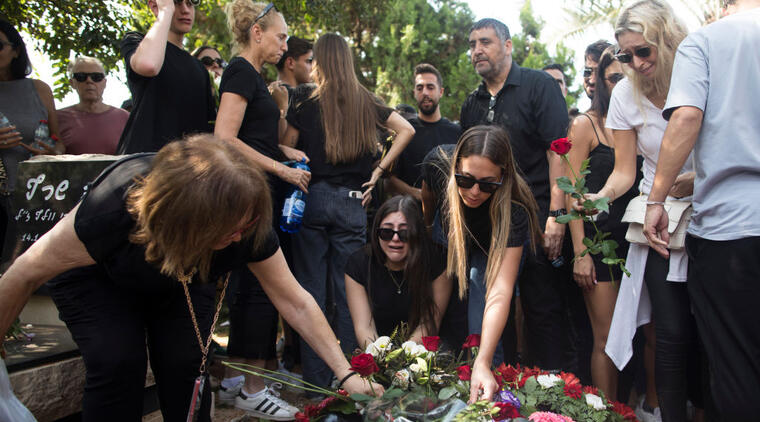
Family and friends of May Naim, 24, who was murdered by Palestinians militants at the "Supernova" festival, near the Israeli border with Gaza strip, react during her funeral on October 11, 2023 in Gan Haim, Israel. (Getty Images)
News

FSI Scholars Analyze Implications of Hamas’ Terror Attack on Israel

Larry Diamond moderated a discussion between Ori Rabinowitz, Amichai Magen and Abbas Milani on the effects of Hamas’ attacks on Israel and what the emerging conflict means for Israel and Middle Eastern geopolitics.
FSI Scholars Analyze Implications of Hamas’ Terror Attack on Israel
Hero Image
Panelists at the event "1973 Yom Kippur War: Lessons Learned"
All News button
1
Subtitle

Scholars of Israel and the Middle East discussed the strategic takeaways of the 1973 Yom Kippur War and their relevance to the region’s current security crisis.

Date Label
-
Family and friends of May Naim, 24, who was murdered by Palestinians militants at the "Supernova" festival, near the Israeli border with Gaza strip, react during her funeral on October 11, 2023 in Gan Haim, Israel. (Getty Images)

On Saturday October 7, 2023, two Iranian-backed terrorist organizations based in the Gaza Strip — Hamas and Palestinian Islamic Jihad (PIJ) — inflicted the most lethal attack suffered by the State of Israel since its founding in May 1948. 

Over 1200 Israelis, overwhelmingly civilians, were murdered, 3000 wounded, and approximately 150 kidnapped into Gaza, to be used as human shields and bargaining chips. The attacks also involved unspeakable acts of sexual violence and infanticide. Retaliatory Israeli air strikes have killed over 800 Gazans so far. 

The conflict risks escalating to an all-out regional confrontation, involving several other Iranian proxies (most notably Hezbollah in Lebanon) and even a direct Iran-Israel war. This could have devastating and transformative implications for the Middle East, U.S. foreign policy, and the entire international system. What led to the events of October 7? How was Israel caught so completely off guard? Did Iran order the attack? What are the possible scenarios for the conflict? And what can the Biden Administration do?

SPEAKERS

Amichai Magen

Amichai Magen

Inaugural visiting fellow in Israel Studies at FSI
Lauder School of Government, Diplomacy, and Strategy, Reichman University in Herzliya, Israel
Full Profile
Abbas Milani photo by Babak Payami

Abbas Milani

Hamid and Christina Moghadam Director of Iranian Studies
Stanford University
Full Profile
Or Rabinowitz

Or Rabinowitz

Visiting associate professor at FSI's Center for International Security and Cooperation
International Relations Department of Hebrew University, Jerusalem
Full Profile

MODERATOR

Portrait of Hesham Sallam

Larry Diamond

Mosbacher Senior Fellow in Global Democracy at FSI
William L. Clayton Senior Fellow at the Hoover Institution
FULL PROFILE
Larry Diamond

Zoom Only

Amichai Magen
Abbas Milani
0
Visiting Scholar
or-rabinowitz_headshot.jpg

Or (Ori) Rabinowitz, (PhD), a Chevening scholar, is an associate professor at the International Relations Department of the Hebrew University of Jerusalem, Israel. During the academic year of 2022-2023 she will hold the post of visiting associate professor at Stanford’s CISAC. Her research interests include nuclear proliferation, intelligence studies, and Israeli American relations. Her book, Bargaining on Nuclear Tests was published in April 2014 by Oxford University Press. Her studies were published leading academic journals, including International Security, Journal of Strategic Studies, and International History Review, as well as op-eds and blog posts in the Washington Post, Foreign Policy and Ha’aretz. She holds a PhD degree awarded by the War Studies Department of King’s College London, an MA degree in Security Studies and an LLB degree in Law, both from Tel-Aviv University. She was awarded numerous awards and grants, including two personal research grants by the Israeli Science Foundation and in 2020 was a member of the Young Academic forum of the Israeli Academy for Sciences and Humanities.  

CV
Date Label
Or Rabinowitz
Seminars
Date Label
Authors
News Type
News
Date
Paragraphs

Against the backdrop of Ukraine's counteroffensive and the Kremlin's efforts to illegally annex additional territory, a delegation of members from the NATO Parliamentary Assembly arrived at Stanford to meet with experts and weigh considerations about the ongoing conflict. First on their circuit was a panel hosted by the Freeman Spogli Institute for International Studies (FSI) chaired by FSI Director Michael McFaul, with Marshall Burke, Francis Fukuyama, Anna Grzymala-Busse, Scott Sagan, and Kathryn Stoner participating.

The delegates represented thirteen of NATO's thirty member nations, including Belgium, the Czech Republic, France, Greece, Hungary, Italy, Latvia, Luxembourg, Portugal, Romania, Spain, Turkey, and the United Kingdom. Top of mind were questions about the possibility of nuclear escalation from the Kremlin, and appropriate repsonses from the alliance, as well as questions about the longevity of Putin's regime, the nature of international authoritarian alliances, and the future of Ukraine as a European nation.

Drawing from their expertise on state-building, democracy, security issues, nuclear enterprise, and political transitions, the FSI scholars offered a broad analysis of the many factors currently playing out on the geopolitical stage. Abbreviated versions of their responses are given below.

Kathryn Stoner, Francis Fukuyama, Marshall Burke, Scott Sagan, Anna Grzymala-Busse, and Michael McFaul present at a panel given to memebers of the NATO Parlimentary Assembly.
Kathryn Stoner, Francis Fukuyama, Marshall Burke, Scott Sagan, Anna Grzymala-Busse, and Michael McFaul present at a panel given to memebers of the NATO Parliamentary Assembly on September 26, 2022. | Melissa Morgan

The following commentary has been edited for clarity and length, and does not represent the full extent of the panel’s discussion.


Rethinking Assumptions about Russia and Putin

Kathryn Stoner

Right now, Putin is the most vulnerable he's ever been in 22 years in power. But I don’t believe he's under so much pressure at this point that he is about to leave office anytime soon. Autocracies do not usually die by popular mobilization, unfortunately. More often they end through an elite coup or turnover. And since the end of WWII, the research has shown that about 75% of the time autocracies are typically replaced by another autocracy, or the perpetuation of the same autocracy, just with a different leader. So, if Putin were replaced, you might get a milder form of autocracy in Russia, but I don't think you are suddenly going to create a liberal democracy.

This means that we in the West, and particularly in the U.S., need to think very hard about our strategies and how we are going to manage our relationships with Putin and his allies. This time last year, the U.S. broadcast that we basically wanted Russia to calm down so we could pivot to China. That’s an invitation to not calm down, and I think it was a mistake to transmit that as policy.

We need to pay attention to what Russia has been doing. They are the second biggest purveyor of weapons globally after the United States. They will sell to anyone. They’ve been forgiving loans throughout Sub Saharan Africa from the Soviet period and using that as a way of bargaining for access to natural resources. They’re marketing oil, selling infrastructure, and building railroads. Wherever there is a vacuum, someone will fill it, and that includes Russia every bit as much as China. We need to realize that we are in competition with both Russia and China, and develop our policies and outreach accordingly.

KStoner

Kathryn Stoner

Mosbacher Director of the Center on Democracy, Development, and the Rule of Law
Full Profile


Confronting Autocracy at Home and Abroad

Anna Grzymala-Busse

Why is Putin in Ukraine? Because the fact that there is a democratic country right next door to Russia is an affront to him. Putin doesn’t care that much about NATO. The fact that nothing happened when Sweden joined is some evidence of this. That’s something to keep in mind as people are debating NATO and Ukraine and Ukraine’s possible future as a member.

NATO membership and EU membership are both wonderful things. But more fundamental that that, this war has to be won first. That’s why I think it’s necessary in the next six months to speed up the support for Ukraine by ensuring there’s a steady stream of armaments, training personnel, and providing other military support.

There’s been incredible unity on Ukraine over the last seven months across the EU, NATO, and amongst our allies. But our recent history with President Trump reminds us how fragile these international commitments can be. In foreign policy, it used to be understood that America stands for liberal democracy. But we had a president of the United States who was more than happy to sidle up to some of the worst autocrats in the world. That’s why we can’t afford to leave rising populism around the world unaddressed and fail to engage with voters. When we do that, we allow far right parties to grab those votes and go unopposed. Whatever happens domestically impacts what happens internationally.

Anna Grzymała-Busse

Anna Grzymala-Busse

Director of The Europe Center
Full Profile


The Consequences of Nuclear Sabre-Rattling

Scott Sagan

We have to very clear-eyed when we’re talking about the threat, however improbable, of the use of a nuclear weapon. When it comes to the deployment of a tactical nuclear weapon, its kinetic effects depend on both the size of the weapon, the yield, and the target. Tactical weapons range in yield from very low — 5-10% of what was in the Hiroshima bomb — to as large as what was used against Hiroshima and Nagasaki. If that kind of weapon was used on an urban target, it would produce widescale effects. In a battlefield or rural area, it would have a relatively small impact.

But in the bigger picture, what any use of a weapon like this does is break a 70+ year tradition of non-use. Those seventy years have been dicey and fragile, but they have held so far. A tradition that is broken creates a precedent, and once there’s a precedent, it makes it much easier for someone to transgress the tradition again. So even if a decision was made to use a tactical weapon with little kinetic importance for strategic effect, I think we still need to be worried about it.

Personalistic dictators surround themselves with yes men. They make lonely decisions by themselves, often filled with vengeance and delusion because no one can tell them otherwise. They don't have the checks and balances. But I want to make one point about a potential coup or overthrow. Putin has done a lot to protect himself against that. But improbable events happen all the time, especially when leaders make really, really bad decisions. That’s not something we should be calling for as official U.S. policy, but it should be our hope.

Headshot of Scott Sagan

Scott Sagan

FSI Senior Fellow at the Center for International Security and Cooperation
Full Profile


Cycles of Conflict, Climate Change, and Food Insecurity

Marshall Burke

The estimates right now project that there are 350 million people around the world facing acute food insecurity. That means 350 million people who literally don’t have enough to eat. That’s roughly double what it was pre-COVID. The factors driving that are things like supply chain disruptions from the pandemic and climate shocks, but also because of ongoing conflict happening around the world, Ukraine included.

There was an early concern that the war in Ukraine would be a huge threat to global food security. That largely has not been the case so far, at least directly. Opening the grain corridors through the Black Sea has been crucial to this, and it’s critical that we keep those open and keep the wheat flowing out. Research shows that unrest increases when food prices spike, so it’s important for security everywhere to keep wheat prices down.

What I’m worried about now is natural gas prices. With high global natural gas prices, that means making fertilizer is also very expensive and prices have increased up to 300% relative to a few years ago. If they stay that high, this is going to be a long-term problem we will have to find a way of reckoning with on top of the other effects from climate change already impacting global crop production and the global economy.

Marshall Burke

Marshall Burke

Deputy Director of the Center on Food Security and the Environment
Full Profile


Ukraine After the War

Francis Fukuyama

I've been more optimistic about the prospects for Ukraine taking back territory for more of this war, just because of the vast difference in motivation between the two sides and the supply of modern weapons that Ukraine has been getting. But I don’t know what the conditions on the ground will look like when the decision to negotiate comes. Will Russia still be sitting on occupied territory? Are they kicked out entirely? Or are the frontlines close to where they are now?

As I’ve observed, Ukraine's demands have shifted depending on how they perceive the war going on. There was a point earlier this summer where they hinted that a return to the February 23 borderlines would be acceptable. But now with their recent successes, they're saying they want everything back to the 2014 lines. What actually happens will depend on what the military situation looks like next spring, by my guess.

However the war does end, I think Ukraine actually has a big opportunity ahead of them. Putin has unwittingly become the father of a new Ukrainian nation. The stresses of the war have created a very strong sense of national identity in Ukraine that didn’t exist previously. It’s accurate that Ukraine had significant problems with corruption and defective institutions before, but I think there’s going to be a great push to rout that out. Even things like the Azov steel factory being bombed out of existence is probably a good thing in the long run, because Ukraine was far too dependent on 20th-century coal, steel, and heavy industry. Now they have an opportunity to make a break from all of that.

There are going to be challenges, obviously. We’ll have to watch very carefully what Zelenskyy chooses to do with the commanding position he has at the moment, and whether the government will be able to release power back to the people and restore its institutions. But Europe and the West and our allies are going to have a really big role in the reconstruction of Ukraine, and that should be regarded by everyone as a tremendous opportunity.

frank_fukuyama

Francis Fukuyama

Olivier Nomellini Senior Fellow at FSI
Full Profile


Victory in Ukraine, Victory for Democracy

Michael McFaul

Nobody likes a loser, and right now, Putin is losing strategically, tactically, and morally. Now, he doesn’t really care about what Biden or NATO or the West think about him. But he does care about what the autocrats think about him, especially Xi Jinping. And with reports coming out of the Shanghai Cooperation Organization that Xi has “concerns” about what’s happening in Ukraine, Putin is feeling that pressure. I think that's why he has decided he needs to double down, not to negotiate, but to try and “win” in some way as defined by him.

In my view, that’s what’s behind the seizure of these four regions. If he feels like he can unequivocally claim them as part of Russia, then maybe he will sue for peace. And that’s exactly what President Zelenskyy fears. Why? Because that’s exactly what happened in 2014. Putin took Crimea, then turned around to the countries of the world and said, “Aren’t we all tired of war? Can’t we just have peace? I’m ready to end the war, as long as you recognize the new borders.” And, let’s be honest, we did.

We keep hearing politicians say we should put pressure for peace negotiations. I challenge any of them to explain their strategy for getting Putin to talk about peace. There is no doubt in my mind that President Zelenskyy would sit down tomorrow to negotiate if there was a real prospect for peace negotiations. But there's also no doubt in my mind right now that Putin has zero interest in peace talks.

Like Dr. Fukuyama, I don’t know how this war will end. But there's nobody inside or outside of Russia that thinks it’s going well. I personally know a lot of people that believe in democracy in Russia. They believe in democracy just as much as you or I. I’ve no doubt of their convictions. But they’re in jail, or in exile today.

If we want to help Russia in the post-Putin world, we have to think about democracy. There’s not a lot we can do to directly help democracy in Russia right now. But we should be doing everything to help democracy in Ukraine.  It didn’t happen in 1991. It didn’t happen in 2004. It didn’t happen in 2014. They had those breakthroughs and those revolutionary moments, but we as the democratic world collectively didn’t get it right. This is our moment to get it right, both as a way of helping Ukraine secure its future, and to give inspiration to “small-d” democrats fighting for rights across the world.

Michael McFaul, FSI Director

Michael McFaul

Director of the Freeman Spogli Institute for International Studies
Full Profile

Read More

President of Russia Vladimir Putin
Commentary

Putin's Disaster in Ukraine

On Vladimir Putin’s order, the Russian army launched a new invasion of Ukraine in February. That has inflicted tragedy on Ukrainians but, seven months later, has also proved a catastrophe for Russia.
Putin's Disaster in Ukraine
Russian flag and NATO flag
Commentary

NATO-Russia: It’s time to suspend the Founding Act

During a period of greater hope for Russia tempered by uncertainties, President Bill Clinton sought both to enlarge NATO and build a strategic partnership between the Alliance and Moscow.
NATO-Russia: It’s time to suspend the Founding Act
Hero Image
A delegation from the NATO Parliamentary Assembly visits the Freeman Spogli Institute for International Studies.
A delegation representing thirteen countries from the NATO Parliamentary Assembly visits Stanford to hear perspectives on the war in Ukraine and its geopolitical impacts from scholars at the Freeman Spogli Institute for International Studies.
Melissa Morgan
All News button
1
Subtitle

FSI Director Michael McFaul, Kathryn Stoner, Francis Fukuyama, Scott Sagan, Anna Grzymala-Busse, and Marshall Burke answered questions from the parliamentarians on the conflict and its implications for the future of Ukraine, Russia, and the global community.

Date Label
News Type
News
Date
Paragraphs

The Freeman Spogli Institute for International Studies (FSI) is pleased to announce that Or Rabinowitz will come to Stanford for the 2022-23 academic year as part of the institute’s new Visiting Fellowship in Israel Studies. Dr. Rabinowitz is currently a Senior Lecturer in International Relations at Hebrew University, Jerusalem.

During her time at Stanford as a visiting fellow in Israel Studies, Dr. Rabinowitz will teach a one quarter long undergraduate course on “Israel: National Security and Nuclear Policy.” She will also organize and run an international workshop on “Deterrence and Weapons of Mass Destruction in the Middle East” in the spring or summer quarters of 2023, and engage with Stanford pre- and postdoctoral fellows and FSI faculty.

Dr. Rabinowitz’s appointment will be based at FSI’s Center for International Security and Cooperation.

“Or Rabinowitz is one of Israel’s finest scholars writing about nuclear proliferation, deterrence, and national security policy,” said Scott Sagan, co-director of CISAC.  “Stanford is really fortunate to be able to bring her to campus for a year under this program.”

Or Rabinowitz is one of Israel’s finest scholars writing about nuclear proliferation, deterrence, and national security policy. Stanford is really fortunate to be able to bring her to campus for a year under this program.
Scott Sagan
Co-director of the Center for International Security and Cooperation

Dr. Rabinowitz’s current research lies at the intersection of nuclear and intelligence studies, with a focus on Israel’s nuclear program and the role of science and technology in its national security doctrine. Her book, “Bargaining on Nuclear Tests: Washington and its Cold War Deals” was published in April 2014 by Oxford University Press, and she has since published articles in International Security, Journal of Strategic Studies, The International History Review and the Bulletin of the Atomic Scientists, among others.

She holds a PhD degree from the War Studies Department of King’s College London, an MA degree in Security Studies and an LLB degree in Law, both from Tel-Aviv University. She is currently conducting a study on intelligence collaboration between allies in the realm of counter-proliferation operations, funded by the Israel Science Foundation.

“I am honored to be joining Stanford this coming academic year, and to share my knowledge about Israel with Stanford’s undergraduates,” said Dr. Rabinowitz. “CISAC is a global leader when it comes to producing new knowledge and insight about the challenges of nuclear proliferation, and being chosen as an Israel Studies Fellow is a true privilege.”

Dr. Rabinowitz’s many awards and honors include being named an Israeli Chevening Scholar by the British Foreign and Commonwealth Office, and receiving The Scouloudi Award from the Institute of Historical Research, University of London. In 2018 she also won the Professor Ya’acov Barsimantov Best Article Award from the Israeli Association for International Studies.

The Visiting Fellowship in Israel Studies was launched in September 2021 with the generous support of Stanford alumni and donors. The search committee included senior fellows from throughout the institute. In addition to bringing to Dr. Rabinowitz to Stanford, the committee selected Dr. Amichai Magen, a scholar of law, government and international relations, as the inaugural Visiting Fellow in Israel Studies. Dr. Magen will also arrive at Stanford in the 2022-2023 academic year.

Read More

CISAC Honors Class 2022
News

Congratulations to Our CISAC Honors Graduates

On Friday, June 10th, 2022, we celebrated the accomplishments of the students in the Honors Program in International Security Studies.
Congratulations to Our CISAC Honors Graduates
All News button
1
Subtitle

Dr. Or Rabinowitz of Hebrew University, Jerusalem, whose research explores how nuclear technology interacts with decision-making, strategy, and diplomacy, will come to Stanford in the 2022-2023 academic year as a visiting fellow in Israel Studies.

Date Label
-
Livestream event on March 1, 2022 at 6:30pm PST: "What's Next for Ukraine and Russia?"

This panel discussion will analyze the most recent developments in the conflict between Ukraine and Russia, and what may lay ahead.

It will be moderated by Francis Fukuyama, director of Stanford’s Ford Dorsey Masters of International Policy Program and Olivier & Nomellini Senior Fellow in International Studies at the Freeman Spogli Institute for International Studies (FSI), with panelists Rose Gottemoeller, the Steven C. Házy Lecturer at FSI’s Center for International Security and Cooperation and deputy secretary general of NATO from 2016 to 2019, and Steve Pifer, the William J Perry Fellow at FSI and former U.S. ambassador to Ukraine.


PANELISTS:

Woman smiling

Rose Gottemoeller

Steven C. Házy Lecturer at the Center for International Security and Cooperation
Full Profile
Man smiling

Steven Pifer

WIlliam J. Perry Fellow at the Center for International Security and Cooperation
Full Profile


MODERATOR:

Francis Fukuyama

Francis Fukuyama

Olivier Nomellini Senior Fellow at the Freeman Spogli Institute for International Studies
Full Profile
Francis Fukuyama

Join via YouTube livesteam

Center for International Security and Cooperation
Encina Hall
616 Jane Stanford Way
Stanford University
Stanford, CA 94305-6165

0
William J. Perry Lecturer, Freeman Spogli Institute
Research Fellow at the Hoover Institution
dsg_gottemoeller.jpg

Rose Gottemoeller is the William J. Perry Lecturer at Stanford University's Freeman Spogli Institute for International Studies and Research Fellow at the Hoover Institute.

Before joining Stanford Gottemoeller was the Deputy Secretary General of NATO from 2016 to 2019, where she helped to drive forward NATO’s adaptation to new security challenges in Europe and in the fight against terrorism.  Prior to NATO, she served for nearly five years as the Under Secretary for Arms Control and International Security at the U.S. Department of State, advising the Secretary of State on arms control, nonproliferation and political-military affairs. While Assistant Secretary of State for Arms Control, Verification and Compliance in 2009 and 2010, she was the chief U.S. negotiator of the New Strategic Arms Reduction Treaty (New START) with the Russian Federation.

Prior to her government service, she was a senior associate with the Carnegie Endowment for International Peace, with joint appointments to the Nonproliferation and Russia programs. She served as the Director of the Carnegie Moscow Center from 2006 to 2008, and is currently a nonresident fellow in Carnegie's Nuclear Policy Program.  

At Stanford, Gottemoeller teaches and mentors students in the Ford Dorsey Master’s in International Policy program and the CISAC Honors program; contributes to policy research and outreach activities; and convenes workshops, seminars and other events relating to her areas of expertise, including nuclear security, Russian relations, the NATO alliance, EU cooperation and non-proliferation. 

Date Label
Rose Gottemoeller Steven C. Házy Lecturer at CISAC
0
rsd25_073_0249a.jpg

Steven Pifer is an affiliate of the Center for International Security and Cooperation as well as a non-resident senior fellow with the Brookings Institution.  He was a William J. Perry Fellow at the center from 2018-2022 and a fellow at the Robert Bosch Academy in Berlin from January-May 2021.

Pifer’s research focuses on nuclear arms control, Ukraine, Russia and European security. He has offered commentary on these issues on National Public Radio, PBS NewsHour, CNN and BBC, and his articles have been published in a wide variety of outlets.  He is the author of The Eagle and the Trident: U.S.-Ukraine Relations in Turbulent Times (Brookings Institution Press, 2017), and co-author of The Opportunity: Next Steps in Reducing Nuclear Arms (Brookings Institution Press, 2012).

A retired Foreign Service officer, Pifer’s more than 25 years with the State Department focused on U.S. relations with the former Soviet Union and Europe, as well as arms control and security issues.  He served as deputy assistant secretary of state in the Bureau of European and Eurasian Affairs with responsibilities for Russia and Ukraine, ambassador to Ukraine, and special assistant to the president and senior director for Russia, Ukraine and Eurasia on the National Security Council.  In addition to Ukraine, he served at the U.S. embassies in Warsaw, Moscow and London as well as with the U.S. delegation to the negotiation on intermediate-range nuclear forces in Geneva.  From 2000 to 2001, he was a visiting scholar at Stanford’s Institute for International Studies, and he was a resident scholar at the Brookings Institution from 2008 to 2017.

Pifer is a 1976 graduate of Stanford University with a bachelor’s in economics.


Affiliate, CISAC
Affiliate, The Europe Center
Date Label
Steven Pifer WIlliam J. Perry Fellow at CISAC
Panel Discussions
News Type
News
Date
Paragraphs

We are happy to share that Oriana Skylar Mastro, an incoming FSI Center Fellow at APARC, has been awarded the 2020 America in the World Consortium Prize for Best Policy Article on U.S. Foreign Policy and Grand Strategy for her article, “The Stealth Superpower: How China Hid Its Global Ambitions” in Foreign Affairs. The award is given annually by the Consortium — which includes the Kissinger Center and Johns Hopkins SAIS, Duke University, and the University of Texas at Austin — for research articles by pre-tenure scholars addressing a major issue of American foreign policy.

Mastro's winning article provides an insightful analysis of the careful, deliberate efforts the PRC has undertaken to obscure its growing global influence. “Although Beijing has pursued an indirect and entrepreneurial strategy of accumulating power,” she writes, “make no mistake: the ultimate goal is to push the United States out of the Indo-Pacific and rival it on the global stage.” Her research as an academic and a United States Air Force Reserve officer focuses on rising global powers and how perceptions of power impact the process and precursors to conflict, particularly in regards to China and East Asian security. As an FSI Center Fellow, she will be based at APARC and also work with CISAC. 

[Sign up for our newsletters to get the latest from our scholars and researchers.]

Mastro describes how the current administration in China epitomizes Deng Xiaoping’s counsel to “Hide your strength, bide your time” by exploiting gaps in international policy and American attention. Rather than compete outright, China leverages ambiguities in existing policies and practices in order to further its agenda and ambitions while still remaining within the rubric of international order. This strategy has allowed it to continue in its assertions in the South China Sea, establish rules on technology like AI that favor Chinese companies while stalling consensus on other issues like cybersecurity and “cyber-sovereignty,” and create a network of economic and political partnerships with nations traditionally outside the United State’s purview.

The result is that China is carefully cultivating a quiet but hugely impactful influence across the globe. To counter this strategy, Mastro urges the United States to lead out on the world stage by increasing its participation in international institutions and agreements, and through deepening and diversifying its relationships with allies and partners. In a time when international tensions are increasing and a pivotal election looms, these perspectives couldn’t be more timely.

Congratulations, Oriana, on the recognition for your excellent research and insight!

Read Oriana’s award-winning article here >>

Read More

Portrait of Oriana Mastro with text: "Q&A with Oriana Skylar Mastro"
Q&As

FSI’s Incoming Center Fellow Oriana Skylar Mastro Discusses Chinese Ambitions, Deteriorating U.S.-China Relations

Mastro, whose appointment as a Center Fellow at Shorenstein APARC begins on August 1, considers the worsening relations between the world’s two largest economies, analyzes Chinese maritime ambitions, and talks about her military career and new research projects.
FSI’s Incoming Center Fellow Oriana Skylar Mastro Discusses Chinese Ambitions, Deteriorating U.S.-China Relations
Hero Image
[left: image] Oriana Skylar Mastro, [right: text] Congratulations, Oriana Skylar Mastro, Recipient of the 2020 America in the World Consortium Prize for 'Best Policy Article' from Duke University, Johns Hopkins SAIS, and Texas University at Austin
Oriana Skylar Mastro, recipient of the 2020 America in the World Consortium Prize for 'Best Policy Article' from Duke University, Johns Hopkins SAIS, and Texas University at Austin.
All News button
1
Subtitle

Mastro, who begins her role as FSI Center Fellow on August 1, has won the AWC Best Policy Article on U.S. Foreign Policy and Grand Strategy award for her insights on how China leverages ambiguity to gain global influence and what the United States can do to counter the PRC’s ambitions.

Authors
Herbert Lin
News Type
Commentary
Date
Paragraphs

On Feb. 12, White House National Security Adviser Robert O’Brien announced that the U.S. government has “evidence that Huawei has the capability secretly to access sensitive and personal information in systems it maintains and sells around the world.” This represents the latest attempt by the Trump administration to support an argument that allied governments—and the businesses they oversee—should purge certain telecommunications networks of Huawei equipment. The position reflects the preferred approach in the United States, which is to issue outright bans against select companies (including Huawei) that meet an as-yet-unknown threshold of risk to national security.


Read the rest at Lawfare Blog


Hero Image
lin herbert
All News button
1
Subscribe to International Law