Democracy
Authors
News Type
Commentary
Date
Paragraphs

There are a lot of changes happening in the world, from the "rupture" in the global order to a new host of the World Class podcast.

For almost a decade, Michael McFaul, a senior fellow at the Freeman Spogli Institute for International Studies at Stanford University, has helped listeners understand what's happening in the world, and why, by bringing them in-depth conversations with scholars working across FSI's nine research centers. Now Colin Kahl, the new director of FSI, is taking on the role of podcast host to carry on the tradition.

In this episode, Kahl and McFaul discuss how institutions like FSI can better study and contribute understanding about the rapidly changing world and how alliances and partnerships — whether across academic departments or between nations — create better, stronger outcomes.
Listen to the episode below. World Class is also available on Apple Podcasts, Spotify, and other major podcast platforms.

TRANSCRIPT


McFaul: Hey everyone, you're listening to World Class from the Freeman Spogli Institute for International Studies at Stanfo rd University. I'm your host, or maybe I should say I'm your co-host, or maybe I should say this is the last time I'll be hosting World Class from Stanford University. Because as listeners and followers of FSI’s news may know, after eleven years, I just stepped down as the director a few weeks ago and I've handed the baton to my guest today, Colin Kahl, who's the brand new director of the Freeman Spogli Institute.

And it is fantastic, Colin, that you agreed to take on this assignment. This is another form, I consider, of public service just like what you've done for the U.S. government and the United States of America.

Colin, as you're going to hear in a few minutes, is the perfect mix of scholar and practitioner that we so value here at FSI. And we are really lucky that you are taking up this assignment.

So Colin, welcome to World Class where everybody will be listening to you forthcoming for, I hope, many, many years.

Kahl: Thanks Mike, it's a real pleasure to be with you and most especially thank you for your tremendous decade plus—eleven years—of service to FSI and the Stanford community. And I look forward to continuing to work with you as you transition to the next thing. And we should talk about that too. But it's great to be on the pod with you.

McFaul: Glad to be here. And just so everybody knows, I stepped down from FSI, but I'm not retiring from Stanford. I still have my various day jobs here. We can come back to that a little bit later.

But Colin, why don't you just tell our listeners and our viewers a little bit about your road to this present position.

Kahl: Yeah, sure. So I grew up in the Bay Area. I grew up in the East Bay in Richmond, California. I applied to Stanford as an undergrad, didn't get in. Applied again as a graduate student, didn't get in. So I got educated elsewhere. I went to the University of Michigan, which is a great school.

McFaul: Very fine institution.

Kahl: And then I went to Columbia University where I got my PhD in political science, focused on international relations and conflict studies. I did my PhD work in the 90s when the field of international relations was trying to figure out what the field even meant after the end of the Cold War.

So it was an exciting and very kind of plastic moment to be doing scholarly work.

I then started my first teaching job at the University of Minnesota in 2000. And of course, a year after that, 9/11 happened. And it was a terrible event for the United States and for the world. For those of us who lived in New York City—I did my graduate work there—it was especially painful.

And it really drove me to want to figure out a way to both do the academic side of understanding the world, but also see if there was a way to engage in public service. So my fifth year at the University of Minnesota, I actually got a fellowship through the Council on Foreign Relations . . .

McFaul: Right.

Kahl: . . . that put me at the Pentagon for a year and a half. This was during the George W. Bush administration. Don Rumsfeld was still the Secretary of Defense. I worked there for a year and a half. I kind of caught the bug, the Washington bug.

McFaul: What was your portfolio back then, Colin? Just remind everybody.

Kahl: So I worked in a small office called the Stability Operations Office. It was only 24 of us. worked within the office of the Undersecretary of Defense for Policy. It had historically been called the Peacekeeping and Humanitarian Affairs Office

McFaul: Right, right, I remember that. They changed it, right.

Kahl: But Rumsfeld was not a fan of peacekeeping, so they changed it to ‘stability operations.’

But at the time, most of what our office did was try to help the U.S. military reform itself in the face of the struggles that the U.S. military was facing in Iraq and Afghanistan with the stabilization missions there.

There's a lot of dark humor at the Pentagon, but we sometimes joked that the 24 of us were doing stability operations while the other 24,000 people in the building were doing instability operations.

McFaul: [laughing] Instability operations, yeah, that’s right.

Kahl: But anyway, it was totally exciting. You know, we were there when when U.S. counterinsurgency doctrine was being revised and a bunch of other things.

So that was 2005, 2006. I kind of caught the bug and decided to try to stay in Washington. So I actually took a job at the Georgetown School of Foreign Service where they were kind enough to give me tenure and I taught in the security studies program there for a decade.

McFaul: Let's just . . . hold on, hold on. Let's be clear. They were not ‘kind enough’ to give you tenure; you earned tenure. Nobody gives tenure anywhere. Congratulations that you landed that job.

Kahl: So, I was in the security studies program there for ten years, about a half that time I served in the Obama administration. We served together . . .

McFaul: Together, yes!

Kahl: . . . in the first few years. I was back at the Pentagon as the deputy assistant secretary of defense for the Middle East during the drawdown of our forces from Iraq during the Arab Spring.

McFaul: Right.

Kahl: During the first flare up of Israel-Iran tensions over Iran's nuclear program. By the way, none of that was my fault, but I was there when all that stuff happened.

And then I went back to Georgetown for a few years and then I got pulled back into the Obama administration at the end to work at the White House as a deputy assistant to the president and as then-vice president Biden's national security advisor. So I was there for Russia's first invasion of Ukraine . . .

McFaul: Right.

Kahl: . . . and the Central American migration crisis and tensions in the South China Sea and the campaign against the Islamic State and the Iran nuclear deal. A lot of interesting things.

And then, when Trump was elected the first time, Mike, you reached out to me with this amazing opportunity at Stanford, the Steven C. Házy Senior Fellow chair that I currently occupy. Applied for the job and got it. It was an opportunity to come back to Stanford. I’ve sat at CISAC, the Center for International Security and Cooperation here at FSI. And I was the co-director of CISAC for a couple of years.

And then last but not least, when Biden was elected president, he asked me to serve as the undersecretary of defense for policy back at DoD, which is essentially the number three civilian and senior policy advisor to the secretary. And I did that for the two first two and a half years of the Biden administration.

Also also very interesting times: fall of Afghanistan . . .

McFaul: Yes.

Kahl: . . . Russia's further invasion of Ukraine, rising tensions with China, dealing with the aftermath of COVID, lot of changes in the world.

So anyway, I'm glad to be back at Stanford. I've been back since the summer of 2023, and I'm excited to try to fill the very big shoes that you've left at FSI after eleven years.

McFaul: Well, let's talk about the future in a minute, but just two follow-up questions on your history. You've had lots of government jobs you just described. I can't think of anybody that's had a more diversified set of experiences in national security. We are lucky to have you here.

Tell us about the best day of any of those jobs and tell us about the worst day and maybe reverse that. Worst day first, best day second.

Kahl: So first of all, I'm fortunate to have had the opportunity to serve my country. I believe in it strongly. I've served in Republican administrations and Democratic administrations. I've worked for two Republican secretaries of defense and two Democratic secretaries of defense. So I think I've demonstrated my nonpartisan bona fides in how I've served my country.

And I just want to mention that because I think it's important.

McFaul: Yes, it is important.

Kahl: Because, of course, FSI is a nonpartisan place.

Worst day and best day: in a sense, it's almost the same. There was no more harrowing experience than the collapse of Kabul.

I was actually at the NIH getting a medical treatment when I got a text message from the secretary's chief of staff that I needed to hurry back to the Pentagon. So I literally pulled an IV out of my arm and raced back to the Pentagon because Kabul fell.

And obviously that was a tremendously terrible event for Afghanistan. It was a particularly harrowing way for the 20-year U.S. involvement in Afghanistan to end. But it also put us on the clock. You know, we had basically 17 days before the deadline for all American forces to be out of Afghanistan, and we suddenly had to do a lot of things.

We had to flood forces back into the country to occupy an airport that was now in hostile Taliban territory when the Taliban took over Kabul. We had to secure that airport. We sent five or six thousand soldiers and Marines to that airfield. We had postured them in the region previously to be able to do that, but we had to get them there.

McFaul: Right.

Kahl: And then we then had to oversee the evacuation of 125,000 human beings in two weeks, which had never happened in human history and no other country in the history of the world would have been capable of doing. And it was pretty horrible.

McFaul: Yeah.

Kahl: A lot of terrible human tragedies. Obviously, we got a lot of people out. A lot of people weren't able to get out. There was the terrible ISIS bombing that killed 13 of our brave service members. Toward the end of the evacuation, there was an errant U.S. strike on what we thought was an ISIS operator that turned out to be an aid worker and his kids. It was horrible.

But I'm also incredibly proud of what we were able to do. I mean, in the macro sense, because we were able to project our power back into Afghanistan, lock down that airfield and get all of those people to safety, including the family members of some Afghans who worked for me. We were able to get a lot of people out.

We were able to bring them to bases and facilities that didn't even exist when the crisis . . . I mean the bases existed, but the facilities to house these people in the Gulf and in Europe and back here in the continental United States . . . the amount of diplomacy that required, the amount of logistics by the U.S. military that it required. It was an unbelievable operation.

And so it was terrible. But it was also an extraordinary demonstration of what the United States was capable of doing even at these dark moments.

McFaul: That's a great way to put it together. I would guess we would not have been able to do that if we did not have NATO allies and bases in that part of the world, or is that incorrect? I don't know the logistics of that part of the world.

Kahl: If anything, it's an understatement. I think one of the things that distinguishes the United States from every other superpower or global power in history is the depth and breadth of our network of allies and partners. At the heart of that are our treaty allies in the NATO alliance, but also in the Indo-Pacific region, so think South Korea, Japan, Australia.

McFaul: All of them, right.

Kahl: But we also have very close security partnerships in the Middle East. And so literally it would not have been possible to fly aircraft into Afghanistan, fly people out from Afghanistan into places like Qatar, Bahrain, UAE, Saudi Arabia. But then we brought them to Germany and Spain and other U.S. bases in Europe. And then we brought them back to bases here in the United States.

And that network, literally that network made it possible. And had we not had those allies and partners when that happened, we couldn't have done what we did. We couldn't have done any of it. We couldn't have gotten any of our people out.

And so that really is like some of the secret sauce to America's power and influence in the world. And it remains the case that we have more allies and partners than any other country in history.

But it's also the case that those alliances and partnerships are probably more strained than they've been in my lifetime.

McFaul: So, one other historical question about you. Why did you come to Stanford? I mean, you've got this great job at Georgetown. You obviously are connected to the policy community. We're far away out here. Tell us about that decision.

Kahl: Part of it is I grew up in the Bay Area. Part of it is that, mean, Georgetown is a remarkable place, but Stanford's one of the two or three best universities in the world. We had a great community of scholars out here. And a lot of the issues that I'm particularly passionate about now—especially the intersection of technology and geopolitics— I mean, this is ground zero for a lot of that.

And so it was for a mix of kind of lifestyle reasons and professional reasons. And it's been awesome.

McFaul: Well, that's a great segue to what I wanted to ask you next, which is about the big agenda items. I mean, FSI has a lot going on: we have lots of centers here, as our listeners know, because we've had many guests from all, I think all of our centers over the time I've been here.

But you've got some particular things that you want to focus on. I know, because I talked to people that were part of the selection committee, that that was what was most impressive about you, is that you have a big agenda. Tell us about that agenda, Colin.

Kahl: As your longtime listeners undoubtedly know, FSI is an interesting place because FSI Central, where you were the director until three weeks ago, and now I sit, essentially sits over nine main research centers that cover everything from democracy to international security to regions like Asia and Europe to issues like technology and defense innovation, food security, global health.

And the breadth of this place is extraordinary. But it's also a highly decentralized place. Yes, we oversee the centers, but in many respects, the centers are kind of quasi-autonomous nation states.

McFaul: Exactly, exactly.

Kahl: So this isn't about trying to micro-manage our centers; that would be a fool's errand. It is actually, though, trying to look for ways to have the whole of FSI add up to more than the sum of its parts. And to look for synergies across our centers on really big questions.

You took the helm of FSI, I believe, back in 2015?

McFaul: Yes.

Kahl: To state the obvious, the world in 2026 is a lot different than it was in 2015. And so, FSI has to adapt to that world. And I think there are four really big questions of the moment that I think FSI really needs to be impactful on.

One is that we're in this new age of geopolitics. And it's become kind of trite to note that, you know, we have a resurgence of great power politics and competition between the United States and China and Russia and other major powers. But it actually runs deeper than that.

The distribution of power in general across the world is fundamentally different than it was 15, 20 years ago, let alone 50 years ago. The United States remains the world's most consequential actor, but China is nipping at our heels as a global superpower. And while Russia can't dominate the world, Russia can blow up the world. And we also know that countries like China, Russia, North Korea, Iran are working more closely together.

At the same time, the traditional role that the United States has played in the world since World War II or since the end of the Cold War is changing. And our relationship with our traditional allies is changing. And I think anybody who kind of paid attention to the World Economic Forum in Davos over the last few days heard speeches from the Prime Minister of Canada referring to the rupture in the international order.

And there's just the sense that things are fundamentally changing. And some of that may be a direct reaction to some of the policies of President Trump. But frankly, I think a lot of it is structural, that the policies of the current administration are as much an artifact as they are a cause even if they are accelerating some of the structural dynamics.

And then of course, there's big chunks of the world that doesn't want to be on anybody's team.

McFaul: Right.

Kahl: That wants to be non-aligned and multi-aligned. A lot of countries in the so-called ‘global south’ fall in that category. So we should be studying this new era of geopolitics

I would encourage you to say more about how you plan to study it, because I know you have a really fascinating project in this space that brings FSI and Hoover scholars together on some of these questions.

Kahl: So, one issue is the new geopolitics. The other though is what I call the new techno politics. It's actually a term I think Ian Bremmer coined.

But it's not just the notion that technologies like AI, biotech, quantum, space, clean energy are transforming our world, but also that the actors at the heart of these innovations are these multinational corporations that if their market cap was translated into GDP,

they would rank as G20 nations, right? When you're Nvidia and you have $5 trillion

McFaul: That's a great point.

Kahl: Like that would be the top half of the G20. But it's not just that. They have global presence. And for a lot of these companies, they have near sovereign control over the environments through which we live our lives.

McFaul: That's a great point.

Kahl: So, think cloud service providers, social media platforms, but also the infrastructure: undersea cables, low earth orbit constellations. And all of these things are under regulated spaces. So, it's not just that the technology is changing the world, but the companies are international actors. And again, where else should we be studying that but here at Stanford?

McFaul: Right.

Kahl: The third thing is there's a broader category of what people might refer to as existential risk. Nuclear weapons and the salience of nuclear weapons are back with a vengeance. For the first time, we're entering a world in which there are not two but three nuclear peers as China quadruples its nuclear arsenal. India and Pakistan are at loggerheads. They both have nuclear weapons. Israel and Iran are at loggerheads over Iran's quest for nuclear weapons. North Korea is expanding its arsenal. And arms control is breaking down.

So we know that the nuclear age is back with a vengeance. Simultaneously, we're facing the climate crisis. We all lived through COVID. It won't be the last pandemic, unfortunately, I think, in our lifetimes. There are other biosecurity risks emanating from emerging technologies. And then there's also the possibility that technologies like AI will produce their own existential externalities in the form of things like rogue super intelligence or other things.

So we should be studying those things. And then lastly, I think we have to be studying the future of global democracy because democracy is under siege around the world from revisionist authoritarian powers like Russia and China. But it's also eroding in many traditional democracies that are becoming increasingly illiberal.

And advanced democracies no longer agree on what democracy is. A big divide between the United States and Europe at the moment is both laying claim to being democratic, but in fundamentally different ways.

And so the point just is, we have 150 researchers at FSI, 50 of them are tenured faculty, many of them were working at the intersection of these issues. I want to support that and I also want them to do more together.

McFaul: That sounds fantastic. That is the agenda for our moment. And I think you're right that we have some people that work on some of those things, but we have holes to fill. And I wish you success in doing that to compliment what we have here, but also to try to get these different scholars that work on these different pieces to understand how they are intertwined, right?

The future of global democracy is also highly impactful on geopolitics and vice versa. I think that is a great agenda for FSI for the future.

I mean, on my own piece: I would just say in terms of what I want to work on, I have a lot of interests, but the main research one is I just did finish this book, as listeners will know, called Autocrats vs. Democrats, China, Russia . . .

Kahl: Available now!

McFaul: Available now! Available while you're listening on your phone. You can get it, and it's highly discounted now. And I'm going to tell you a little story about that actually, Colin. I don't think we've talked about it. The original title was ‘American Renewal.’ That was like two or three years ago. Then it switched the title to ‘Autocrats vs. Democrats.’ But the subtitle, until just a few months ago was ‘China, Russia and the New Global Order.’ The now title is ‘China, Russia, America and the New Global Disorder,’ reflecting a year ago what I thought was going to be a pretty tumultuous time. And I think I underestimated how tumultuous it is and your agenda is addressing that.

But I would say two things that I want to do here at FSI. One is, when I was working on this book, I knew a lot about the Cold War, so there's a debate, are we in the Cold War or not? And I addressed that. My answer is yes and no.

But I knew a lot about the Cold War. I know quite a bit about Russia. I know a fair bit about America and America's place in the world, both from teaching and being in the government. But I had to learn a lot about China. And I've been going to China for three decades, but I'm not an expert. It took me a long time. That's why it took me eight years to finish this book

But there were two big gaps that I saw at the end of it. One is we have a lot of great people working on capabilities of these various great powers. We have a really great literature on intentions of America, Russia, and China. And big debates, by the way, on the intentions, especially on the China side. I would say comparing the debate in the Russia field to China field, there's a lot more consensus in the Russia field about intentions of Putin's Russia than there is of Xi's China, and that's a good thing. I think that debate is unsettled and we should keep interrogating our hypotheses.

But what I was really struck by is very little examination. And with some exceptions, I'm looking at my shelf. There's some really great books. But there's not that many books that look at impact of this competition on other countries in the world. And when you do find great books—there's a great one on China and Zambia, for instance—it's just China and its impact on Zambia. There's no Europe in that story. There's no Russia in that story. There's no America in that story. So that's the academic kind of research project that I want to do here with Liz Economy from the Hoover Institution, Jim Goldgeier—he's going to cover the European part. And that'll take many, many years because we want to really get into the nitty gritty of these countries. And we want to find country experts to be the main people that write that.

The second part in my book—you know, my book looks at the debate, examines where we're at, and then has these three prescriptive chapters. And even had Vice President Harris won the election last year, the structural things that you identified would have been still a part of our trying to figure out where we're going and the debate about international order and how to manage the decline of democracy, technology and the global order, that would all been there. But to your other point you made earlier, it's been accelerated by President Trump.

And in my public policy life, I want to keep engaging that debate because yes, the old order is broken. We're not going to go back to it. But the idea that we have to just go back to some Hobbesian jungle that Trump seems to want to fight in, I don't accept that as an inevitable consequence. And even if it is analytically, and I'm wrong about that, I want to do everything I can to avoid it, even if it's going to be in failure. In a way, Trump has moved us in a different direction and I want to be part of that debate.

And one of the things I would add to that is part of the reason liberal internationalists like myself have lost that debate is because we lost the American people on it. And we didn't focus enough on trying to explain why being a NATO is in our interest or explain why it's better off to have a foot in even something like the United Nations than to pull out. Why we're better off to support ideas of democracy and freedom rather than just think that it's just all about power.

And so I'm going to be spending a lot of time speaking, not just in Silicon Valley—I'm still doing that—and not just Washington and New York or Brussels and Beijing, but my next stop for my book tour is Boise, Idaho. And I've done this for a while and not everybody agrees with me. I even had a few people walk out before I even said a word because they saw that I'd worked for Barack Obama.

But what I can tell you and report is people are curious. All my talks are sold out. And the agenda you just outlined, Colin, is an agenda I think that when we have things to say with our scholars, we should bring those ideas through things like World Class. I think there's a demand and a thirst for trying to figure out this new world order/disorder that we're in, and FSI has a great role to play in that.

Kahl: Hard agree. And also I'm thrilled that this is going to  be so much of your focus.

I would just say on the alliance piece: my view is that as the distribution of power changes, it's clearer than ever that foreign policy is a team sport.

McFaul: Yes.

Kahl: I used to make this reference: Michael Jordan, probably the best basketball player who ever lived. Although I'm sure there are people who claim it's LeBron or Kobe or somebody else. But if you believe that Michael Jordan was the best basketball player who ever lived, he still needed four other Bulls to win championships.

And as we go around, and address every problem that I've ever encountered as a policymaker, whether it's the rise of the Islamic state or the invasion of Ukraine, we need our team.

McFaul: Exactly.

Kahl: And our allies and partners are our team. So I think we have to tell that story. We also, as we enter this new world, have to figure out a way to re-anchor our alliances in a way that are politically sustainable on all sides, and that actually deliver benefits for the American people.

So it's not just telling a better story. There's an interesting example of this. Recently the Trump administration agreed to help South Korea with their submarine program. But South Korea in exchange is making tens of billions of dollars of investments in American shipyards . . .

McFaul: Right.

Kahl: . . . to build up our capacity. And I do think these ideas about joint industrial capacity across the free world might be a way to generate jobs, to generate political incentives on all sides to keep those alliances intact and give some people confidence on both sides of our alliances that we're not going to have these violent swings every four to eight years.

McFaul: I could not agree more. And that example you gave is a great example. And we have to be more creative about re-anchoring and win-win for everybody. I think that's a great idea.

Colin, I'm going to hand this over to you. We've already gone longer than we should have because you're so interesting. Tell us a few of the guests you have coming up on World Class.

Kahl: First of all, not only big shoes to fill on the FSI director position, but big shoes to fill as the host of World Class. We're going to try to start off with a bang in the near future. So stay tuned. We hope to have a great conversation involving H.R. McMaster, who is at Hoover, but as many of your listeners will know, was President Trump's national security adviser at the beginning of the first Trump administration.

And we're going to pair H.R. with Jake Sullivan, who was Joe Biden's national security advisor.

McFaul: Wow! Both on the same show?

Kahl: On the same show!

McFaul: Oh my God, that's fantastic!

Kahl: And the idea is to ask two of the smartest minds on different parts of the political spectrum to help get us smarter about the state of the world and where things are going for the rest of 2026. I have to say for the rest of 2026, because like we're not even a month in and we had Venezuela and Greenland and Iran, and Iran could come back and like, we're three weeks in.

But people should stay tuned because that's going to be an awesome conversation.

And then without naming names, I'm very hopeful to bring on leaders from the tech community here in Silicon Valley to interface with our scholars about some of these technology trends we talked about earlier.

McFaul: Great, excellent.

Kahl: So it's gonna be great. If you're a geopolitical nerd, you're going to love it. If you're into technology, you're going love it. And we're gonna find ways I think to both highlight the extraordinary work being done here at Stanford, but also Stanford's role in the broader ecosystem. It’s going to be fun.

McFaul: Sounds exciting, Colin. Well, first of all, thank you for taking on the role of leading FSI. We need you because of all the things you just described. Second, thanks for taking on World Class. And third, just with that teaser, I know that World Class is going to get a lot more interesting in the weeks and months to come. So congratulations.

Kahl: Thanks, Mike.

McFaul: You've been listening to World Class from the Freeman Spogli Institute for International Studies at Stanford University. If you like what you're hearing, please leave us review and be sure to subscribe on Apple, Spotify, or wherever you get your podcasts to stay tuned, to stay up to date on what's happening in the world and why.

And for the last time, this is Michael McFaul signing off as your host of World Class. Stay tuned for the next episode hosted by Colin Kahl.

Read More

Hero Image
All News button
1
Subtitle

On the World Class podcast, Michael McFaul officially hands the hosting baton over to FSI's new director, Colin Kahl, who makes the case for why alliances and partnerships — whether across academic departments or between nations — create better, stronger outcomes.

Date Label
Display Hero Image Wide (1320px)
No
-

This event is expected to be at full capacity. Seating is available on a first-come basis.

Join us for a book talk and signing with Professor Michael McFaul, director of the Freeman Spogli Institute for International Studies, New York Times bestselling author, and former U.S. ambassador to Russia. 

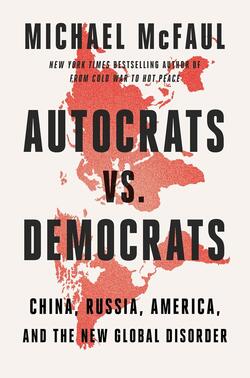
Autocrats vs. Democrats: China, Russia, America, and the New Global Disorder is a clear-eyed look at how the rise of autocratic China and Russia are compelling some to think that we have entered a new Cold War—and why we must reject that thinking in order to prevail. 

Cover of Autocrats vs Democrats Book

Amid the constant party divisions in Washington, DC, one issue generates stunning consensus—China—with Republicans and Democrats alike battling over which party can take the most hawkish stance toward the ascendant superpower. Indeed, far from trying to avoid a new Cold War with China, many have embraced it, finding comfort in the familiar construct, almost willing it into existence. And yet, even as politicians and intellectuals race to embrace this Cold War 2.0, many of the perils we face today are distinctly different from those of the Cold War with the Soviets. The alliance between the autocracies of China and Russia, the nature of the ideological struggle, China’s economic might, the rise of the far right in the United States and in Europe, and the growing isolationism and polarization in American society—taken together these represent new challenges for the democratic world. Some elements of the Cold War have reappeared today, but many features of the current great power competition have no analogy from the past century.

For decades Michael McFaul, former ambassador to Russia and international affairs analyst for NBC News, has been one of the preeminent thinkers about American foreign policy. Now, in this provocative work, he challenges the encroaching orthodoxy on Russia and China, arguing persuasively that the way forward is not to force our current conflict into a decades-old paradigm but to learn from our Cold War past so that democracy can again emerge victorious. Examining America’s layered, modern history with both Russia and China, he demonstrates that, instead of simplistically framing our competition with China and Russia as a second Cold War, we must understand the unique military, economic, and ideological challenges that come from China and Russia today, and the develop innovative policies that follow from that analysis, not just a return to the Cold War playbook.

At once a clarion call for American foreign policy and a forceful rebuttal of the creeping Washington consensus around China, Autocrats vs. Democrats demonstrates that the key to prevailing in this new era isn’t simply defeating our enemies through might, but using their oppressive regimes against them—to remind the world of the power and potential that our democratic freedoms make possible. 

Michael McFaul headshot

Professor Michael McFaul

FSI Director
"Autocrats vs. Democrats: China, Russia, America, and the New Global" is available starting October 28, 2025.
Order Now

Hauck Auditorium, Traitel Building, 435 Lasuen Mall, Stanford, CA 94305

Encina Hall
616 Jane Stanford Way
Stanford, CA 94305-6055

0
Senior Fellow, Freeman Spogli Institute for International Studies
Ken Olivier and Angela Nomellini Professor of International Studies, Department of Political Science
Peter and Helen Bing Senior Fellow, Hoover Institution
mcfaul_headshot_2025.jpg PhD

Michael McFaul is the Ken Olivier and Angela Nomellini Professor of International Studies in Political Science, Senior Fellow at the Freeman Spogli Institute for International Studies, and the Peter and Helen Bing Senior Fellow at the Hoover Institution, all at Stanford University. He joined the Stanford faculty in 1995 and served as FSI Director from 2015 to 2025. He is also an international affairs analyst for MSNOW.

McFaul served for five years in the Obama administration, first as Special Assistant to the President and Senior Director for Russian and Eurasian Affairs at the National Security Council at the White House (2009-2012), and then as U.S. Ambassador to the Russian Federation (2012-2014).

McFaul has authored ten books and edited several others, including, most recently, Autocrats vs. Democrats: China, Russia, America, and the New Global Disorder, as well as From Cold War to Hot Peace: An American Ambassador in Putin’s Russia, (a New York Times bestseller) Advancing Democracy Abroad: Why We Should, How We Can; and Russia’s Unfinished Revolution: Political Change from Gorbachev to Putin.

He is a recipient of numerous awards, including an honorary PhD from Montana State University; the Order for Merits to Lithuania from President Gitanas Nausea of Lithuania; Order of Merit of Third Degree from President Volodymyr Zelenskyy of Ukraine, and the Dean’s Award for Distinguished Teaching at Stanford University. In 2015, he was the Distinguished Mingde Faculty Fellow at the Stanford Center at Peking University.

McFaul was born and raised in Montana. He received his B.A. in International Relations and Slavic Languages and his M.A. in Soviet and East European Studies from Stanford University in 1986. As a Rhodes Scholar, he completed his D. Phil. in International Relations at Oxford University in 1991. 

CV
Date Label
Michael McFaul
Lectures
Date Label
Authors
News Type
News
Date
Paragraphs

While the potential benefits of artificial intelligence are significant and far-reaching, AI’s potential dangers to the global order necessitates an astute governance and policy-making approach, panelists said at the Freeman Spogli Institute for International Studies (FSI) on May 23.

An alumni event at the Ford Dorsey Master’s in International Policy (MIP) program featured a panel discussion on “The Impact of AI on the Global Order.” Participants included Anja Manuel, Jared Dunnmon, David Lobell, and Nathaniel Persily. The moderator was Francis Fukuyama, Olivier Nomellini senior fellow at FSI and director of the master’s program.

Manuel, an affiliate at FSI’s Center for International Security and Cooperation and executive director of the Aspen Strategy Group, said that what “artificial intelligence is starting to already do is it creates superpowers in the way it intersects with other technologies.”

An alumna of the MIP program, Manuel noted an experiment a year ago in Switzerland where researchers asked an AI tool to come up with new nerve agents – and it did very rapidly, 40,000 of them. On the subject of strategic nuclear deterrence, AI capabilities may upend existing policy approaches. Though about 30 countries have voluntarily signed up to follow governance standards in how AI would be used in military conflicts, the future is unclear.

“I worry a lot,” said Manuel, noting that AI-controlled fighter jets will likely be more effective than human-piloted craft. “There is a huge incentive to escalate and to let the AI do more and more and more of the fighting, and I think the U.S. government is thinking it through very carefully.”


AI amplifies the abilities of all good and bad actors in the system to achieve all the same goals they’ve always had.
Nathaniel Persily
Co-director of the Cyber Policy Center


Geopolitical Competition


Dunnmon, a CISAC affiliate and senior advisor to the director of the Defense Innovation Unit, spoke about the “holistic geopolitical competition” among world powers in the AI realm as these systems offer “unprecedented speed and unprecedented scale.”

“Within that security lens, there’s actually competition across the entirety of the technical AI stack,” he said.

Dunnmon said an underlying security question involves whether a given AI software is running on top of libraries that are sourced from Western companies then if software is being built on top of an underlying library stack owned by state enterprises. “That’s a different world.”

He said that “countries are competing for data, and it’s becoming a battlefield of geopolitical competition.”

Societal, Environmental Implications


Lobell, a senior fellow at FSI and the director of the Center for Food Security and the Environment, said his biggest concern is about how AI might change the functioning of societies as well as possible bioterrorism.

“Any environment issue is basically a collective action problem, and you need well-functioning societies with good governance and political institutions, and if that crumbles, I don’t think we have much hope.”

On the positive aspects of AI, he said the combination of AI and synthetic biology and gene editing are starting to produce much faster production cycles of agricultural products, new breeds of animals, and novel foods. One company found how to make a good substitute for milk if pineapple, cabbage and other ingredients are used.

Lobell said that AI can understand which ships are actually illegally capturing seafood, and then they can trace that back to where they eventually offload such cargo. In addition, AI can help create deforestation-free supply chains, and AI mounted on farm tractors can help reduce 90% of the chemicals being used that pose environmental risks.

“There’s clear tangible progress being made with these technologies in the realm of the environment, and we can continue to build on that,” he added.


Countries are competing for data, and it’s becoming a battlefield of geopolitical competition.
Jared Dunnmon
Affiiate at the Center for International Security and Cooperation (CISAC)


AI and Democracy


Persily, a senior fellow and co-director of FSI’s Cyber Policy Center, said, “AI amplifies the abilities of all good and bad actors in the system to achieve all the same goals they’ve always had.”

He noted, “AI is not social media,” even though it can interact with social media. Persily said AI is so much more pervasive and significant than a given platform such as Facebook. Problems arise in the areas of privacy, antitrust, bias and disinformation, but AI issues are “characteristically different” than social media.

“One of the ways that AI is different than social media is the fact that they are open-source tools. We need to think about this in a little bit of a different way, which is that it is not just a few companies that can be regulated on closed systems,” Persily said.

As a result, AI tools are available to all of us, he said. “There is the possibility that some of the benefits of AI could be realized more globally,” but there are also risks. For example, in the year and a half since OpenAI released ChatGPT, which is open sourced, child pornography has multiplied on the Internet.

“The democratization of AI will lead to fundamental challenges to establish legacy infrastructure for the governance of the propagation of content,” Persily said.

Balance of AI Power


Fukuyama pointed out that an AI lab at Stanford could not afford leading-edge technology, yet countries such as the U.S. and China have deeper resources to fund AI endeavors.

“This is something obviously that people are worried about,” he said, “whether these two countries are going to dominate the AI race and the AI world and disadvantage everybody.”

Manuel said that most of AI is now operating with voluntary governance – “patchwork” – and that dangerous things involving AI can be done now. “In the end, we’re going to have to adopt a negotiation and an arms control approach to the national security side of this.” 

Lobell said that while it might seem universities can’t stay up to speed with industry, people have shown they can reproduce those models’ performances just days after their releases.


In the end, we’re going to have to adopt a negotiation and an arms control approach to the national security side of this.
Anja Manuel
Affiiate at the Center for International Security and Cooperation (CISAC)


On regulation — the European Union is currently weighing legislation — Persily said it would be difficult to enforce regulations and interpret risk assessments, so what is needed is a “transparency regime” and an infrastructure so civil entities have a clear view on what models are being released – yet this will be complex.

“I don’t think we even really understand what a sophisticated, full-on AI audit of these systems would look like,” he said.

Dunnmon suggested that an AI governance entity could be created that’s similar to how the U.S. Food and Drug Agency reviews pharmaceuticals before release.

In terms of AI and military conflicts, he spoke about the need for AI and humans to understand the rewards and risks involved, and in the case of the latter, how the risk compares to the “next best option.”

“How do you communicate that risk, how do you assess that risk, and how do you make sure the right person with the right equities and the right understanding of those risks is making that risk trade-off decision?” he asked.


The Ford Dorsey Master’s in International Policy program was established in 1982 to provide students with the knowledge and skills necessary to analyze and address complex global challenges in a rapidly changing world, and to prepare the next generation of leaders for public and private sector careers in international policymaking and implementation.

Read More

Hero Image
Francis Fukuyama, Anja Manuel, Jared Dunnmon, David Lobell, and Nathaniel Persily discuss the impact of artificial intelligence during a panel held at the Freeman Spogli Institute for International Studies at Stanford University.
At the annual alumni gathering of the Ford Dorsey Master's in International Policy, Francis Fukuyama, Anja Manuel, Jared Dunnmon, David Lobell, and Nathaniel Persily discussed the impact of artificial intelligence on the global order.
Meghan Moura
All News button
1
Subtitle

At a gathering for alumni, the Ford Dorsey Master's in International Policy program hosted four experts to discuss the ramifications of AI on global security, the environment, and political systems.

Terms
Date Label
Authors
News Type
News
Date
Paragraphs

On Thursday, February 9, the Freeman Spogli Institute for International Studies was pleased to welcome a delegation of chief information officers from the Department of Defense for a panel session with security and foreign policy experts. The CIOs were hosted by the Gordian Knot Center for National Security Innovation, an interdisciplinary, cross-campus effort at the Center for International Security and Cooperation (CISAC) aimed at solving pressing national security problems at the locus of diplomacy, information, the military, the economy, and technology.

The delegation was led by David McKeown, the Acting Principal Deputy Chief Information Officer, and represented each of the branches of the military as well as various DoD task forces focused on cybersecurity, digital modernization, and integrated defense strategies.

As the officers responsible for cybersecurity, communications, information systems, and other information enterprises at the Department of Defense, the war in Ukraine and the lessons it teaches about how technology functions in a modern conflict were top of mind for the visiting officials. To provide insight into what can be learned from Ukraine, FSI Director Michael McFaul and senior fellows Scott Sagan and Amy Zegart presented their perspectives on Putin, nuclear security, and the evolving intelligence ecosystem.


Counting Assets and Creating Confidence
 

For former U.S. Ambassador to Russia Michael McFaul, one of the biggest takeaways from the war so far in Ukraine is how poorly conventional wisdom served both Putin and Western alliances in estimating how Ukraine would respond to an invasion. By the numbers — tanks, missiles, personnel, ammunitions — Russia’s military capability is formidable. Yet it has vastly underperformed against traditionally-held expectations, a fact McFaul admitted has required him to revise his own research and thinking.

“Clearly tanks, aircraft, missiles, and soldiers are not the whole war effort,” he told the delegation. “That tells me we need to figure out better ways to measure capabilities than just counting things.”

[Left to Right] Amy Zegaty, Michael McFaul, and Soctt sagan at pajlwn secittek

His concerns over military enterprise were not limited to Russia. Turning a critical eye towards home, McFaul also stressed the importance of fixing acquisition and development challenges in the United States’ industrial base. Reliable, scalable access to military resources is not only crucial to the defense of America and its allies, McFaul reminded the panel, but it has direct impacts on how effective deterrence strategies will be elsewhere. Without such guarantees, the United States will lack credibility, whether in Ukraine and the active conflict there or in Taiwan and the challenges it faces from China.

For McFaul, the odds-defying performance of the Ukrainian military thus far also highlights the complimentary need to quantify the human side of defense and the impact it can have on strategic outcomes.

“How do you measure will to fight? We need to understand that better if we want to be better at our assessments in the future,” he urged.
 

Keeping a Clear Eye on Nuclear Threats
 

Early in the war, Putin and other Kremlin spokespeople made headlines with less-than-veiled allusions to the possibility of using nuclear weapons in their campaign against Ukraine. While that nuclear sabre-rattling has cooled in recent months, Scott Sagan says the United States and its allies need to remain very clear-eyed to the dangers posed by raising even the specter of nuclear use.

“I don’t think it’s out of the question yet,” said Sagan. He went on to explain, “I don’t think Vladimir Putin has decided yet whether he would use nuclear weapons or not. Part of these threats are about trying to deter us from intervening and to scare and divide the West. But it’s also about Putin getting a gauge of what we’re thinking and how we might respond if he did.”

Sagan, an internationally recognized expert on nuclear security and nuclear policy, said that even with the assurances that high-level U.S. officials such as Secretary of State Antony Blinken and Secretary of Defense Lloyd Austin have communicated to their Russian counterparts, the unacceptable nature of any kind of nuclear use in war needs to be emphasized. 

What’s at stake here is not just the future of Ukraine, or the future of democracy, or the future of American credibility. It’s also about the future of what kind of nuclear world we live in.
Scott Sagan
FSI Senior Fellow at CISAC

“We need to underline the illegality of this. We need to remind them that we have a long history of going after war criminals. We need to make it clear that if they think they will not suffer catastrophic personal consequences, they should think again,” said Sagan.

Beyond individual actors, the threat of nuclear weapons directly challenges the regime of non-proliferation currently in place around the world. By Sagan’s assessment, the endurance of non-proliferation rests on how the West would respond to the use of a nuclear weapon in Ukraine. In the scenario where nuclear use leads to the Russian military intervening against Putin, or the West escalating to bring about a definite Russian defeat, Sagan believes non-proliferation would continue largely intact.

If, however, nuclear use leads to the collapse of the Ukrainian government and causes the West to back away, the domino effect could topple the commitment to non-proliferation the world over. Sagan points to the recent uptick in dialogue about nuclear programs in South Korea, Japan, and Iran as early indicators of what a more devastating event could trigger.

“What’s at stake here is not just the future of Ukraine and the future of democracy, and the future of American credibility; it’s also, potentially, the future of what kind of nuclear world we live in,” he cautioned.

Amy Zegart discusses the changing landscape of intelligence gathering at a panel with Department of Department CIOs.
Amy Zegart discusses the changing landscape of intelligence gathering at a panel with Department of Department CIOs. | Melissa Morgan

Grappling with a Deluge of Data
 

Amy Zegart offered similar cautions when asked about cyber capabilities and intelligence. Analysts have been quick to comment on the seemingly underwhelming cyber front in the war against Ukraine, particularly when compared with Russia’s estimated cyber capabilities and prior campaigns into cyber interference. Zegart flipped the scenario to pose a different perspective.

“The lesson may not be that Putin is not ten feet tall. I think the right question to ask is, ‘Could he have been?’” she told the CIOs.

Rather than view the events in Ukraine as a win for Western cyber defense, Zegart believes it will be much more constructive to unpack how the current war was almost a near miss.

“What are the factors that tilted in our favor? What if those aren’t there next time? Is a near miss a signal that things are working well? Or is the near miss a sign that things are prone to catastrophic failure?” she posed to the delegates.

Zegart has studied and written extensively about how emerging technologies are rapidly and dramatically changing the landscapes of cyber and intelligence gathering, an analysis she summarizes as the “Five Mores”: more threats, more speed, more data, more customers, and more competitors. While not exclusive to the events unfolding in Ukraine, each of these areas has been highlighted and accelerated by the conflict, says Zegart. In a world where information is coming faster and from more directions than ever before, understanding those points of potential failure and building resiliency and protocols into the process becomes absolutely crucial for security and defense, whether in Russia and Ukraine or with adversarial relationships elsewhere.

How can autocrats prevent self-deception? How can we help our adversaries stop deceiving themselves?
Amy Zegart
FSI Senior Fellow at CISAC

Understanding Parallels Between Moscow and Beijing
 

While the current conflict in Ukraine was the immediate topic of the panel, the implications of what is happening now in Eastern Europe have clear correlations to how events unfold between China and Taiwan in coming years. Beyond Ukraine, the question many of the officers had was: What is Xi Jinping learning from all of this?

As both Scott Sagan and Michael McFaul were quick to point out, Xi, like Putin, is a very difficult target to read, and making any assessment of his thinking is exceptionally difficult.

Echoing the sentiment, Amy Zegart explained, “When I go down the list, I can make an argument for polar opposite learnings on every dimension. That’s what concerns me the most. I don't know which of those Xi Jinping is learning.”

Turning the question around, Zegart offered an alternative. “Maybe the question we need to be asking is, ‘How can autocrats prevent self-deception? How can we help our adversaries stop deceiving themselves?” As Scott Sagan noted, autocratic systems built around an authoritarian leader like Putin are highly incentivized towards yes-man politics rather than criticism and constructive critiques about how to identify problems and achieve results. Putin’s miscalculations in Ukraine and the apparent gaps in his intelligence briefings are evidence of this.

In regimes prone to self-deception, the answer to Zegart’s question may lie in data and analysis. If autocratic leaders are unable to rely on information from within their own system, outside actors should work to fill in those gaps and communicate an accurate cost-benefit analysis, she suggests.

Looking toward China, Michael McFaul agrees that this type of communication and analysis needs to be a key part of the U.S. deterrence strategy.

“I think it would be a very worthy enterprise for a government organization or a think tank to spell out in detail the economic consequences of an attempted invasion of Taiwan. We want Xi Jinping to know that,” he advised.

Learning from Today and Planning for Tomorrow
 

Whether in Ukraine, China, or in other challenging policy areas, McFaul also emphasized the need for longevity and commitment.  “This is year one of the war,” he reminded the delegation. ”We can feel really good about what we’ve done today, but if in Year 4 we’ve lost the war, nobody is going to remember that.”

McFaul highlighted not only the urgency of the current situation, but also the importance of dialogue and partnerships between academia and policymakers. While political appointments and assignments in government may shift from term to term or from one administration to another, experts at academic organizations like the Freeman Spogli Institute and the Gordian Knot Center can provide the continuity and deep bench of expertise needed to make, adapt, and sustain challenging policy decisions in the long-term.

In his concluding remarks, McFaul reminded the visiting delegates of one of the institute’s foundational principles. “Our mission statement here at FSI is to translate research into policy outcomes. We want people based in D.C. to understand how many resources and people we have for them to call on,” he said.

Wrapping up the discussion, Joe Felter, the director of the Gordian Knot Center, likewise emphasized the importance of this connection. Speaking to the CIOs he said, ”This panel clearly shows that academia does more than just admire problems. Stanford is in this fight, and we’re putting our best forward to provide solutions.”

Read More

Rose Gottemoeller speaks at a reception in New York City in 2016.
Blogs

Policy Impact Spotlight: Rose Gottemoeller and Negotiations for a Safer World

From a missed phone call in Moscow to becoming the lead U.S. negotiator of the New START Treaty, scholars like Rose Gottemoeller demonstrate the importance of collaboration between scholars in academic institutions and policymakers in government.
Policy Impact Spotlight: Rose Gottemoeller and Negotiations for a Safer World
A delegation from the NATO Parliamentary Assembly visits the Freeman Spogli Institute for International Studies.
News

NATO Parliamentary Delegation Joins FSI Scholars for Discussion on Ukraine and Russia

FSI Director Michael McFaul, Kathryn Stoner, Francis Fukuyama, Scott Sagan, Anna Grzymala-Busse, and Marshall Burke answered questions from the parliamentarians on the conflict and its implications for the future of Ukraine, Russia, and the global community.
NATO Parliamentary Delegation Joins FSI Scholars for Discussion on Ukraine and Russia
Students on team one present their project to the class
News

Stanford Students Pitch Solutions to U.S. National Security Challenges to Government Officials and Technology Experts

In the class “Technology, Innovation, and Great Power Competition,” students across disciplines work in teams and propose their detailed solutions to active stakeholders in the technology and national security sectors.
Stanford Students Pitch Solutions to U.S. National Security Challenges to Government Officials and Technology Experts
Hero Image
CIOs from the Department of Defense listen to experts at the Freeman Spogli Institute discuss the war in Ukraine.
Chief Information officers from the Department of Defense listen to experts at the Freeman Spogli Institute discuss the war in Ukraine and its implications for foreign policy an global security.
Melissa Morgan
All News button
1
Subtitle

Chief Information Officers representing specialties across the Department of Defense met with Michael McFaul, Scott Sagan, and Amy Zegart to discuss the war in Ukraine and how it’s changing the discussion around cyber defense, nuclear policy, and deterrence.

Authors
Oriana Skylar Mastro
News Type
Commentary
Date
Paragraphs

This opinion article first appeared in the Washington Post.


Most world leaders, including President Biden and Japanese Prime Minister Fumio Kishida, agree that the defense of Taiwan is crucial for regional security. But most options for improving deterrence will take too long. Building Taiwan’s self-defense, developing more U.S. firepower in the region, creating the economic resilience to make severe sanctions feasible: None of these will come to fruition before 2030.

Japan could change the game now. Allied forces, responding immediately and en masse, have a chance of thwarting a Chinese invasion, according to a recent report from the Center for Strategic & International Studies. But, in meetings with high-level officials in Tokyo last month, I sensed a mismatch between talk and walk. Japan must broaden its vision of self-defense to encompass priorities and declaratory policies that will avert calamity in the region. Tokyo cannot wait until war breaks out to start the tougher conversations.

Here’s why.


Sign up for APARC newsletters to receive our experts' analysis >


First, without Japan, the United States could be outgunned in a fight to defend Taiwan, notwithstanding Washington’s new basing agreement with the Philippines. A combined U.S.-Japan fleet, on the other hand, would boast more than three times as many aircraft carriers, cruisers and destroyers as the People’s Liberation Army Navy. The quality of many Japanese ships approaches that of its U.S. counterparts. Eight of Japan’s destroyers field a state-of-the-art Aegis weapons system used by some of the more advanced ships in the U.S. Navy.

Tokyo could contribute significantly to a military effort to deny China the ability to take Taiwan by force. To do so [... it] must be willing to go after the amphibious invasion force and targets on mainland China — a very controversial proposition indeed.

Second, Japan’s involvement could mitigate some of the geographic vulnerabilities of the United States. Adding Japanese bases more than doubles the locations from which the two countries together could conduct operations. Japan’s southwestern islands are closer to Taiwan than mainland China. Take Yonaguni Island, just about 70 miles from Taiwan’s east coast. On it are intelligence, surveillance and reconnaissance assets, as well as anti-ship and anti-aircraft capabilities. Operating from these bases in the defense of Taiwan, allied forces would have more opportunities to quickly target an invading force. That would make attacks on U.S. bases in Japan, such as Kadena, at the southernmost tip of the archipelago, less attractive to the Chinese. Such strikes would no longer completely cripple an air effort.

Third, Japan has military strengths that would make a fait accompli almost impossible for China. Though Japanese diesel submarines are slower than U.S. counterparts, they could reach the Taiwan Strait in just two days. U.S. submarines departing from Hawaii would take at least a week; from San Diego even longer. This makes Japan the first line of defense for Taiwan. Japanese boats could also monitor key choke points through which Chinese navy submarines would be attempting to exit the First Island Chain in the western Pacific. This would free up the quieter submarines of the U.S. Navy to wreak havoc on amphibious vessels and escort ships.

In short, Tokyo could contribute significantly to a military effort to deny China the ability to take Taiwan by force. To do so, Japan must increase its stockpile of torpedoes and long-range strike weapons, as planned. Tokyo must be willing to go after the amphibious invasion force and targets on mainland China — a very controversial proposition indeed.

On the surface, it looks as if Japan is moving in the right direction. The government took the groundbreaking historic step of increasing defense spending to 2 percent of Japan’s gross domestic product over the next five years. This meant a whopping 26.3 percent increase in 2023 alone. The greatest increase in the past was in 1986, by nearly 50 percent.

Last year, former prime minister Shinzo Abe stated that the security of Japan is connected to Taiwan. He said a Chinese use of force against a U.S. vessel defending Taiwan could legally trigger the deployment of Japan’s military (known as the Self-Defense Force).

Indeed, a 2015 law allows Japan to engage in collective defense when presented with an existential threat. This provides plenty of flexibility for Japan to fight alongside the United States without the need for a constitutional amendment. The officials I spoke with in Tokyo were firm that Japan would respond if China attacked U.S. bases such as Kadena.

Crudely, Japan seems to be prepared to push back against only Chinese assets that are clearly poised to attack its sovereign territory. Those heading toward Taiwan? Not so much.

But all these initiatives concern self-defense. Japan does worry that military activity around Taiwan could extend to the security of its southwestern islands. Or that if China takes Taiwan, it would be emboldened to take the Senkaku/Diaoyu islands, which Tokyo administers but which China also claims. There are even concerns that Okinawa, a group of 160-plus islands that is home to 1.4 million people (and dozens of U.S. bases), could then prove enticing to Beijing.

Crudely, Japan seems to be prepared to push back against only Chinese assets that are clearly poised to attack its sovereign territory. Those heading toward Taiwan? Not so much.

While a degree of strategic ambiguity makes sense, too much could backfire. If Japan is clearly unwilling to defend Taiwan, then improvements in Japanese military capabilities will do little to deter conflict across the strait. Japanese officials don’t need to say they would attack any Chinese invading forces, but they need to let their counterparts know it is a real possibility. The officials I met were unwilling to send such strong messages; some insisted reassuring Beijing was more important.

Tokyo must make clear at home and abroad that defending Taiwan is no longer off the table. The prospect of Japan engaging in offensive operations in the defense of Taiwan would stay Chinese President Xi Jinping’s hand. Only then would recent monumental changes in Japanese politics fulfill their potential in contributing to peace and security in Asia. If Ukraine has taught us anything, it is that deterrence is costly, but war is worse.

Read More

Hero Image
U.S. and Japanese forces conduct a maritime partnership exercise in the South China Sea.
U.K. Royal Navy aircraft carrier HMS Queen Elizabeth (R08), U.S. Navy Nimitz-class aircraft carrier USS Carl Vinson (CVN 70), and Japan Maritime Self-Defense Force Izumo-class helicopter destroyer JS Kaga (DDH 184) sail together as part of Maritime Partnership Exercise, Oct. 17, 2021.
Petty Officer 3rd Class Erin Zor via U.S. Indo-Pacific Command
All News button
1
Subtitle

Tokyo must make clear at home and abroad that defending Taiwan is no longer off the table.

Date Label
Authors
News Type
News
Date
Paragraphs

Against the backdrop of Ukraine's counteroffensive and the Kremlin's efforts to illegally annex additional territory, a delegation of members from the NATO Parliamentary Assembly arrived at Stanford to meet with experts and weigh considerations about the ongoing conflict. First on their circuit was a panel hosted by the Freeman Spogli Institute for International Studies (FSI) chaired by FSI Director Michael McFaul, with Marshall Burke, Francis Fukuyama, Anna Grzymala-Busse, Scott Sagan, and Kathryn Stoner participating.

The delegates represented thirteen of NATO's thirty member nations, including Belgium, the Czech Republic, France, Greece, Hungary, Italy, Latvia, Luxembourg, Portugal, Romania, Spain, Turkey, and the United Kingdom. Top of mind were questions about the possibility of nuclear escalation from the Kremlin, and appropriate repsonses from the alliance, as well as questions about the longevity of Putin's regime, the nature of international authoritarian alliances, and the future of Ukraine as a European nation.

Drawing from their expertise on state-building, democracy, security issues, nuclear enterprise, and political transitions, the FSI scholars offered a broad analysis of the many factors currently playing out on the geopolitical stage. Abbreviated versions of their responses are given below.

Kathryn Stoner, Francis Fukuyama, Marshall Burke, Scott Sagan, Anna Grzymala-Busse, and Michael McFaul present at a panel given to memebers of the NATO Parlimentary Assembly.
Kathryn Stoner, Francis Fukuyama, Marshall Burke, Scott Sagan, Anna Grzymala-Busse, and Michael McFaul present at a panel given to memebers of the NATO Parliamentary Assembly on September 26, 2022. | Melissa Morgan

The following commentary has been edited for clarity and length, and does not represent the full extent of the panel’s discussion.


Rethinking Assumptions about Russia and Putin

Kathryn Stoner

Right now, Putin is the most vulnerable he's ever been in 22 years in power. But I don’t believe he's under so much pressure at this point that he is about to leave office anytime soon. Autocracies do not usually die by popular mobilization, unfortunately. More often they end through an elite coup or turnover. And since the end of WWII, the research has shown that about 75% of the time autocracies are typically replaced by another autocracy, or the perpetuation of the same autocracy, just with a different leader. So, if Putin were replaced, you might get a milder form of autocracy in Russia, but I don't think you are suddenly going to create a liberal democracy.

This means that we in the West, and particularly in the U.S., need to think very hard about our strategies and how we are going to manage our relationships with Putin and his allies. This time last year, the U.S. broadcast that we basically wanted Russia to calm down so we could pivot to China. That’s an invitation to not calm down, and I think it was a mistake to transmit that as policy.

We need to pay attention to what Russia has been doing. They are the second biggest purveyor of weapons globally after the United States. They will sell to anyone. They’ve been forgiving loans throughout Sub Saharan Africa from the Soviet period and using that as a way of bargaining for access to natural resources. They’re marketing oil, selling infrastructure, and building railroads. Wherever there is a vacuum, someone will fill it, and that includes Russia every bit as much as China. We need to realize that we are in competition with both Russia and China, and develop our policies and outreach accordingly.

KStoner

Kathryn Stoner

Mosbacher Director of the Center on Democracy, Development, and the Rule of Law
Full Profile


Confronting Autocracy at Home and Abroad

Anna Grzymala-Busse

Why is Putin in Ukraine? Because the fact that there is a democratic country right next door to Russia is an affront to him. Putin doesn’t care that much about NATO. The fact that nothing happened when Sweden joined is some evidence of this. That’s something to keep in mind as people are debating NATO and Ukraine and Ukraine’s possible future as a member.

NATO membership and EU membership are both wonderful things. But more fundamental that that, this war has to be won first. That’s why I think it’s necessary in the next six months to speed up the support for Ukraine by ensuring there’s a steady stream of armaments, training personnel, and providing other military support.

There’s been incredible unity on Ukraine over the last seven months across the EU, NATO, and amongst our allies. But our recent history with President Trump reminds us how fragile these international commitments can be. In foreign policy, it used to be understood that America stands for liberal democracy. But we had a president of the United States who was more than happy to sidle up to some of the worst autocrats in the world. That’s why we can’t afford to leave rising populism around the world unaddressed and fail to engage with voters. When we do that, we allow far right parties to grab those votes and go unopposed. Whatever happens domestically impacts what happens internationally.

Anna Grzymała-Busse

Anna Grzymala-Busse

Director of The Europe Center
Full Profile


The Consequences of Nuclear Sabre-Rattling

Scott Sagan

We have to very clear-eyed when we’re talking about the threat, however improbable, of the use of a nuclear weapon. When it comes to the deployment of a tactical nuclear weapon, its kinetic effects depend on both the size of the weapon, the yield, and the target. Tactical weapons range in yield from very low — 5-10% of what was in the Hiroshima bomb — to as large as what was used against Hiroshima and Nagasaki. If that kind of weapon was used on an urban target, it would produce widescale effects. In a battlefield or rural area, it would have a relatively small impact.

But in the bigger picture, what any use of a weapon like this does is break a 70+ year tradition of non-use. Those seventy years have been dicey and fragile, but they have held so far. A tradition that is broken creates a precedent, and once there’s a precedent, it makes it much easier for someone to transgress the tradition again. So even if a decision was made to use a tactical weapon with little kinetic importance for strategic effect, I think we still need to be worried about it.

Personalistic dictators surround themselves with yes men. They make lonely decisions by themselves, often filled with vengeance and delusion because no one can tell them otherwise. They don't have the checks and balances. But I want to make one point about a potential coup or overthrow. Putin has done a lot to protect himself against that. But improbable events happen all the time, especially when leaders make really, really bad decisions. That’s not something we should be calling for as official U.S. policy, but it should be our hope.

Headshot of Scott Sagan

Scott Sagan

FSI Senior Fellow at the Center for International Security and Cooperation
Full Profile


Cycles of Conflict, Climate Change, and Food Insecurity

Marshall Burke

The estimates right now project that there are 350 million people around the world facing acute food insecurity. That means 350 million people who literally don’t have enough to eat. That’s roughly double what it was pre-COVID. The factors driving that are things like supply chain disruptions from the pandemic and climate shocks, but also because of ongoing conflict happening around the world, Ukraine included.

There was an early concern that the war in Ukraine would be a huge threat to global food security. That largely has not been the case so far, at least directly. Opening the grain corridors through the Black Sea has been crucial to this, and it’s critical that we keep those open and keep the wheat flowing out. Research shows that unrest increases when food prices spike, so it’s important for security everywhere to keep wheat prices down.

What I’m worried about now is natural gas prices. With high global natural gas prices, that means making fertilizer is also very expensive and prices have increased up to 300% relative to a few years ago. If they stay that high, this is going to be a long-term problem we will have to find a way of reckoning with on top of the other effects from climate change already impacting global crop production and the global economy.

Marshall Burke

Marshall Burke

Deputy Director of the Center on Food Security and the Environment
Full Profile


Ukraine After the War

Francis Fukuyama

I've been more optimistic about the prospects for Ukraine taking back territory for more of this war, just because of the vast difference in motivation between the two sides and the supply of modern weapons that Ukraine has been getting. But I don’t know what the conditions on the ground will look like when the decision to negotiate comes. Will Russia still be sitting on occupied territory? Are they kicked out entirely? Or are the frontlines close to where they are now?

As I’ve observed, Ukraine's demands have shifted depending on how they perceive the war going on. There was a point earlier this summer where they hinted that a return to the February 23 borderlines would be acceptable. But now with their recent successes, they're saying they want everything back to the 2014 lines. What actually happens will depend on what the military situation looks like next spring, by my guess.

However the war does end, I think Ukraine actually has a big opportunity ahead of them. Putin has unwittingly become the father of a new Ukrainian nation. The stresses of the war have created a very strong sense of national identity in Ukraine that didn’t exist previously. It’s accurate that Ukraine had significant problems with corruption and defective institutions before, but I think there’s going to be a great push to rout that out. Even things like the Azov steel factory being bombed out of existence is probably a good thing in the long run, because Ukraine was far too dependent on 20th-century coal, steel, and heavy industry. Now they have an opportunity to make a break from all of that.

There are going to be challenges, obviously. We’ll have to watch very carefully what Zelenskyy chooses to do with the commanding position he has at the moment, and whether the government will be able to release power back to the people and restore its institutions. But Europe and the West and our allies are going to have a really big role in the reconstruction of Ukraine, and that should be regarded by everyone as a tremendous opportunity.

frank_fukuyama

Francis Fukuyama

Olivier Nomellini Senior Fellow at FSI
Full Profile


Victory in Ukraine, Victory for Democracy

Michael McFaul

Nobody likes a loser, and right now, Putin is losing strategically, tactically, and morally. Now, he doesn’t really care about what Biden or NATO or the West think about him. But he does care about what the autocrats think about him, especially Xi Jinping. And with reports coming out of the Shanghai Cooperation Organization that Xi has “concerns” about what’s happening in Ukraine, Putin is feeling that pressure. I think that's why he has decided he needs to double down, not to negotiate, but to try and “win” in some way as defined by him.

In my view, that’s what’s behind the seizure of these four regions. If he feels like he can unequivocally claim them as part of Russia, then maybe he will sue for peace. And that’s exactly what President Zelenskyy fears. Why? Because that’s exactly what happened in 2014. Putin took Crimea, then turned around to the countries of the world and said, “Aren’t we all tired of war? Can’t we just have peace? I’m ready to end the war, as long as you recognize the new borders.” And, let’s be honest, we did.

We keep hearing politicians say we should put pressure for peace negotiations. I challenge any of them to explain their strategy for getting Putin to talk about peace. There is no doubt in my mind that President Zelenskyy would sit down tomorrow to negotiate if there was a real prospect for peace negotiations. But there's also no doubt in my mind right now that Putin has zero interest in peace talks.

Like Dr. Fukuyama, I don’t know how this war will end. But there's nobody inside or outside of Russia that thinks it’s going well. I personally know a lot of people that believe in democracy in Russia. They believe in democracy just as much as you or I. I’ve no doubt of their convictions. But they’re in jail, or in exile today.

If we want to help Russia in the post-Putin world, we have to think about democracy. There’s not a lot we can do to directly help democracy in Russia right now. But we should be doing everything to help democracy in Ukraine.  It didn’t happen in 1991. It didn’t happen in 2004. It didn’t happen in 2014. They had those breakthroughs and those revolutionary moments, but we as the democratic world collectively didn’t get it right. This is our moment to get it right, both as a way of helping Ukraine secure its future, and to give inspiration to “small-d” democrats fighting for rights across the world.

Michael McFaul, FSI Director

Michael McFaul

Director of the Freeman Spogli Institute for International Studies
Full Profile

Read More

President of Russia Vladimir Putin
Commentary

Putin's Disaster in Ukraine

On Vladimir Putin’s order, the Russian army launched a new invasion of Ukraine in February. That has inflicted tragedy on Ukrainians but, seven months later, has also proved a catastrophe for Russia.
Putin's Disaster in Ukraine
Russian flag and NATO flag
Commentary

NATO-Russia: It’s time to suspend the Founding Act

During a period of greater hope for Russia tempered by uncertainties, President Bill Clinton sought both to enlarge NATO and build a strategic partnership between the Alliance and Moscow.
NATO-Russia: It’s time to suspend the Founding Act
Hero Image
A delegation from the NATO Parliamentary Assembly visits the Freeman Spogli Institute for International Studies.
A delegation representing thirteen countries from the NATO Parliamentary Assembly visits Stanford to hear perspectives on the war in Ukraine and its geopolitical impacts from scholars at the Freeman Spogli Institute for International Studies.
Melissa Morgan
All News button
1
Subtitle

FSI Director Michael McFaul, Kathryn Stoner, Francis Fukuyama, Scott Sagan, Anna Grzymala-Busse, and Marshall Burke answered questions from the parliamentarians on the conflict and its implications for the future of Ukraine, Russia, and the global community.

Date Label
News Type
News
Date
Paragraphs

The Freeman Spogli Institute for International Studies (FSI) is pleased to announce that Or Rabinowitz will come to Stanford for the 2022-23 academic year as part of the institute’s new Visiting Fellowship in Israel Studies. Dr. Rabinowitz is currently a Senior Lecturer in International Relations at Hebrew University, Jerusalem.

During her time at Stanford as a visiting fellow in Israel Studies, Dr. Rabinowitz will teach a one quarter long undergraduate course on “Israel: National Security and Nuclear Policy.” She will also organize and run an international workshop on “Deterrence and Weapons of Mass Destruction in the Middle East” in the spring or summer quarters of 2023, and engage with Stanford pre- and postdoctoral fellows and FSI faculty.

Dr. Rabinowitz’s appointment will be based at FSI’s Center for International Security and Cooperation.

“Or Rabinowitz is one of Israel’s finest scholars writing about nuclear proliferation, deterrence, and national security policy,” said Scott Sagan, co-director of CISAC.  “Stanford is really fortunate to be able to bring her to campus for a year under this program.”

Or Rabinowitz is one of Israel’s finest scholars writing about nuclear proliferation, deterrence, and national security policy. Stanford is really fortunate to be able to bring her to campus for a year under this program.
Scott Sagan
Co-director of the Center for International Security and Cooperation

Dr. Rabinowitz’s current research lies at the intersection of nuclear and intelligence studies, with a focus on Israel’s nuclear program and the role of science and technology in its national security doctrine. Her book, “Bargaining on Nuclear Tests: Washington and its Cold War Deals” was published in April 2014 by Oxford University Press, and she has since published articles in International Security, Journal of Strategic Studies, The International History Review and the Bulletin of the Atomic Scientists, among others.

She holds a PhD degree from the War Studies Department of King’s College London, an MA degree in Security Studies and an LLB degree in Law, both from Tel-Aviv University. She is currently conducting a study on intelligence collaboration between allies in the realm of counter-proliferation operations, funded by the Israel Science Foundation.

“I am honored to be joining Stanford this coming academic year, and to share my knowledge about Israel with Stanford’s undergraduates,” said Dr. Rabinowitz. “CISAC is a global leader when it comes to producing new knowledge and insight about the challenges of nuclear proliferation, and being chosen as an Israel Studies Fellow is a true privilege.”

Dr. Rabinowitz’s many awards and honors include being named an Israeli Chevening Scholar by the British Foreign and Commonwealth Office, and receiving The Scouloudi Award from the Institute of Historical Research, University of London. In 2018 she also won the Professor Ya’acov Barsimantov Best Article Award from the Israeli Association for International Studies.

The Visiting Fellowship in Israel Studies was launched in September 2021 with the generous support of Stanford alumni and donors. The search committee included senior fellows from throughout the institute. In addition to bringing to Dr. Rabinowitz to Stanford, the committee selected Dr. Amichai Magen, a scholar of law, government and international relations, as the inaugural Visiting Fellow in Israel Studies. Dr. Magen will also arrive at Stanford in the 2022-2023 academic year.

Read More

CISAC Honors Class 2022
News

Congratulations to Our CISAC Honors Graduates

On Friday, June 10th, 2022, we celebrated the accomplishments of the students in the Honors Program in International Security Studies.
Congratulations to Our CISAC Honors Graduates
All News button
1
Subtitle

Dr. Or Rabinowitz of Hebrew University, Jerusalem, whose research explores how nuclear technology interacts with decision-making, strategy, and diplomacy, will come to Stanford in the 2022-2023 academic year as a visiting fellow in Israel Studies.

Date Label
-
Livestream event on March 1, 2022 at 6:30pm PST: "What's Next for Ukraine and Russia?"

This panel discussion will analyze the most recent developments in the conflict between Ukraine and Russia, and what may lay ahead.

It will be moderated by Francis Fukuyama, director of Stanford’s Ford Dorsey Masters of International Policy Program and Olivier & Nomellini Senior Fellow in International Studies at the Freeman Spogli Institute for International Studies (FSI), with panelists Rose Gottemoeller, the Steven C. Házy Lecturer at FSI’s Center for International Security and Cooperation and deputy secretary general of NATO from 2016 to 2019, and Steve Pifer, the William J Perry Fellow at FSI and former U.S. ambassador to Ukraine.


PANELISTS:

Woman smiling

Rose Gottemoeller

Steven C. Házy Lecturer at the Center for International Security and Cooperation
Full Profile
Man smiling

Steven Pifer

WIlliam J. Perry Fellow at the Center for International Security and Cooperation
Full Profile


MODERATOR:

Francis Fukuyama

Francis Fukuyama

Olivier Nomellini Senior Fellow at the Freeman Spogli Institute for International Studies
Full Profile
Francis Fukuyama

Join via YouTube livesteam

Center for International Security and Cooperation
Encina Hall
616 Jane Stanford Way
Stanford University
Stanford, CA 94305-6165

0
William J. Perry Lecturer, Freeman Spogli Institute
Research Fellow at the Hoover Institution
dsg_gottemoeller.jpg

Rose Gottemoeller is the William J. Perry Lecturer at Stanford University's Freeman Spogli Institute for International Studies and Research Fellow at the Hoover Institute.

Before joining Stanford Gottemoeller was the Deputy Secretary General of NATO from 2016 to 2019, where she helped to drive forward NATO’s adaptation to new security challenges in Europe and in the fight against terrorism.  Prior to NATO, she served for nearly five years as the Under Secretary for Arms Control and International Security at the U.S. Department of State, advising the Secretary of State on arms control, nonproliferation and political-military affairs. While Assistant Secretary of State for Arms Control, Verification and Compliance in 2009 and 2010, she was the chief U.S. negotiator of the New Strategic Arms Reduction Treaty (New START) with the Russian Federation.

Prior to her government service, she was a senior associate with the Carnegie Endowment for International Peace, with joint appointments to the Nonproliferation and Russia programs. She served as the Director of the Carnegie Moscow Center from 2006 to 2008, and is currently a nonresident fellow in Carnegie's Nuclear Policy Program.  

At Stanford, Gottemoeller teaches and mentors students in the Ford Dorsey Master’s in International Policy program and the CISAC Honors program; contributes to policy research and outreach activities; and convenes workshops, seminars and other events relating to her areas of expertise, including nuclear security, Russian relations, the NATO alliance, EU cooperation and non-proliferation. 

Date Label
Rose Gottemoeller Steven C. Házy Lecturer at CISAC
0
rsd25_073_0249a.jpg

Steven Pifer is an affiliate of the Center for International Security and Cooperation as well as a non-resident senior fellow with the Brookings Institution.  He was a William J. Perry Fellow at the center from 2018-2022 and a fellow at the Robert Bosch Academy in Berlin from January-May 2021.

Pifer’s research focuses on nuclear arms control, Ukraine, Russia and European security. He has offered commentary on these issues on National Public Radio, PBS NewsHour, CNN and BBC, and his articles have been published in a wide variety of outlets.  He is the author of The Eagle and the Trident: U.S.-Ukraine Relations in Turbulent Times (Brookings Institution Press, 2017), and co-author of The Opportunity: Next Steps in Reducing Nuclear Arms (Brookings Institution Press, 2012).

A retired Foreign Service officer, Pifer’s more than 25 years with the State Department focused on U.S. relations with the former Soviet Union and Europe, as well as arms control and security issues.  He served as deputy assistant secretary of state in the Bureau of European and Eurasian Affairs with responsibilities for Russia and Ukraine, ambassador to Ukraine, and special assistant to the president and senior director for Russia, Ukraine and Eurasia on the National Security Council.  In addition to Ukraine, he served at the U.S. embassies in Warsaw, Moscow and London as well as with the U.S. delegation to the negotiation on intermediate-range nuclear forces in Geneva.  From 2000 to 2001, he was a visiting scholar at Stanford’s Institute for International Studies, and he was a resident scholar at the Brookings Institution from 2008 to 2017.

Pifer is a 1976 graduate of Stanford University with a bachelor’s in economics.


Affiliate, CISAC
Affiliate, The Europe Center
Date Label
Steven Pifer WIlliam J. Perry Fellow at CISAC
Panel Discussions
-

Russian forces invaded Ukraine on February 24, 2022. Why is Ukraine strategically important to Russia and the West? What are the broader global implications of this attack? Join Stanford scholars from the Freeman Spogli Institute for International Studies for a discussion of the military invasion of Ukraine and the policy choices facing the United States, NATO, and their allies.

Panelists include Kathryn Stoner, the Mosbacher Director of the Center for Democracy, Development and the Rule of Law and senior fellow at the Freeman Spogli Institute for International Studies (FSI), Steve Pifer, the William J. Perry Fellow at the Center for International Security and Cooperation (CISAC) and a former U.S. ambassador to Ukraine, Rose Gottemoeller, the Steven C. Házy Lecturer at CISAC and a former deputy secretary-general of NATO, and Andriy Kohut, Director of the Sectoral State Archive of the Security Service of Ukraine and visiting scholar at the Stanford Center for Russian, East European and Eurasian Studies.

Scott Sagan, co-director of CISAC, senior fellow at FSI, and the Caroline S.G. Munro Professor of Political Science will moderate.

This event is co-sponsored by the Center on Democracy, Development and the Rule of Law (CDDRL), the Center for International Security and Cooperation (CISAC), and the Freeman Spogli Institute for International Studies (FSI).

Scott D. Sagan


In-person attendance is limited to Stanford affiliates only.
Attendance by Zoom is open to the public.

Oksenberg Conference Room
Encina Hall, Third Floor, Central
616 Jane Stanford Way, Stanford, CA 94305

FSI
Stanford University
Encina Hall C140
Stanford, CA 94305-6055

(650) 736-1820 (650) 724-2996
0
Satre Family Senior Fellow, Freeman Spogli Institute for International Studies
kathryn_stoner_1_2022_v2.jpg MA, PhD

Kathryn Stoner is the Mosbacher Director of the Center on Democracy, Development, and the Rule of Law (CDDRL), and a Senior Fellow at CDDRL and the Center on International Security and Cooperation at FSI. From 2017 to 2021, she served as FSI's Deputy Director. She is Professor of Political Science (by courtesy) at Stanford and she teaches in the Department of Political Science, and in the Program on International Relations, as well as in the Ford Dorsey Master's in International Policy Program. She is also a Senior Fellow (by courtesy) at the Hoover Institution.

Prior to coming to Stanford in 2004, she was on the faculty at Princeton University for nine years, jointly appointed to the Department of Politics and the Princeton School for International and Public Affairs (formerly the Woodrow Wilson School). At Princeton she received the Ralph O. Glendinning Preceptorship awarded to outstanding junior faculty. She also served as a Visiting Associate Professor of Political Science at Columbia University, and an Assistant Professor of Political Science at McGill University. She has held fellowships at Harvard University as well as the Woodrow Wilson Center in Washington, DC. 

In addition to many articles and book chapters on contemporary Russia, she is the author or co-editor of six books: "Transitions to Democracy: A Comparative Perspective," written and edited with Michael A. McFaul (Johns Hopkins 2013);  "Autocracy and Democracy in the Post-Communist World," co-edited with Valerie Bunce and Michael A. McFaul (Cambridge, 2010);  "Resisting the State: Reform and Retrenchment in Post-Soviet Russia" (Cambridge, 2006); "After the Collapse of Communism: Comparative Lessons of Transitions" (Cambridge, 2004), coedited with Michael McFaul; and "Local Heroes: The Political Economy of Russian Regional" Governance (Princeton, 1997); and "Russia Resurrected: Its Power and Purpose in a New Global Order" (Oxford University Press, 2021).

She received a BA (1988) and MA (1989) in Political Science from the University of Toronto, and a PhD in Government from Harvard University (1995). In 2016 she was awarded an honorary doctorate from Iliad State University, Tbilisi, Republic of Georgia.

Download full-resolution headshot; photo credit: Rod Searcey.

Mosbacher Director, Center on Democracy, Development and the Rule of Law
Professor of Political Science (by courtesy), Stanford University
Senior Fellow (by courtesy), Hoover Institution
CV
Date Label
0
rsd25_073_0249a.jpg

Steven Pifer is an affiliate of the Center for International Security and Cooperation as well as a non-resident senior fellow with the Brookings Institution.  He was a William J. Perry Fellow at the center from 2018-2022 and a fellow at the Robert Bosch Academy in Berlin from January-May 2021.

Pifer’s research focuses on nuclear arms control, Ukraine, Russia and European security. He has offered commentary on these issues on National Public Radio, PBS NewsHour, CNN and BBC, and his articles have been published in a wide variety of outlets.  He is the author of The Eagle and the Trident: U.S.-Ukraine Relations in Turbulent Times (Brookings Institution Press, 2017), and co-author of The Opportunity: Next Steps in Reducing Nuclear Arms (Brookings Institution Press, 2012).

A retired Foreign Service officer, Pifer’s more than 25 years with the State Department focused on U.S. relations with the former Soviet Union and Europe, as well as arms control and security issues.  He served as deputy assistant secretary of state in the Bureau of European and Eurasian Affairs with responsibilities for Russia and Ukraine, ambassador to Ukraine, and special assistant to the president and senior director for Russia, Ukraine and Eurasia on the National Security Council.  In addition to Ukraine, he served at the U.S. embassies in Warsaw, Moscow and London as well as with the U.S. delegation to the negotiation on intermediate-range nuclear forces in Geneva.  From 2000 to 2001, he was a visiting scholar at Stanford’s Institute for International Studies, and he was a resident scholar at the Brookings Institution from 2008 to 2017.

Pifer is a 1976 graduate of Stanford University with a bachelor’s in economics.


Affiliate, CISAC
Affiliate, The Europe Center
Date Label

Center for International Security and Cooperation
Encina Hall
616 Jane Stanford Way
Stanford University
Stanford, CA 94305-6165

0
William J. Perry Lecturer, Freeman Spogli Institute
Research Fellow at the Hoover Institution
dsg_gottemoeller.jpg

Rose Gottemoeller is the William J. Perry Lecturer at Stanford University's Freeman Spogli Institute for International Studies and Research Fellow at the Hoover Institute.

Before joining Stanford Gottemoeller was the Deputy Secretary General of NATO from 2016 to 2019, where she helped to drive forward NATO’s adaptation to new security challenges in Europe and in the fight against terrorism.  Prior to NATO, she served for nearly five years as the Under Secretary for Arms Control and International Security at the U.S. Department of State, advising the Secretary of State on arms control, nonproliferation and political-military affairs. While Assistant Secretary of State for Arms Control, Verification and Compliance in 2009 and 2010, she was the chief U.S. negotiator of the New Strategic Arms Reduction Treaty (New START) with the Russian Federation.

Prior to her government service, she was a senior associate with the Carnegie Endowment for International Peace, with joint appointments to the Nonproliferation and Russia programs. She served as the Director of the Carnegie Moscow Center from 2006 to 2008, and is currently a nonresident fellow in Carnegie's Nuclear Policy Program.  

At Stanford, Gottemoeller teaches and mentors students in the Ford Dorsey Master’s in International Policy program and the CISAC Honors program; contributes to policy research and outreach activities; and convenes workshops, seminars and other events relating to her areas of expertise, including nuclear security, Russian relations, the NATO alliance, EU cooperation and non-proliferation. 

Date Label
Andriy Kohut
Lectures
-

For Fall Quarter 2021, FSI will be hosting hybrid events. Many events will be open to the public online via Zoom, and limited-capacity in-person attendance for Stanford affiliates may be available in accordance with Stanford’s health and safety guidelines.

                                                Register for Zoom                                                         Register for In-Person
                                                           (Open to all)                                                                    (Stanford affiliates only)              


Why is democracy so threatened in America and around the world? And what can we do about it? Join Ben Rhodes to explore the answers to these questions and discuss his recent book, After the Fall.

Image
Ben Rhodes

In 2017, as Ben Rhodes was helping Barack Obama begin his next chapter, the legacy they had worked to build for eight years was being taken apart. To understand what was happening in America, Rhodes decided to look outward. Over the next three years, he traveled to dozens of countries, meeting with politicians, activists, and dissidents confronting the same nationalism and authoritarianism that was tearing America apart. Part memoir and part reportage, After the Fall investigates how much America’s fingerprints are on a world we helped to shape, through our post–Cold War embrace of unbridled capitalism and our post-9/11 nationalism and militarism; our mania for technology and social media; and the racism that fueled the backlash to America’s first Black president. At the same time, Rhodes learns from stories of a diverse set of characters—from Barack Obama himself to Cuban rebels to a rising generation of international leaders—that looking squarely at where America has gone wrong makes clear how essential it is to fight for what America is supposed to be, for our own country and the entire world.

Ben Rhodes is a writer, political commentator, and national security analyst. He is currently a contributor for NBC News and MSNBC; co-host of Pod Save the World; a senior advisor to former President Barack Obama; and chair of National Security Action, which he co-founded with Jake Sullivan in 2018. From 2009-2017, Ben served as a Deputy National Security Advisor to President Obama. In that capacity, he participated in all of President Obama’s key decisions, and oversaw the President’s national security communications, speechwriting, and public diplomacy.

Writer, political commentator, and national security analyst
Ben Rhodes | Writer, political commentator, and national security analyst
Seminars
Subscribe to Democracy