Institutions and Organizations
-

At the NATO Summit in Wales in September 2014, NATO leaders were clear about the security challenges on the Alliance’s borders. In the East, Russia’s actions threaten our vision of a Europe that is whole, free and at peace.  On the Alliance’s southeastern border, ISIL’s campaign of terror poses a threat to the stability of the Middle East and beyond.  To the south, across the Mediterranean, Libya is becoming increasingly unstable. As the Alliance continues to confront theses current and emerging threats, one thing is clear as we prepare for the 2016 Summit in Warsaw: NATO will adapt, just as it has throughout its 65-year history.

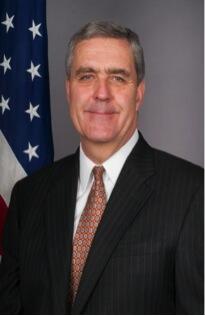
Image
Douglas Lute, Ambassador of the United States to NATO


In August 2013, Douglas E. Lute was sworn-in as the Ambassador of the United States to the North Atlantic Treaty Organization (NATO).  From 2007 to 2013, Lute served at the White House under Presidents Bush and Obama, first as the Assistant to the President and Deputy National Security Advisor for Iraq and Afghanistan, and more recently as the Deputy Assistant to the President focusing on Afghanistan, Pakistan and India.  In 2010, AMB Lute retired from the U.S. Army as a Lieutenant General after 35 years on active duty.  Prior to the White House, he served as the Director of Operations on the Joint Staff, overseeing U.S. military operations worldwide. He served multiple tours in NATO commands including duty in Germany during the Cold War and commanding U.S. forces in Kosovo.  He holds degrees from the United States Military Academy and Harvard University.

A light lunch will be provided.  Please plan to arrive by 11:30am to allow time to check in at the registration desk, pick up your lunch and be seated by 12:00 noon.

Co-sponsored by The Europe Center, the Freeman Spogli Institute for International Studies, the Center for International Security and Cooperation and the Center for Russian, East European and Eurasian Studies.


Douglas Lute United States Ambassador to NATO Speaker
Lectures
-

Abstract: What explains why the United States abandoned nuclear sharing schemes like the Multilateral Force in the 1960s, ultimately adopting a universalistic nonproliferation policy and the NPT? This paper argues that increased fears of nuclear domino effects caused by the 1964 Chinese nuclear tests were a crucial motivating factor, convincing policymakers that proliferation could not be contained to allied states and therefore had to be opposed across the board. As evidence for this claim, I draw heavily on archival evidence from the Eisenhower, Kennedy, and Johnson administrations. The paper demonstrates that when nuclear domino effects were perceived to be relatively weak in the 1950s and early 1960s, the United States favored expanding nuclear sharing arrangements; when fears of nuclear domino effects increased post-1964, this caused policymakers to turn away from these policies and conclude the NPT.

About the Speaker: Nicholas Miller is an assistant professor in the Department of Political Science and Watson Institute for International Studies at Brown University. His research focuses primarily on the causes and consequences of nuclear proliferation. He is currently working on a book manuscript that combines archival sources and quantitative analysis to examine the historical development and efficacy of U.S. nonproliferation policy. His work has been published in the American Political Science Review, International Organization, the Journal of Conflict Resolution, and Security Studies. He received his PhD in Political Science from MIT in 2014.


Nuclear Dominoes, US Nonproliferation Policy, and the NPT
Download pdf
Nuclear Dominoes, US Nonproliferation Policy, and the NPT
Download pdf

Encina Hall (2nd floor)

Nicholas Miller Assistant Professor in the Department of Political Science and Watson Institute for International Studies Speaker Brown University
Seminars
-

Abstract: Imagine two guys. Second-generation Muslim-American Ahmad feels threatened by the ‘corrupting influences’ within his suburban factory town, detests his mother’s ‘western’ ways, and seeks out a radical imam for guidance. In contrast, Palestinian-born Mike worked as an Intel engineer, married an American Christian, and played company softball in his spare time. If only one is a terrorist, it is easy to pick out which one. Right? Wrong. Maher “Mike” Hawash served a six-year sentence for conspiring to aid the Taliban. Ahmad Mulloy is the fictional protagonist of John Updike’s novel, Terrorist.

It is easy to assume that terrorists are poorly integrated or disconnected from society. But this talk argues that such assumptions about the ‘typical terrorist’ are not only wrong, but dangerous. I argue that better immigrant integration will not stop terrorism – because most terrorists are just as well, if not better, integrated into western societies than other immigrants. Further, policies that exacerbate differences between immigrants and the native-born actually may facilitate radicalization of new terrorists; they provide new fuel for the argument that immigrants, and especially Muslims, are being disproportionately targeted.

About the Speaker: Betsy Cooper is a Law and International Security Postdoctoral Fellow with CISAC, working on projects related to state immigration policy. Dr. Cooper recently finished serving as a Yale Public Interest Fellow, working with the Department of Homeland Security's Office of Policy on Comprehensive Immigration Reform and related issues. She is a 2012 graduate of Yale Law School, after which she clerked for Judge William Fletcher on the Ninth Circuit Court of Appeals. Dr. Cooper is the author of over twenty manuscripts and articles on US and European immigration and refugee policy, and has consulted for Atlantic Philanthropies (Dublin, Ireland), the Prime Minister's Strategy Unit in London, the World Bank, and a number of immigration think tanks. In addition to her law degree, Betsy holds a DPhil in Politics from Oxford University, an M.Sc. in Forced Migration from Oxford University, and a B.A. in Industrial and Labor Relations from Cornell University.

Encina Hall (2nd floor)

0
Affiliate
betsy_cooper_headshot.png

Betsy Cooper is the founding Director of the Aspen Policy Academy. A cybersecurity expert, Dr. Cooper joined the Aspen Institute after serving as the Executive Director of the Berkeley Center for Long-Term Cybersecurity at the University of California, Berkeley. 

Previously, Dr. Cooper served at the U.S. Department of Homeland Security as an attorney advisor to the Deputy General Counsel and as a policy counselor in the Office of Policy. She has worked for over a decade in homeland security consulting, managing projects for Atlantic Philanthropies in Dublin, the Prime Minister’s Strategy Unit in London, and the World Bank, and other organizations. 

In addition, Dr. Cooper has clerked for Berkeley Law professor and Judge William Fletcher on the Ninth Circuit Court of Appeals. She completed a postdoctoral fellowship at Stanford’s Center for International Security and Cooperation (where she currently is a nonresident affiliate), as well as a Yale Public Interest Fellowship. Dr. Cooper has written more than twenty manuscripts and articles on U.S. and European homeland security policy. She is also a Senior Advisor at Albright Stonebridge Group. 

Dr. Cooper earned a J.D. from Yale University, a D.Phil. in Politics from Oxford University, an M.Sc. in Forced Migration from Oxford University, and a B.A. in Industrial and Labor Relations from Cornell University. She speaks advanced French. She is based in the San Francisco Bay Area.

Date Label
Betsy Cooper Law and International Security Postdoctoral Fellow, CISAC Speaker CISAC
Seminars
-

Abstract: The development and maintenance of a nuclear weapons arsenal is primarily about managing risk trade-offs. However, there is no integrated method for performing the high-level risk analysis that would allow for the more explicit examination of those trade-offs, or the testing of assumptions and alternatives. Quantitative risk analytic methods can provide powerful insights to policy and decision makers by explicitly examining estimates of consequences, disparate uncertainties, interdependencies, and trade-offs. Even the initial process of framing a formal risk analysis can provide increased clarity and valuable insights. I will present the current status of my efforts to construct a first version of a quantitative risk analytic method and the associated models. I will also discuss some of the challenges that must be addressed to fully implement those models, and my plans for further development. 

About the Speaker: Jason C. Reinhardt is a national security systems analyst, and is currently pursuing a Ph.D. in Risk Analysis from Stanford University’s Department of Management Science and Engineering Engineering Risk Research Group, focusing on nuclear weapons arsenal management. Specifically, he is developing quantitative risk models to examine the trade-offs faced by nuclear armed nations in the process of disarmament. He is also pursuing research aimed at modeling and quantifying the catastrophic risks posed by near earth asteroid encounters. Other research interests include game theoretic applications to risk analysis and management, as well as adversary models. While at CISAC, he hopes to engage subject matter and policy experts to strengthen his modeling and analysis of nuclear weapon arsenal risk.

Prior to beginning his current studies, Jason managed a group of experts at Sandia National Laboratories that focused on technical studies to guide policy and decision makers across government. He joined Sandia National Laboratories in August of 2002, and has worked on a diverse set of projects both as an engineer and as an analyst, including the development of instrumentation for in-situ atmospheric measurement, embedded systems design, borders security analyses, and nuclear counter-terrorism strategy development.

He has worked extensively with the Department of Homeland Security on nuclear matters, and has also worked with the Department of Energy, the Department of Defense, the intelligence community, and within the national laboratory enterprise on a diverse array of national security projects. He has participated in the planning and hosting of international conferences and engagements, briefed congressional representatives, and served as a subject-matter expert on the topics of border security and nuclear and radiological defense.

Jason holds a B.S. in Electrical Engineering from the Purdue School of Electrical Engineering at Indianapolis, and a M.S. in Electrical Engineering from Stanford University.


Encina Hall (2nd floor)

0
Affiliate
jasonreinhardtoriginal.jpg

Jason C. Reinhardt is a national security systems analyst, and is currently pursuing a Ph.D. in Risk Analysis from Stanford University’s Department of Management Science and Engineering Engineering Risk Research Group, focusing on nuclear weapons arsenal management. Specifically, he is developing quantitative risk models to examine the trade-offs faced by nuclear armed nations in the process of disarmament. He is also pursuing research aimed at modeling and quantifying the catastrophic risks posed by near earth asteroid encounters. Other research interests include game theoretic applications to risk analysis and management, as well as adversary models. While at CISAC, he hopes to engage subject matter and policy experts to strengthen his modeling and analysis of nuclear weapon arsenal risk.

Prior to beginning his current studies, Jason managed a group of experts at Sandia National Laboratories that focused on technical studies to guide policy and decision makers across government. He joined Sandia National Laboratories in August of 2002, and has worked on a diverse set of projects both as an engineer and as an analyst, including the development of instrumentation for in-situ atmospheric measurement, embedded systems design, borders security analyses, and nuclear counter-terrorism strategy development.

He has worked extensively with the Department of Homeland Security on nuclear matters, and has also worked with the Department of Energy, the Department of Defense, the intelligence community, and within the national laboratory enterprise on a diverse array of national security projects. He has participated in the planning and hosting of international conferences and engagements, briefed congressional representatives, and served as a subject-matter expert on the topics of border security and nuclear and radiological defense.

Jason holds a B.S. in Electrical Engineering from the Purdue School of Electrical Engineering at Indianapolis, and a M.S. in Electrical Engineering from Stanford University.

Jason Reinhardt MacArthur Nuclear Security Predoctoral Fellow Speaker CISAC
Seminars
-

Abstract: With the development of cyber capabilities by an increasing number of states, policymakers as well as scholars have been calling for the negotiation of a new international treaty to regulate cyber warfare. This paper provides an account and analysis of relevant debates in the United Nations with a focus on the position of four states – Russia, China, the US and the UK. Discussions have been concentrated in the First Committee of the General Assembly which has been seized with the issue since 1998 when the Russian Federation submitted a proposal for an international convention to govern the use of information and communication technologies for military purposes. While these efforts towards a wholesale international treaty have not materialized, Russia and China continue to advocate a change in the legal status through the promulgation of additional norms. In contrast, the US and the UK have been firm supporters of applying current legal regimes, including the UN Charter and the Geneva Conventions, to the use of cyber capabilities by states. In advancing these positions, two powerful narratives have emerged each emphasizing different aspects of the cybersecurity debate.


About the Speaker: Elaine Korzak is a postdoctoral cybersecurity fellow at CISAC. She earned her Ph.D from the Department of War Studies at King´s College London in 2014. Her thesis examined the applicability and adequacy of international legal frameworks to the emerging phenomenon of cyber attacks. Her analysis focused on two legal areas in particular: international law on the use of force and international humanitarian law. Elaine holds both an MA in International Peace and Security from King´s College London and an LL.M in Public International Law from the LSE. Her professional experience includes various governmental and non-governmental institutions, including NATO´s Cyber Defence Section as well as the European Commission´s Directorate-General on Information Society and Media.


Encina Hall (2nd floor)

0
Affiliate
elaine_korzak.jpg

Elaine Korzak is a research scholar at the Berkeley Risk and Security Lab (BRSL) at UC Berkeley where she focuses on international cybersecurity governance. She is also an affiliate at the Center for Long-Term Cybersecurity (CLTC) at UC Berkeley and the Center for International Security and Cooperation (CISAC) at Stanford University.

Her research covers international legal, policy, and governance aspects in cybersecurity, including norms and international law governing state conduct in cyberspace, cybersecurity negotiations at the United Nations, and the international regulation of commercial spyware. Her work has appeared in the Oxford Handbook of Cyber Security, the Routledge Handbook of International Cybersecurity, the Georgetown Journal of International Affairs, the Bulletin of the Atomic Scientists, and RUSI Journal.

Previously, Elaine was a cybersecurity postdoctoral fellow at the Center for International Security and Cooperation (CISAC) and a national fellow at the Hoover Institution, both at Stanford University, before leading the Cyber Initiative at the Middlebury Institute of International Studies at Monterey (MIIS). She holds a PhD in War Studies and an MA in International Peace and Security from King’s College London, as well as an LL.M. in Public International Law from the London School of Economics and Political Science (LSE).


Date Label
Elaine Korzak Cybersecurity Fellow Speaker CISAC
Seminars
-

Due to the combination of a great response and our space constraints, this event is now full. We regret that we cannot accept any more RSVPs.

Lunch and seating are reserved for our registered guests.


Abstract: On April 5, 2009, President Obama stated his intent to seek "...the peace and security of a world without nuclear weapons". He is not the first US President to state such a desire (President Reagan, among others), and he acknowledged that the goal "will not be reached quickly--perhaps not in my lifetime". President Obama proposed reducing the number and role of nuclear weapons in US national security strategy as key steps toward achieving this goal.

While such a world is appealing, nuclear weapons remain woven into the fabric of US national security strategy as the ultimate guarantor of US and Allied security. Originally constructed by the US to end a war, the unique physical and psychological power of nuclear weapons rapidly made them a political tool to prevent or constrain conflict in the ensuing decades of the Cold War. United States foreign policy was underpinned by deterrence and assurance concepts that were both based on nuclear weapons and that defined their primary roles.

To be sure, the strategic context for nuclear weapons has changed since the end of the Cold War and the threat of sudden massive nuclear attack has receded. Significant reductions have been made to the deployed US nuclear force, the weapon stockpile, and the very specialized industrial base that supports it. Modifications have been made to employment concepts. New concepts of tailored deterrence have emerged that include highly capable US conventional forces, limited missile defenses, and space and cyberspace capabilities. 

But nuclear weapons continue to influence the security relationships and behaviors between major nations, and the primary deterrence and assurance role of US nuclear weapons remains at the foundation of US national security. Recent global events remind us that other nations continue to value the influence their nuclear weapons provide and, absent a viable replacement, US nuclear weapons will be needed for a very long time to come. Sustaining a safe, secure, and effective nuclear deterrent will be a challenge that has to be met.   


About the Speaker: General C. Robert "Bob" Kehler is the 2014-2015 Lee Lecturer at CISAC.

Prior to his retirement in December 2013, he was the Commander of United States Strategic Command at Offutt Air Force Base, Nebraska.  In that role he was directly responsible to the Secretary of Defense and President for the plans and operations of all U. S. forces conducting global strategic deterrence, nuclear alert, global strike, space, cyberspace and associated operations.  While in command, he crafted and implemented critical elements of policies and plans to deter strategic attacks against the U.S. and its key allies, and led a joint team of over 60,000 military and civilians to 100% mission success in multiple, high-stakes global operations.  He also integrated Department of Defense (DOD) activities for global missile defense, combating weapons of mass destruction, and intelligence, surveillance, and reconnaissance.  His forces directly supported combat operations in Southwest Asia and North Africa.

General Kehler’s military career spanned almost 39 years of service that included important operational and staff assignments.  He was one of a very few officers to command at the squadron, group, wing, major command, and combatant command levels, and he had a broad range of operational experience in Intercontinental Ballistic Missile (ICBM), space launch, space control, space surveillance and missile warning units.  Before taking command of Strategic Command, General Kehler commanded Air Force Space Command where he organized, trained, and equipped over 46,000 professionals conducting mission-ready nuclear missile, space, and cyberspace operations.  In that role, he designed the Air Force’s inaugural blueprint, operating concept, organizational structure, and personnel program to meet rapidly growing cyberspace challenges. 

His staff assignments included tours with the Air Staff, Strategic Air Command, Air Force Space Command, and the Joint Staff.  He was also assigned to the Secretary of the Air Force’s Office of Legislative Liaison where he was the point man on Capitol Hill for matters regarding the President’s ICBM Modernization Program.  As Director of the National Security Space Office, General Kehler integrated the activities of a number of DOD and Intelligence Community organizations on behalf of the Undersecretary of the Air Force and Director, National Reconnaissance Office. 

He entered the Air Force in 1975 as a Distinguished Graduate of the Pennsylvania State University R.O.T.C. program, has master’s degrees from the University of Oklahoma in Public Administration and the Naval War College in National Security and Strategic Studies, and completed executive level programs at Carnegie-Mellon University, Syracuse University, and Harvard University.

General Kehler’s military awards include the Defense Distinguished and Superior Service Medals, the Distinguished Service Medal (2 awards), Legion of Merit (3 awards), and the French Legion of Honor (Officer).  He wears Command Space and ICBM Operations Badges.  His other honors include the Thomas D. White Space Award (recognizing outstanding contributions to space) and the H. H. Arnold Award (for the most significant contribution by a military member for national defense), both presented by the Air Force Association. 

General Kehler serves as a Trustee of the Mitre Corporation, is on the Board of Directors of the Inmarsat Corporation, and is Chairman of the Board of BEI Precision Systems and Space Company.  He is a Distinguished Alumnus of the Pennsylvania State University, where he also serves as a member of the Advisory Board for Outreach and Online Education.  A Senior Fellow of the National Defense University and an Associate Fellow of the American Institute of Aeronautics and Astronautics, he has testified before numerous Congressional Committees and has spoken widely on matters of national security.  His articles have appeared in The Naval War College Review and Joint Forces Quarterly.  Time permitting; he enjoys playing the guitar, golf, and target shooting.

Encina Hall (2nd floor)

0
Affiliate
robert_kehler.png

*Please contact Tracy Hines (tmhines23@stanford.edu) for any inquires regarding General Kehler.

Prior to his retirement on January 1, 2014, General Kehler was the Commander of United States Strategic Command at Offutt Air Force Base, Nebraska.  In that role he was directly responsible to the Secretary of Defense and President for the plans and operations of all U. S. forces conducting global strategic deterrence, nuclear alert, global strike, space, cyberspace and associated operations.  While in command, he crafted and implemented critical elements of policies and plans to deter strategic attacks against the U.S. and its key allies and led a joint team of military members and civilians to 100% mission success in multiple, high-stakes global operations.  He also integrated Department of Defense (DOD) activities for global missile defense, combating weapons of mass destruction, and intelligence, surveillance, and reconnaissance.  His forces directly supported combat operations in Southwest Asia and North Africa.

General Kehler’s military career spanned almost thirty-nine years of service that included progressively important operational and staff assignments.  He commanded units at the squadron, group, wing, major command, and combatant command levels, and had a broad range of operational experience in Intercontinental Ballistic Missiles, space launch, space control, space surveillance and missile warning.  Before taking command of Strategic Command, General Kehler commanded Air Force Space Command (predecessor to U.S. Space Force) where he organized, trained, and equipped airmen conducting mission-ready nuclear missile, space, and cyberspace operations.  His command designed the Air Force’s inaugural blueprint, operating concept, organizational structure, and personnel program to meet emerging cyberspace challenges. 

His staff assignments included tours with the Air Staff, Strategic Air Command, Air Force Space Command, and the Joint Staff.  He was also assigned to the Secretary of the Air Force’s Office of Legislative Liaison where he was the point man on Capitol Hill for matters regarding the President’s ICBM Modernization Program.  As Director of the National Security Space Office, General Kehler integrated the activities of a number of DOD and Intelligence Community organizations on behalf of the Undersecretary of the Air Force and Director, National Reconnaissance Office. 

General Kehler entered the Air Force in 1975 as a Distinguished Graduate of the Pennsylvania State University R.O.T.C. program, has master’s degrees from the University of Oklahoma in Public Administration and the Naval War College in National Security and Strategic Studies, and completed executive level programs at Carnegie-Mellon University, Syracuse University, and Harvard University.

Since his retirement, General Kehler has continued to apply his expertise as a consultant, corporate director and trustee, and senior advisor and fellow to a number of prominent public, private, and educational institutions. He writes and speaks on matters of national security. Bob and his late wife have two adult sons and two grandsons. Time permitting, he enjoys playing the guitar and golf.

General C. Robert Kehler USAF (ret.), Lee Lecturer Speaker
Seminars
-

Is Europe "elderly and haggard", and could France become "the crucible of  Europe" (Jan. 10, 2015 NYTimes op-ed)?

On the one hand, Europe is warned by the US about an Asian "pivot", and is perceived here as less relevant and effective. Significantly, certainly as a wake up call, Pope Francis recently compared Europe to  a "grandmother, no longer fertile and vibrant, increasingly a bystander in a world that has apparently become less and less Eurocentric”. France had been previously presented here as an eminent representative of an "Old Europe".

On the other hand,  the US has been constantly, during the last decade, advocating for a stronger Europe  and stressing a special French role in this endeavour. A few days ago, after the terrorist attacks in Paris, President Obama publicly stated that "France was the US oldest Ally". 

At a time when we have to face common challenges in the Middle East and in Africa, to adapt to new emerged actors and a more assertive Russia, to deal with direct threats including in the field of proliferation and the cyber space, to define a multipolar world and organize our economic relation (TTIP), what can be the EU contribution? What can also be a special intellectual and diplomatic French input to this global realignment?

Co-sponsored by The Europe Center, the Center for International Security and Cooperation and the France-Stanford Center.

Image
Ambassador Eric Lebédel of France


Ambassador Eric Lebédel is a French diplomat, former ambassador to the OSCE and to Finland, with a deep experience in Transatlantic relationship (twice as Minister's advisor;  in the French embassy in Washington DC) and in European affairs. He is also involved in crisis management (PMs office), international security (embassy in Moscow, consul general in Istanbul) and multilateral diplomacy ( NATO's Director for crisis management, OSCE). Presently working on Strategic Partnerships for the French MFA and interested in e.diplomacy, he also regularly lectures  at Sciences-po and ENA (Ecole Nationale d'Administration) on crisis management and Europe.


Ambassador Eric Lebédel French Diplomat Speaker
Seminars
Authors
News Type
News
Date
Paragraphs


Suraya Omar first became intrigued by nuclear technology as a Stanford undergrad and CISAC honors student. Today she’s helping build nuclear engines for the U.S. Navy.

Omar’s fascination began in the popular MS&E course, Technology and National Security, taught by CISAC’s Siegfried Hecker and William J. Perry, the former head of the Los Alamos National Lab and U.S. secretary of state, respectively.

“I loved the class,” said Omar, who graduated with a BS in materials science and engineering in 2012 and a MS&E master’s degree in 2013. “The nuclear-related topics were interesting because it's a powerful technology and interesting from an engineering standpoint – but crazy complex from a safety and security perspective.”

Omar serves in the U.S. Navy as an engineer in the Naval Reactors Headquarters (NR) in Washington, D.C. The NR provides program management and technical expertise to the Navy Nuclear Propulsion Program, which builds nuclear propulsion plants for aircraft carriers and submarines. The NR oversees everything from their design to installment and operation.

Building nuclear engines, more than most things, requires stringent attention to minute details. That’s where Omar comes in.

“When the engineer responsible for an item receives a request for approval, they send that to all the sections that have a stake in that decision,” Omar said. “So my workday involves reading a lot of incoming proposals and background material, then asking questions, such as: `Is the recommended material appropriate for the application? Are there corrosion or structural concerns?’ and then discussing with other engineers and making recommendations.”

Omar says this also entails a lot of contact with the national nuclear laboratories to discuss upcoming and ongoing test programs “or get a more detailed technical perspective.”

The Naval Reactors Headquarters is one of the more prestigious components of the U.S. Navy, due to its polished reputation for implementing efficient management practices and maintaining a rigorous technical culture. Congress and presidential administrations often tap NR staffers for consultation and higher office; their skills and training also make NR engineers highly sought after by private enterprise.

Omar credits CISAC with inspiring her to follow a career in nuclear engineering. The prestigious honors program has taken Stanford seniors from more than 21 different majors and programs since its inception in 2000. More than 150 students have graduated from the yearlong program, which launches in Washington, D.C. with a two-week policy brainstorming college, and culminates with a thesis that deals with a major international security issue.


suraya graduation Suraya Omar during the CISAC Honors Graduation ceremony in June 2012.


Omar, who was advised by Hecker, wrote her thesis about “Critical Concerns: Evaluating the safety of North Korea’s new light water reactor.”

“Besides solidifying my interest in nuclear applications, participating in the CISAC thesis program helped me quickly recognize areas I don’t completely understand when doing research, and taught me how to be scrupulous in pursuing those questions thoroughly,” she said.

While she was completing her MS degree at Stanford, she joined the Nuclear Propulsion Officer Candidate Program and interviewed with NR in Washington, D.C. just after graduation. Today she holds the rank of Ensign (O-1), a junior commissioned officer in the United States Navy.

Omar is committed to Naval Reactors Headquarters until 2019 and enjoys being part of the community.

“Since so many big and small decisions come through NR, we deal with a lot of minutiae,” she said. “But it’s always encouraging to remember that our decisions have a direct impact on the fleet, and that it’s the diligent attention to detail that has ensured safe naval nuclear operations since the beginning of the program,” she said.

Nonetheless, she has her eye to the future.

“I may stay on after 2019, but I'm also interested in pursuing something in strategic diplomacy or nuclear security and safety on a more global level,” she said.


Joshua Alvarez was a CISAC Honors Student for the 2011-2012 academic year.

Hero Image
suraya nr portrait
CISAC Honors Alumna 2012 Suraya Omar in front of the U.S. Naval Reactors Headquarters in Washington, D.C., where she is a nuclear engineer.
Joshua Alvarez
All News button
1
News Type
Q&As
Date
Paragraphs

For 14 years, Mariano-Florentino Cuéllar has been a tireless Stanford professor who has strengthened the fabric of university’s interdisciplinary nature. Joining the faculty at Stanford Law School in 2001, Cuéllar soon found a second home for himself at the Freeman Spogli for International Studies. He held various leadership roles throughout the institute for several years – including serving as co-director of the Center for International Security and Cooperation. He took the helm of FSI as the institute’s director in 2013, and oversaw a tremendous expansion of faculty, research activity and student engagement. 

An expert in administrative law, criminal law, international law, and executive power and legislation, Cuéllar is now taking on a new role. He leaves Stanford this month to serve as justice of the California Supreme Court and will be succeeded at FSI by Michael McFaul on Jan. 5.

 As the academic quarter comes to a close, Cuéllar took some time to discuss his achievements at FSI and the institute’s role on campus. And his 2014 Annual Letter and Report can be read here.

You’ve had an active 20 months as FSI’s director. But what do you feel are your major accomplishments? 

We started with a superb faculty and made it even stronger. We hired six new faculty members in areas ranging from health and drug policy to nuclear security to governance. We also strengthened our capacity to generate rigorous research on key global issues, including nuclear security, global poverty, cybersecurity, and health policy. Second, we developed our focus on teaching and education. Our new International Policy Implementation Lab brings faculty and students together to work on applied projects, like reducing air pollution in Bangladesh, and improving opportunities for rural schoolchildren in China.  We renewed FSI's focus on the Ford Dorsey Program in International Policy Studies, adding faculty and fellowships, and launched a new Stanford Global Student Fellows program to give Stanford students global experiences through research opportunities.   Third, we bolstered FSI's core infrastructure to support research and education, by improving the Institute's financial position and moving forward with plans to enhance the Encina complex that houses FSI.

Finally, we forged strong partnerships with critical allies across campus. The Graduate School of Business is our partner on a campus-wide Global Development and Poverty Initiative supporting new research to mitigate global poverty.  We've also worked with the Law School and the School of Engineering to help launch the new Stanford Cyber Initiative with $15 million in funding from the Hewlett Foundation. We are engaging more faculty with new health policy working groups launched with the School of Medicine and an international and comparative education venture with the Graduate School of Education. 

Those partnerships speak very strongly to the interdisciplinary nature of Stanford and FSI. How do these relationships reflect FSI's goals?

The genius of Stanford has been its investment in interdisciplinary institutions. FSI is one of the largest. We should be judged not only by what we do within our four walls, but by what activity we catalyze and support across campus. With the business school, we've launched the initiative to support research on global poverty across the university. This is a part of the SEED initiative of the business school and it is very complementary to our priorities on researching and understanding global poverty and how to alleviate. It's brought together researchers from the business school, from FSI, from the medical school, and from the economics department.  

Another example would be our health policy working groups with the School of Medicine. Here, we're leveraging FSI’s Center for Health Policy, which is a great joint venture and allows us to convene people who are interested in the implementation of healthcare reforms and compare the perspective and on why lifesaving interventions are not implemented in developing countries and how we can better manage biosecurity risks. These working groups are a forum for people to understand each other's research agendas, to collaborate on seeking funding and to engage students. 

I could tell a similar story about our Mexico Initiative.  We organize these groups so that they cut across generations of scholars so that they engage people who are experienced researchers but also new fellows, who are developing their own agenda for their careers. Sometimes it takes resources, sometimes it takes the engagement of people, but often what we've found at FSI is that by working together with some of our partners across the university, we have a more lasting impact.

Looking at a growing spectrum of global challenges, where would you like to see FSI increase its attention? 

FSI's faculty, students, staff, and space represent a unique resource to engage Stanford in taking on challenges like global hunger, infectious disease, forced migration, and weak institutions.  The  key breakthrough for FSI has been growing from its roots in international relations, geopolitics, and security to focusing on shared global challenges, of which four are at the core of our work: security, governance, international development, and  health. 

These issues cross borders. They are not the concern of any one country. 

Geopolitics remain important to the institute, and some critical and important work is going on at the Center for International Security and Cooperation to help us manage the threat of nuclear proliferation, for example. But even nuclear proliferation is an example of how the transnational issues cut across the international divide. Norms about law, the capacity of transnational criminal networks, smuggling rings, the use of information technology, cybersecurity threats – all of these factors can affect even a traditional geopolitical issue like nuclear proliferation. 

So I can see a research and education agenda focused on evolving transnational pressures that will affect humanity in years to come. How a child fares when she is growing up in Africa will depend at least as much on these shared global challenges involving hunger and poverty, health, security, the role of information technology and humanity as they will on traditional relations between governments, for instance. 

What are some concrete achievements that demonstrate how FSI has helped create an environment for policy decisions to be better understood and implemented?

We forged a productive collaboration with the U.N. High Commissioner for Refugees through a project on refugee settlements that convened architects, Stanford researchers, students and experienced humanitarian responders to improve the design of settlements that house refugees and are supposed to meet their human needs. That is now an ongoing effort at the UN Refugee Agency, which has also benefited from collaboration with us on data visualization and internship for Stanford students. 

Our faculty and fellows continue the Institute's longstanding research to improve security and educate policymakers. We sometimes play a role in Track II diplomacy on sensitive issues involving global security – including in South Asia and Northeast Asia.  Together with Hoover, We convened a first-ever cyber bootcamp to help legislative staff understand the Internet and its vulnerabilities. We have researchers who are in regular contact with policymakers working on understanding how governance failures can affect the world's ability to meet pressing health challenges, including infectious diseases, such as Ebola.

On issues of economic policy and development, our faculty convened a summit of Japanese prefectural officials work with the private sector to understand strategies to develop the Japanese economy.  

And we continued educating the next generation of leaders on global issues through the Draper Hills summer fellows program and our honors programs in security and in democracy and the rule of law. 

How do you see FSI’s role as one of Stanford’s independent laboratories?

It's important to recognize that FSI's growth comes at particularly interesting time in the history of higher education – where universities are under pressure, where the question of how best to advance human knowledge is a very hotly debated question, where universities are diverging from each other in some ways and where we all have to ask ourselves how best to be faithful to our mission but to innovate. And in that respect, FSI is a laboratory. It is an experimental venture that can help us to understand how a university like Stanford can organize itself to advance the mission of many units, that's the partnership point, but to do so in a somewhat different way with a deep engagement to practicality and to the current challenges facing the world without abandoning a similarly deep commitment to theory, empirical investigation, and rigorous scholarship.

What have you learned from your time at Stanford and as director of FSI that will inform and influence how you approach your role on the state’s highest court?

Universities play an essential role in human wellbeing because they help us advance knowledge and prepare leaders for a difficult world. To do this, universities need to be islands of integrity, they need to be engaged enough with the outside world to understand it but removed enough from it to keep to the special rules that are necessary to advance the university's mission. 

Some of these challenges are also reflected in the role of courts. They also need to be islands of integrity in a tumultuous world, and they require fidelity to high standards to protect the rights of the public and to implement laws fairly and equally.  

This takes constant vigilance, commitment to principle, and a practical understanding of how the world works. It takes a combination of humility and determination. It requires listening carefully, it requires being decisive and it requires understanding that when it's part of a journey that allows for discovery but also requires deep understanding of the past.

Hero Image
tino mug
All News button
1
Authors
News Type
News
Date
Paragraphs

The rise of China as a global and regional power has created areas where the interests of China and the United States overlap in competition, the senior U.S. military commander in the Pacific told a Stanford audience. But Admiral Samuel Locklear III, the commander of U.S. Pacific Command (USPACOM), rejected the traditional realpolitik argument, which predicts inevitable confrontation between the United States, a status quo power, and China, a rising power.

“Historians will say this will lead to conflict,” Locklear said, during an address at the Walter H. Shorenstein Asia-Pacific Research Center last Friday. “I don’t believe it has to.”

The United States and China have a “mutual skepticism of each other,” the Pacific Commander acknowledged, but he characterized the relationship as “collaborative, generally.”

He said the dangers of direct military confrontation between the two powers is low, but warned against Chinese tendencies to perceive the United States as engaged in an effort to ‘contain’ the expansion of China’s influence. Instead, Locklear urged China to work with the United States to build new security and economic structures in the region.

Economic interdependence between the countries makes it impossible for the two countries to avoid working together, he told the seminar, co-sponsored by the Center for International Security and Cooperation and the Freeman Spogli Institute for International Studies at Stanford University.

He said that China has also benefited from the security environment that the United States has helped shape and maintain in the region.

Locklear reminded the audience of the central importance of the vast area under his command, which stretches from the Indian subcontinent across the vast Pacific Ocean. More than nine out of 10 of the largest ports in the world are in the Asia-Pacific region, and over 70 percent of global trade passes through its waters. The U.S. rebalance to Asia, a policy pursued by the Obama administration as early as year 2009, largely happened because of the economic and political importance of that area.

The mutual interest in economic prosperity depends, however, on a stable security environment. Washington has an interest in maintaining the structure of security that has ensured peace for the last few decades. Beijing seeks to change the status quo, to build a regional system that reflects its growth as a power.

Locklear called on China to work with the United States and other nations in the region, such as Japan and Australia, as well as the countries of Southeast Asia, to take the current “patchwork quilt” of bilateral and multilateral alliances and build a basis to maintain economic interdependence and security. He pointed to the U.S.-led effort to form a Trans-Pacific Partnership as a 12-nation economic structure, which could eventually include China.

“We want China to be a net security contributor,” he said, “And my sense is that both the United States and the nations on the periphery of China are willing to allow China to do that – but with circumstances.” He said conditions for the United States included open access to shared domains in sea, air, space and cyberspace.

The Pacific Commander cautioned against the danger, however, of unintended conflict, fueled by territorial disputes and Chinese assertiveness that worries its neighbors. Locklear stressed the need for more dialogue, including among the militaries in the region, an effort that the U.S. Pacific Command is currently carrying out.

“There’s a trust deficit in Asia among the nations, as it relates in particular to China,” he said.

Relations have been so icy that the top political leaders of Japan and China didn’t meet for nearly two years, only breaking the divide for a 20-minute meeting at the Asia-Pacific Economic Summit (APEC) in Beijing last month.

Refusing to engage at the highest level has made it difficult for countries to work on solutions to shared problems. The region now sees a confluence of old and new challenges that could threaten global stability if ill-managed, said Locklear, who has led the U.S. military command in the Pacific since 2012.                 

For decades, China and Japan have been at odds about sovereignty claims over islands in the East China Sea. In the past, during the time of Deng Xiaoping’s rule in China, the two countries agreed to, as Deng reportedly put it, ‘kick the issue into the tall grass’ for future generations to deal with it. These disputes have resurfaced in recent years, threatening to trigger armed conflict between the air and naval forces of the two countries.

Locklear said he believed that China and Japan would avoid inadvertent escalation, thanks to improved communications and tight command and control over their forces. But he also warned  that at least seven nations have conflicting claims in the South China Sea, which could easily escalate into direct conflict.

These situations, paired with an upsurge in Chinese military spending and the growing belief that the United States is a declining power, raise doubts about China’s intentions in the region. China’s Asian neighbors increasingly question the intensions of the world’s most populous nation, and second largest economy.

“Is it a return to the old days where you had basic tributary states? Is that the model that China is looking for? Or is it a 21st century model?”

Locklear said China and other nations in the Asia-Pacific, as well as the United States, need to work harder to form shared views and consensus, particularly among those who “own the guns.”

Dialogue and interactions among the militaries are crucial, especially those who are called upon to make quick decisions during a possible flashpoint, for instance an accidental clash of boats or planes.

“Trust really does fall in many ways to military leaders to get it right and to lead, to some degree, the politicians and the diplomats,” he said. Locklear spoke of a tangible example of collaboration in the Rim of the Pacific Exercise, also known as RIMPAC, hosted by USPACOM. Twenty-two countries participate in the world’s largest maritime warfare exercise in Hawaii, which this year included naval forces from China.

“Does it fix those friction points? No, it doesn’t.” But, Locklear concluded, “We hope that this kind of thing opens the door for future interaction.”


The audio file and transcript from the event can be accessed by clicking here

Hero Image
locklear news article headline
Admiral Samuel Locklear III spoke about the future of the Asia-Pacific region at Stanford University.
Debbie Warren
All News button
1
Subscribe to Institutions and Organizations