Space and U.S. national security are deeply entwined. The U.S. military is tremendously dependent upon satellites for intelligence gathering and for guiding military operations, and the most promising ballistic missile defense systems are space-based. Proponents of developing space-based military capabilities, including the Bush administration, maintain that this development is essential to protecting the American people and their interests. Opponents, however, argue that such development will lead to a space arms race with at least the Chinese, will hurt the U.S.’s global standing, and will actually make America less secure. What is the current state of the law- international treaties, in particular- in terms of U.S. obligations? Would a multilateral approach of demilitarizing space, including the acceptance of new legal obligations through additional international treaties, be a better way of protecting America’s interests?

The National Press Club
Washington, DC

Robert L. Pfaltzgraff, Jr. Institute of Foreign Policy Analysis Speaker
Robert F. Turner Center for National Security Law, University of Virginia School Speaker
0
Affiliate
lenweiss_rsd17_076_0373a.jpg

Leonard Weiss is a visiting scholar at Stanford University’s Center for International Security and Cooperation (CISAC). He is also a national advisory board member of the Center for Arms control and Non-Proliferation in Washington, DC. He began his professional career as a PhD researcher in mathematical system theory at the Research Institute for Advanced Studies in Baltimore. This was followed by tenured professorships in applied mathematics and electrical engineering at Brown University and the University of Maryland. During this period he published widely in the applied mathematics literature. In 1976 he received a Congressional Science Fellowship that resulted in a career change. For more than two decades he worked for Senator John Glenn as the staff director of both the Senate Subcommittee on Energy and Nuclear Proliferation and the Committee on Governmental Affairs. He was the chief architect of the Nuclear Nonproliferation Act of 1978 and legislation that created the Defense Nuclear Facilities Safety Board. In addition, he led notable investigations of the nuclear programs of India and Pakistan. Since retiring from the Senate staff in 1999, he has published numerous articles on nonproliferation issues for the Bulletin of Atomic Scientists, Arms Control Today, and the Nonproliferation Review. His current research interests include an assessment of the impact on the nonproliferation regime of nuclear trade with non-signers of the Nuclear Nonproliferation Treaty, and more generally the relationship of energy security concerns with nonproliferation.

For a comprehensive list of Dr. Weiss's publications, click here.
CV
Leonard Weiss Center for International Security and Cooperation, Stanford Speaker
Dean Reuter Director of Practice Groups, The Federalist Society Moderator
Conferences
-

The Stanford University Libraries is pleased to invite you to a book party to celebrate a new publication by Mariano-Florentino Cuéllar: "Governing Security: The Hidden Origins of American Security Agencies."

ABOUT THE BOOK: The impact of public law depends on how politicians secure control of public organizations, and how these organizations in turn are used to define national security. Governing Security explores this dynamic by investigating the surprising history of two major federal agencies that touch the lives of Americans every day: the Roosevelt-era Federal Security Agency (which became today's Department of Health and Human Services) and the more recently created Department of Homeland Security.Through the stories of both organizations, Cuéllar offers a compelling account of crucial developments affecting the basic architecture of our nation. He shows how Americans end up choosing security goals not through an elaborate technical process, but in lively and overlapping settings involving conflict over agency autonomy, presidential power, and priorities for domestic and international risk regulation. Ultimately, as Cuéllar shows, the ongoing fights about the scope of national security reshape the very structure of government, particularly during—or in anticipation of—a national crisis.

Green Library, Bing Wing, 5th floor, Bender Room

Mariano-Florentino Cuéllar Stanley Morrison Professor of Law at Stanford Law School; Co-Director of CISAC; FSI Senior Fellow; CDDRL Affiliated Faculty;FSE Affiliated Faculty Speaker
Conferences

A three-day conference in Pretoria, South Africa, to discuss the historical dimensions of South Africa's nuclear weapons program. CISAC was strongly represented at the event. Hosted by Monash University, Australia. 

The conference presentation, "The Vela Event of 1979 (Or The Israeli Nuclear Test of 1979)" by CISAC Affiliate Leonard Weiss, is available for download below. 

CISAC
Stanford University
Encina Hall, E214
Stanford, CA 94305-6165

(650) 723-1737 (650) 723-0089
0
Senior Fellow Emeritus at the Freeman Spogli Institute of International Studies
Raymond A. Spruance Professor of International History
0820stanford-davidholloway-238-edit.jpg PhD

David Holloway is the Raymond A. Spruance Professor of International History, a professor of political science, and an FSI senior fellow. He was co-director of CISAC from 1991 to 1997, and director of FSI from 1998 to 2003. His research focuses on the international history of nuclear weapons, on science and technology in the Soviet Union, and on the relationship between international history and international relations theory. His book Stalin and the Bomb: The Soviet Union and Atomic Energy, 1939-1956 (Yale University Press, 1994) was chosen by the New York Times Book Review as one of the 11 best books of 1994, and it won the Vucinich and Shulman prizes of the American Association for the Advancement of Slavic Studies. It has been translated into seven languages, most recently into Chinese. The Chinese translation is due to be published later in 2018. Holloway also wrote The Soviet Union and the Arms Race (1983) and co-authored The Reagan Strategic Defense Initiative: Technical, Political and Arms Control Assessment (1984). He has contributed to the Bulletin of the Atomic Scientists, Foreign Affairs, and other scholarly journals.

Since joining the Stanford faculty in 1986 -- first as a professor of political science and later (in 1996) as a professor of history as well -- Holloway has served as chair and co-chair of the International Relations Program (1989-1991), and as associate dean in the School of Humanities and Sciences (1997-1998). Before coming to Stanford, he taught at the University of Lancaster (1967-1970) and the University of Edinburgh (1970-1986). Born in Dublin, Ireland, he received his undergraduate degree in modern languages and literature, and his PhD in social and political sciences, both from Cambridge University.

Faculty member at the Center for International Security and Cooperation
Affiliated faculty at the Center on Democracy, Development, and the Rule of Law
Affiliated faculty at The Europe Center
CV
Date Label
David Holloway Panelist
0
Affiliate
lenweiss_rsd17_076_0373a.jpg

Leonard Weiss is a visiting scholar at Stanford University’s Center for International Security and Cooperation (CISAC). He is also a national advisory board member of the Center for Arms control and Non-Proliferation in Washington, DC. He began his professional career as a PhD researcher in mathematical system theory at the Research Institute for Advanced Studies in Baltimore. This was followed by tenured professorships in applied mathematics and electrical engineering at Brown University and the University of Maryland. During this period he published widely in the applied mathematics literature. In 1976 he received a Congressional Science Fellowship that resulted in a career change. For more than two decades he worked for Senator John Glenn as the staff director of both the Senate Subcommittee on Energy and Nuclear Proliferation and the Committee on Governmental Affairs. He was the chief architect of the Nuclear Nonproliferation Act of 1978 and legislation that created the Defense Nuclear Facilities Safety Board. In addition, he led notable investigations of the nuclear programs of India and Pakistan. Since retiring from the Senate staff in 1999, he has published numerous articles on nonproliferation issues for the Bulletin of Atomic Scientists, Arms Control Today, and the Nonproliferation Review. His current research interests include an assessment of the impact on the nonproliferation regime of nuclear trade with non-signers of the Nuclear Nonproliferation Treaty, and more generally the relationship of energy security concerns with nonproliferation.

For a comprehensive list of Dr. Weiss's publications, click here.

CV
Leonard Weiss Panelist
0
Affiliate
Pabian,_Frank.jpg

Frank Pabian is a globally recognized expert in the fields of nuclear nonproliferation and satellite imagery intelligence analysis with one half century of professional experience, beginning with the CIA’s Office of Imagery Analysis, followed by employment at US and European National Nuclear Laboratories. During the period from 1996-98, Frank was a Nuclear Chief Inspector for the UN’s International Atomic Energy Agency (IAEA) during ground inspections in Iraq, focusing primarily on equipment/materials “Hide Sites” and “Capable Sites” potentially associated with weapons of mass destruction development and/or production. His Iraq Action Team’s efforts helped garner support for the IAEA and its Director General to be awarded the Nobel Peace Prize.

Frank is recipient of the US Intelligence Community’s highest  award for contractors, the Gold Seal Medallion, for “sustained superior performance” for Nuclear Non-Proliferation Treaty verification support to the IAEA during South Africa’s denuclearization, and for associated discoveries derived from original analysis of all-source information. He was also named a Los Alamos National Laboratory Fellow in 2013, having served as the senior geospatial open-source information analyst in both the Global Security Directorate and the Earth and Environmental Sciences Division to help solve key intelligence questions in a geospatial context until retirement in May 2017. During 2014-2016, served as a Senior Fellow Researcher during USG authorized overseas service at the Joint Research Centre in Ispra, Italy; and is continuing as an Affiliate at Stanford University's Center for International Security and Cooperation where, previously, Frank was a Research Fellow during the 2011-2012 academic year.
 

Although now fully retired, Frank remains a consultant to the CISAC IMINT Team and continues to lecture on new developments for Open Source Geospatial Intelligence.  Frank is a “Certified Mapping Scientist, Remote Sensing” with the American Society for Photogrammetry and Remote Sensing (ASP&RS) and an American Mensan.

Date Label
Frank Pabian Panelist
Conferences
-

CISAC Conference Room

Conferences
-


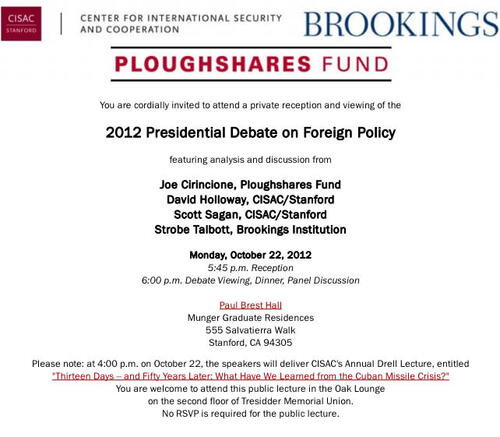
Please note: at 4:00 p.m. on October 22, the speakers will deliver CISAC's Annual Drell Lecture, entitled
"Thirteen Days -- and Fifty Years Later: What Have We Learned from the Cuban Missile Crisis?"

You are welcome to attend this public lecture in the Oak Lounge
on the second floor of Tresidder Memorial Union.
No RSVP is required for the public lecture.


Image

Paul Brest Hall
Munger Graduate Residences
555 Salvatierra Walk
Stanford, CA 94305

Conferences
-

Fifty years ago, the Soviet Union and the United States stood on the brink of nuclear war. For thirteen days in October 1962, people around the world held their breath and hoped for a peaceful resolution to the Cuban Missile Crisis. This distinguished panel will discuss and debate the crisis from the perspectives of Moscow and Washington, and consider what history has taught us since those thirteen days in 1962.


Drell Lecture Recording: NA


Drell Lecture Transcript: NA


Speaker's Biography: NA


Materials: 


Oak Lounge

CISAC
Stanford University
Encina Hall, E214
Stanford, CA 94305-6165

(650) 723-1737 (650) 723-0089
0
Senior Fellow Emeritus at the Freeman Spogli Institute of International Studies
Raymond A. Spruance Professor of International History
0820stanford-davidholloway-238-edit.jpg PhD

David Holloway is the Raymond A. Spruance Professor of International History, a professor of political science, and an FSI senior fellow. He was co-director of CISAC from 1991 to 1997, and director of FSI from 1998 to 2003. His research focuses on the international history of nuclear weapons, on science and technology in the Soviet Union, and on the relationship between international history and international relations theory. His book Stalin and the Bomb: The Soviet Union and Atomic Energy, 1939-1956 (Yale University Press, 1994) was chosen by the New York Times Book Review as one of the 11 best books of 1994, and it won the Vucinich and Shulman prizes of the American Association for the Advancement of Slavic Studies. It has been translated into seven languages, most recently into Chinese. The Chinese translation is due to be published later in 2018. Holloway also wrote The Soviet Union and the Arms Race (1983) and co-authored The Reagan Strategic Defense Initiative: Technical, Political and Arms Control Assessment (1984). He has contributed to the Bulletin of the Atomic Scientists, Foreign Affairs, and other scholarly journals.

Since joining the Stanford faculty in 1986 -- first as a professor of political science and later (in 1996) as a professor of history as well -- Holloway has served as chair and co-chair of the International Relations Program (1989-1991), and as associate dean in the School of Humanities and Sciences (1997-1998). Before coming to Stanford, he taught at the University of Lancaster (1967-1970) and the University of Edinburgh (1970-1986). Born in Dublin, Ireland, he received his undergraduate degree in modern languages and literature, and his PhD in social and political sciences, both from Cambridge University.

Faculty member at the Center for International Security and Cooperation
Affiliated faculty at the Center on Democracy, Development, and the Rule of Law
Affiliated faculty at The Europe Center
CV
Date Label
David Holloway CISAC, History, and Political Science, Stanford Speaker

CISAC
Stanford University
Encina Hall, E202
Stanford, CA 94305-6165

(650) 725-2715 (650) 723-0089
0
The Caroline S.G. Munro Professor of Political Science
The Bass University Fellow in Undergraduate Education  
Senior Fellow, Freeman Spogli Institute for International Studies
rsd25_073_1160a_1.jpg PhD

Scott D. Sagan is Co-Director and Senior Fellow at the Center for International Security and Cooperation, the Caroline S.G. Munro Professor of Political Science, and the Bass University Fellow in Undergraduate Education at Stanford University. He also serves as Co-Chair of the American Academy of Arts and Sciences’ Committee on International Security Studies. Before joining the Stanford faculty, Sagan was a lecturer in the Department of Government at Harvard University and served as special assistant to the director of the Organization of the Joint Chiefs of Staff in the Pentagon.

Sagan is the author of Moving Targets: Nuclear Strategy and National Security (Princeton University Press, 1989); The Limits of Safety: Organizations, Accidents, and Nuclear Weapons (Princeton University Press, 1993); and, with co-author Kenneth N. Waltz, The Spread of Nuclear Weapons: An Enduring Debate (W.W. Norton, 2012). He is the co-editor of Insider Threats (Cornell University Press, 2017) with Matthew Bunn; and co-editor of The Fragile Balance of Terror (Cornell University Press, 2022) with Vipin Narang. Sagan was also the guest editor of a two-volume special issue of DaedalusEthics, Technology, and War (Fall 2016) and The Changing Rules of War (Winter 2017).

Recent publications include “Creeds and Contestation: How US Nuclear and Legal Doctrine Influence Each Other,” with Janina Dill, in a special issue of Security Studies (December 2025); “Kettles of Hawks: Public Opinion on the Nuclear Taboo and Noncombatant Immunity in the United States, United Kingdom, France, and Israel”, with Janina Dill and Benjamin A. Valentino in Security Studies (February 2022); “The Rule of Law and the Role of Strategy in U.S. Nuclear Doctrine” with Allen S. Weiner in International Security (Spring 2021); “Does the Noncombatant Immunity Norm Have Stopping Power?” with Benjamin A. Valentino in International Security (Fall 2020); and “Just War and Unjust Soldiers: American Public Opinion on the Moral Equality of Combatants” and “On Reciprocity, Revenge, and Replication: A Rejoinder to Walzer, McMahan, and Keohane” with Benjamin A. Valentino in Ethics & International Affairs (Winter 2019).

In 2022, Sagan was awarded Thérèse Delpech Memorial Award from the Carnegie Endowment for International Peace at their International Nuclear Policy Conference. In 2017, he received the International Studies Association’s Susan Strange Award which recognizes the scholar whose “singular intellect, assertiveness, and insight most challenge conventional wisdom and intellectual and organizational complacency" in the international studies community. Sagan was also the recipient of the National Academy of Sciences William and Katherine Estes Award in 2015, for his work addressing the risks of nuclear weapons and the causes of nuclear proliferation. The award, which is granted triennially, recognizes “research in any field of cognitive or behavioral science that advances understanding of issues relating to the risk of nuclear war.” In 2013, Sagan received the International Studies Association's International Security Studies Section Distinguished Scholar Award. He has also won four teaching awards: Stanford’s 1998-99 Dean’s Award for Distinguished Teaching; Stanford's 1996 Hoagland Prize for Undergraduate Teaching; the International Studies Association’s 2008 Innovative Teaching Award; and the Monterey Institute for International Studies’ Nonproliferation Education Award in 2009.     

Co-director of the Center for International Security and Cooperation
CV
Date Label
Scott D. Sagan CISAC and Political Science, Stanford Speaker
Strobe Talbott President, Brookings Institution Speaker
Joe Cirincione President, Ploughshares Fund Moderator
Conferences
-

Special CISAC Seminar 

Stephen Craig

Recipient of The Firestone Medal for Excellence in Undergraduate Research 

Tamed Tiger or Restless Beast? German Foreign Policy in the Post-Unification Period


&


Clay Ramel

Recipient of The William J. Perry Prize 

Reconsidering the Roots of Crude Coercion: a Policymaking Analysis of “the Oil Weapon”

CISAC Conference Room

Stephen Craig Recipient of The Firestone Medal for Excellence in Undergraduate Research Speaker
Clay Ramel Recipient of The William J. Perry Prize Speaker
Conferences

On May 18-19, the Program on Poverty and Governance will host a two-day conference on the provision of public goods and good governance throughout the world. This conference, co-sponsored by the Center for Latin American Studies, will bring together an interdisciplinary group of economists, political scientists, policymakers, and public health researchers examining these questions. Public goods—goods and services such as education, healthcare, sanitation, potable water, and other benefits provided by the government—are intrinsically tied to issues of governance, which we broadly define as the exercise of political authority and the use of institutional resources to manage society’s problems and affairs. More specifically, factors such how political leaders get elected, the way in which government projects get funded, whether the community participates in decision-making, and the extent to which the distribution of government benefits is done through clientelistic networks, among others, play an important role in the quality and coverage of public goods that governments provide. Additionally, a critical question in large parts of the developing world relates to the role of international players and foreign aid in the provision of public goods –does external provision of public goods enable or hinder governmental capacity to deliver public services in poor communities? Through two days of presentations and panel discussions, the conference will explore how various facets of governance affect the provision of public goods and services throughout the world.

The conference will be held in Encina Hall at Stanford University May 18th and 19th, 2012. Guests are encouraged to RSVP by May 16th. Any questions may be addressed to the Program on Poverty and Governance program associate Elena Cryst.

Click Here for Papers

CISAC Conference Room

Dept. of Political Science
Encina Hall, Room 436
Stanford University,
Stanford, CA

(650) 724-5949
0
Senior Fellow at the Freeman Spogli Institute for International Studies
Graham H. Stuart Professor of International Relations
Professor of Political Science
beatriz_magaloni_2024.jpg MA, PhD

Beatriz Magaloni Magaloni is the Graham Stuart Professor of International Relations at the Department of Political Science. Magaloni is also a Senior Fellow at the Freeman Spogli Institute, where she holds affiliations with the Center on Democracy, Development and the Rule of Law (CDDRL) and the Center for International Security and Cooperation (CISAC). She is also a Stanford’s King Center for Global Development faculty affiliate. Magaloni has taught at Stanford University for over two decades.

She leads the Poverty, Violence, and Governance Lab (Povgov). Founded by Magaloni in 2010, Povgov is one of Stanford University’s leading impact-driven knowledge production laboratories in the social sciences. Under her leadership, Povgov has innovated and advanced a host of cutting-edge research agendas to reduce violence and poverty and promote peace, security, and human rights.

Magaloni’s work has contributed to the study of authoritarian politics, poverty alleviation, indigenous governance, and, more recently, violence, crime, security institutions, and human rights. Her first book, Voting for Autocracy: Hegemonic Party Survival and its Demise in Mexico (Cambridge University Press, 2006) is widely recognized as a seminal study in the field of comparative politics. It received the 2007 Leon Epstein Award for the Best Book published in the previous two years in the area of political parties and organizations, as well as the Best Book Award from the American Political Science Association’s Comparative Democratization Section. Her second book The Politics of Poverty Relief: Strategies of Vote Buying and Social Policies in Mexico (with Alberto Diaz-Cayeros and Federico Estevez) (Cambridge University Press, 2016) explores how politics shapes poverty alleviation.

Magaloni’s work was published in leading journals, including the American Political Science Review, American Journal of Political Science, Criminology & Public Policy, World Development, Comparative Political Studies, Annual Review of Political Science, Cambridge Journal of Evidence-Based Policing, Latin American Research Review, and others.

Magaloni received wide international acclaim for identifying innovative solutions for salient societal problems through impact-driven research. In 2023, she was named winner of the world-renowned Stockholm Prize in Criminology, considered an equivalent of the Nobel Prize in the field of criminology. The award recognized her extensive research on crime, policing, and human rights in Mexico and Brazil. Magaloni’s research production in this area was also recognized by the American Political Science Association, which named her recipient of the 2021 Heinz I. Eulau Award for the best article published in the American Political Science Review, the leading journal in the discipline.

She received her Ph.D. in political science from Duke University and holds a law degree from the Instituto Tecnológico Autónomo de México.

Director, Poverty, Violence, and Governance Lab
Co-director, Democracy Action Lab
CV
Date Label
Beatriz Magaloni Host
Conferences
Subscribe to Conferences