Authors
Oriana Skylar Mastro
News Type
Commentary
Date
Paragraphs

This essay was originally published in Foreign Affairs magazine.

As Russian President Vladimir Putin intensifies his assault on Ukraine, a growing number of U.S. military and foreign policy analysts are voicing concern that China may be emboldened by Russia’s example and try to take Taiwan by force. “If Russia can grab chunks of Ukraine or install a puppet regime and withstand economic sanctions, that could embolden nationalists in China to look to Taiwan and think they could do the same,” Ian Johnson, a China expert at the Council on Foreign Relations, has argued. Representative Michael McCaul, Republican of Texas, made a similar argument in an interview last month, as did retired Army General Jack Keane, who said that Chinese President Xi Jinping sees “weakness in the West and how that can advantage him in terms of his national objectives as well.”

Xi is certainly watching events in Ukraine, but his calculus for whether to use force against Taiwan is shaped primarily by domestic factors, not foreign ones. As I have argued in Foreign Affairs, Chinese leaders are considering “armed reunification” with Taiwan more seriously than at any time in the last 50 years. But Xi will assert Chinese control over the island only if he is confident his military can conduct a successful amphibious invasion and if he believes the timing is right for his own career.


Sign up for our newsletters to receive in-depth analysis from our experts.


Shifts in the international environment would be important for Taiwan if they changed Xi’s thinking on either count. But the war in Ukraine has not. Xi’s views about U.S. power and resolve and about the likely international response to an invasion of Taiwan probably remain unchanged. If anything, China’s desire not to invite comparisons with Russia at a time when the world is united against Moscow will lengthen its timeline for taking control of Taiwan, not shorten it.

Too Big to Sanction?

The economic sanctions that the United States, Canada, and many European countries have imposed on Russia give China little reason for pause. To the contrary, these punitive measures simply confirm Beijing’s previous assessments of the possible economic repercussions of using force against Taiwan. Chinese leaders expect the economic costs of an invasion to be heavy but acceptable—partly because of how the international community has responded to Chinese provocations in the past and partly because Beijing’s foreign policy is designed to convince countries to stay out of China’s “internal” affairs, such as the status of Taiwan.

That is not to say the economic measures Washington and its allies have imposed on Russia in recent days are insignificant. The United States and European countries have blocked Russia’s access to most of its foreign currency reserves, making it impossible for Moscow to intervene to prop up its collapsing currency. They have frozen the assets of senior Russian officials, including Putin himself. And they have moved to exclude big Russian banks from SWIFT, the global financial messaging system.

China’s ability to retaliate against the West with economic sanctions of its own is much greater than Russia’s.
Oriana Skylar Mastro

But the United States and its allies could do more to punish Russia. They could bar all transactions with Russia, whether trade or financial. They could seize all Russian assets within their jurisdictions. Washington could announce secondary sanctions on anyone using U.S. dollars for any transaction with Russia. Most important, the United States could use these and other measures to prevent Russia from exporting oil and gas. Letting Russia continue to export oil and gas would be like letting China sell consumer electronics even after it had taken Taiwan by force.

If the United States and its allies have been cautious in their response to Russia, they are likely to be even more restrained when responding to China — and Beijing knows it. China’s ability to retaliate against the West with economic sanctions of its own is much greater than Russia’s. Singapore, which announced trade and banking restrictions against Moscow, trades about $2.5 billion worth of goods with Russia each year — but $57 billion worth of goods with China. China’s leaders likely do not fear U.S.-led economic sanctions in the event of a Taiwan takeover because they probably think that China’s own productive capacity, resources, and friendly partners will allow them to survive on their own, especially since China will soon be the world’s largest economy. They are probably right. China could absorb the types of sanctions being imposed on Russia. And given China’s ability to inflict pain on Western countries, any measures levied against Beijing would likely be softer than those imposed on Moscow.

Taiwan Is Not Ukraine

The Western military response to Russia’s invasion of Ukraine will have an even smaller impact than sanctions on China’s thinking about Taiwan. True, neither the United States nor NATO has deployed troops to fight on Ukraine’s behalf. And U.S. military assistance to Ukraine has been modest: late last month, President Joe Biden instructed the State Department to release up to an additional $350 million worth of weapons from U.S. stocks to Ukraine.

But Russia would have to invade a NATO ally without provoking a U.S. military response for Chinese leaders to seriously question Washington’s commitment to defending Taiwan. Biden has made clear from the beginning of the crisis that his administration will never send troops to Ukraine—a stark contrast with his rhetoric on Taiwan. Just last week, Biden stated unequivocally that the United States would defend Taiwan in the event of a Chinese attack. As a show of support, he also sent to the island a delegation of former U.S. officials led by Mike Mullen, a former chairman of the Joint Chiefs of Staff.

Chinese planners largely assume the United States would intervene militarily on behalf of Taiwan.
Oriana Skylar Mastro

In any case, Chinese planners largely assume the United States would intervene militarily on behalf of Taiwan. What some of them question is whether the United States could amass enough forces fast enough to blunt a Chinese assault on the island. Ironically, if the United States had launched a military operation in response to Russia’s invasion of Ukraine, Chinese leaders would have had further reason to question Washington’s ability to thwart a Chinese assault on Taiwan. The United States does not have the resources to fight the Russians in Europe and prepare adequately for a great-power war in Asia.  

Of course, these facts have not prevented China from trying to manipulate the narrative to undermine Taiwan’s resolve. Chinese state media has been flush with stories about how the United States did not come to Ukraine’s aid and therefore won’t come to Taiwan’s either. Like much of what appears on Chinese state media, however, these stories reflect what Chinese leaders want the world to believe—not what they believe themselves.

Not the Right Time

Chinese leaders are without a doubt considering an attack on Taiwan, but now is not the right time. China’s military is still honing the capabilities it would need to take and hold the island. And Xi is unlikely to take a dangerous gamble on Taiwan before the next Party Congress in late 2022, when he is widely expected to secure a third term as general secretary of the Chinese Communist Party. Xi is also working hard to lessen China’s technological dependence on the West, thus minimizing the impact on any further decoupling after a possible war. For all these reasons, an assault on Taiwan before 2025 is unlikely.

If anything, the crisis in Ukraine creates an additional incentive for China to wait. Beijing does not want the world to equate the two scenarios. From China’s perspective, Ukraine is an independent country engaged in a border dispute with Russia. Taiwan, by contrast, “has always been an inalienable part of China’s territory,” as China’s ambassador to the Association of Southeast Asian Nations, Deng Xijun, put it late last month. In other words, linking the two issues would undermine China’s claim to the island.

China also understands that moving against Taiwan now would solidify fears in the West of an axis of autocrats. The United States may not have the resolve to fight a protracted war to defend Taiwan. But suddenly faced with a need to defend freedom and democracy against an authoritarian alliance, Washington could muster a greater military response and convince its allies to do the same. Partly for this reason, China has desperately tried to maintain some semblance of neutrality during the Ukrainian crisis.

Russia’s invasion of Ukraine has certainly changed aspects of the international order. It has rallied European countries against Russia, prompted Germany to increase defense spending, and even convinced historically neutral countries such as Finland, Sweden, and Switzerland to take a stance against Moscow. From China’s perspective, however, nothing Russia or its adversaries have done meaningfully alters the calculus on Taiwan. 

Headshot of Oriana Skylar Mastro

Oriana Skylar Mastro

Center Fellow at the Freeman Spogli Institute for International Studies

Read More

Army Reserve members during practice
Commentary

Ukraine Is a Distraction from Taiwan

Getting bogged down in Europe will impede the U.S.’s ability to compete with China in the Pacific.
Ukraine Is a Distraction from Taiwan
President Xi and Kim Jong Un meet on a TV screen
Commentary

North Korea Is Becoming an Asset for China

Pyongyang’s Missiles Could Fracture America’s Alliances
North Korea Is Becoming an Asset for China
Chinese military propaganda depicting the Second Taiwan Strait Crisis of 1958.
News

Reassessing China’s Capabilities and Goals for Strategic Competition

On the World Class podcast, Oriana Skylar Mastro argues that in order to set effective policy toward China, the United States needs to better understand how and why China is projecting power.
Reassessing China’s Capabilities and Goals for Strategic Competition
Hero Image
Protesters display placards in front of the Representative Office of the Moscow-Taipei Coordination Commission to protest against Russia’s military invasion of Ukraine on February 25, 2022 in Taipei, Taiwan.
Lam Yik Fei/ Getty Images
All News button
1
Subtitle

Russia’s War in Ukraine Doesn’t Presage a Chinese Assault on Taiwan

Date Label
-
Livestream event on March 1, 2022 at 6:30pm PST: "What's Next for Ukraine and Russia?"

This panel discussion will analyze the most recent developments in the conflict between Ukraine and Russia, and what may lay ahead.

It will be moderated by Francis Fukuyama, director of Stanford’s Ford Dorsey Masters of International Policy Program and Olivier & Nomellini Senior Fellow in International Studies at the Freeman Spogli Institute for International Studies (FSI), with panelists Rose Gottemoeller, the Steven C. Házy Lecturer at FSI’s Center for International Security and Cooperation and deputy secretary general of NATO from 2016 to 2019, and Steve Pifer, the William J Perry Fellow at FSI and former U.S. ambassador to Ukraine.


PANELISTS:

Woman smiling

Rose Gottemoeller

Steven C. Házy Lecturer at the Center for International Security and Cooperation
Full Profile
Man smiling

Steven Pifer

WIlliam J. Perry Fellow at the Center for International Security and Cooperation
Full Profile


MODERATOR:

Francis Fukuyama

Francis Fukuyama

Olivier Nomellini Senior Fellow at the Freeman Spogli Institute for International Studies
Full Profile
Francis Fukuyama

Join via YouTube livesteam

Center for International Security and Cooperation
Encina Hall
616 Jane Stanford Way
Stanford University
Stanford, CA 94305-6165

0
William J. Perry Lecturer, Freeman Spogli Institute
Research Fellow at the Hoover Institution
dsg_gottemoeller.jpg

Rose Gottemoeller is the William J. Perry Lecturer at Stanford University's Freeman Spogli Institute for International Studies and Research Fellow at the Hoover Institute.

Before joining Stanford Gottemoeller was the Deputy Secretary General of NATO from 2016 to 2019, where she helped to drive forward NATO’s adaptation to new security challenges in Europe and in the fight against terrorism.  Prior to NATO, she served for nearly five years as the Under Secretary for Arms Control and International Security at the U.S. Department of State, advising the Secretary of State on arms control, nonproliferation and political-military affairs. While Assistant Secretary of State for Arms Control, Verification and Compliance in 2009 and 2010, she was the chief U.S. negotiator of the New Strategic Arms Reduction Treaty (New START) with the Russian Federation.

Prior to her government service, she was a senior associate with the Carnegie Endowment for International Peace, with joint appointments to the Nonproliferation and Russia programs. She served as the Director of the Carnegie Moscow Center from 2006 to 2008, and is currently a nonresident fellow in Carnegie's Nuclear Policy Program.  

At Stanford, Gottemoeller teaches and mentors students in the Ford Dorsey Master’s in International Policy program and the CISAC Honors program; contributes to policy research and outreach activities; and convenes workshops, seminars and other events relating to her areas of expertise, including nuclear security, Russian relations, the NATO alliance, EU cooperation and non-proliferation. 

Date Label
Rose Gottemoeller Steven C. Házy Lecturer at CISAC
0
rsd25_073_0249a.jpg

Steven Pifer is an affiliate of the Center for International Security and Cooperation as well as a non-resident senior fellow with the Brookings Institution.  He was a William J. Perry Fellow at the center from 2018-2022 and a fellow at the Robert Bosch Academy in Berlin from January-May 2021.

Pifer’s research focuses on nuclear arms control, Ukraine, Russia and European security. He has offered commentary on these issues on National Public Radio, PBS NewsHour, CNN and BBC, and his articles have been published in a wide variety of outlets.  He is the author of The Eagle and the Trident: U.S.-Ukraine Relations in Turbulent Times (Brookings Institution Press, 2017), and co-author of The Opportunity: Next Steps in Reducing Nuclear Arms (Brookings Institution Press, 2012).

A retired Foreign Service officer, Pifer’s more than 25 years with the State Department focused on U.S. relations with the former Soviet Union and Europe, as well as arms control and security issues.  He served as deputy assistant secretary of state in the Bureau of European and Eurasian Affairs with responsibilities for Russia and Ukraine, ambassador to Ukraine, and special assistant to the president and senior director for Russia, Ukraine and Eurasia on the National Security Council.  In addition to Ukraine, he served at the U.S. embassies in Warsaw, Moscow and London as well as with the U.S. delegation to the negotiation on intermediate-range nuclear forces in Geneva.  From 2000 to 2001, he was a visiting scholar at Stanford’s Institute for International Studies, and he was a resident scholar at the Brookings Institution from 2008 to 2017.

Pifer is a 1976 graduate of Stanford University with a bachelor’s in economics.


Affiliate, CISAC
Affiliate, The Europe Center
Date Label
Steven Pifer WIlliam J. Perry Fellow at CISAC
Panel Discussions
-

Russian forces invaded Ukraine on February 24, 2022. Why is Ukraine strategically important to Russia and the West? What are the broader global implications of this attack? Join Stanford scholars from the Freeman Spogli Institute for International Studies for a discussion of the military invasion of Ukraine and the policy choices facing the United States, NATO, and their allies.

Panelists include Kathryn Stoner, the Mosbacher Director of the Center for Democracy, Development and the Rule of Law and senior fellow at the Freeman Spogli Institute for International Studies (FSI), Steve Pifer, the William J. Perry Fellow at the Center for International Security and Cooperation (CISAC) and a former U.S. ambassador to Ukraine, Rose Gottemoeller, the Steven C. Házy Lecturer at CISAC and a former deputy secretary-general of NATO, and Andriy Kohut, Director of the Sectoral State Archive of the Security Service of Ukraine and visiting scholar at the Stanford Center for Russian, East European and Eurasian Studies.

Scott Sagan, co-director of CISAC, senior fellow at FSI, and the Caroline S.G. Munro Professor of Political Science will moderate.

This event is co-sponsored by the Center on Democracy, Development and the Rule of Law (CDDRL), the Center for International Security and Cooperation (CISAC), and the Freeman Spogli Institute for International Studies (FSI).

Scott D. Sagan


In-person attendance is limited to Stanford affiliates only.
Attendance by Zoom is open to the public.

Oksenberg Conference Room
Encina Hall, Third Floor, Central
616 Jane Stanford Way, Stanford, CA 94305

FSI
Stanford University
Encina Hall C140
Stanford, CA 94305-6055

(650) 736-1820 (650) 724-2996
0
Satre Family Senior Fellow, Freeman Spogli Institute for International Studies
kathryn_stoner_1_2022_v2.jpg MA, PhD

Kathryn Stoner is the Mosbacher Director of the Center on Democracy, Development, and the Rule of Law (CDDRL), and a Senior Fellow at CDDRL and the Center on International Security and Cooperation at FSI. From 2017 to 2021, she served as FSI's Deputy Director. She is Professor of Political Science (by courtesy) at Stanford and she teaches in the Department of Political Science, and in the Program on International Relations, as well as in the Ford Dorsey Master's in International Policy Program. She is also a Senior Fellow (by courtesy) at the Hoover Institution.

Prior to coming to Stanford in 2004, she was on the faculty at Princeton University for nine years, jointly appointed to the Department of Politics and the Princeton School for International and Public Affairs (formerly the Woodrow Wilson School). At Princeton she received the Ralph O. Glendinning Preceptorship awarded to outstanding junior faculty. She also served as a Visiting Associate Professor of Political Science at Columbia University, and an Assistant Professor of Political Science at McGill University. She has held fellowships at Harvard University as well as the Woodrow Wilson Center in Washington, DC. 

In addition to many articles and book chapters on contemporary Russia, she is the author or co-editor of six books: "Transitions to Democracy: A Comparative Perspective," written and edited with Michael A. McFaul (Johns Hopkins 2013);  "Autocracy and Democracy in the Post-Communist World," co-edited with Valerie Bunce and Michael A. McFaul (Cambridge, 2010);  "Resisting the State: Reform and Retrenchment in Post-Soviet Russia" (Cambridge, 2006); "After the Collapse of Communism: Comparative Lessons of Transitions" (Cambridge, 2004), coedited with Michael McFaul; and "Local Heroes: The Political Economy of Russian Regional" Governance (Princeton, 1997); and "Russia Resurrected: Its Power and Purpose in a New Global Order" (Oxford University Press, 2021).

She received a BA (1988) and MA (1989) in Political Science from the University of Toronto, and a PhD in Government from Harvard University (1995). In 2016 she was awarded an honorary doctorate from Iliad State University, Tbilisi, Republic of Georgia.

Download full-resolution headshot; photo credit: Rod Searcey.

Mosbacher Director, Center on Democracy, Development and the Rule of Law
Professor of Political Science (by courtesy), Stanford University
Senior Fellow (by courtesy), Hoover Institution
CV
Date Label
0
rsd25_073_0249a.jpg

Steven Pifer is an affiliate of the Center for International Security and Cooperation as well as a non-resident senior fellow with the Brookings Institution.  He was a William J. Perry Fellow at the center from 2018-2022 and a fellow at the Robert Bosch Academy in Berlin from January-May 2021.

Pifer’s research focuses on nuclear arms control, Ukraine, Russia and European security. He has offered commentary on these issues on National Public Radio, PBS NewsHour, CNN and BBC, and his articles have been published in a wide variety of outlets.  He is the author of The Eagle and the Trident: U.S.-Ukraine Relations in Turbulent Times (Brookings Institution Press, 2017), and co-author of The Opportunity: Next Steps in Reducing Nuclear Arms (Brookings Institution Press, 2012).

A retired Foreign Service officer, Pifer’s more than 25 years with the State Department focused on U.S. relations with the former Soviet Union and Europe, as well as arms control and security issues.  He served as deputy assistant secretary of state in the Bureau of European and Eurasian Affairs with responsibilities for Russia and Ukraine, ambassador to Ukraine, and special assistant to the president and senior director for Russia, Ukraine and Eurasia on the National Security Council.  In addition to Ukraine, he served at the U.S. embassies in Warsaw, Moscow and London as well as with the U.S. delegation to the negotiation on intermediate-range nuclear forces in Geneva.  From 2000 to 2001, he was a visiting scholar at Stanford’s Institute for International Studies, and he was a resident scholar at the Brookings Institution from 2008 to 2017.

Pifer is a 1976 graduate of Stanford University with a bachelor’s in economics.


Affiliate, CISAC
Affiliate, The Europe Center
Date Label

Center for International Security and Cooperation
Encina Hall
616 Jane Stanford Way
Stanford University
Stanford, CA 94305-6165

0
William J. Perry Lecturer, Freeman Spogli Institute
Research Fellow at the Hoover Institution
dsg_gottemoeller.jpg

Rose Gottemoeller is the William J. Perry Lecturer at Stanford University's Freeman Spogli Institute for International Studies and Research Fellow at the Hoover Institute.

Before joining Stanford Gottemoeller was the Deputy Secretary General of NATO from 2016 to 2019, where she helped to drive forward NATO’s adaptation to new security challenges in Europe and in the fight against terrorism.  Prior to NATO, she served for nearly five years as the Under Secretary for Arms Control and International Security at the U.S. Department of State, advising the Secretary of State on arms control, nonproliferation and political-military affairs. While Assistant Secretary of State for Arms Control, Verification and Compliance in 2009 and 2010, she was the chief U.S. negotiator of the New Strategic Arms Reduction Treaty (New START) with the Russian Federation.

Prior to her government service, she was a senior associate with the Carnegie Endowment for International Peace, with joint appointments to the Nonproliferation and Russia programs. She served as the Director of the Carnegie Moscow Center from 2006 to 2008, and is currently a nonresident fellow in Carnegie's Nuclear Policy Program.  

At Stanford, Gottemoeller teaches and mentors students in the Ford Dorsey Master’s in International Policy program and the CISAC Honors program; contributes to policy research and outreach activities; and convenes workshops, seminars and other events relating to her areas of expertise, including nuclear security, Russian relations, the NATO alliance, EU cooperation and non-proliferation. 

Date Label
Andriy Kohut
Lectures
Authors
Oriana Skylar Mastro
News Type
Commentary
Date
Paragraphs

This commentary was originally published by The Wall Street Journal.


A Russian invasion of Ukraine would be the most consequential use of military force in Europe since World War II and could put Moscow in a position to threaten U.S. allies in Europe. Many in the American foreign-policy establishment argue that the appropriate U.S. response to any such invasion is a major American troop deployment to the Continent. This would be a grave mistake.

The U.S. can no longer afford to spread its military across the world. The reason is simple: an increasingly aggressive China, the most powerful state to rise in the international system since the U.S. itself. By some measures, China’s economy is now the world’s largest. And it has built a military to match its economic heft. Twenty-five years ago, the Chinese military was backward and obsolete. But extraordinary increases in Beijing’s defense budget over more than two decades, and top political leaders’ razor-sharp focus, have transformed the People’s Liberation Army into one of the strongest militaries the world has ever seen.


Sign up for APARC newsletters to receive our experts' commentary and analysis.


China’s new military is capable not only of territorial defense but of projecting power. Besides boasting the largest navy in the world by ship count, China enjoys some capabilities, like certain types of hypersonic weapons, that even the U.S. hasn’t developed.

Most urgently, China poses an increasingly imminent threat to Taiwan. Xi Jinping has made clear that his platform of “national rejuvenation” can’t be successful until Taiwan unifies with the mainland—whether it wants to or not. The PLA is growing more confident in its ability to conquer Taiwan even if the U.S. intervenes. Given China’s military and economic strength, China’s leaders reasonably doubt that the U.S. or anyone else would mount a meaningful response to an invasion of Taiwan. To give a sense of his resolve, Mr. Xi warned that any “foreign forces” standing in China’s way would have “their heads . . . bashed bloody against a Great Wall of steel forged by over 1.4 billion Chinese people.”

If Taiwan falls into Chinese hands, the U.S. will find it harder to defend critical allies like Japan and the Philippines, while China will be able to project its naval, air and other forces close to the U.S. and its territories

The U.S. must defend Taiwan to retain its credibility as the leader of a coalition for a free and open Indo-Pacific. From a military perspective, Taiwan is a vital link in the first island chain of the Western Pacific. If Taiwan falls into Chinese hands, the U.S. will find it harder to defend critical allies like Japan and the Philippines, while China will be able to project its naval, air and other forces close to the U.S. and its territories. Taiwan is also an economic dynamo, the ninth-largest U.S. trading partner of goods with a near-monopoly on the most advanced semiconductor technology—to which the U.S. would most certainly lose access after a war.

The Biden administration this month ordered more than 6,000 additional U.S. troops deployed to Eastern Europe, with many more potentially on the way. These deployments would involve major additional uncounted commitments of air, space, naval and logistics forces needed to enable and protect them. These are precisely the kinds of forces needed to defend Taiwan. The critical assets—munitions, top-end aviation, submarines, and intelligence, surveillance and reconnaissance capabilities—that are needed to fight Russia or China are in short supply. For example, stealthy heavy bombers are the crown jewel of U.S. military power, but there are only 20 in the entire Air Force.

The U.S. has no hope of competing with China and ensuring Taiwan’s defense if it is distracted elsewhere. It is a delusion that the U.S. can, as Pentagon press secretary John Kirby said recently, “walk and chew gum at the same time” with respect to Russia and China. Sending more resources to Europe is the definition of getting distracted. Rather than increasing forces in Europe, the U.S. should be moving toward reductions.

To be blunt: Taiwan is more important than Ukraine. America’s European allies are in a better position to take on Russia than America’s Asian allies are to deal with China.

There is a viable alternative for Europe’s defense: The Europeans themselves can step up and do more for themselves, especially with regard to conventional arms. This is well within Europe’s capacity, as the combined economic power of the NATO states dwarfs that of Russia. NATO allies spend far more on their militaries than Russia. To aid its European allies, the U.S. can provide various forms of support, including lethal weapons, while continuing to remain committed to NATO’s defense, albeit in a more constrained fashion, by providing high-end and fungible military capabilities. The U.S. can also continue to extend its nuclear deterrent to NATO.

The U.S. should remain committed to NATO’s defense but husband its critical resources for the primary fight in Asia, and Taiwan in particular. Denying China the ability to dominate Asia is more important than anything that happens in Europe. To be blunt: Taiwan is more important than Ukraine. America’s European allies are in a better position to take on Russia than America’s Asian allies are to deal with China. The Chinese can’t be allowed to think that America’s distraction in Ukraine provides them with a window of opportunity to invade Taiwan. The U.S. needs to act accordingly, crisis or not.

Ms. Mastro is a center fellow at the Shorenstein Asia-Pacific Research Center, part of Stanford’s Freeman Spogli Institute for International Studies, and a nonresident senior fellow at the American Enterprise Institute. Mr. Colby is a principal at the Marathon Initiative and author of “The Strategy of Denial: American Defense in an Age of Great Power Conflict.”

Headshot of Oriana Skylar Mastro

Oriana Skylar Mastro

Center Fellow at the Freeman Spogli Institute for International Studies
Full Biography

Read More

President Xi and Kim Jong Un meet on a TV screen
Commentary

North Korea Is Becoming an Asset for China

Pyongyang’s Missiles Could Fracture America’s Alliances
North Korea Is Becoming an Asset for China
Chinese military propaganda depicting the Second Taiwan Strait Crisis of 1958.
News

Reassessing China’s Capabilities and Goals for Strategic Competition

On the World Class podcast, Oriana Skylar Mastro argues that in order to set effective policy toward China, the United States needs to better understand how and why China is projecting power.
Reassessing China’s Capabilities and Goals for Strategic Competition
Hero Image
Army Reserve members during practice
U.S. Army Reserve members during a Cold Weather Operations Course near Fort McCoy, Wisconsin, Jan. 13, 2022.
U.S. Army Reserve photo by Sgt. 1st Class Clinton Wood
All News button
1
Subtitle

Getting bogged down in Europe will impede the U.S.’s ability to compete with China in the Pacific.

Date Label
News Type
Q&As
Date
Paragraphs

STEVEN PIFER: You would not see American or NATO forces on the ground, fighting the Russians on Ukraine's behalf. I don't want the Ukrainian government to make a decision based on a miscalculation of how much help they can get from the West.

Listen on NPR

Hero Image
Man smiling
All News button
1
Subtitle

The U.S. and its partners have sent weapons to Ukraine. They've provided political and moral support. But if Russia invades, Ukraine's army looks to be largely on its own against a stronger force.

Authors
News Type
Q&As
Date
Paragraphs

By stepping up its military presence along the Ukrainian border, Russian President Vladimir Putin hopes that Ukraine and the West will make concessions and Ukraine will realign itself back to Moscow, says Stanford scholar Steven Pifer. But nothing has alienated Ukraine more than Kremlin policy over the past eight years, particularly Russia’s military seizure of Crimea in 2014 and its role in the Donbas conflict that has claimed more than 13,000 lives, he said.

Here, Pifer, the William J. Perry Fellow at Stanford’s Center for International Security and Cooperation (CISAC), discusses what Putin hopes to accomplish by amassing military troops along the Ukrainian border and why Ukraine’s democratic ambitions pose such a threat to Russia’s authoritarian leader.

Read the rest at Stanford News

Hero Image
Man smiling
All News button
1
Subtitle

As Russia increases its military presence along the Ukrainian border, Stanford scholar Steven Pifer discusses what Russia hopes to achieve and why its policies toward Ukraine are backfiring.

Authors
Steven Pifer
News Type
Commentary
Date
Paragraphs

At dinner at the American ambassador’s residence in Moscow some years ago, I asked a former senior foreign policy official if anyone in the Kremlin understood Ukraine.  He replied that someone there understood Ukraine very well.  He then added “but nobody listens to him.” 

The abject failure of Russian policy toward Ukraine over the past seven years suggests the Kremlin and Vladimir Putin have a flawed understanding of the country. 

On Dec. 17, Kremlin spokesperson Dmitry Peskov said, “Have we [Russia] lost Ukraine as a partner, ally and so on?  At this point, yes, completely.” 

The Russian leadership presumably did not intend this.  Thus, the question of whether the Kremlin and Putin understand Ukraine.  Many signs suggest that they do not. 

Putin’s last visit to Kiev occurred in 2013, when he traveled to mark the 1025th anniversary of Kievan Rus’s acceptance of Christianity. In a speech Putin said, “We are all spiritual heirs of what happened here 1025 years ago.  And in this sense we [Ukrainians and Russians] are, without a doubt, one people.”  

What an utterly tone-deaf statement to make in Ukraine.  Millions of ethnic Ukrainians heard it as a denial of their culture, history and language.  Putin has since often repeated that point. 

Russia’s use of military force to seize Crimea following the Maidan Revolution could hardly be expected to win over Ukrainian sympathies.  Nor would sparking and sustaining a conflict in Donbas that has now claimed more than 13,000 lives. 

Shortly after the Russia-Ukraine conflict began in 2014, Putin and other Russians started speaking of “Novorossiya” — the idea that much of eastern and southern Ukraine would rise in revolt against Kiev.  The allure of Novorossiya held sway in Moscow long after it became clear that there was little enthusiasm among Ukrainians for breaking away. 

Volodymyr Zelenskiy won the Ukrainian presidency in 2019.  He came to office a political novice who comfortably spoke Russian and promised a different approach from that of his predecessor, whom Moscow despised.  Zelensky endorsed the Minsk agreements as the basis for resolving the Donbas conflict and spoke approvingly of the “Steinmeier formula” for moving forward—politically risky steps for the new president given growing frustration and anger in Ukraine about the failure of the Minsk agreements to deliver peace in Donbas. 

What did that get Zelensky?  Putin agreed to a meeting in December 2019 with the Ukrainian leader, German Chancellor Angela Merkel and French President Emmanuel Macron.  The meeting produced agreement on a prisoner exchange, a full ceasefire in Donbass and a follow-up meeting in spring 2020.  Only the prisoner exchange occurred. 

Rather than seek compromise, the Kremlin leaders seemed to calculate that they could force the newcomer to make humiliating concessions.  

Moscow increasingly took the position that it was not a party to the conflict — despite a Russian signature to the Minsk II agreement — and sought to force Kiev to deal directly with the so-called Donetsk and Luhansk “people’s republics.”  The Kremlin now swats away any request by Zelensky to meet Putin. 

The unsurprising result:  Zelenskiy’s attitude toward Moscow has hardened.  While he brought to office an ambivalent view of the Ukraine-NATO relationship, he now publicly calls for an early membership path for Ukraine.  

Kremlin policy has driven Ukraine away.  More than anything else, it has persuaded the Ukrainian government and an increasingly large segment of the Ukrainian population that they can find security and stability only if their country is anchored in institutions such as the European Union and NATO. 

The Kremlin appears intent on continuing this course.  Putin released an essay in July in which he all but denied Ukraine’s right to exist as a sovereign nation.  In October, former President Dmitry Medvedev termed talking to Kiev “pointless.”   

The Russian military has massed tens of thousands of troops and tanks, artillery and other combat vehicles in staging areas near Ukraine, suggesting that Russia is preparing a major military assault. 

That would not bring Ukraine back to Russia.  It would instead generate more sanctions on Russia, an increased flow of Western arms to Ukraine, a bolstering of NATO military presence near Russia’s borders — and dead Russian soldiers.   

The Russian military is undoubtedly stronger, but the Ukrainian military would exact a price.  Moreover, Kiev is preparing for partisan warfare, and an early December poll showed that one-third of those asked, including one-fourth in the country’s east, would take up arms if the Russians invade. 

It is time for the Russian leadership to reexamine the premises on which it has based its approach.  Bad understanding leads to bad policy, and the Kremlin appears poised to make another in a line of mistakes in its approach toward Ukraine.  This one would prove a tragedy for Ukraine … but also for Russia. 

Originally for The Moscow Times

Hero Image
Vladimir Putin Reuters
All News button
1
Subtitle

The abject failure of Russian policy toward Ukraine over the past seven years suggests Vladimir Putin has a flawed understanding of the country.

Authors
Steven Pifer
News Type
Commentary
Date
Paragraphs

As Russian troops gather on Ukraine’s borders, the outstanding question is whether Russian President Putin is prepared to bear the domestic and international costs of a full-scale invasion or if he’ll stop at pressuring NATO and the West for political concessions. Steven Pifer explains why a military incursion in 2022 will not be as easy for Russia as annexing Crimea in 2014, and where there are avenues for dialogue to defuse the brewing confrontation.

Read the rest at Brookings

Hero Image
Valdimir Putin making a speech Omer Messinger via Getty Images
All News button
1
Subtitle

As Russian troops gather on Ukraine’s borders, the outstanding question is whether Russian President Putin is prepared to bear the domestic and international costs of a full-scale invasion or if he’ll stop at pressuring NATO and the West for political concessions.

Authors
Steven Pifer
News Type
Commentary
Date
Paragraphs

Senior Ukrainian officials have voiced concern that NATO has provided no clarity regarding Ukraine’s membership prospects.  Specifically, when might Kyiv receive a membership action plan, known as MAP?

Ukraine has already waited a long time. It will have to wait longer. That is unfair, but that is the reality.

Speaking in New York on the margins of the United Nations General Assembly meetings, Foreign Minister Dmytro Kuleba complained that the MAP process “has been dragging on for an indecently long time…there can be no endless integration.  Everything must have its certainty and its clarity.”

President Volodymyr Zelensky expressed similar concerns earlier in the summer:  “If we are talking about NATO and MAP, I would really like to get specifics – yes or no.”

Kuleba and Zelensky’s frustrations are entirely understandable.  However, they will remain disappointed.

Over the past three decades, Ukraine’s interest in NATO has steadily grown.  In 1994, it was among the first to join NATO’s Partnership for Peace.  In 1997, NATO and Ukraine established a “distinctive partnership” aimed at deepening Kyiv’s relationship with the alliance.

In 2002, Ukraine announced that it would seek to join NATO, but Kyiv did little to prepare itself or follow up.  After the 2004 Orange Revolution, which led to the election of Viktor Yushchenko as president, the new Ukrainian government adopted a more serious approach. In the first half of 2006, it appeared headed for a MAP. Moscow did not express strong opposition, and many assumed that NATO leaders would approve a MAP at their November summit.  However, Yushchenko’s appointment of Victor Yanukovych as prime minister derailed things, especially in September when Yanukovych said he had no interest in a MAP.

Yushchenko asked again for a MAP in January 2008, with support from Prime Minister Yulia Tymoshenko. This time, the Kremlin made its opposition loud and clear. President George W. Bush nevertheless supported the request.  However, Washington curiously did no lobbying with other NATO members on Kyiv’s behalf.  Only when alliance leaders gathered in Bucharest in April did Bush urge his counterparts to approve a MAP for Ukraine, but having heard nothing from Washington, positions had set against the idea in key European capitals, including Berlin and Paris. Ukraine did not get a MAP, though NATO leaders stated “NATO welcomes Ukraine’s and Georgia’s Euro-Atlantic aspirations for membership in NATO.  We agreed today that these countries will become members of NATO.”

The language about “becoming” members seemed a concession to Bush, who failed in his MAP goal since, 13 years later, Ukraine continues to wait.

NATO has no fixed checklist of what countries must do to qualify for a MAP, that is, an aspirant for a MAP cannot present a fully checked scorecard and automatically claim one.  The decision to bestow one ultimately is a political call by alliance members. What is unfair is that Ukraine today arguably has made as much progress toward meeting the criteria for membership as had other countries when they received their MAPs, for example, Bulgaria and Romania in 1999 or Albania in 2007.  Indeed, Ukraine has probably done more.

The reason why Ukraine waits is also unfair. NATO’s 1995 enlargement study said, “No country outside the alliance should be given a veto or droit de regard over the process and decisions.”  Yet the Kremlin has, in effect, exercised such a veto. Allies appear unenthusiastic about a MAP now, particularly because there is no good answer to the question “if Ukraine joins NATO tomorrow, does the alliance then find itself at war with Russia?”

Unfortunately, life sometimes is not fair. That is the reality for Ukraine.  If the alliance could not reach a consensus on giving Kyiv a MAP in 2008, it will not do so now, when Ukraine remains mired in the low-intensity military conflict that Russia inflicted has inflicted on it since 2014.  Indeed, one reason why the Kremlin keeps that conflict simmering undoubtedly is to obstruct Ukraine’s efforts to forge stronger links with the West.

There should be candor between NATO and Ukrainian officials about the state of play with MAP, as there should be on Washington’s part.  True, corruption remains a problem that Ukrainians must deal more effectively with, but it does not block a MAP.

What should Kyiv do?  Here are three recommendations.

First, stop asking for a MAP, especially in public. In the current circumstances, the answer will either be silence or no. Neither helps NATO-Ukraine relations.

Second, load up Ukraine’s annual national program with the substance of a MAP – U.S., British, Polish, Lithuanian and Canadian diplomats at NATO can advise on this – but, critically, do not call it a MAP.  By all appearances, the negative reactions—both from Moscow and from within the alliance—are to the title, not the contents.

Third, having agreed a program with NATO, implement, implement and implement more.  Implementation has not always been Kyiv’s strong suit.  The more Ukraine does to strengthen interoperability with NATO military forces, meet alliance standards, and complete democratic, economic, military and security sector reforms, the better it will prepare itself for membership.

That should be Kyiv’s goal now.  It should seek, without a formal MAP, to do everything it can so that Ukraine is ready, when the political circumstances change, to take advantage and advance its membership bid.

Steven Pifer is a William J. Perry Fellow at Stanford’s Center for International Security and Cooperation and a former U.S. ambassador to Ukraine. 

Originally for Kyviv Post

Hero Image
Man smiling
All News button
1
Subtitle

Senior Ukrainian officials have voiced concern that NATO has provided no clarity regarding Ukraine’s membership prospects. Specifically, when might Kyiv receive a membership action plan, known as MAP?

Authors
News Type
News
Date
Paragraphs

In 2015, Volodymyr Zelenskyy was at the height of a successful career as an entertainer. Though trained as a lawyer at the Kryvyi Rih Institute of Economics in Eastern Ukraine, the then 37 year old Zelenskyy was a successful comedian and public personality. As the star of the popular TV show, Servant of the People, he played a local history teacher who inadvertently becomes the president of Ukraine following a viral video rant about corruption.

No one watching comedic President Zelenskyy then could have possibly imagined the real-life plot twist that would follow. In an incredible act of life imitating art, in April 2019, Volodymyr Zelenskyy once again stood on stage in front of a cheering crowd, but this time as the actual president of Ukraine.

He won in a landslide election against incumbent president Petro Poroshenko on a platform of systemic change and progress using an almost exclusively virtual campaign. Speaking from his headquarters on election night, he affirmed the exuberance and hope of his supporters: “I can say as a citizen of Ukraine to all countries of the post-Soviet Union: Look at us — everything is possible.”

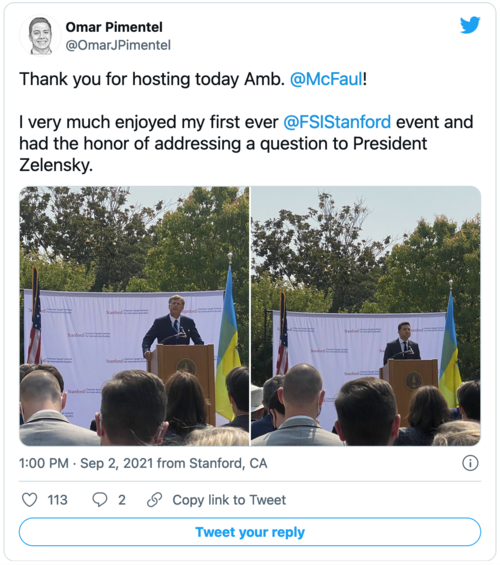
This same message shaped the theme of President Zelenskyy’s remarks at his historic address from the Freeman Spogli Institute for International Studies (FSI) at Stanford University on September 2. The first Ukrainian president to ever visit California, President Zelenskyy, First Lady Olena Zelenska and their delegation joined a group of FSI faculty members led by FSI Director Michael McFaul at an outdoor event held in the Encina Courtyard.

In his remarks, Zelenskyy drew inspiration from Steve Jobs’ famous "How to Live Before You Die" commencement address given at Stanford in 2005.

"This is one of the most famous speeches ever given at Stanford,” he said. “It's about believing in dreams and overcoming the impossible. This is the same as my story. I am just a common guy from a common family from a common industrial town in Eastern Ukraine. Yet here I am today at Stanford, because everything is possible."

He continued, “It is the same for Ukraine. Many people look at us and think that it will be impossible to achieve the goals we hope for. But we know that our critics are wrong. The people of our country love democracy and freedom and will not let threats take those things away. We know that anything is possible."

Looking to the future, Zelenskyy outlined the steps his administration is undertaking to bring increased digitization to Ukraine. These efforts include launching fully electronic passports, moving business and legal services online and expanding the scope of e-goverance. The hope is that this meld of new technology will help curb corruption while simultaneously creating more equitable opportunities and better access to public services for more Ukranians.

Speaking on the ambitious scope of these plans, the president acknowledged, “There will be resistance to the changes and innovations that we are going to make.” Nonetheless, he remains committed to the work ahead of strengthening democratic institutions in Ukraine and building on the progress that has already been made.  “We do not have a ‘Ukrainian Dream,’ yet,” he said. “But we have a ‘Ukrainian Goal’ and a ‘Ukrainian Mission’ to make the future we want for our country.” An edited recording of his remarks is below.

Keeping with Stanford tradition, Zelenskyy took questions from the audience after his prepared remarks. A variety of students and Stanford community members from Russia, Burma, Belarus and beyond had the opportunity to engage the president on a range of issues including U.S.-Ukraine relations, armament sales abroad and concerns over Russian aggression in Crimea and influence Eastern Ukraine. Of particular meaning was Zelensky’s affirmation and support for the democratic movement in Belarus led by Svaitlana Tsikhanouskaya, whom FSI hosted earlier this summer at a faculty roundtable.

Image
Tweet from Franak Viačorka

Students and faculty alike were appreciative of the president’s candor and good nature in addressing difficult topics.

Image
Tweet from Rose Gottemoeller
Image
Tweet from Graham Webster
Image
Tweet from Me Me Khant
Image
Tweet from Omar Pimentel

Following the formal remarks, President Zelenskyy and First Lady Zelenska had an opportunity to meet with Stanford President Marc Tessier-Lavigne in the Memorial Church Courtyard. Prior to leaving, the First Lady also sat down with leaders and students from Stanford's Office of Accessible Education (OAE), an area of interest she would like to support and better develop in Ukraine.

For FSI, the president’s visit was another affirmation of the special connection between Ukraine and the Stanford community. Since 2016, the Center on Democracy, Development and the Rule of Law has hosted the Ukrainian Emerging Leaders Program, which provides a 10-month academic training fellowship in support of mid-career practitioners working actively as policy-makers, legal professionals, entrepreneurs and leaders of civil society organizations in Ukraine.

Speaking to this shared history in his opening introductions, FSI Director Michael McFaul emphasized the crucial need for ongoing support and intellectual investment into Ukraine. “The fight for democracy and independence in Ukraine is one of the most important causes in the world today,” he affirmed. “Not just for Ukrainians, but for all who cherish the ideals of democracy, liberty and sovereignty.”

To President Zelenskyy, McFaul extended a future invitation: “You are always welcome back, either as president or in retirement as a professor.”

“With the classes you offer, I will think about it,” Zelenskyy replied with a smile.

Read More

Sviatlana Tsikhanouskaya discusses the future of democracy in Belarus with a roundtable of Stanford scholars.
News

Belarusian Leader Sviatlana Tsikhanouskaya Meets with Stanford Scholars for Roundtable on Democracy in Belarus

Democratic leader Sviatlana Tsikhanouskaya and her delegation joined an interdisciplinary panel of Stanford scholars and members of the Belarusian community to discuss the future of democracy in Belarus.
Belarusian Leader Sviatlana Tsikhanouskaya Meets with Stanford Scholars for Roundtable on Democracy in Belarus
Hero Image
President Volodymyr Zelenskyy of Ukraine speaks at the Freeman Spogli Institute for International Studies Rod Searcey
All News button
1
Subtitle

President Zelenskyy outlined the steps his administration is undertaking to bring increased digitization to Ukraine, curb corruption and create more equitable access to public services for more Ukrainians.

Subscribe to Ukraine