-

* Please note all CISAC events are scheduled using the Pacific Time Zone.


Register in advance for this webinar: https://stanford.zoom.us/webinar/register/8416226562432/WN_WLYcdRa6T5Cs1MMdmM0Mug


About the Event: Is there a place for illegal or nonconsensual evidence in security studies research, such as leaked classified documents? What is at stake, and who bears the responsibility, for determining source legitimacy? Although massive unauthorized disclosures by WikiLeaks and its kindred may excite qualitative scholars with policy revelations, and quantitative researchers with big-data suitability, they are fraught with methodological and ethical dilemmas that the discipline has yet to resolve. I argue that the hazards from this research—from national security harms, to eroding human-subjects protections, to scholarly complicity with rogue actors—generally outweigh the benefits, and that exceptions and justifications need to be articulated much more explicitly and forcefully than is customary in existing work. This paper demonstrates that the use of apparently leaked documents has proliferated over the past decade, and appeared in every leading journal, without being explicitly disclosed and defended in research design and citation practices. The paper critiques incomplete and inconsistent guidance from leading political science and international relations journals and associations; considers how other disciplines from journalism to statistics to paleontology address the origins of their sources; and elaborates a set of normative and evidentiary criteria for researchers and readers to assess documentary source legitimacy and utility. Fundamentally, it contends that the scholarly community (researchers, peer reviewers, editors, thesis advisors, professional associations, and institutions) needs to practice deeper reflection on sources’ provenance, greater humility about whether to access leaked materials and what inferences to draw from them, and more transparency in citation and research strategies.

View Written Draft Paper


About the Speaker: Christopher Darnton is a CISAC affiliate and an associate professor of national security affairs at the Naval Postgraduate School. He previously taught at Reed College and the Catholic University of America, and holds a Ph.D. in Politics from Princeton University. He is the author of Rivalry and Alliance Politics in Cold War Latin America (Johns Hopkins, 2014) and of journal articles on US foreign policy, Latin American security, and qualitative research methods. His International Security article, “Archives and Inference: Documentary Evidence in Case Study Research and the Debate over U.S. Entry into World War II,” won the 2019 APSA International History and Politics Section Outstanding Article Award. He is writing a book on the history of US security cooperation in Latin America, based on declassified military documents.

Virtual Seminar

Christopher Darnton Associate Professor of National Security Affairs Naval Postgraduate School
Seminars
Authors
News Type
Commentary
Date
Paragraphs

The January 3, 2026, U.S. “Operation Absolute Resolve” in Venezuela to capture and remove President Nicolás Maduro has raised urgent questions about its repercussions for the U.S.-China competition, Taiwan Strait security, American strategic priorities in the Indo-Pacific region, and U.S. allies and partners.

In two new episodes of the APARC Briefing series, Stanford scholars Larry Diamond, the Mosbacher Senior Fellow in Democracy at the Freeman Spogli Institute for International Studies (FSI) and William L. Clayton Senior Fellow at the Hoover Institution, and APARC faculty affiliate Oriana Skylar Mastro, a center fellow at FSI, join host Kiyoteru Tsutsui, the director of APARC, to unravel what happened in Venezuela and the implications of the U.S. actions in Latin America for Taiwan, security and alliances in the Indo-Pacific, and U.S. relations with stakeholders in the region.

Both scholars agree that the U.S. mission in Venezuela is a precedent that likely emboldens rather than deters China in its Taiwan calculus, warning that the shift it represents in U.S. national security policy might detract from American capabilities in the Indo-Pacific region at a crucial moment. They also provide sobering advice for U.S. allies struggling to adjust to rapidly shifting geopolitical realities under the second Trump administration.

A Shocking Action in World Affairs


There is no dispute that the Maduro government has been deeply authoritarian, deeply corrupt, and deeply illegitimate, says Diamond, author of Ill Winds: Saving Democracy from Russian Rage, Chinese Ambition, and American Complacency. Yet the United States “has probably violated international law to intervene forcibly in the internal affairs of Venezuela and remove its political leader," creating enormous implications for the international community. If it does not pursue a strategy of systemic democratic change in Venezuela, “all of this will have been for naught, and it will have paid a tragic price in terms of international precedent and international legitimacy,” Diamond argues.

Beijing is already using the operation as a "discourse power win," depicting the United States as crushing sovereignty and international law, Mastro notes. Moreover, in addition to Venezuela, President Trump continues to make statements about Greenland, reiterating its importance for U.S. national security and his interest in acquiring the territory, which has alarmed European partners and exacerbated strains with NATO.

“For the first time since WWII, some European countries have declared the United States to be a security threat,” Mastro says. “So I am curious to see if the Chinese try to bring along the Venezuela case as well, to convince U.S. allies and partners to distance themselves from the United States, which would have significant repercussions for the global order and for the United States' role in it.”

There is no situation in which we 'neutralize' Chinese air defenses and then somehow do some sort of infiltration.
Oriana Skylar Mastro

A Risky Strategic Reorientation


By unilaterally bypassing international norms to wield power in its own "backyard," the United States may have set a precedent that China can now exploit to justify its own ambitions in Taiwan as a legitimate exercise of regional dominance.

Diamond remarks on this line of thought: “If the United States, as a hegemon, can just do what it wants to arrest and remove a leader, in its kind of declared sphere of influence, what's to stop Xi Jinping from doing the same in his sphere of influence, and with a democratic system in Taiwan, whose sovereignty he does not recognize?” 

On the other hand, many commentators have argued that Operation Absolute Resolve serves as a deterrent to Chinese aggression. Granted, there is no doubt that the operation was a remarkably successful military attack showcasing the capabilities of U.S. special forces, notes Mastro, who, alongside her academic career, also serves in the United States Air Force Reserve, for which she currently works at the Pentagon as deputy director of research for Global China Strategy. Nevertheless, she emphasizes that the United States cannot carry out a similar attack in Asia.

“There is no situation in which we ‘neutralize’ Chinese air defenses and then somehow do some sort of infiltration,” says Mastro, author of Upstart: How China Became a Great Power. The U.S. intervention in Venezuela, therefore, “does not tell us a lot, operationally, about what the United States is capable of in a contingency via China.”

More troubling, Mastro identifies the Venezuela operation as demonstrating a fundamental shift in U.S. strategic priorities, with the raid conducted just weeks after the Trump administration released its 2025 National Security Strategy, which prioritizes restoring “American preeminence in the Western Hemisphere.” Mastro characterizes it as “the one region where U.S. dominance faces no serious challenge.” Thus, Venezuela suggests “the Trump administration means business about the renewed focus on the Western Hemisphere, and, unfortunately, that makes me concerned that there might be strategic neglect of the Indo-Pacific moving forward,” she points out.

Diamond stresses that, virtually throughout the entire presidency of Xi Jinping, dating back to 2012, China has been rapidly building up its military capabilities, prioritizing those specifically suited for coercing, isolating, or potentially seizing Taiwan. Against this backdrop, “I am much more fearful about the future of Taiwan in the week following U.S. military action on January 3 in Venezuela than I was before that action.” 

Mastro agrees with this assessment about the ripple effects of the operation in Venezuela. “I would say that it probably emboldens China.”

[M]y advice to the leaderships [of our allies is]: Find a way to get to the fundamental interests you need to pursue, defend, and preserve. And in the case of East Asia, that has to be number one, above all else, the preservation of our alliances.
Larry Diamond

Frank Advice for U.S. Allies


For U.S. allies in the Indo-Pacific, including Japan, South Korea, the Philippines, and Australia, as well as allies and partners in Europe, both scholars offer pragmatic counsel for coping with the Trump administration.

Diamond urges U.S. allies to manage Trump diplomatically while staying focused on core interests, namely, prioritizing the preservation of the alliances and strengthening autonomous defense capabilities to demonstrate commitment and hedge against potential U.S. retrenchment.

“It takes constant, energetic, proactive, imaginative, relentless, and in some ways deferential working of the relationship, including the personal relationship between these leaders and Donald Trump [...] The future will be better if the leaders of these countries internalize that fundamental lesson about Trump.”

Mastro is equally direct about the limited alternatives ahead of U.S. allies: "You don't really have an option. That Chinese military – if it gives the United States problems, it definitely gives you problems. There's no hope for a country like Taiwan without the United States. There's no hope for Australia without the United States."

Counterintuitively, U.S. assertiveness may indicate its insecurity about the balance of power with China. “It seems to me that the United States also needs to be reassured that our allies and partners support us [...] And if we had that confidence, maybe the United States would be less aggressive in its use of military force.”

Watch the two APARC Briefing episodes:

🔸 What the U.S. Raid in Venezuela Means for Taiwan and Asia - with Larry Diamond >

🔸 Does Venezuela Provide China a Roadmap for Taiwan? – with Oriana Skylar Mastro >

Read More

Hero Image
Oriana Skylar Mastro (left), Map of Venezuela (center), and Larry Diamond (right)
All News button
1
Subtitle

Speaking on the APARC Briefing video series, Larry Diamond and Oriana Skylar Mastro analyze the strategic implications of the U.S. operation in Venezuela for the balance of power in the Taiwan Strait, Indo-Pacific security, America’s alliances, and the liberal international order.

Date Label
Display Hero Image Wide (1320px)
No
-

This event is expected to be at full capacity. Seating is available on a first-come basis.

Join us for a book talk and signing with Professor Michael McFaul, director of the Freeman Spogli Institute for International Studies, New York Times bestselling author, and former U.S. ambassador to Russia. 

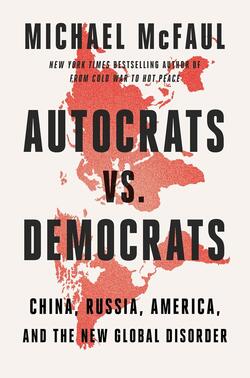
Autocrats vs. Democrats: China, Russia, America, and the New Global Disorder is a clear-eyed look at how the rise of autocratic China and Russia are compelling some to think that we have entered a new Cold War—and why we must reject that thinking in order to prevail. 

Cover of Autocrats vs Democrats Book

Amid the constant party divisions in Washington, DC, one issue generates stunning consensus—China—with Republicans and Democrats alike battling over which party can take the most hawkish stance toward the ascendant superpower. Indeed, far from trying to avoid a new Cold War with China, many have embraced it, finding comfort in the familiar construct, almost willing it into existence. And yet, even as politicians and intellectuals race to embrace this Cold War 2.0, many of the perils we face today are distinctly different from those of the Cold War with the Soviets. The alliance between the autocracies of China and Russia, the nature of the ideological struggle, China’s economic might, the rise of the far right in the United States and in Europe, and the growing isolationism and polarization in American society—taken together these represent new challenges for the democratic world. Some elements of the Cold War have reappeared today, but many features of the current great power competition have no analogy from the past century.

For decades Michael McFaul, former ambassador to Russia and international affairs analyst for NBC News, has been one of the preeminent thinkers about American foreign policy. Now, in this provocative work, he challenges the encroaching orthodoxy on Russia and China, arguing persuasively that the way forward is not to force our current conflict into a decades-old paradigm but to learn from our Cold War past so that democracy can again emerge victorious. Examining America’s layered, modern history with both Russia and China, he demonstrates that, instead of simplistically framing our competition with China and Russia as a second Cold War, we must understand the unique military, economic, and ideological challenges that come from China and Russia today, and the develop innovative policies that follow from that analysis, not just a return to the Cold War playbook.

At once a clarion call for American foreign policy and a forceful rebuttal of the creeping Washington consensus around China, Autocrats vs. Democrats demonstrates that the key to prevailing in this new era isn’t simply defeating our enemies through might, but using their oppressive regimes against them—to remind the world of the power and potential that our democratic freedoms make possible. 

Michael McFaul headshot

Professor Michael McFaul

FSI Director
"Autocrats vs. Democrats: China, Russia, America, and the New Global" is available starting October 28, 2025.
Order Now

Hauck Auditorium, Traitel Building, 435 Lasuen Mall, Stanford, CA 94305

Encina Hall
616 Jane Stanford Way
Stanford, CA 94305-6055

0
Senior Fellow, Freeman Spogli Institute for International Studies
Ken Olivier and Angela Nomellini Professor of International Studies, Department of Political Science
Peter and Helen Bing Senior Fellow, Hoover Institution
mcfaul_headshot_2025.jpg PhD

Michael McFaul is the Ken Olivier and Angela Nomellini Professor of International Studies in Political Science, Senior Fellow at the Freeman Spogli Institute for International Studies, and the Peter and Helen Bing Senior Fellow at the Hoover Institution, all at Stanford University. He joined the Stanford faculty in 1995 and served as FSI Director from 2015 to 2025. He is also an international affairs analyst for MSNOW.

McFaul served for five years in the Obama administration, first as Special Assistant to the President and Senior Director for Russian and Eurasian Affairs at the National Security Council at the White House (2009-2012), and then as U.S. Ambassador to the Russian Federation (2012-2014).

McFaul has authored ten books and edited several others, including, most recently, Autocrats vs. Democrats: China, Russia, America, and the New Global Disorder, as well as From Cold War to Hot Peace: An American Ambassador in Putin’s Russia, (a New York Times bestseller) Advancing Democracy Abroad: Why We Should, How We Can; and Russia’s Unfinished Revolution: Political Change from Gorbachev to Putin.

He is a recipient of numerous awards, including an honorary PhD from Montana State University; the Order for Merits to Lithuania from President Gitanas Nausea of Lithuania; Order of Merit of Third Degree from President Volodymyr Zelenskyy of Ukraine, and the Dean’s Award for Distinguished Teaching at Stanford University. In 2015, he was the Distinguished Mingde Faculty Fellow at the Stanford Center at Peking University.

McFaul was born and raised in Montana. He received his B.A. in International Relations and Slavic Languages and his M.A. in Soviet and East European Studies from Stanford University in 1986. As a Rhodes Scholar, he completed his D. Phil. in International Relations at Oxford University in 1991. 

CV
Date Label
Michael McFaul
Lectures
Date Label
-
Mary Elise Sarotte — Post-Cold War Era as History

Professor Mary Elise Sarotte, award-winning historian and author of Not One Inch: America, Russia, and the Making of Post-Cold War Stalemate, will offer reflections on the difficult task of writing history that is still unfolding. Covering the pivotal years from 1989 to 2022, her work traces how early decisions at the end of the Cold War shaped the trajectory of U.S.–Russia relations and contributed to the impasse that continues to trouble the international order today. In this conversation, Sarotte will explore the historian’s challenge of disentangling myth from evidence, of balancing archival distance with contemporary resonance, and of reckoning with a legacy that remains deeply contested and urgently relevant.

The event will begin with opening remarks from Kathryn Stoner, Mosbacher Director of the Center on Democracy, Development, and the Rule of Law (CDDRL). The event will conclude with an audience Q&A.

This event is co-sponsored by the Center on Democracy, Development and the Rule of Law (CDDRL), and the Center for International Security and Cooperation (CISAC).

speakers

Mary Elise Sarotte

Mary Elise Sarotte

Johns Hopkins School of Advanced International Studies (SAIS), Kravis Professor of Historical Studies
full bio

Mary Elise Sarotte received her AB in History and Science from Harvard and her PhD in History from Yale. She is an expert on the history of international relations, particularly European and US foreign policy, transatlantic relations, and Western relations with Russia. Her book, Not One Inch: America, Russia, and the Making of Post-Cold War Stalemate, was shortlisted for both the Cundill Prize and the Duke of Wellington Medal, received the Council on Foreign Relations Arthur Ross Prize Silver Medal, and won the Pushkin House Prize for Best Non-Fiction Book on Russia. Not One Inch is now appearing in multiple Asian and European languages, including a best-selling and updated version in German, Nicht einen Schritt weiter nach Osten. In 2026, Sarotte will return to Yale for a joint appointment as a tenured professor in both the Jackson School of Global Affairs and the School of Organization and Management.

Kathryn Stoner

Kathryn Stoner

Mosbacher Director of the Center on Democracy, Development, and the Rule of Law
full bio

Kathryn Stoner is the Mosbacher Director of the Center on Democracy, Development and the Rule of Law (CDDRL), and a Senior Fellow at CDDRL and the Center on International Security and Cooperation at FSI. From 2017 to 2021, she served as FSI's Deputy Director. She is Professor of Political Science (by courtesy) at Stanford, and she teaches in the Department of Political Science, in the Program on International Relations, as well as in the Ford Dorsey Master's in International Policy Program. She is also a Senior Fellow (by courtesy) at the Hoover Institution.

Kathryn Stoner
Kathryn Stoner

William J. Perry Conference Room, 2nd Floor
Encina Hall (616 Jane Stanford Way, Stanford)

This is a hybrid event. For virtual participation, if prompted for a password, use: 123456

Mary Elise Sarotte Johns Hopkins School of Advanced International Studies (SAIS) Presenter Johns Hopkins University
Lectures
Date Label
Paragraphs
Cover of Autocrats vs Democrats Book

Amid the constant party divisions in Washington, DC, one issue generates stunning consensus—China—with Republicans and Democrats alike battling over which party can take the most hawkish stance toward the ascendant superpower. Indeed, far from trying to avoid a new Cold War with China, many have embraced it, finding comfort in the familiar construct, almost willing it into existence. And yet, even as politicians and intellectuals race to embrace this Cold War 2.0, many of the perils we face today are distinctly different from those of the Cold War with the Soviets. The alliance between the autocracies of China and Russia, the nature of the ideological struggle, China’s economic might, the rise of the far right in the United States and in Europe, and the growing isolationism and polarization in American society—taken together these represent new challenges for the democratic world. Some elements of the Cold War have reappeared today, but many features of the current great power competition have no analogy from the past century.

For decades Michael McFaul, former ambassador to Russia and international affairs analyst for NBC News, has been one of the preeminent thinkers about American foreign policy. Now, in this provocative work, he challenges the encroaching orthodoxy on Russia and China, arguing persuasively that the way forward is not to force our current conflict into a decades-old paradigm but to learn from our Cold War past so that democracy can again emerge victorious. Examining America’s layered, modern history with both Russia and China, he demonstrates that, instead of simplistically framing our competition with China and Russia as a second Cold War, we must understand the unique military, economic, and ideological challenges that come from China and Russia today, and the develop innovative policies that follow from that analysis, not just a return to the Cold War playbook.

At once a clarion call for American foreign policy and a forceful rebuttal of the creeping Washington consensus around China, Autocrats vs. Democrats demonstrates that the key to prevailing in this new era isn’t simply defeating our enemies through might, but using their oppressive regimes against them—to remind the world of the power and potential that our democratic freedoms make possible. 

Michael McFaul headshot

Professor Michael McFaul

FSI Director
"Autocrats vs. Democrats: China, Russia, America, and the New Global" is available starting October 28, 2025.
ORDER NOW
All Publications button
1
Publication Type
Books
Publication Date
Subtitle

From FSI Director, New York Times bestselling author, and former ambassador to Russia Michael McFaul comes a clear-eyed look at how the rise of autocratic China and Russia are compelling some to think that we have entered a new Cold War—and why we must reject that thinking in order to prevail. 

Authors
Michael A. McFaul
Book Publisher
Mariner Books
Authors
News Type
Commentary
Date
Paragraphs

China is rapidly gaining influence and power on the global stage, and if the United States wants to stay ahead, Oriana Skylar Mastro believes Washington need to fundamentally rethink its understanding of Beijing's geopolitical strategy. She joined host Michael McFaul on the World Class podcast to discuss how America can counter an "upstart" great power.

Watch the video version of their conversation above, or or listen to the audio below, on Apple Podcasts, Spotify, and other major podcast platforms. A full transcript of the episode is also available.

Oriana Skylar Mastro's latest book is Upstart: How China Became a Great Power, published by Oxford University Press.


TRANSCRIPT:


McFaul: You’re listening to World Class from the Freeman Spogli Institute for International Studies at Stanford University. We bring you in-depth expertise on international affairs from Stanford's campus straight to you. I'm your host, Michael McFaul, the director of the Freeman Spogli Institute.

Today I'm joined by Oriana Skylar Mastro, a Center Fellow here at FSI, an active member of the United States Air Force Reserve, in fact, a recently promoted officer of the Air Force Reserve, and Deputy Director of Reserve Global China Strategy at the Pentagon. Oriana combines all that expertise in her latest book called Upstart, How China Became a Great Power.

I strongly advise you to buy this book. I don't care if you read it, but I want you to buy it now. In all seriousness, I've read lots of books on China in recent years. This is one of the best. It's one-stop shopping for all you need to know about China. It examines China's climb to great power status through a careful mix of strategic emulation, exploitation, and entrepreneurship on the international stage.

So Oriana, let's get right to it. Let's talk about Upstart. So, Upstart sounds like a Silicon Valley topic. Tell us about the title and tell us why you decided to write this book.

Mastro: Maybe I'll start with why I decided to write the book because it leads into the title. In my academic work and in my policy work, looking at how China was building power, the conventional wisdom was the same. Academics called it something a little fancier, but it was basically mirror imaging. There were a lot of arguments being made.

McFaul: What was the academic words? I'm curious.

Mastro: Oh, Kenneth Waltz, like, “emulation,” diffusion” . . .

McFaul: Got it, got it, got it, okay.

Mastro: Kenneth Waltz argued that success breeds the same type of competitive tendencies. Meaning, if you want to be a great power, if you're China in the 1990s, the way to do it is to act like the United States.

McFaul: Right.

Mastro: You go into the policy world and you see the same exact things. Constant arguments about, Is China going to build overseas bases? Is China going to, you know, have a military the same as ours? that were all basically predicated on the understanding that they wanted to mirror image the United States.

McFaul: Right.

Mastro: As a China specialist, I'm a political scientist, I'm also doing this policy work, but I'm also a China specialist. And I speak Chinese, I spend a lot of time in China. And on the surface, it just didn't really make any sense. Like, why would China do exactly what we do? How would that make them competitive?

McFaul: Right.

Mastro: And it really was an introduction in my life to literature on competition from business and management. Partially being in Silicon Valley inspired that, and partially it's because the rise and fall of great powers is very rare, but the introduction and destruction of companies is actually very frequent.

McFaul: Good point.

Mastro: So I discovered this whole other literature on, how are you competitive in trade and in commerce? And a lot of the arguments about competitive advantage, about being entrepreneurial, innovative, trying to find a different way of doing things, really resonated with how I saw China. And so that's what sparked the original idea. It takes writing a whole book to try to convince people that there is very strong evidence and a logical argument for why we have to look at this situation differently than past historic cases of rising powers.

McFaul: Dig into it a little bit. Give us some examples, especially about military power, which is your strong suit. And then if we have time, we'll talk about economic power. So, give us some examples of the “upstart strategy.”

Mastro: So the upstart strategy has three components: emulation, entrepreneurship, and exploitation. Now the first one is based on the conventional wisdom, right?

China does emulate some aspects of U.S. power, but the book tries to evaluate the conditions under which they do so. When are we most likely to see them take the old strategies, whatever the United States is doing, and apply it in the exact same area? That's my definition of emulation.

McFaul: Okay.

Mastro: And they tend to do this when it's reassuring to the United States. So think of examples like engaging in free trade, joining international institutions. In the military realm, they started to participate in humanitarian aid and disaster relief campaigns. They started to participate in peacekeeping operations, right? They're the number one contributor to PKOs on the Security Council of the United Nations.

And so they did decide to do certain things that they thought, Listen, this will help us build power — mediation diplomacy is a great example, helping to mediate between different countries when they're engaged in conflicts —it helps us build power and it makes us look good and it makes the United States calmer about our rise. Because one of the main reasons why you don't want to act exactly like the United States, is that actually could seem very threatening, right?

If you're trying to build the exact power the United States has, it would be very easy for people in the United States to say, Hey, wait a minute, what's going on here?

McFaul: Right.

Mastro: Right? And the example I give, if China built overseas bases, like our network of 120 bases, we would have seen that a lot differently than what they ended up doing, which was the Belt and Road Initiative, like economic policies. So those are in the emulation category.

For military power, most of them are about reassurance. And then there's a few times where they have such a competitive advantage and this area of power is so important that even though there's a downside in terms of how the U.S. will perceive it, they go for it anyway.

So, an example in the military realm is building what we call C4ISR network, or Command Control Computers Communication Intelligence Surveillance Reconnaissance, which in the most simple way...

McFaul: That's what — ISR, you just spelled out the acronym, right?

Mastro: Yeah, right.

McFaul: Thank you.

Mastro: So in the most simple sense, it's building a space architecture.

McFaul: Right.

Mastro: Having their own navigation systems, having their own precision timing, you know. So, they realized that was really important for the nature of warfare. They needed it. The United States might not like it, but it was just so necessary. And because their engineers are cheaper, because they're actually really advanced in certain missile technologies, they knew they would have an advantage there.

McFaul: Right.

Mastro: So that's emulation. Exploitation is when they use the U.S. strategy, but in an area where the United States isn't competing. There's disincentives to do it directly. And this largely could be because of competitive advantages. So one area is like arms sales, Chinese arms sales around the world. China really only sells arms to countries that cannot buy them from the United States. Either because they're under some sort of human rights arms embargo, they’re poor countries that are not strategically relevant enough to be gifted arms by the United States, so the Bangladeshes of the world get a lot of their military equipment from China.

McFaul: Because they're too poor? I did not know that.

Mastro: Yeah, well, Chinese stuff is a lot cheaper. Now, there's some countries who are poor that still have U.S. stuff, but that's because we've decided, like . . .

McFaul: They're important.

Mastro: They're important for strategic reasons, so we have gifts and loans and things. And then there's certain technologies that because of treaty obligations, the United States wasn't exporting. And this is how China got sort of a stronghold in the market on unmanned systems, for example. On the diplomatic side, elite visits, right? A Chinese leader like Xi Jinping makes as many overseas visits as a U.S. president, but they go to fundamentally different places, right?

McFaul: Right.

Mastro: The U.S. president is mainly going to the UK, Germany, Japan, Australia. Chinese president is visiting Africa.

McFaul: A lot.

Mastro: A lot! So Xi Jinping has visited three times more countries than President Obama did, and President Obama visited more African countries than any previous U.S. president. He also goes to the poorest countries in the world, the 70% of the poorest African countries Xi Jinping has been to, that no U.S. president has ever been to. So it's kind of filling in those gaps.

And then the military realm, for those of you out there with military background, the example that's just perfect for this is something we refer to as A2/AD, or the Anti-Access/Area Denial strategy.

What is that? Very simply put, China deliberately evaluated the types of things the United States needs to project power, and then they developed specific capabilities to target those. So things like the aircraft carrier. So China developed a missile designed to hit and sink an aircraft carrier, right? Or a need to refuel because our bases are far away, you know, or blinding satellites because we need satellites more because we don't have the home-court advantage.

McFaul: Right.

Mastro: So in the military realm, this exploitation strategy is very strong.

And the last category, entrepreneurship, is when they do something completely different. And this, I would say, is the most controversial aspect of the book. I briefed it to a lot of military audiences. Just on Friday I got a note that a four-star wanted my address to send me a letter about the book. And I'm like, Is this– I don't know if it's going to be like I loved your book or it's gonna be like I hate everything you say about the following chapters, because it is a Navy admiral.

So I imagine that they're sensitive about, one, my argument that China is not seeking an overseas basing network despite all the concerns over the past 20 years that they're, you know, they're on the cusp and they're going to build when they're going to build one. One of the reasons China sometimes does things differently from the United States is that they think U.S. strategy is stupid. So, one of the parts of the argument is trying to look at how China might change in the future. And it's important, the rationale.

McFaul: Right.

Mastro: So the book looks at thousands of Chinese . . .

McFaul: Startups are not always startups, right? They get old, and…

Mastro: . . . They evolve. This book relies on thousands of Chinese sources to also evaluate the rationale of why they chose certain strategies. So you could imagine if they chose a strategy because they were weaker or didn't have an advantage, as they get more powerful, they might start emulating.

But this is an aspect when they're like, you know, the war in Afghanistan cost the equivalent of ten Belt and Road Initiatives. Why would we be engaged in sort of foreign military intervention, which tends to go hand in hand with these overseas basing networks, when we can achieve our goals better with economic and political means of power? And that's outside of Asia. China does clearly want to dominate Asia militarily, but they don't need bases for that because they have China.

So, that's one of those arguments that says this is not for lack of ambition. Of course, they will have certain military roles in some places. We'll probably see some more intelligence gathering, you know, sensors being put places, but not offensive combat operations.

And the second very controversial one is about China's nuclear forces. And I had a follow-up piece in The Economist last month by invitation to talk about China's nuclear arsenal. China has, basically, since 1964, every aspect of their approach to nuclear weapons has been different than the United States: posture, doctrine, readiness, delivery systems, number of nuclear weapons, structure of the organization for nuclear weapons.

I mean, besides the initial decision to build them for the sake of nuclear deterrence, nothing has been the same. And part of that, again, is about inefficiency arguments, that China never understood why the United States needs thousands and thousands and thousands of them. And from a competitive point of view, up until the mid 2000s, the United States spent more on its nuclear weapons than China spent on its whole military.

McFaul: Wow.

Mastro: So, one of the reasons they've been able to get this conventional power that people like me write very openly about being concerned of, right? I'm not as concerned about their nuclear weapons. But, I'm absolutely concerned about the tipping of conventional power in China's favor. They've been able to do that by not overspending on nuclear weapons.

McFaul: Right.

Mastro: So there's a lot of debate right now because they're increasing their numbers. They used to just have like 200 and 320. There's a debate right now about whether or not they're going to push up to 1,000 or 1,500 in the next 10 years. But even so, I sort of argue that there's other reasons for that, dealing with advancements in technology and changes in U.S. doctrine that has made them concerned that their deterrent has weakened.

McFaul: Their nuclear deterrent has weakened.

Mastro: Their nuclear deterrent has weakened. And so they still have the same sort of minimal deterrent posture that they've had before. So that hasn't changed. But those are kind of the two most controversial entrepreneurial areas that I discuss in the book on the military side.

McFaul: So, if you had the chance to . . . in fact, I learned this term from military folks when I worked in the government: the BLUF, right? “Bottom line up front”. Really great phrase for all people having to do briefings.

But if you got, say, 45 seconds with President Trump, and he asked you, Lieutenant Colonel - can I call you that now?

Mastro: Yeah, sure. Yeah.

McFaul: Lieutenant Colonel Mastro. He probably wouldn't call you Dr. Mastro, but Lieutenant Colonel Mastro.

Mastro: He'd probably be like, “Hey lady!”  But, yeah. Yeah.

McFaul: Congratulations on being Lieutenant Colonel, by the way. That's a fantastic achievement. But if he just asked, What's the balance of military power between the United States and China today? How could you answer that in 45 to 60 seconds?

Mastro: I would say that we're outgunned in Asia. We have the advantage everywhere else. We're deterring China from a large-scale protracted war.

But the problem is in conflicts close to China, in particular over Taiwan, the United States is outgunned. And we need to put more bombers, submarines, and land-based missiles closer into China, which means we have to be nicer to countries in the region because they have to agree to let us put that stuff there. And we have to reform the defense industrial complex so that we can innovate in those areas, in particular land-based anti-ship ballistic missiles, and be able to produce them in mass in a cost-effective way.

McFaul: Fantastic answer. You know how to do this. I can tell.

Mastro: You usually get more than 45 seconds, but sometimes they get right to it.

McFaul: You hit it, I saw it. Now we have a little more time to dig into that. Because that was a very profound thing you just said. Take us through the pieces that you think are inadequate. And then let's talk about whether the Trump administration will begin to realize those solutions. But first, just articulate the threat posture that — you had three big buckets there — maybe more, but I heard three. Tell us a little more in detail about what is alarming about that balance of power in Asia to you?

Mastro: So, if you can humor me, right before I do that, I just want to really hammer home a point that I said in that answer, that I feel is clouding some of the debates among policy experts and academics, okay?

McFaul: Please.

Mastro: Which is, we are adequately deterring China from engaging in a large-scale war with the United States. So people are always like, China doesn't want to fight a war with the United States and all of our allies and partners. And, the economic costs will be huge. And it's like, yes, but that is not what people in the defense department are worried about. We're not worried that tomorrow China attacks the United States and we're fighting World War III.

McFaul: Right.

Mastro: What we're worried about is that there are certain aspects of contingencies like Taiwan that they can move and gain, in this case, control over Taiwan before the U.S. military can come in mass. Okay? And the coming in mass is just a more diplomatic way of saying, Before we can really start blowing things up. So, let me just start with that because what people say . . .

McFaul: That's very important. I'm glad you did that. Yeah.

Mastro: It's very important because it's not the case that I think, like, China's like, gunning for whatever. Or, I do a lot of media interviews when I'm walking my kids to and from school and once my four year old was like, “Does the United States lose all the wars that we fight?” after they hear me on the phone, I'm like, “Mom did not say that!”

What I'm saying is that there's this particular scenario, and if China initiates conflict, they're going to initiate it when it's most favorable to them.

So the problem is, the United States, we have forces close to Taiwan, right? In Japan, for example. But there are so few of them that if we actually mobilized them after the immediate attack on Taiwan, for example, they're not survivable. Which, again, is the military diplomatic speech of saying everyone is going to die.

And if that were credible, if China thought we were going to do that, then they're in the major war with the United States, right? They’ve just killed thousands of Americans. So, that doesn't become appealing. But the logic is, most U.S. presidents are not going to send in those forces — in this case, it's mainly air power — when they're all going to die. And then we also lose in this sort of exchange about 70% of our most advanced aircraft? Which means then, now we're transitioning to that major war with China. It's like, we're not in a great position.

McFaul: Right.

Mastro: So we have stuff there, but we don't have enough. The question is like, what does enough mean? Very simply, you gotta keep the ships that are carrying the people across the strait from landing on Taiwan. And so, I'm kind of a broken record on this with the military when people are always like, “Well I'm contributing to deterrence. You know, I'm doing this dance, I'm doing this messaging.” Or even certain weapon systems like, well, you know, “I got this tank . . .”

I'm like, if it does not sink ships, I do not care. Right? Because then you're in this realm of cost in which people say they're trying to deny China the objective of Taiwan, but really it's like, well, I could sink a ship or two. And I'm like, well, when you got thousands of them, you know, one or two is not going to do it.

McFaul: Right.

Mastro: So the thing I laid out, basically, are designed to sink a lot of ships quickly. Submarines, the United States has the advantage undersea still. There's an apocryphal story that I talk about in my book that when they devised that strategy to target the key platforms of the United States in the 1990s, the Navy, for some odd reason, was changing their patrolling schedule. So the submarines just weren't patrolling them.

And so when China was like, we got to get the aircraft carriers, we got to get the satellites. We got to hit the fixed bases where the aircraft are taking off. They just didn't think of the submarines, you know? So that's the story. I don't know how true it is, but that's the apocryphal story.

So we have, full reign with submarines. The problem is we just don't have a lot of them.

McFaul: Right.

Mastro: And then the munitions they carry, they can only sink a few ships. And then we have no capability to replenish them in the region. So they have to go all the way back to Guam or Hawaii. So I talk about tenders, submarine tenders, a lot of military personnel being like, I need that stuff and I need it in the Philippines and Japan. Like, that's where we need it.

McFaul: Right.

Mastro: And then the bombers are very controversial because those are an offensive capability that are designed to penetrate into China and bomb mainland targets. Mike, we're just throwing it out there. That's what they do.

McFaul: That’s what they do.

Mastro: That's important because the biggest threat are all the missiles that China is going to be shooting at us.

McFaul: Right.

Mastro: Missile defense on the back end is hard, like missiles coming towards you. It's a lot easier if you just took out the launcher where it's coming from.

And so that's really what that is about. Like, okay, if we're going to stop all these missiles from being shot at Taiwan, from being shot at our carriers, from being shot at our bases that we need to operate, we're going to have to get in there, we're going to have to take care of it, and that's where the strategic bombers come from.

And then the last component was the land-based anti-ship ballistic missiles.

McFaul: Right.

Mastro: Missiles are a lot cheaper than everything else. Because they're land-based, they tend to be more powerful, more precise. There is a deterrent against China, just a little bit more, because they have to attack the country where the missiles are based.

McFaul: Right. Good point.

Mastro: That's an additional thing that imposes caution on them. So yeah, those are the things that I would want more than anything else. And I really believe that if we put those things in place and so China couldn't do this quickly, the two-and-a-half to three weeks that they might consider, that they'll never do it.

And then this problem will just persist forever, but at least we won't fight a hot war over it. So that's why I really focus on some of those issues and focus on just understanding that China sees a lot of things differently than we do. So, that's what really the book… the heart of the book is about convincing people to keep an open mind about how they're understanding and interpreting Chinese actions so that we can be more entrepreneurial ourselves about how to deal with great power competition.

McFaul: That's a great point. Your recommendations are crystal clear. Who is listening in the Trump administration? And I mean that as our last question.

Don't talk about the specifics, but at the end of the Trump administration, as you know better than I, they focused pretty heavily on diagnosing the China threat. And they put out all sorts of speeches. And Secretary Pompeo did this big long paper about the threat.

It's a little curious to me, and it's only a few weeks, of course, so let's give them time, but it's a little curious to me how we're focused on a lot of other things besides what you just described so far.

Is that unfair or is it too early? And what do you expect in the coming weeks and months in terms of the Trump administration doing some of the things that you just outlined?

Mastro: Well, I think the fact that it's been quiet, I'm very hopeful.

McFaul: Mmm. Explain that, that's good!

Mastro: Because generally speaking, you want the experts to have the space to do the things they need to do. And I see a lot of those policies being driven by some of the domestic political stuff. Like we know tariffs is not going to help anyone get their jobs back, but the people who voted for President Trump believe that.

And so when you say, Who is listening? I mean, this is one of the main reasons that 15 years ago I enlisted in the military, when I was doing my PhD at Princeton, is because people explained to me the pathways that academics could be influential.

And I thought, Okay, so I could write an op-ed and hope someone read it and hope they did this. Or I could go into government, which is a great pathway, but as a woman who, I knew I wanted to have children, the in and out of government thing could be disruptive to the move, and I didn't want to wait 10 to 15 years before I got to do anything interesting.

McFaul: Right.

Mastro: So, for me, there are people listening. I feel like I do have the ear of some pretty important people. And then, as someone who works in the system, I make changes directly.

So I get to see, here's the national defense strategy. It's done. Here's our war plan. It's done. Here's our force posture, our force modernization. I get to physically just go in there and change it and then hope no one notices and changes it back.

But that's how I tend to focus on my influence. And as long as the Trump administration, the more they stay out of that space, the easier it will be, I think, for us to devise good effective strategies.

So if you have that top level of support, and respect for the expertise of the people in the building, which I think we've seen some signs that maybe that's going to be a problem, you know, we'll give them the benefit of the doubt. They respect their military advisors and that expertise. Then we can really make some advancements.

My biggest concern is that we're going to upset a lot of other countries in the region. And Biden made a lot of improvements in our force posture by getting countries to agree to certain things, in particular, Japan and the Philippines and Australia and some second island, you know, Pacific Islands, that if that's reversed, it's going to make it harder for us to deter China.

So I just hope that . . . the way I articulate it to people who have some of those more isolationist views, or unilateralist views, is like, this isn't about your love for this other country or even about multilateralism or legitimacy. If you want the United States to be powerful and that you want to do whatever you want, you need to have these countries willing to host you.

Hopefully they won't disrupt those relationships too much. But on the other hand, they're not as worried about provoking China, which a lot of my recommendations, like with the bombers or something, previous administrations might be like, Oh, I don't know, that might be a little touchy.

McFaul: Right.

Mastro: But maybe with the Trump administration, they're like, yeah, get in there, what you need to get in there. So there could be some pros and there could be some cons, but I think it takes this type of academic research is important because then we can really stand from a position of knowledge and authority and confidence, when you're making arguments that are controversial that people might push back on, that, at least I believe they better inform policy.

So, I stick to them even when people try to push back in more emotional ways about stuff. I think that is really the role of the academic practitioner, and I hope this book serves that purpose.

McFaul: Well, that's one of the most optimistic things I've heard in the first weeks of the Trump administration. As long as they're not talking about the issue, that's a good sign, not a bad sign.

And we can't see what you write for the Pentagon and inside the Pentagon and who you brief, but we can read your book, and everybody should. It's called Upstart: How China Became a Great Power. Thanks for talking with us about some of the ideas here. And I encourage everybody to go out and get this book.

Mastro: Thank you, Mike.

McFaul: Thanks for being here.

You’ve been listening to World Class from the Freeman Spogli Institute for International Studies at Stanford University. If you like what you’re hearing, please leave us a review. And be sure to subscribe on Apple, Spotify, or wherever you get your podcasts, to stay up to date on what’s happening in the world and why.

Read More

Steven Pifer on World Class podcast
Commentary

Assessing Europe's Security After Three Years of War in Ukraine

Steven Pifer joins Michael McFaul on World Class to discuss how America's relationship with Ukraine and Europe is shifting, and what that means for the future of international security.
Assessing Europe's Security After Three Years of War in Ukraine
All News button
1
Subtitle

Drawing from her book "Upstart," Oriana Skylar Mastro joins Michael McFaul on World Class to discuss what the United States is getting wrong about its strategy toward China, and what America should do differently to retain its competitive advantage.

Date Label
Authors
News Type
Commentary
Date
Paragraphs

A warming planet. Backsliding in democracy at home and abroad. Competition with China. And active war in Europe. Broadening conflicts in the Middle East.

The world today is facing no shortage of overlapping, multilateral challenges. At a recent panel titled, “Global Threats Today: What's At Stake and What We Can Do About It,” scholars from the Freeman Spogli Institute for International Studies (FSI) had an opportunity to delve deeper into what the data says about how these global threats are evolving, and how we should be thinking about how to address them.

The discussion, which was held as part of Stanford University's 2024 Reunion and Homecoming weekend, was moderated by Michael McFaul, director of the Freeman Spogli Institute, and featured Marshall Burke, Didi Kuo, Amichai Magen, Oriana Skylar Mastro, and Steven Pifer.

In the highlights below, each scholar shares what they wish people understood better about climate change, the war in Ukraine and Russia's aggression, China's strategy for building power, the health of American democracy, and how the fighting between Israel and Hamas fits into the geopolitical struggle between democracies and autocracies.

Their full conversation can be heard on the World Class podcast, and the panel can be watched in its entirety on YouTube.
 

Follow the link for a full transcript of "Global Threats Today: The 2024 Edition."


Illiberal Actors Are on the Move  |  Amichai Magen


Around the world, we are seeing a new axis of influence coalescing. Some have called it the "axis of misery" or the "axis of resistance." It is composed of Russia and Iran and North Korea, with a lot of Chinese involvement as well. It is transforming our international system in unbelievable ways. It is united by the desire to dismantle the liberal international order, and we're starting to see the nature and the interconnectivity of this new axis of chaos much more clearly. 

You see North Korean soldiers fighting for Putin in Ukraine. You see Putin helping the Houthis attack international Western shipping in Yemen. We see North Korean tunnel technology turn up in Lebanon with Hezbollah and then with Hamas in Gaza. The interconnectivity is something that we really need to know much more about.

Historically, emperors, kings, dukes, used to spend 50% of their resources on preparing for war or waging war. But in the post-Second World War era, we built a critical norm that we've called the liberal international order. And the miracle of the liberal international order is that we've managed to take global averages of defense spending from about 50% to a global average of about 7%. And the resulting surplus wealth has allowed us to invest in education, health, and scientific discovery.

What is at stake now is the possibility of a return of a norm where states are destroyed and disappear. And we have currently three states in the international system, at the very least — Ukraine, Israel and Taiwan — that are at risk of annihilation. To that end, we must articulate a positive strategic vision for the Middle East that will strive towards a two state solution, that would give the Palestinian people the dignity and the freedom that they deserve alongside a safe and secure Israel, and that will leverage the new spirit of cooperation that exists in the Middle East.

If we allow the norm of the non-disappearance of state to erode and collapse, we will go back to the law of the jungle, where we will have to spend so much more money on the wrong things. That is what is at stake in Ukraine, in the Middle East, and with Taiwan.
 

Amichai Magen

Amichai Magen

Visiting Fellow in Israel Studies at the Freeman Spogli Institute
Full Profile


Challenges to Democracy Come From Within |  Didi Kuo


Many people think that the threat to democracy comes from outside our borders, particularly from countries like Russia and China that are asserting themselves in new and aggressive ways.

But the real threat to democracies that we're seeing across the globe is coming from within. Leaders come to power through democratic means, but then they begin to erode power from within. They attack the electoral system and the process of democratic elections, and they take power from other branches of government and aggregate it to themselves within the office of the executive. 

The good news is there are examples of countries like France, Brazil, and Poland where illiberal leaders have been stopped by pro-democracy coalitions of people who came together. These coalitions don't necessarily agree with each other politically, but they've come together and adapted in order to foreclose on these anti-democratic forces. 

That flexibility and adaptability is the reason democracies succeed. We see this over and over again in the the United States. When our institutions have become out of date, we've changed them. We extended suffrage, first to Black Americans who were formerly enslaved, then to women, then to Native Americans. We eliminating poll taxes and rethought what it means to have a multiracial democracy. We have a long track record of making changes.

Today in 2024, some of our democratic institutions are antiquated and don't reflect our contemporary values. This is a moment where we should lean into that flexible strength of democracy and think about institutional reforms that will both strengthen our system against illiberal creep and help us better achieve the ideals that we aspiring to as a people.
 

Didi Kuo

Didi Kuo

Center Fellow at the Center on Democracy, Development, and the Rule of Law
Full Profile


Ukraine Is Not Fated to Lose |  Steven Pifer


There's a narrative that's taking place that Russia is winning the war, Ukraine is losing, and it's only a matter of time. And it is true that Russia has captured a bit more territory than they occupied at the start of the year. But they've only achieved that at enormous cost.

As of September, the Pentagon says Russia had lost 600,000 dead and wounded soldiers. To put that in context, in February of 2022 when this major invasion began, the total Russian military — not just the army, but the total Russian military — was 1.1 million people. And the British Ministry of Defense earlier this week assessed that Russia now is losing 1,200 soldiers killed or severely wounded per day. You have to ask how long that's sustainable.

When I talk to Ukrainians, they still regard this war as existential. They're very determined to win, and we need to do a better job of supporting that. A stable and secure Europe is vital to America's national security interests, and you're not going to have a stable and secure Europe unless there's a stable and secure Ukraine. So we need to both provide them the weapons they need and relieve some of the restrictions we currently have and allow the Ukrainians to use those weapons to strike military targets in Russia.

Because we have to ask ourselves: what does an emboldened Vladimir Putin do if he wins in Ukraine? I don't think his ambitions end with Ukraine, perhaps not even with the post-Soviet space. There's going to be a much darker Russian threat hovering over Europe if Putin wins. So let's not count the Ukrainians out.
 

Man smiling

Steven Pifer

Affiliate at the Center for International Security and Cooperation and The Europe Center
Full Profile


China Isn't Going Away Anytime Soon  |  Oriana Skylar Mastro


There is a lot of discussion right now about the fact that the economy in China is slowing down and its demography is undergoing significant changes. What I'm here to tell you is that the challenge of China is not over, and is not going to be over any time soon. China has built power in a different way than the United States, and we have to reassess how we understand that power if we want to effectively deter, blunt, and block them from acting out in ways that threaten our partners and allies.

Since the 1990s, China has developed a significant amount of political, economic, and military power. They've gone from having an economy smaller than France’s  to the second largest in the world. They've gone from not being involved in international institutions to a great degree, not even having diplomatic relations with major countries like South Korea, to now having stronger and greater diplomatic networks, especially in Asia, than the United States.

What we really need to understand is that the U.S.-China competition is not about the United States or about China; it's about the rest of the world, and how the rest of the world sees us and how China interacts with us. The balance of power is shifting, and we have to be a lot smarter and a lot faster if we want to make sure it shifts in favor of our interests.

The United States hasn't had a comprehensive strategy towards the developing world in a long time. And we are running out of time to get that balance right in Asia. We don't have the right stuff. We don't have it in the right numbers, and it's not in the right place. Some of this is about deterring war over Taiwan, but it's also about generally maintaining peace and stability in Asia.
 

Oriana Skylar Mastro

Oriana Skylar Mastro

FSI Center Fellow at the Asia-Pacific Research Center and the Center for International Security and Cooperation
Full Profile


We're Doing Better (But Not Enough) on Climate Change |  Marshall Burke


Many people don't recognize how much progress we're actually making on climate issues. Emissions have fallen by 20% since 2005. We're actually speeding up the amount of substantial progress being made in reducing greenhouse gas emissions and dealing with the core climate change problem, which is the human emission of greenhouse gasses.

In the United States, the Inflation Reduction Act and the subsequent implementation of various rules the Biden administration has championed has given a huge boost in transitioning our economy to greener energy technologies, transportation technologies, and other kinds of infrastructure. We're moving a lot of cash to get that done, and the president is trying to get as much of it out the door as he can before his term ends.

Globally, the progress has been less rapid. Emissions are roughly flat. But overall, we're still making progress. I co-teach an undergraduate class on climate change, and we've had to update our slides on how much warming we're expecting over the next century. We thought it was going to be four degrees Celsius. Now we think it's going to be something between two and three degrees Celsius.

But the flip side of that is that we're still going to get warming of two to three degrees Celsius. We're already experiencing warming of about a degree Celsius, which is about two degrees Fahrenheit, and it's projected that we're going to get another three to five degrees Fahrenheit by the end of the century. That is a lot of warming, and we are not prepared to deal with it. We need to do much more on mitigation and much more on adaptation if we're going to meet the realities of living in a changing climate.

So we've had progress on the one hand, but there's still a lot of work left to do in the coming decades.
 

Marshall Burke

Marshall Burke

Deputy Director of the Center on Food Security and the Environment
Full Profile


Get additional analysis from scholars at the Freeman Spogli Institute for International Studies by following us on X, Facebook, LinkedIn, Instagram, YouTube, and by subscribing to our newsletters and updates.

Read More

Hero Image
[Left to right]: Michael McFaul, Marshall Burke, Steven Pifer, Oriana Skylar Mastro, Didi Kuo, and Amichai Magen on stage.
Scholars from the Freeman Spogli Institute for International Studies offered their insights on climate change, the war between Russia and Ukraine, China's ambitions, the current conflicts in the Middle East, and the state of global democracy during a panel held at Stanford's Reunion weekend.
Melissa Morgan
All News button
1
Subtitle

At a panel during Stanford's 2024 Reunion weekend, scholars from the Freeman Spogli Institute for International Studies shared what their research says about climate change, global democracy, Russia and Ukraine, China, and the Middle East.

Date Label
Paragraphs
Cover of book "Beyond Power Transitions" showing a Chinese painting of officials

Questions about the likelihood of conflict between the United States and China have dominated international policy discussion for years. But the leading theory of power transitions between a declining hegemon and a rising rival is based exclusively on European examples, such as the Peloponnesian War, as chronicled by Thucydides, as well as the rise of Germany under Bismarck and the Anglo-German rivalry of the nineteenth and early twentieth centuries. What lessons does East Asian history offer for both the power transitions debate and the future of U.S.-China relations?

Examining the rise and fall of East Asian powers over 1,500 years, Beyond Power Transitions offers a new perspective on the forces that shape war and peace. Xinru Ma and David C. Kang argue that focusing on the East Asian experience underscores domestic risks and constraints on great powers, not relative rise and decline in international competition. They find that almost every regime transition before the twentieth century was instigated by internal challenges, and even the exceptions deviated markedly from the predictions of power transition theory. Instead, East Asia was stable for a remarkably long time despite massive power differences because of common understandings about countries’ relative status. Provocative and incisive, this book challenges prevailing assumptions about the universality of power transition theory and shows why East Asian history has profound implications for international affairs today.


About the Authors


Xinru Ma is a Research Fellow on the Stanford Next Asia Policy Lab research team at Stanford University’s Walter H. Shorenstein Asia-Pacific Research Center. Her scholarship focuses on nationalism, great power politics, and East Asian security.

David C. Kang is Maria Crutcher Professor of International Relations at the University of Southern California, where he also directs the Korean Studies Institute. His Columbia University Press books include East Asia Before the West: Five Centuries of Trade and Tribute (2010) and, with Victor D. Cha, Nuclear North Korea: A Debate on Engagement Strategies (revised and updated edition, 2018).


Book Review


By Stefan Messingschlager, Helmut-Schmidt-University Hamburg, Germany
International Studies Review, Volume 28, Issue 1, March 2026


"Beyond Power Transitions distinguishes itself through its theoretical originality, empirical rigor, and incisive critique of dominant IR paradigms. By adeptly integrating meticulous historical scholarship with critical theoretical insights, Ma and Kang not only challenge entrenched Eurocentric perspectives but significantly advance discourse on the normative underpinnings of international stability."


Extract


Amid escalating geopolitical tensions between the USA and China, Xinru Ma and David C. Kang’s Beyond Power Transitions thoughtfully engages one of the most pivotal contemporary debates in International Relations (IR): How can shifts between established and rising powers be conceptualized without presuming an inevitable conflict? Critically examining “power transition theory”—a paradigm famously articulated by A.F.K. Organski and recently popularized through Graham Allison’s concept of the “Thucydides Trap,” which contends that rapid shifts in relative power between a declining hegemon and an ascending challenger significantly heighten the risk of war—Ma and Kang persuasively argue that the theory’s predominantly materialist and Eurocentric foundations severely limit its explanatory power beyond Western historical contexts. By disproportionately emphasizing cases such as the Anglo-German rivalry of the late nineteenth century, traditional analyses systematically obscure alternative historical experiences and non-Western mechanisms for managing power shifts.

To redress this imbalance, Ma and Kang propose a theoretical recalibration that emphasizes the crucial role of normative and culturally embedded structures in managing interstate relations (Chapter 1). Central to their reconceptualization is the innovative notion of the “common conjecture,” defined as a socially constructed consensus among East Asian states regarding legitimate leadership roles, recognized hierarchies, and accepted status positions within the regional order (p. 5). Significantly, the authors stress that this normative consensus was not merely an abstract ideal but rather a concretely institutionalized system maintained through culturally embedded diplomatic rituals and tributary practices. Korea’s regular tribute missions to the Ming and Qing courts, involving highly formalized ceremonies, exemplify how these normative practices symbolically enacted legitimacy and mutual recognition, thereby actively reinforcing and stabilizing regional hierarchies. Ma and Kang convincingly argue that these normative frameworks functioned as “snap-back mechanisms,” effectively restoring regional stability after major disruptions, such as dynastic transitions or external invasions. Additionally, they underscore the strategic agency exercised by smaller states within these normative orders, demonstrating how such actors carefully balanced hierarchical obligations with their own political autonomy—thus highlighting the tangible political significance and practical effectiveness of normative diplomacy.

Continue reading via International Studies Review >

All Publications button
1
Publication Type
Books
Publication Date
Subtitle

The Lessons of East Asian History and the Future of U.S.-China Relations

Authors
Xinru Ma
Book Publisher
Columbia University Press
Authors
Oriana Skylar Mastro
News Type
Commentary
Date
Paragraphs

This opinion piece originally appeared in The New York Times


Over the past 15 years, China has expanded its once-minimal military presence in the South China Sea into a significant one. Beijing has laid claim to nearly all of the strategic waterway, a vital shipping lifeline for the global economy that is rich in energy and fishery resources. China has used nonmilitary assets such as its Coast Guard, fishing vessels and maritime militia to bully its neighbors, blockade their ships and build Chinese military bases on disputed islands.

America is partly to blame. It has condemned China’s behavior, but, eager to avoid escalation, has consistently refrained from standing up militarily, which has only further emboldened Beijing. A new approach is needed. The United States must take real action to strengthen alliances and confront China before it eventually takes control of this hugely important body of water without firing a shot. 

Like any unchallenged bully, China has become increasingly aggressive. Last month, Chinese Coast Guard personnel attacked a Philippine supply vessel with axes and other crude weapons — Manila says a Filipino sailor and several others were injured — in one of the worst acts of violence between China and its rivals in the South China Sea in years. The incident took place near the Sierra Madre, a rusting World War II-era ship that the Philippines had beached 25 years ago at Second Thomas Shoal to assert its territorial claim. The shoal lies about 120 miles off the Philippine island of Palawan and is well within the nation’s exclusive economic zone.

China also had past territorial confrontations in the South China Sea or other waters on its periphery with Vietnam, the United States, Australia, Japan and Taiwan. In 2012, China took control of the disputed Scarborough Shoal from the Philippines, and run-ins between China and the Philippines have grown in number and intensity in recent years. In late May, President Ferdinand Marcos Jr. of the Philippines warned that any Filipino deaths caused by a “willful act” by a foreign force in the South China Sea would be “very close to what we define as an act of war.”

Concern has grown in Manila, Beijing and Washington that tensions in the South China Sea — perhaps even more than Taiwan — could trigger a conflict with China. These fears are overblown. I study Chinese military strength and strategy, and I’m convinced that if the United States were to take a more assertive stance in the South China Sea, Beijing would be likely to back down to avoid a war it knows it would lose.

China may enjoy military advantages in a potential conflict with Taiwan, which is just off the mainland. But its position is less secure in the South China Sea. Over the past 15 years China has built more than two dozen military outposts on disputed islands. Among the largest — at Mischief Reef, Fiery Cross Reef and Subi Reef — there are air strips, fighter jets, radar systems, and laser and jamming equipment. But so far China lacks sufficient antiaircraft and anti-ship missile systems in the region to deny U.S. forces the ability to operate, which leaves the Chinese bases vulnerable to air and naval bombardment.

And the South China Sea is vast — about half the size of the continental United States. The Sierra Madre is around 800 miles from the Chinese mainland. A conflict there would require the People’s Liberation Army to mount joint air and naval resupply operations and to refuel its fighters across great distances — something it has never done and is not equipped for.

If the Philippines is in the fight, treaty obligations would trigger the participation of the United States, which would have access to nine Philippine air and naval bases, greatly enhancing its already considerable ability to project military power in the region. China does have “carrier-killer” ballistic missiles based on its mainland. But U.S. carriers could still send fighters into parts of the South China Sea from outside the range of those missiles. In conjunction with land-based fighters operating from the Philippines, the United States could gain crucial air superiority over a Chinese surface fleet.

China has spent huge sums on its aircraft carrier program and has two in operation, with two more in development. But those still cannot rival the number or capabilities of nuclear-powered U.S. carriers, which are larger, support more aircraft and need to refuel only about every 20 years. China’s carriers need to be refueled about every six days. And learning how to effectively conduct carrier operations takes time; the Chinese have only just begun.

It’s telling that China has been careful to use Coast Guard and civilian vessels in its encounters with neighbors rather than hard military assets — the latter would signal an escalation that Beijing is not yet willing to embark on.

But there is another very good reason China is unlikely to risk war with the United States: It doesn’t need to. Its brinkmanship and use of nonmilitary assets to intimidate its Asian neighbors has been more than enough to take China from almost no military presence in the South China Sea in the late 2000s to a significant force today.

America should call China’s bluff and press its military advantage. This could include escorting Philippine resupply vessels headed to Second Thomas Shoal or even conducting some supply missions itself or with allies like Australia and Japan. This would send China the powerful message that its intimidation will no longer go unchallenged, while allowing Manila to remain visibly in the lead but part of a more enduring coalition. To save face for China, Washington could present operations like these as exercises or training to minimize pressure on Beijing to respond.

Manila is a strategically vital player in America’s regional competition with China. The United States and the Philippines should strengthen their alliance to allow for more U.S. bases in the Philippines and a stronger U.S. commitment to help defend against Chinese incursions into Philippine waters. Closer relations could also make it easier for the United States to resupply Taiwan from Philippine bases during a conflict with China and open the door for enhanced military cooperation with other South China Sea nations, whose fear of an unrestrained Beijing may be deterring them from taking that step. If China determines that its provocations are likely to draw in the United States, it might begin to moderate its behavior .

Of course, anything is possible — Beijing may respond with a full-on military escalation, a daunting prospect that should not be taken lightly. But that risk is low for a Chinese military whose own doctrine is to avoid any war in which victory is not ensured.

Neither U.S. option — standing up to China or backing down — is attractive. But unless the United States asserts itself, China will continue chipping away with its tactics of bluster and intimidation until its military presence in the South China Sea becomes so dominant that it no longer fears war.

The United States can re-establish a favorable balance of power, but it must act now.

Read More

Hero Image
Two men in uniform looking out of the window of a ship
Members of the Philippine Coast Guard take part in a simulation during a trilateral maritime exercise with Japan and US coast guard on June 6, 2023. The drills that took place in waters facing the South China Sea included maneuverings, maritime law enforcement, and search and rescue at sea. (Photo by Jes Aznar/Getty Images)
All News button
1
Subtitle

China could seize control of a strategically vital waterway without firing a shot.

Date Label
Paragraphs
3d book cover mockup of "Upstart: How China Became a Great Power," by Oriana Skylar Mastro

A powerful new explanation of China's rise that draws from the business world to show that China is not simply copying established great powers, but exploiting geopolitical opportunities around the world that those other powers had ignored.

Listen to our APARC book talk with Mastro >

Thirty years ago, the idea that China could challenge the United States economically, globally, and militarily seemed unfathomable. Yet today, China is considered another great power in the international system. How did China manage to build power, from a weaker resource position, in an international system that was dominated by the U.S.? What factors determined the strategies Beijing pursued to achieve this feat?

Using granular data and authoritative Chinese sources, Oriana Skylar Mastro demonstrates that China was able to climb to great power status through a careful mix of strategic emulation, exploitation, and entrepreneurship on the international stage. This “upstart approach” — determined by where and how China chose to compete — allowed China to rise economically, politically, and militarily, without triggering a catastrophic international backlash that would stem its rise. China emulated (i.e. pursued similar strategies to the U.S. in similar areas) when its leaders thought doing so would build power while reassuring the U.S. of its intentions. China exploited (i.e. adopted similar approaches to the U.S. in new areas of competition) when China felt that the overall U.S. strategy was effective, but didn't want to risk direct confrontation. Lastly, China pursued entrepreneurial actions (i.e. innovative approaches to new and existing areas of competition) when it believed emulation might elicit a negative reaction and a more effective approach was available. Beyond explaining the unique nature of China's rise, "Upstart" provides policy guidance on how the U.S. can maintain a competitive edge in this new era of great power competition.

All Publications button
1
Publication Type
Books
Publication Date
Subtitle

How China Became a Great Power

Authors
Oriana Skylar Mastro
Book Publisher
Oxford University Press
Subscribe to China