FSI's research on the origins, character and consequences of government institutions spans continents and academic disciplines. The institute’s senior fellows and their colleagues across Stanford examine the principles of public administration and implementation. Their work focuses on how maternal health care is delivered in rural China, how public action can create wealth and eliminate poverty, and why U.S. immigration reform keeps stalling.
FSI’s work includes comparative studies of how institutions help resolve policy and societal issues. Scholars aim to clearly define and make sense of the rule of law, examining how it is invoked and applied around the world.
FSI researchers also investigate government services – trying to understand and measure how they work, whom they serve and how good they are. They assess energy services aimed at helping the poorest people around the world and explore public opinion on torture policies. The Children in Crisis project addresses how child health interventions interact with political reform. Specific research on governance, organizations and security capitalizes on FSI's longstanding interests and looks at how governance and organizational issues affect a nation’s ability to address security and international cooperation.
At the NATO Summit in Wales in September 2014, NATO leaders were clear about the security challenges on the Alliance’s borders. In the East, Russia’s actions threaten our vision of a Europe that is whole, free and at peace. On the Alliance’s southeastern border, ISIL’s campaign of terror poses a threat to the stability of the Middle East and beyond. To the south, across the Mediterranean, Libya is becoming increasingly unstable. As the Alliance continues to confront theses current and emerging threats, one thing is clear as we prepare for the 2016 Summit in Warsaw: NATO will adapt, just as it has throughout its 65-year history.
Image
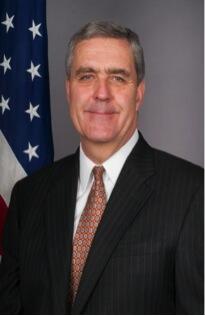
In August 2013, Douglas E. Lute was sworn-in as the Ambassador of the United States to the North Atlantic Treaty Organization (NATO). From 2007 to 2013, Lute served at the White House under Presidents Bush and Obama, first as the Assistant to the President and Deputy National Security Advisor for Iraq and Afghanistan, and more recently as the Deputy Assistant to the President focusing on Afghanistan, Pakistan and India. In 2010, AMB Lute retired from the U.S. Army as a Lieutenant General after 35 years on active duty. Prior to the White House, he served as the Director of Operations on the Joint Staff, overseeing U.S. military operations worldwide. He served multiple tours in NATO commands including duty in Germany during the Cold War and commanding U.S. forces in Kosovo. He holds degrees from the United States Military Academy and Harvard University.
A light lunch will be provided. Please plan to arrive by 11:30am to allow time to check in at the registration desk, pick up your lunch and be seated by 12:00 noon.
Co-sponsored by The Europe Center, the Freeman Spogli Institute for International Studies, the Center for International Security and Cooperation and the Center for Russian, East European and Eurasian Studies.
Douglas Lute
United States Ambassador to NATO
Speaker
Abstract: The first Snowden disclosure was that Verizon was providing daily updates of telephony metadata to the NSA. This caused great consternation, and resulted in two government studies, one by the President's NSA Review Committee and one by the Privacy and Civil Liberties Oversight Board. Both concluded the collection should be ended. The President asked Office of the Director of National Intelligence to produce a report "assessing the feasibility of creating software that would allow the intelligence community more easily to conduct targeted information acquisition rather than bulk collection." This talk reports on that work, which considered the issue from the angle of technical alternatives, and concluded that there is no technical replacement for bulk data collection, but that software can enhance targeted collection and automate control of data usage. This talk will discuss that report, conducted by the National Research Council, explaining what the report says — and what it doesn't say.
About the Speaker: Susan Landau is Professor of Cybersecurity Policy in the Department of Social Science and Policy Studies at Worcester Polytechnic Institute. Landau has been a senior staff Privacy Analyst at Google, a Distinguished Engineer at Sun Microsystems, a faculty member at the University of Massachusetts at Amherst and at Wesleyan University. She has held visiting positions at Harvard, Cornell, and Yale, and the Mathematical Sciences Research Institute. Landau is the author of Surveillance or Security? The Risks Posed by New Wiretapping Technologies (MIT Press, 2011), and co-author, with Whitfield Diffie, of Privacy on the Line: The Politics of Wiretapping and Encryption (MIT Press, 1998, rev. ed. 2007). She has written numerous scientific and policy research papers, and has also published in other venues, including Science,Scientific American, and the Washington Post. Landau has testified in Congress on cybersecurity and on electronic surveillance. Landau currently serves on the Computer Science Telecommunications Board of the National Research Council. A 2012 Guggenheim fellow, Landau was a 2010-2011 fellow at the Radcliffe Institute for Advanced Study, the recipient of the 2008 Women of Vision Social Impact Award, and also a fellow of the American Association for the Advancement of Science and the Association for Computing Machinery. She received her BA from Princeton, her MS from Cornell, and her PhD from MIT.
Encina Hall (2nd floor)
Susan Landau
Professor of Cybersecurity Policy in the Department of Social Science and Policy Studies
Speaker
Worcester Polytechnic Institute
Corporate leaders and government agencies must work more closely together to safeguard computer networks from cyber attacks, President Barack Obama said Friday during a speech at Stanford University.
“This has to be a shared mission,” Obama said. “Government cannot do this alone. But the private sector cannot do it alone, either.”
Following his 30-minute address, Obama signed an executive order creating a framework for how companies can better share cyber data with the government. Obama said the order creates “hubs” that will allow businesses to share security information with one another and will also give corporations access to classified threat information that could potentially help protect them.
And he stressed the need to balance privacy protection with a need for increased security against hackers who threaten the country’s economy and public safety.
“Grappling with how the government protects the American people from adverse events while making sure the government itself is not abusing its capabilities is hard,” Obama said. “The cyber world is the wild wild west. To some degree, we’re asked to be the sheriff.”
And he acknowledged that it’s more than reasonable to ask “what safeguards do we have against the government intruding on our own privacies?”
“When we go online, we shouldn’t have to forfeit the basic rights to privacy we have as Americans,” Obama said.
The president’s remarks were delivered during a White House Summit on Cybersecurity and Consumer Protection hosted at Stanford. The daylong event included panels moderated by Homeland Security Secretary Jeh Johnson and Commerce Secretary Penny Pritzker and attended by other government officials, Stanford scholars and the chief executives of major technology and health care companies, public utilities and financial institutions. He also surprised a group of Stanford students, including three honors students at FSI's Center for International Security and Cooperation, with an in-depth talk about global issues.
“Stanford’s proximity and sustained relationships with Silicon Valley are important assets in building a more secure cyber infrastructure,” Stanford President John Hennessy said in his welcoming remarks Friday morning. “But we need – and we have today – industry from across the country representing the many sectors that are connected to cyber systems.”
Friday’s summit came three months after Stanford launched a major Cyber Initiative. The initiative – funded with a $15 million grant from the William and Flora Hewlett Foundation – brings together faculty and researchers from across campus to address the challenges posed by cyber technologies. It also intends to connect their academic work with policymakers and industry leaders.
"This is the beginning of a new challenge for the government and a new field of study for us,” Michael McFaul, director and senior fellow at the university’s Freeman Spogli Institute for International Studies, said after the president’s remarks. McFaul, who is also a senior fellow at the Hoover Institution, served as Obama’s ambassador to Russia.
“For a president to come and talk about these issues is a huge boost to this as a subject of real inquiry. It's rare that the White House do a summit not at the White House. It shows the importance of this institution, the initiative and the collaboration that need to take place between universities, government and the private sector."
Obama ticked off a number of milestones that are the stuff of Stanford and Silicon Valley lore – the partnership between William Hewlett and David Packard, the creation of the computer mouse, the birth of Google, Yahoo, and dozens of other tech companies that have redefined how life is lived around the world.
“When we had to decide where to have this summit, the decision was easy,” Obama said, adding that Stanford is helping to “lead the way” technology is developed and used.
Those points resonated with students who were able to attend the speech after receiving tickets through a lottery.
"So much that is done in Silicon Valley got its start here," said Jason Chen, a sophomore interested in computer science and foreign languages. "Even though I don't know what exactly I'm going to do, what part I may contribute, (Obama) made us all connected to each other, part of the same community."
Obama also cited the university’s role in keeping a policy-relevant perspective when it comes to addressing issues of personal privacy and security against cyber threats. He also acknowledged the Stanford graduates and faculty members who have served in his administration – including Pritzker and McFaul; Valerie Jarrett, Obama’s senior adviser; Susan Rice, the U.S. ambassador to the United Nations; and Steven Chu, who served as Obama’s energy secretary.
President Obama meets with Stanford students, including three from the Honors Program at FSI's Center for International Security and Cooperation, at the White House Summit on Cybersecurity and Consumer Protection at Stanford University on Feb. 13, 2015.
The summit and Obama’s executive order come on the heels of high-profile computer network attacks that helped make the case for Obama to put cybersecurity at the top of his agenda. Hackers have breached the computer systems of federal agencies, Sony Pictures, Home Depot, Target, and Anthem – the nation’s second-largest health insurer.
The Obama administration also announced this week the creation of the Cyber Threat Intelligence Integration Center, which will share and help monitor cybersecurity intelligence gathered by government agencies.
Amy Zegart, co-director of the Center for International Security and Cooperation and a senior fellow at Hoover, said Stanford is an obvious place for Obama to discuss the responsibilities of tech companies when it comes to the safety of computer networks.
“The most important message that came across today is that this effort crosses all the traditional boundaries in academia, in industry, in government,” said Zegart, who has been a key player in the university’s Cyber Initiative and met with Obama just before the president delivered his remarks. “Cybersecurity is the ultimate team sport and the summit brought all the elements of the team together."
And Kathy Garcia, a sophomore majoring in management science and engineering, said the president spoke about cybersecurity and consumer protection in a way that everyone could understand.
"He made a good point that to be successful both the public and the private sectors have to work together," Garcia said
Before Obama’s remarks, Apple CEO Tim Cook talked about the privacy concerns that are inherent to data sharing. But he said the private sector and government agencies could work together to protect the safety and privacy of customers and citizens.
“Safeguarding the world of digitized personal information is an enormous task,” he said. “And no single company or organization can accomplish it on its own. That is why we’re committed to engaging productively with the White House and Congress and putting the results of these conversations into action.”
Other business leaders attending the summit agreed.
"I think the president is really trying to come to grips with a really big problem that's ever expanding,” said RSA executive chairman Art Coviello. “He's doing it by executive order, but as was said so many times today, we need congressional action as well. We also need to ensure that we create the trust that we need between government and private sector to ensure that we can have this public-private partnership. As a starting point, I think (the summit) was terrific, but let's see a lot of action coming out of it."
As weighty as the substance of his talk was, Obama opened his talk with some lighthearted comments about the bicycle-riding, fountain-splashing, Cardinal-obsessed Stanford students who have “made nerd cool.”
“Ambassador McFaul told me if I came to Stanford, you'd talk nerdy to me,” Obama said.
Then, getting to business, the president said: “I’m not just here to enjoy myself.”
A half-hour later, he signed his executive order and walked off the stage in Memorial Auditorium with a wave to the audience.
Brooke Donald, Beth Duff-Brown, Amy Adams, Kathleen Sullivan, Ker Than, Bjorn Carey and Tom Abate contributed to this report.
Hero Image
President Barack Obama onstage at the White House Summit on Cybersecurity and Consumer Protection on Feb. 13.
Abstract: What explains why the United States abandoned nuclear sharing schemes like the Multilateral Force in the 1960s, ultimately adopting a universalistic nonproliferation policy and the NPT? This paper argues that increased fears of nuclear domino effects caused by the 1964 Chinese nuclear tests were a crucial motivating factor, convincing policymakers that proliferation could not be contained to allied states and therefore had to be opposed across the board. As evidence for this claim, I draw heavily on archival evidence from the Eisenhower, Kennedy, and Johnson administrations. The paper demonstrates that when nuclear domino effects were perceived to be relatively weak in the 1950s and early 1960s, the United States favored expanding nuclear sharing arrangements; when fears of nuclear domino effects increased post-1964, this caused policymakers to turn away from these policies and conclude the NPT.
About the Speaker: Nicholas Miller is an assistant professor in the Department of Political Science and Watson Institute for International Studies at Brown University. His research focuses primarily on the causes and consequences of nuclear proliferation. He is currently working on a book manuscript that combines archival sources and quantitative analysis to examine the historical development and efficacy of U.S. nonproliferation policy. His work has been published in the American Political Science Review, International Organization, the Journal of Conflict Resolution, and Security Studies. He received his PhD in Political Science from MIT in 2014.
Nuclear Dominoes, US Nonproliferation Policy, and the NPT
Abstract: Imagine two guys. Second-generation Muslim-American Ahmad feels threatened by the ‘corrupting influences’ within his suburban factory town, detests his mother’s ‘western’ ways, and seeks out a radical imam for guidance. In contrast, Palestinian-born Mike worked as an Intel engineer, married an American Christian, and played company softball in his spare time. If only one is a terrorist, it is easy to pick out which one. Right? Wrong. Maher “Mike” Hawash served a six-year sentence for conspiring to aid the Taliban. Ahmad Mulloy is the fictional protagonist of John Updike’s novel, Terrorist.
It is easy to assume that terrorists are poorly integrated or disconnected from society. But this talk argues that such assumptions about the ‘typical terrorist’ are not only wrong, but dangerous. I argue that better immigrant integration will not stop terrorism – because most terrorists are just as well, if not better, integrated into western societies than other immigrants. Further, policies that exacerbate differences between immigrants and the native-born actually may facilitate radicalization of new terrorists; they provide new fuel for the argument that immigrants, and especially Muslims, are being disproportionately targeted.
About the Speaker: Betsy Cooper is a Law and International Security Postdoctoral Fellow with CISAC, working on projects related to state immigration policy. Dr. Cooper recently finished serving as a Yale Public Interest Fellow, working with the Department of Homeland Security's Office of Policy on Comprehensive Immigration Reform and related issues. She is a 2012 graduate of Yale Law School, after which she clerked for Judge William Fletcher on the Ninth Circuit Court of Appeals. Dr. Cooper is the author of over twenty manuscripts and articles on US and European immigration and refugee policy, and has consulted for Atlantic Philanthropies (Dublin, Ireland), the Prime Minister's Strategy Unit in London, the World Bank, and a number of immigration think tanks. In addition to her law degree, Betsy holds a DPhil in Politics from Oxford University, an M.Sc. in Forced Migration from Oxford University, and a B.A. in Industrial and Labor Relations from Cornell University.
Betsy Cooper is the founding Director of the Aspen Policy Academy. A cybersecurity expert, Dr. Cooper joined the Aspen Institute after serving as the Executive Director of the Berkeley Center for Long-Term Cybersecurity at the University of California, Berkeley.
Previously, Dr. Cooper served at the U.S. Department of Homeland Security as an attorney advisor to the Deputy General Counsel and as a policy counselor in the Office of Policy. She has worked for over a decade in homeland security consulting, managing projects for Atlantic Philanthropies in Dublin, the Prime Minister’s Strategy Unit in London, and the World Bank, and other organizations.
In addition, Dr. Cooper has clerked for Berkeley Law professor and Judge William Fletcher on the Ninth Circuit Court of Appeals. She completed a postdoctoral fellowship at Stanford’s Center for International Security and Cooperation (where she currently is a nonresident affiliate), as well as a Yale Public Interest Fellowship. Dr. Cooper has written more than twenty manuscripts and articles on U.S. and European homeland security policy. She is also a Senior Advisor at Albright Stonebridge Group.
Dr. Cooper earned a J.D. from Yale University, a D.Phil. in Politics from Oxford University, an M.Sc. in Forced Migration from Oxford University, and a B.A. in Industrial and Labor Relations from Cornell University. She speaks advanced French. She is based in the San Francisco Bay Area.
Hide publication sections
Off
Date Label
Betsy Cooper
Law and International Security Postdoctoral Fellow, CISAC
Speaker
CISAC
Abstract: The development and maintenance of a nuclear weapons arsenal is primarily about managing risk trade-offs. However, there is no integrated method for performing the high-level risk analysis that would allow for the more explicit examination of those trade-offs, or the testing of assumptions and alternatives. Quantitative risk analytic methods can provide powerful insights to policy and decision makers by explicitly examining estimates of consequences, disparate uncertainties, interdependencies, and trade-offs. Even the initial process of framing a formal risk analysis can provide increased clarity and valuable insights. I will present the current status of my efforts to construct a first version of a quantitative risk analytic method and the associated models. I will also discuss some of the challenges that must be addressed to fully implement those models, and my plans for further development.
About the Speaker: Jason C. Reinhardt is a national security systems analyst, and is currently pursuing a Ph.D. in Risk Analysis from Stanford University’s Department of Management Science and Engineering Engineering Risk Research Group, focusing on nuclear weapons arsenal management. Specifically, he is developing quantitative risk models to examine the trade-offs faced by nuclear armed nations in the process of disarmament. He is also pursuing research aimed at modeling and quantifying the catastrophic risks posed by near earth asteroid encounters. Other research interests include game theoretic applications to risk analysis and management, as well as adversary models. While at CISAC, he hopes to engage subject matter and policy experts to strengthen his modeling and analysis of nuclear weapon arsenal risk.
Prior to beginning his current studies, Jason managed a group of experts at Sandia National Laboratories that focused on technical studies to guide policy and decision makers across government. He joined Sandia National Laboratories in August of 2002, and has worked on a diverse set of projects both as an engineer and as an analyst, including the development of instrumentation for in-situ atmospheric measurement, embedded systems design, borders security analyses, and nuclear counter-terrorism strategy development.
He has worked extensively with the Department of Homeland Security on nuclear matters, and has also worked with the Department of Energy, the Department of Defense, the intelligence community, and within the national laboratory enterprise on a diverse array of national security projects. He has participated in the planning and hosting of international conferences and engagements, briefed congressional representatives, and served as a subject-matter expert on the topics of border security and nuclear and radiological defense.
Jason holds a B.S. in Electrical Engineering from the Purdue School of Electrical Engineering at Indianapolis, and a M.S. in Electrical Engineering from Stanford University.
Jason C. Reinhardt is a national security systems analyst, and is currently pursuing a Ph.D. in Risk Analysis from Stanford University’s Department of Management Science and Engineering Engineering Risk Research Group, focusing on nuclear weapons arsenal management. Specifically, he is developing quantitative risk models to examine the trade-offs faced by nuclear armed nations in the process of disarmament. He is also pursuing research aimed at modeling and quantifying the catastrophic risks posed by near earth asteroid encounters. Other research interests include game theoretic applications to risk analysis and management, as well as adversary models. While at CISAC, he hopes to engage subject matter and policy experts to strengthen his modeling and analysis of nuclear weapon arsenal risk.
Prior to beginning his current studies, Jason managed a group of experts at Sandia National Laboratories that focused on technical studies to guide policy and decision makers across government. He joined Sandia National Laboratories in August of 2002, and has worked on a diverse set of projects both as an engineer and as an analyst, including the development of instrumentation for in-situ atmospheric measurement, embedded systems design, borders security analyses, and nuclear counter-terrorism strategy development.
He has worked extensively with the Department of Homeland Security on nuclear matters, and has also worked with the Department of Energy, the Department of Defense, the intelligence community, and within the national laboratory enterprise on a diverse array of national security projects. He has participated in the planning and hosting of international conferences and engagements, briefed congressional representatives, and served as a subject-matter expert on the topics of border security and nuclear and radiological defense.
Jason holds a B.S. in Electrical Engineering from the Purdue School of Electrical Engineering at Indianapolis, and a M.S. in Electrical Engineering from Stanford University.
Jason Reinhardt
MacArthur Nuclear Security Predoctoral Fellow
Speaker
CISAC
The thirteenth session of the Korea-U.S. West Coast Strategic Forum, held in Seoul on December 11, 2014, convened senior South Korean and American policymakers, scholars and regional experts to discuss North Korea policy and recent developments in the Korean peninsula. Hosted by the Korea Program at the Walter H. Shorenstein Asia-Pacific Research Center at Stanford University, the Forum is also supported by the Korea National Diplomatic Academy.
Abstract: NSA stands for National Security Agency, but the agency is at odds with itself in its security mission. Undermining global encryption standards, intercepting Internet companies' data center transmissions, using auto-update to spread malware, and demanding law enforcement back doors in products and services are all business as usual. What legal basis does NSA and FBI have for these demands, and do they make the country more or less safe?
About the Speaker: Jennifer Granick started as the Stanford Law School Center for Internet and Society's (CIS) Director of Civil Liberties in June of 2012. She became an affiliate at the Center for International Security and Cooperation in July 2012.
Jennifer returned to Stanford after stints as General Counsel of entertainment company Worldstar Hip Hop and as counsel with the internet boutique firm of Zwillgen PLLC. Before that, she was the Civil Liberties Director at the Electronic Frontier Foundation. Jennifer practices, speaks and writes about computer crime and security, electronic surveillance, consumer privacy, data protection, copyright, trademark and the Digital Millennium Copyright Act.
From 2001 to 2007, Jennifer was Executive Director of CIS and taught Cyberlaw, Computer Crime Law, Internet intermediary liability, and Internet law and policy. Before teaching at Stanford, Jennifer spent almost a decade practicing criminal defense law in California. She was selected by Information Security magazine in 2003 as one of 20 "Women of Vision" in the computer security field. She earned her law degree from University of California, Hastings College of the Law and her undergraduate degree from the New College of the University of South Florida.
Encina Hall (2nd floor)
Jennifer Granick
Director of Civil Liberties at Stanford Center for Internet and Society
Speaker
Stanford University
When we consider national security, we typically think of protecting our borders, securing data and preventing disease and conflict. Winning wars.
The U.S. military is increasingly thinking about the final frontier as the last stand for strategic defense.
“Space is no longer the sanctuary it was 30 years ago; it is becoming increasingly congested, contested and competitive,” said Air Force Lt. Gen. John “Jay” Raymond, commander of the 14th Air Force and the Joint Functional Component Command for Space, within the U.S. Strategic Command.
“Our ultimate goal is to promote the safe and responsible use of space while we execute our mission of supporting the war-fighter through delivering space capabilities,” said Raymond, who recently invited a dozen scholars from CISAC and the Freeman Spogli Institute for International Studies to Vandenberg Air Force Base.
Raymond visited CISAC last year to open a dialogue on policy and strategy among Stanford scholars and the U.S. Strategic Command, one of nine unified commands in the Department of Defense. Raymond’s mandate includes space surveillance and control.
CISAC has had a long partnership with USSTRATCOM headquarters in Omaha, Neb., with fellows visiting officers there each year. Raymond is now looking to Stanford for a policy partnership with his commanders at the Air Force base on the California coast between San Francisco and Los Angeles.
“To continue to be the best in this business we have to constantly assess our current policies and operations while always keeping an eye toward future challenges,” Raymond said. “This is where a relationship with CISAC is invaluable. I saw this as a phenomenal opportunity to provide the fellows insight into the real-world challenges we are facing in the space domain – and to help support, stimulate and develop their academic pursuits.”
CISAC Co-Directors Amy Zegart and David Relman are taking the general up on the proposal. Zegart led the delegation that toured the Joint Space Operations Center and then held senior-level policy and strategy talks with two dozen officers and NASA officials.
The off-the-record talks were lively and frank. The sessions focused on foreign counter-space threats, space policy efforts with China and Russia, the growing problem of space debris and the policy debate over the use of cube satellites.
“We naturally think about national security challenges on land, under water, in the air, and even in cyberspace,” said Zegart, who is also a senior fellow at the Hoover Institution. “But space is playing an increasingly vital role in international security, whether it's the 23,000 pieces of debris the U.S. tracks every day that could hit vital satellites, or deliberate moves by some nations to develop counter-space capabilities. In many ways, space really is the final frontier in the international security landscape.”
Space Debris
The Joint Space Operations Center currently tracks 23,000 objects in orbit; only 1,400 of which are active payloads. Another estimated 500,000 pieces of orbital debris are too small to track. Events such as the Chinese anti-satellite missile test in 2007 and the Iridium-Cosmos collision in 2009 produced thousands of pieces of debris at already congested altitudes.
European Space Agency
“Debris in space, particularly at lower orbits, travels upwards of 17,000 mph and presents a significant danger to space assets,” Raymond said. “Last year alone, satellites operators around the world executed 121 collision-avoidance maneuvers to avoid hitting debris.”
The participants also discussed the fine balance of militarily protecting space systems against disruption, while allowing the open use of space in a globally connected economy.
U.S. Strategic Commander Admiral Cecil B. Haney spent a day at CISAC and Hoover last year and touched on the importance of space in the nation's 21st century deterrence program. He recently told a House Armed Services subcommittee that China space capabilities are now threatening U.S. strategic satellite systems. He noted Beijing conducted a test of a missile-fire, anti-satellite kill vehicle as recently as last summer.
As more countries develop space capabilities, the problem will grow, the admiral said, according to a Department of Defense news release on Feb. 6.
North Korea has been busy upgrading launch facilities, Haney said, and Iran just successfully launched a satellite into orbit after a string of failures.
Countries also are working to take away America’s strategic advantage in space, Haney said, with China and Russia warranting the most attention.
“Both countries have advanced directed-energy capabilities that could be used to track or blind satellites, disrupting key operations, and both have demonstrated the ability to perform complex maneuvers in space,” he said. Multiple countries already are frequently using military jamming capabilities designed to interfere with satellite communications and global positioning systems.
Rod Ewing, a senior FSI fellow and Frank Stanton Professor in Nuclear Security at CISAC, said after the meeting at Vandenberg that it was important to keep dialogue open with other nations about joint space operations and agreements.
“Of particular interest to me was the intersection of space command issues with those of the space programs of other countries,” Ewing said, “particularly the effort to keep track of space debris.”
U.S. Strategic Command currently has more than 50 Space Situational Awareness data-sharing agreements with partner nations, intergovernmental organizations and commercial entities worldwide. The most recent one was signed with the European Space Agency to provide the ESA with more timely and better data about satellite positions and radio-frequency details for planned orbit maneuvers.
Stephen Krasner, a senior fellow at FSI and a professor of international relations, is working on a paper about governance in space for the European Space Policy Institute and traveled with the Stanford group. He said few Americans realize how much the United States contributes to making the benefits of space available to all.
“The work of the space operations center and U.S. Strategic Command – in particular its tracking of all objects in space above 10cm and its commitment to notify all states of potential collisions – is one more example of the exceptional capacity of the American military and the contributions that the United States makes to providing global public goods.”
CubeSats: The democratization of space and proliferation of debris
Another space conundrum is the rapid growth of 3-pound satellites called CubeSats. Cal Poly and Stanford University developed specifications for the cube-shaped satellites to help graduate students perform space experiments and exploration.
There currently are some 160 CubeSats in space; another 2,000 to 2,750 are expected to launch by 2020. They are built to remain in orbit for more than 25 year, before falling back to Earth. Since 2005, the nanosatellites have been involved in more than 360,000 close approaches of less than 5 kilometers with other orbiting objects, according to a study by the University of Southampton.
“Last year alone over 100 cubesats were launched into orbit,” Raymond said. “This trend is stressing our ability to have domain awareness.”
Climate Satellite Launch
Raymond had invited the Stanford group to observe the launch of a NASA satellite that is collecting data to provide the most accurate high-resolution maps of soil moisture ever obtained. The three-year Soil Moisture Active Passive mission will map soil moisture around the world.
Though the launch was scrubbed the day the Stanford group visited, due to high winds, it went off two days later and the climate satellite is currently in orbit.
NASA is running a smart Twitter campaign @NASASMAP, which follows the work of the first Earth-observing satellite designed to collect data on saturated ground for climate scientists, weather forecasters, agricultural and water resource managers, disease and prevention experts, as well as emergency planners and policymakers.
“High-resolution, space-based measurements of soil moisture will give scientists a new capability to observe and predict natural hazards of extreme weather, climate change, floods and droughts, and will help reduce uncertainties in our understanding of Earth’s water, energy and carbon cycles,” Raymond said.
Matthew Daniels was a predoctoral fellow at CISAC last year and is now an engineer at NASA’s Ames Research Center who studies new mission concept for Earth-orbit satellites. He contributed greatly to the closed-door talks.
“I think it’s really important for engineers outside the U.S. government to talk to military and national security leaders about space projects," said Daniels, who helped create NASA-DARPA partnerships on new space projects.
“National security space projects are facing some big decisions in the years ahead,” Daniels said, such as whether to keep building the large, consolidated satellites or move some capabilities toward smaller distributed systems.
“These are decisions that involve a combination of physics, engineering, military choices and national policy," he said. “So I think it’s really important for groups like CISAC to come and have conversations with the military leadership."



 President Obama meets with Stanford students, including three from the Honors Program at FSI's Center for International Security and Cooperation, at the White House Summit on Cybersecurity and Consumer Protection at Stanford University on Feb. 13, 2015.

 European Space Agency
