Governance

FSI's research on the origins, character and consequences of government institutions spans continents and academic disciplines. The institute’s senior fellows and their colleagues across Stanford examine the principles of public administration and implementation. Their work focuses on how maternal health care is delivered in rural China, how public action can create wealth and eliminate poverty, and why U.S. immigration reform keeps stalling. 

FSI’s work includes comparative studies of how institutions help resolve policy and societal issues. Scholars aim to clearly define and make sense of the rule of law, examining how it is invoked and applied around the world. 

FSI researchers also investigate government services – trying to understand and measure how they work, whom they serve and how good they are. They assess energy services aimed at helping the poorest people around the world and explore public opinion on torture policies. The Children in Crisis project addresses how child health interventions interact with political reform. Specific research on governance, organizations and security capitalizes on FSI's longstanding interests and looks at how governance and organizational issues affect a nation’s ability to address security and international cooperation.

-

Seminar Recording: https://youtu.be/XFFT74SvaCM


Abstract: Pro-government militias have become a regular dimension of counterinsurgency operations, serving governments in fighting rebels locally. The level of violence employed by these irregulars, which often seems to exceed that of the regular army, but also the fascination with civilian fighters, have motivated students of counterinsurgency to pay more considerable attention to such actors in recent years. Much of this body of work has focused on the battlefield and tactical utilities of pro-government militias. However, these militias have other functions, which most of the studies tend to overlook, and that are socio-political in nature. Most notably, militias serve governments in their endeavors to divide societies, mainly by playing up parochial identities, such as tribalism and sectarianism, and playing up old rivalries. This function of militias has been particularly visible in cases of “defector militias,” namely militias composed of defectors from the rebel constituency to the government ranks. At least in some cases, these socio-political functions of militias have played no less significant role in governments’ decision to employ these forces than short-term battlefield needs. My study of pro-government defector militias uses two case studies: That of Iraq under the Ba‘th regime and its counterinsurgency efforts against Kurdish separatists in the north; and that of the Sudanese governments and their war against Southern rebels during the First Sudanese Civil War. Based on extensive archival, my work seeks to substantiate the argument about the strategic socio-political function of defector militias.


Speaker's Biography:

Image
yaniv voller
Yaniv Voller is a Lecturer (Assistant Professor) in the Politics of the Middle East at the School of Politics and International Relations, University of Kent. His research focuses on counterinsurgency, rebel governance and regional diplomacy in the Middle East. His book, The Kurdish Liberation Movement in Iraq: From Insurgency to Statehood, was published in 2014. His articles have appeared in International Affairs, Democratization, the Middle East Journal and the International Journal of Middle East studies, among others. He is currently working on projects relating to militia recruitment in counterinsurgency, ethnic defection, the impact of anti-colonial ideas in shaping post-colonial separatist strategies, and the role of diaspora communities as a transnational civil society. In 2018-2019 he was a Conflict Research Fellow at the LSE-based Conflict Research Programme, funded by the Department of International Development. Before moving to the University of Kent, he taught and held fellowships at the University of Edinburgh and the London School of Economics, where he obtained his PhD in International Relations.

Yaniv Voller University of Kent
Seminars
Authors
Steven Pifer
News Type
News
Date
Paragraphs

Congress has long weighed sanctions as a tool to block the Nord Stream II gas pipeline under the Baltic Sea from Russia to Germany. Unfortunately, it has mulled the question too long, and time has run out. With some 85% of the pipeline already laid, new congressional sanctions aimed at companies participating in the pipeline’s construction will not stop it. Instead, they will become a new bone of contention between the United States and Europe.

There is a smarter way for Congress to proceed, one that could avoid a U.S.-Europe spat while ensuring significant gas flows continue to transit through pipelines in Ukraine.

The giant Russian Gazprom parastatal company currently moves a large amount of gas through Ukraine to destinations located further west in Europe. In 2018, the volume totaled 87 billion cubic meters (BCM), shipped under a contract that expires at the end of 2019.

The Ukrainians would like to negotiate a new long-term contract, ideally, for 10 years. Russian negotiators, however, have proposed an agreement that would last only one year, anticipating completion in 2020 of Nord Stream II and a separate pipeline to Turkey. The two new pipelines will have a combined capacity of about 71 BCM, meaning that they could take most of the gas that now traverses pipelines through Ukraine.

These new pipelines reflect a decision taken by Moscow more than a decade ago to find ways to get gas to Europe that circumvent Ukraine. The Russian government and Gazprom seek to eliminate Gazprom’s dependence on Ukrainian pipelines as well as to end the transit fees that last year generated $3 billion in revenue for Kyiv.

As Russia has reduced its dependence on Ukraine for transiting gas, Kyiv stopped importing gas directly from Russia for Ukrainian use in 2015, instead bringing gas in from Poland, Hungary, and Slovakia. That gas fills about one-third of Ukraine’s needs, with domestic production satisfying the remainder.

The European Union has sought to facilitate agreement between Kyiv and Moscow on a new contract on gas transit. A deal so far has eluded negotiators, given the wide difference in proposals for a new contract’s duration and Russia’s unreasonable demand that Ukraine drop a $2.7 billion judgment it won against Gazprom.

That all raises questions as to what happens on January 1, 2020. Some suspect that, if there is no agreed contract, Gazprom might nevertheless continue to ship gas west via Ukrainian pipelines, daring Kyiv to stop the flow and incur the wrath of those European countries that depend on that gas.

European Union officials have suggested a 10-year contract with a provision requiring that 60 BCM of gas be shipped each year via Ukraine. While making clear her support for Nord Stream II, German Chancellor Angela Merkel also expressed support for Ukraine continuing to transit significant volumes of Russian gas.

Nord Stream II has concerned Congress, which fears the pipeline would deepen Europe’s dependence on Russian gas and would allow Gazprom to reduce the gas it ships via Ukraine, perhaps to a trickle. Committees in both houses of Congress have developed legislation to sanction companies involved in constructing the pipeline, particularly those owning the ships that are laying the pipes. However, given that the pipeline is almost complete and Congress has not yet passed the legislation, those sanctions could end up punishing European companies — but not actually stopping the pipeline.

It will prove difficult for Congress to make Europe cut its dependence on Russian gas. In any case, Nord Stream II is less about how much gas Europe buys from Russia than about how Russia ships that gas to European markets.

On the latter question, Congress could help protect gas transit through Ukraine. It could amend the legislation, perhaps by adding provisions to provide for waiving the Nord Stream II-related sanctions if a long-term gas transit contract were agreed on between Kyiv and Moscow, a contract that entailed a significant flow of gas through Ukraine. That would give EU negotiators and Merkel an additional incentive to broker an agreement sustaining significant gas transit revenues for Kyiv.

Clearly, Congress’s preferred solution is to block Nord Stream II. That now seems all but impossible. Congress still has a chance to facilitate a second-best outcome, one that would ensure that Ukraine could continue to take advantage of — and profit from — its position as a transit country for Russian gas while avoiding creation of a new area of disagreement with Europe. Congress should amend its legislation accordingly.


Originally for Brookings:https://www.brookings.edu/blog/order-from-chaos/2019/11/12/congress-nord-stream-ii-and-ukraine/

Hero Image
screen shot 2019 11 13 at 7 51 02 am
All News button
1
-

This event is cosponsored with the Stanford Woods Institute for the Environment


Seminar Recording: https://youtu.be/yMVJu1gmRFk


Abstract: Joshua Busby, University of Texas-Austin, will present the main argument and empirical work from his draft book manuscript. Over the past decade, a rich literature on the connections between climate change and security emerged, much of it quantitative on the links between climate change and violent internal conflict. In this book manuscript, Busby seeks to widen the aperture of security concerns to include major humanitarian emergencies. Through the study of paired cases, he explores why countries that face similar physical exposure to climate hazards experience different outcomes. His argument combines state capacity, the degree of political inclusion, and the role of international assistance to explain differences between countries as well as within countries over time. Countries with low state capacity, high political exclusion, and where assistance is denied or delivered in a one-sided manner are expected to have the worst security outcomes in the wake of exposure to climate hazards. While assistance can sometimes compensate for weak state capacity, improvements in capacity and inclusion can diminish the risks of climate-related emergencies and conflict. In this talk, Busby will compare the experience of Bangladesh, India, and Myanmar to cyclones.


Speaker's Biography:

Joshua Busby is an Associate Professor at the LBJ School of Public Affairs at the University of Texas-Austin. He is also a Senior Research Fellow at the Center for Climate and Security. He has been part of two U.S. Department of Defense-funded research projects on climate and security and his work on the topic has been published in Foreign Affairs, World Development, Climatic Change, Political Geography, International Security, Security Studies, among other publications.


Joshua Busby Associate Professor University of Texas-Austin
Seminars
Authors
Steven Pifer
News Type
News
Date
Paragraphs
Editor's Note:  The observations in this article are based on the author’s conversations with Ukrainians, both inside and outside of government, and others in Kyiv during an October 31-November 2, 2019 visit.
 

How do Ukrainians assess the performance and prospects of President Volodymyr Zelenskiy, now five months in office, as he tackles the country’s two largest challenges: resolving the war with Russia and implementing economic and anti-corruption reforms? In two words: cautious optimism. Many retain the optimism they felt when Zelenskiy swept into office this spring, elected with more than 70% of the vote. At the same time, they express caution about how his presidency will perform.

OPTIMISM

Almost everyone credits Zelenskiy with being open-minded and genuinely sincere in his desire to promote reform, make progress in ending the conflict with Russia in Donbas, and build a successful Ukrainian state. They see his young supporting team — the cabinet ministers’ average age is 39 — as energetic and pro-reform. They want to move quickly.

Zelenskiy has brought many new faces into his presidential office. Likewise, new faces populate the cabinet of ministers and his political party, Sluha Narodu (Servant of the People, which was also the name of his television show before he became president). These people went through their formative years in the mid 1990s and 2000s. Like Zelenskiy himself, they came of age after the collapse of the Soviet system.

Zelenskiy, moreover, has a position unique for Ukrainian presidents since the country regained independence in 1991. He has his own man as prime minister, and Sluha Narodu controls a solid majority of seats in the Rada (parliament). He thus is well positioned to press through reforms and other changes — and has every incentive to do so since, if things go badly, he will have no one to blame other than himself.

All of this generates optimism that, finally, Ukraine can make a definitive breakthrough and proceed quickly down the path to becoming a normal European state — what many joined the Maidan Revolution protests to achieve. However, cautions also arise.

CAPACITY TO MAKE DOMESTIC CHANGES?

Some question whether Zelenskiy’s team has the professional skills and intellectual capacity to manage the government and deliver real change. They have set some lofty ambitions. For example, Prime Minister Oleksiy Honcharuk has suggested the economy will grow by 40% in five years. Accomplishing that will prove a challenge. It will require a focused reform program and discipline among Sluha Narodu members in the Rada.

Whether Sluha Narodu can maintain the needed discipline is, for many, an open question. The party holds 252 of 423 seats in the Rada; another 27 seats that would represent Crimea, illegally annexed by Russia in 2014, or parts of Donbas occupied by Russian and Russian proxy forces, remain unfilled. As it takes 226 votes to pass legislation, Sluha Narodu has real political power. But questions have arisen about differences within the party, with some already seeing factions aligning with particular oligarchs. Lack of party unity could bode ill for Zelenskiy’s legislative agenda.

Another question concerns the nature of Zelenskiy’s relationship with oligarch Ihor Kolomoisky, who owns the television channel that broadcast Zelenskiy’s popular comedy show. A September Zelenskiy-Kolomoisky meeting in the presidential office undercut prior Zelenskiy assurances that Kolomoisky would have no influence over him.

The primary test case for that relationship remains Privatbank, in which Kolomoisky was a major shareholder. The National Bank of Ukraine nationalized Privatbank in 2016, after an audit revealed losses on the order of $5.5 billion. Kolomoisky has filed suit to reclaim his ownership share or wants $2 billion in compensation. He won a favorable ruling in a Ukrainian court earlier this year, though he lost a ruling in a parallel case in London.

Questions about Privatbank’s future have slowed consideration by the International Monetary Fund (IMF) of a new program of credits for Ukraine. If Kolomoisky were to prevail, that would almost certainly kill the IMF program. However, the ministers of finance and economy oppose any compromise with Kolomoisky, and Zelenskiy supporters point to statements by the president and his office that Zelenskiy will not let Kolomoisky win. They express frustration that those statements have not satisfied IMF officials.

Another concern is that Zelenskiy follows opinion polls too closely and adjusts his positions if they appear unpopular. For example, Zelenskiy came out shortly after his election in favor of allowing the sale of agricultural land (a moratorium on such sales dating back to the 1990s has proven a major impediment to development of Ukraine’s agricultural sector). Apparently based on poll results, he subsequently decided to limit sales to Ukrainian citizens. While it might not be surprising that he follows polls, his approval rating in early October exceeded 70% — wildly high by Ukrainian standards. He has political space to take controversial decisions that might go against pollsters’ findings.

PEACE, DONBAS, AND RUSSIA

The simmering conflict in eastern Ukraine, where Russian and Russian proxy forces occupy part of Donbas, has now entered its sixth year. Zelenskiy attaches top priority to ending that conflict and restoring Ukrainian sovereignty. He and his team justify this in real and understandable terms: More Ukrainian soldiers die each week along the line of contact. Moreover, they feel that now could offer their best opportunity to reach a settlement with Moscow.

Zelenskiy seeks a summit meeting of the “Normandy format,” which would involve Russian President Vladimir Putin, German Chancellor Angela Merkel, and French President Emmanuel Macron. To try to shake things loose on Donbas, Zelenskiy endorsed the Minsk agreements reached in 2014 and 2015, accepted the “Steinmeier formula” for implementation of Minsk (albeit reinterpreting its terms), and ordered Ukrainian military forces to disengage and pull back from the line of contact in two locations, with a third disengagement possible in the near future.

The president’s team hopes these steps will set up a summit meeting in which progress can be made or, failing that, the blame falls on Putin. Other Ukrainians worry, however, that Zelenskiy appears too eager for agreement. That could lead Putin to up his demands. They also question whether he has solid red lines on where to stop in any negotiation with the more experienced Russian leader.

CONCERN ABOUT RELATIONSHIPS WITH WEST

As Kyiv prepares for a possible Normandy format summit, Ukrainians are nervous about the backing they will receive from Germany and France. They note the decision to re-admit Russia to the Parliamentary Assembly of the Council of Europe, the nearing completion of the Nord Stream II gas pipeline, and the apparent French desire to move toward business as usual with Moscow and restore the G-8 by bringing Russia back in. All these actions strike Ukrainians as steps to return to a more normal Europe-Russia relationship, despite the fact that the Russians have done nothing to correct their aggressions of the past five-plus years.

Ukrainians also express nervousness about whether the congressional impeachment inquiry might lead to a reduction in U.S. support for Ukraine. Ukrainian officials note that Secretary of State Mike Pompeo’s decision last week to cancel a visit to Kyiv just two days after it was proposed did not help in this regard. Kyiv wants full U.S. backing as it prepares for the possible Normandy summit, especially as Ukrainians see the United States as the only Western country that can serve as a counterbalance to Russia.

SO, CAUTIOUS OPTIMISM

The bottom line is that Ukrainians are both optimistic and cautious about what Zelenskiy might achieve. Depending on whom one speaks to, the emphasis on optimism or caution varies, though caution seems to win out more than optimism, at least in the short term.

Zelenskiy faces two early tests: how he handles a Ukrainian-Russian-German-French summit meeting (assuming that it happens), and whether he can reassure the International Monetary Fund and others (both in Ukraine and in the West) that he will protect Privatbank and that there will be no compromise with Kolomoisky. These questions will affect judgments about Zelenskiy’s ability over the longer term to press forward with the kinds of economic reforms and anti-corruption measures that would enable a significant acceleration in Ukraine’s growth rate and in its movement toward European normalcy.


Originally for Brookings: https://www.brookings.edu/blog/order-from-chaos/2019/11/04/five-months-…

Hero Image
screen shot 2019 11 08 at 11 18 58 am
All News button
1
-

This event is co-sponsored with The Freeman Spogli Institute for International Studies


Seminar Recording: https://www.youtube.com/watch?v=-vHBvzWHcpw&feature=youtu.be


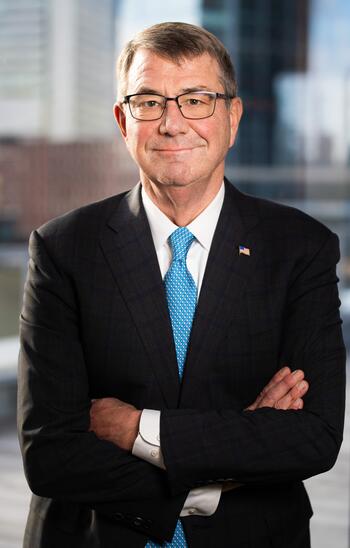
Abstract: The world’s largest organization is also one of its most mysterious. The Department of Defense (DOD) employs more men and women than Amazon, McDonald’s, FedEx, Target, and General Electric combined. Yet most Americans know little about it beyond its $700 billion budget and iconic five-sided headquarters. Now, the leader who knows the Pentagon best pulls back the curtain on an institution that many regard with a mix of awe and suspicion, revealing not just what it does but why, and why it matters. Former Secretary of Defense Ash Carter will offer an insider’s account of how America’s military works—and how it should work. It is also a timely reassessment of U.S. foreign policy and national security strategies in a rapidly changing world, and a timeless reflection on the leadership qualities essential to not only run but also reform a dauntingly complex organization. 


Speaker's Biography:

Image
2164204 carter ash1
For or over thirty-five years Ash Carter served in numerous jobs in the Department of Defense, mostly recently as the twenty-fifth Secretary of Defense under President Obama. He currently serves as the Director of the Belfer Center for Science and International Affairs at Harvard Kennedy School and an innovation fellow at MIT. He also is a Rhodes scholar with a PhD in nuclear physics.

Ash Carter 25th Secretary of Defense
Seminars
Authors
News Type
News
Date
Paragraphs

Following the death of ISIS leader Abu Bakr al-Baghdadi and the decision by President Donald Trump to remove U.S. troops from northern Syria, there are many questions surrounding the future of the region, which is controlled in part by Al-Qaeda-affiliated extremists, former Special Presidential Envoy for the Global Coalition to Defeat ISIS Brett McGurk told Freeman Spogli Institute for International Studies Director Michael McFaul on the World Class podcast.


ISIS initially gained momentum in Syria in 2012, when the government had eroded and a state of anarchy was developing, said McGurk, who is the Payne Distinguished Lecturer at the Center for International Security and Cooperation. “Starting in 2012 and 2013, thousands of foreign extremist fighters were pouring into Syria, looking for extremist groups to join. And Baghdadi’s guys — which became ISIS — basically took advantage of this.”

By 2014, ISIS controlled a territory with about eight million people and had revenues of about $1 billion a year, McGurk noted.

“I was an early advocate that we needed military force almost immediately,” he said. “To get someone recruited right into Syria, then go blow himself up at a kid’s soccer game, or an ice cream shop — if you have that pipeline, you know you have something pretty serious.” 

[Get stories like this delivered to your inbox by signing up for FSI email alerts]

The Anti-ISIS Strategy
In the summer of 2014, President Barack Obama decided to take action, with a few conditions: first, that the coalition against ISIS would be broad, and include countries outside of the United States; second, that U.S. troops would work with local partners in Iraq and Syria to fight the terror group; and third, that the coalition would share the costs and burdens associated with the military campaign.

“The campaign launched during the third week of August or so during that summer, and it was a real war,” McGurk said. “It was a very difficult, town-by-town struggle, but a successful war.”

The Death of al-Baghdadi
While al-Baghdadi will be replaced by a successor, the former ISIS leader is “somewhat irreplaceable,” said McGurk. He claimed to be a caliph — a religious leader in Islam believed to be a successor to the Prophet Mohammed — and in 2014 declared the territory controlled by ISIS in Iraq and Syria a caliphate, or Islamic state.

“People around the world who pledge allegiance to ISIS pledge allegiance to him — so Baghdadi is a unique figure,” McGurk said. “His removal from the scene is excellent news.”

Related: Read Brett McGurk’s thoughts on what it takes for U.S. foreign policy to succeed in the Middle East

Hero Image
Brett McGurk
Former Special Presidential Envoy for the Global Coalition to Counter ISIS Brett McGurk listens to questions from reporters during a Pentagon briefing May 19, 2017. Photo: Win McNamee - Getty Images
All News button
1
-
Livestream: This event will not be live-streamed or recorded.
 
Abstract: Seventy-five years after the introduction of nuclear weapons, it is no longer clear that these tools of security remain the most effective means of holding an adversary at risk.  This talk will examine whether there are alternatives to nuclear weapons for missions like deterrence, and asks whether policy attention ought to be rebalanced in view of a more modern understanding of risk. 
 
Speaker's Biography: 
R. Scott Kemp is the MIT Class of '43 Associate Professor of Nuclear Science and Engineering, and director of the MIT Laboratory for Nuclear Security and Policy.  His research combines physics, politics, and history to identify options for addressing societal problems in the areas of nuclear weapons and energy.  Scott received his undergraduate degree in physics from the University of California, Santa Barbara, and his Ph.D. in Public Policy from Princeton University. He is the recipient of the Sloan Research Fellowship in Physics, and is a Fellow of the American Physical Society
Scott Kemp Associate Professor of Nuclear Science and Engineering MIT
Seminars
Authors
Steven Pifer
News Type
Commentary
Date
Paragraphs

For more than two weeks now, a stream of current and former U.S. officials, this week including Amb. Bill Taylor, have described to Congressional committees the White House’s sordid effort to outsource American foreign policy to the president’s lawyer, Rudy Giuliani, who sought to advance the personal political interests of Donald Trump. Faced with compelling testimonies to the effect that the president subverted U.S. national interests to his own, the White House has begun to trash those officials.

Even for this White House, that is a despicable new low.

The testimonies make clear that President Trump insisted on a quid pro quo, as his Acting Chief of Staff Mick Mulvaney confirmed in an October 17 press conference (he later tried to walk it back, but watch the video of the press conference). The president wanted Ukrainian President Volodymyr Zelensky to investigate a long-debunked charge about former Vice President Joe Biden, his possible opponent in the 2020 U.S. presidential election. President Trump also wanted the Ukrainians to check whether the Democratic National Committee’s e-mail servers might have ended up in, of all places, Ukraine (no one has offered evidence to suggest that they have).

Hero Image
1 zlfekfbd3jlyp4lobtuefw
All News button
1
0
smith-heys_headshot.jpg

Colonel Jennifer Smith-Heys, PhD, is a senior U.S. Army intelligence officer with extensive experience across Army, joint, and interagency assignments. She specializes in analysis, collection management, intelligence, surveillance and reconnaissance (ISR) systems, joint targeting, and geospatial intelligence.

She has also contributed significantly to teaching and curriculum development, serving as an Instructor and Course Developer at the U.S. Army Military Intelligence Officer Basic Course (MIOBC), an Assistant Professor at the National Intelligence University (NIU), and as General Michael V. Hayden’s Teaching Assistant at the Schar School of Policy and Government at George Mason University (GMU).

Jennifer earned her PhD in Public Policy at GMU, where her research centers on intelligence oversight and reform. Her dissertation, A Roadmap to Reform: Building a Theory of Commissions, received both the 2025 Joseph L. Fisher Public Policy Award from GMU and the Bobby R. Inman Award from the University of Texas at Austin.

COL Smith-Heys’ assignments include:

2025-Present – Deputy Chief, Center for Defense Collection Management, Defense Intelligence Agency (DIA), Washington, DC

2022-2024 – Chief, Policy and Strategy, George. C. Marshall Center for European Security Studies, Garmisch-Partenkirchen, Germany

2022-2022 – Chief of Intelligence Analysis (J22), US Forces Korea (USFK), and Deputy C22, Combined Forces Command, Pyeongtaek, South Korea

2019-2020 – US Army War College Fellow at the Center for Security and International Cooperation (CISAC) at Stanford University

2018-2019 – Deputy Director for Intelligence, Joint Staff J2, National Military Command Center (NMCC), Pentagon, VA

2016-2018 – Assistant Professor, Collections and Analysis Department, School of Strategic Intelligence, National Intelligence University, Washington DC

2012-2013 - Deputy Military Executive to the Director, National Geospatial-Intelligence Agency (NGA), Springfield, VA

2011-2012 - Geospatial Intelligence (GEOINT) Collection Manager, International Security Assistance Forces (ISAF) Joint Command (IJC), Kabul, Afghanistan

2009-2001 - Airborne Operations Division Chief, National Geospatial-Intelligence Agency (NGA) Representative at the Defense Intelligence Agency (DIA), Washington, DC

2007-2009 - Chief, I Corps/Overseas Continental United States (OCONUS) Branch, US Army Human Resources Command (HRC), Alexandria, VA

2004-2006 - Company Commander, U.S. Army Akron-Canton Recruiting Company, Canton, OH

2002-2004 - Instructor and Course Developer, US Army Military Intelligence Basic Officer Course and 35C Geospatial Officer Training, US Army Intelligence Center of Excellence, Fort Huachuca, AZ

2001-2003 - Company Commander, Headquarters and Headquarters Support Company, 306th Military Intelligence Battalion, Fort Huachuca, AZ

1997-2000 – Company Executive Officer, Company Commander, and Targeting Officer, 513th Military Intelligence Brigade, Fort Gordon, GA

1989-1993 - Russian Electronic Warfare/Signals Intelligence Voice Interceptor, Field Station Kunia, Schofield Barracks, HI and Fort Huachuca, AZ

Her awards and decorations include the Defense Meritorious Service Medal, Meritorious Service Medal, Joint Service Commendation Medal, Army Commendation Medal, Joint Service Achievement Medal, Army Achievement Medal, Army Good Conduct Medal, and the Military Outstanding Volunteer Service Medal. Throughout her career, she has been recognized as Instructor of the Year, Soldier of the Year, and received the National Geospatial-Intelligence Agency’s (NGA) Woman of the Year award.

Affiliate
Date Label
Authors
Amy Zegart
News Type
Commentary
Date
Paragraphs

Smoking guns are the stuff of spy movies. In real-life intelligence-gathering, they are exceptionally rare. That’s why the business of intelligence typically requires collecting and analyzing fragments of information—putting together secret nuggets with unclassified information—to try to make sense of complex reality. If nothing else, the whistle-blower who filed a complaint against President Donald Trump clearly followed his or her training. SECOND PARAGRAPH I’ve spent 20 years reading intelligence reports and researching the U.S. intelligence community. And I’m not automatically inclined to believe the worst allegations about any administration; everyone has agendas and incentives to reveal information, some more noble than others. Trump and his allies have dismissed the complaint as hearsay and accused the whistle-blower of acting on political motives. But a close reading of the whistle-blower’s lengthy complaint, which accuses Trump of “using the power of his office to solicit interference from a foreign country in the 2020 U.S. election,” yields a lot of concrete leads for investigators to follow.

Here are three things I learned:


Read the rest at The Atlantic

Hero Image
lead 720 405
All News button
1
Subscribe to Governance