Security

FSI scholars produce research aimed at creating a safer world and examing the consequences of security policies on institutions and society. They look at longstanding issues including nuclear nonproliferation and the conflicts between countries like North and South Korea. But their research also examines new and emerging areas that transcend traditional borders – the drug war in Mexico and expanding terrorism networks. FSI researchers look at the changing methods of warfare with a focus on biosecurity and nuclear risk. They tackle cybersecurity with an eye toward privacy concerns and explore the implications of new actors like hackers.

Along with the changing face of conflict, terrorism and crime, FSI researchers study food security. They tackle the global problems of hunger, poverty and environmental degradation by generating knowledge and policy-relevant solutions. 

Authors
News Type
Q&As
Date
Paragraphs

Brett McGurk served as Special Presidential Envoy for the Global Coalition to Counter ISIL from Oct. 23, 2015 to Dec. 31, 2018. He was appointed to the post by former President Barack Obama, but the Donald Trump administration kept McGurk in the position until his resignation in the wake of Trump’s decision to withdraw troops from Syria. McGurk has worked in diplomacy for the past 15 years, including a stint from October 2014 to January 2016 as deputy assistant secretary of state for Iraq and Iran. He is currently a lecturer at the Freeman Spogli Institute. 

The Daily sat down to talk to McGurk about his career and his thoughts on the Middle East in the wake of the withdrawal of U.S. troops from Syria and ISIL leader Abu Bakr al-Baghdadi’s death.

The Stanford Daily (TSD): Could you talk a little bit about your transition from working in the government to lecturing at Stanford?

Brett McGurk (BM): I had the unique experience of serving at fairly senior levels with President Bush, Obama and then two years of President Trump — three very different presidents. I resigned from the Trump administration at the end of last year following his decision to abruptly abandon Syria, which was very contrary to what our established policy was. 

Read the Rest at The Stanford Daily

Hero Image
1599px brett mcgurk 171024 d pb383 016 37912859172
All News button
1

Not in residence

0
rsd19_072_0369a.jpg

Andrew Shaver is an assistant professor of political science at the University of California, Merced. Prior to that, he completed postdoctoral research fellowships at Stanford University's Political Science Department and, separately, at Dartmouth College, where he was also a lecturer. Professor Shaver earned his PhD in Public Affairs (security studies) from Princeton University's School of Public and International Affairs and completed his final year of the doctoral program as a predoctoral fellow at Harvard University's John F. Kennedy School of Government. He is also the founding director of the Political Violence Lab. His research focuses broadly on contemporary sub-state conflict and appears in the American Political Science Review, American Economic Review, Annual Review of Sociology, and Journal of Politics, amongst other outlets. Professor Shaver previously served in different foreign affairs/national security positions within the U.S. Government, including spending nearly one and a half years in Iraq during the U.S.-led war with the Pentagon.

Affiliate
-

Livestream: This event will not be live-streamed or recorded.


Abstract: When U.S. Senator Arthur Vandenberg famously told President Harry Truman that he’d have to “scare the hell out of the American people” to secure support for the coming Cold War, Vandenburg was tapping into a tried and true tradition of strategically cultivating fear to influence attitudes and change behavior. While this tactic has a long history of use, strikingly little has been written on precisely how, why, and when it actually works. In this talk, Professor Kelly M. Greenhill offers just such an explanation. Drawing upon findings from her next book, Fear and Present Danger: Extra-factual Sources of Threat Conception and Proliferation, Greenhill describes how and why cognitive and psychological biases can be triggered and strategically manipulated as means to political and military ends.


Greenhill further explains why actors engaged in this particular kind of cognitive hacking frequently eschew fact-based arguments in favor of “truthier” alternatives, such as rumors, conspiracy theories, propaganda, fiction and so-called fake news, sources she collectively refer to as “extra-factual information” (EFI). She identifies the conditions under which policymakers and the public tend to find EFI-infused threat narratives persuasive, and, drawing upon a wide array of historical examples, show that while information content and delivery platforms have changed, the underlying mechanisms that make this tool such an effective instrument of political influence, and EFI, such a useful handmaiden to it, have not. Greenhill highlights the implications of historical cases for our contemporary, EFI-saturated political environment and what current trends may portend for the future.


Speaker’s Biography: Kelly M. Greenhill (PhD, MIT) is a professor and Director of International Relations at Tufts University and Research Fellow at Harvard University’s Kennedy School. Greenhill has published four books, including Weapons of Mass Migration: Forced Displacement, Coercion, and Foreign Policy (winner of ISA’s Best Book of the Year Award); Sex, Drugs, and Body Counts: The Politics of Numbers in Global Crime and Conflict; The Use of Force: Military Power and International Politics; and Coercion: The Power to Hurt in International Politics. Outside of academia, Greenhill has consulted for the US government, UN, UNHCR, World Bank and Ford Foundation and worked as an analyst for the U.S. Defense Department. 


Kelly Greenhill Professor and Director of International Relations Tufts University
Seminars
-

This event is cosponsored with the Stanford Woods Institute for the Environment


Seminar Recording: https://youtu.be/yMVJu1gmRFk


Abstract: Joshua Busby, University of Texas-Austin, will present the main argument and empirical work from his draft book manuscript. Over the past decade, a rich literature on the connections between climate change and security emerged, much of it quantitative on the links between climate change and violent internal conflict. In this book manuscript, Busby seeks to widen the aperture of security concerns to include major humanitarian emergencies. Through the study of paired cases, he explores why countries that face similar physical exposure to climate hazards experience different outcomes. His argument combines state capacity, the degree of political inclusion, and the role of international assistance to explain differences between countries as well as within countries over time. Countries with low state capacity, high political exclusion, and where assistance is denied or delivered in a one-sided manner are expected to have the worst security outcomes in the wake of exposure to climate hazards. While assistance can sometimes compensate for weak state capacity, improvements in capacity and inclusion can diminish the risks of climate-related emergencies and conflict. In this talk, Busby will compare the experience of Bangladesh, India, and Myanmar to cyclones.


Speaker's Biography:

Joshua Busby is an Associate Professor at the LBJ School of Public Affairs at the University of Texas-Austin. He is also a Senior Research Fellow at the Center for Climate and Security. He has been part of two U.S. Department of Defense-funded research projects on climate and security and his work on the topic has been published in Foreign Affairs, World Development, Climatic Change, Political Geography, International Security, Security Studies, among other publications.


Joshua Busby Associate Professor University of Texas-Austin
Seminars
-

This event is co-sponsored with The Freeman Spogli Institute for International Studies


Seminar Recording: https://www.youtube.com/watch?v=-vHBvzWHcpw&feature=youtu.be


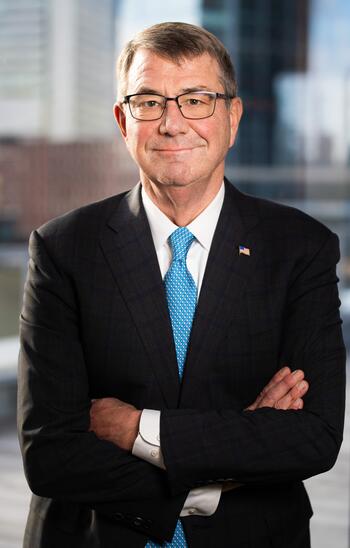
Abstract: The world’s largest organization is also one of its most mysterious. The Department of Defense (DOD) employs more men and women than Amazon, McDonald’s, FedEx, Target, and General Electric combined. Yet most Americans know little about it beyond its $700 billion budget and iconic five-sided headquarters. Now, the leader who knows the Pentagon best pulls back the curtain on an institution that many regard with a mix of awe and suspicion, revealing not just what it does but why, and why it matters. Former Secretary of Defense Ash Carter will offer an insider’s account of how America’s military works—and how it should work. It is also a timely reassessment of U.S. foreign policy and national security strategies in a rapidly changing world, and a timeless reflection on the leadership qualities essential to not only run but also reform a dauntingly complex organization. 


Speaker's Biography:

Image
2164204 carter ash1
For or over thirty-five years Ash Carter served in numerous jobs in the Department of Defense, mostly recently as the twenty-fifth Secretary of Defense under President Obama. He currently serves as the Director of the Belfer Center for Science and International Affairs at Harvard Kennedy School and an innovation fellow at MIT. He also is a Rhodes scholar with a PhD in nuclear physics.

Ash Carter 25th Secretary of Defense
Seminars
0
smith-heys_headshot.jpg

Colonel Jennifer Smith-Heys, PhD, is a senior U.S. Army intelligence officer with extensive experience across Army, joint, and interagency assignments. She specializes in analysis, collection management, intelligence, surveillance and reconnaissance (ISR) systems, joint targeting, and geospatial intelligence.

She has also contributed significantly to teaching and curriculum development, serving as an Instructor and Course Developer at the U.S. Army Military Intelligence Officer Basic Course (MIOBC), an Assistant Professor at the National Intelligence University (NIU), and as General Michael V. Hayden’s Teaching Assistant at the Schar School of Policy and Government at George Mason University (GMU).

Jennifer earned her PhD in Public Policy at GMU, where her research centers on intelligence oversight and reform. Her dissertation, A Roadmap to Reform: Building a Theory of Commissions, received both the 2025 Joseph L. Fisher Public Policy Award from GMU and the Bobby R. Inman Award from the University of Texas at Austin.

COL Smith-Heys’ assignments include:

2025-Present – Deputy Chief, Center for Defense Collection Management, Defense Intelligence Agency (DIA), Washington, DC

2022-2024 – Chief, Policy and Strategy, George. C. Marshall Center for European Security Studies, Garmisch-Partenkirchen, Germany

2022-2022 – Chief of Intelligence Analysis (J22), US Forces Korea (USFK), and Deputy C22, Combined Forces Command, Pyeongtaek, South Korea

2019-2020 – US Army War College Fellow at the Center for Security and International Cooperation (CISAC) at Stanford University

2018-2019 – Deputy Director for Intelligence, Joint Staff J2, National Military Command Center (NMCC), Pentagon, VA

2016-2018 – Assistant Professor, Collections and Analysis Department, School of Strategic Intelligence, National Intelligence University, Washington DC

2012-2013 - Deputy Military Executive to the Director, National Geospatial-Intelligence Agency (NGA), Springfield, VA

2011-2012 - Geospatial Intelligence (GEOINT) Collection Manager, International Security Assistance Forces (ISAF) Joint Command (IJC), Kabul, Afghanistan

2009-2001 - Airborne Operations Division Chief, National Geospatial-Intelligence Agency (NGA) Representative at the Defense Intelligence Agency (DIA), Washington, DC

2007-2009 - Chief, I Corps/Overseas Continental United States (OCONUS) Branch, US Army Human Resources Command (HRC), Alexandria, VA

2004-2006 - Company Commander, U.S. Army Akron-Canton Recruiting Company, Canton, OH

2002-2004 - Instructor and Course Developer, US Army Military Intelligence Basic Officer Course and 35C Geospatial Officer Training, US Army Intelligence Center of Excellence, Fort Huachuca, AZ

2001-2003 - Company Commander, Headquarters and Headquarters Support Company, 306th Military Intelligence Battalion, Fort Huachuca, AZ

1997-2000 – Company Executive Officer, Company Commander, and Targeting Officer, 513th Military Intelligence Brigade, Fort Gordon, GA

1989-1993 - Russian Electronic Warfare/Signals Intelligence Voice Interceptor, Field Station Kunia, Schofield Barracks, HI and Fort Huachuca, AZ

Her awards and decorations include the Defense Meritorious Service Medal, Meritorious Service Medal, Joint Service Commendation Medal, Army Commendation Medal, Joint Service Achievement Medal, Army Achievement Medal, Army Good Conduct Medal, and the Military Outstanding Volunteer Service Medal. Throughout her career, she has been recognized as Instructor of the Year, Soldier of the Year, and received the National Geospatial-Intelligence Agency’s (NGA) Woman of the Year award.

Affiliate
Date Label
0
dunnmonheadshot.jpg

Dr. Jared Dunnmon is currently the Cofounder and Chief Scientist of a maritime logistics startup.  He has previously served as the Technical Director for Artificial Intelligence at the Defense Innovation Unit (DIU), Vice President of Future Technologies at battery firm Our Next Energy (ONE), and a member of the early team at Snorkel AI. Prior to this, Jared was an Intelligence Community Postdoctoral Fellow in Computer Science at Stanford University, where he was advised by Prof. Chris Ré at the Stanford AI Lab. Jared holds a PhD in Mechanical Engineering from Stanford University (2017), a B.S. from Duke University, and both an MSc in Mathematical Modeling and Scientific Computing and an MBA from Oxford, where he studied as a Rhodes Scholar.

Affiliate
Date Label
-

Seminar Recording: https://youtu.be/8JDHuY0HMCM


Abstract: The motivation to develop nuclear energy waned in the latter part of the twentieth century. Technologies such as very-high-temperature gas-cooled reactors and fast-neutron liquid-metal reactors had been pursued for the purpose of recycling used nuclear fuel from water-cooled reactors, or for the purpose of supplying high-temperature process heat to the chemical industry or for hydrogen production. While both worthwhile causes, one could argue that the important missing element of all of these advanced nuclear reactor technologies was a business case: how were nuclear power plants to be profitable? With the more widely recognized need for decarbonizing energy production, the new driver for developing nuclear energy became cost. Can nuclear power be economically competitive with natural gas and coal, in order to provide an economic driver for the displacement of fossil fuel? This became the new motivation for nuclear energy development in the twenty-first century, and over the last decade the unthinkable happened: a growing and striving ecosystem of nuclear energy start-up companies. Many of these start-up companies pursue the development of liquid-fuel molten salt reactors, fueled by thorium or uranium fuel. Other start-up companies develop solid-fuel reactors cooled by salt, or even fusion reactors cooled by salt. The common feature of nuclear reactors that utilize molten salt is the operation at high-temperature and atmospheric pressure. The high temperature leads to doubled power efficiencies, compared to conventional water-cooled reactors. The atmospheric pressure leads to a safety case that is arguably easier to demonstrate, and hence that would enable a faster commercialization time.  On the other hand, there remain many technical risks and time-line uncertainties for the development of salt nuclear technologies. There remain also questions of policy, licensing, and compatibility with local industry and local culture, necessary elements for the global development of such nuclear reactors. This talk will explore some of the challenges faced by the global deployment of molten-salt and salt-cooled reactors, and some of the challenges faced by nuclear start-up companies in order to change the innovation cycle for nuclear energy technology from thirty years to a much shorter time frame.


Speaker's Biography:

Image
screen shot 2019 10 03 at 1 23 12 pm
Raluca Scarlat is an assistant professor at UC Berkeley, in the Department of Nuclear Engineering. Raluca Scarlat’s research focuses on chemistry, electrochemistry and physical chemistry of high-temperature inorganic fluids and their application to energy systems. Her research includes safety analysis, licensing and design of nuclear reactors and engineering ethics, and she has extensive experience in design and  safety analysis of fluoride-salt-cooled high-temperature reactors (FHRs) and Molten Salt Reactors (MSRs). Professor Scarlat has a Ph.D. in Nuclear Engineering from UC Berkeley, a certificate in Management of Technology from the Hass School of Business, and a B.S. in Chemical and Biomolecular Engineering from Cornell University. Scarlat has published articles in Electrochemical Society Journal, Journal of Fluorine Chemistry, Journal of Nuclear Materials, Nuclear Engineering and Design, Nuclear Instruments and Methods, Journal of Engineering for Gas Turbines and Power, Nuclear Technology, and Progress in Nuclear Energy.

Raluca Scarlat UC Berkeley
Seminars
-

Abstract: In 2013, the Obama Administration’s “Nuclear Employment Strategy” guidance announced that all war plans and operations would be “consistent with the fundamental principles of the Law of Armed Conflict” (LOAC). The Trump Administration’s 2018 Nuclear Posture Review repeated this commitment. The literature on nuclear strategy and deterrence in political science however, has either ignored these legal requirements or misunderstood them. The legal literature on nuclear weapons, however, has largely ignored the technical revolution regarding improved accuracy and lower-yield nuclear weapons and the different strategic contexts in which the U.S. might contemplate nuclear use. This paper analyzes how proper application of the Law of Armed Conflict should constrain U.S. nuclear doctrine and war planning and how knowledge of strategic considerations is fundamental to proper legal analysis. We argue that the principle of proportionality can permit “counter-force” targeting— most clearly when such attacks can prevent or significantly reduce the expected damage to U.S. and allied populations with lower foreign collateral damage. We also argue that the legal requirement to take “feasible precautions” to protect non-combatants means the U.S. must use conventional weapons or the lowest yield nuclear weapons possible in any counterforce attack. Finally, we contend that the prohibition against deliberate targeting of civilians has gained the status of customary international law and that the U.S. government should therefore reverse its traditional position and reject the doctrine of “belligerent reprisal” against foreign civilians. This prohibition means that it is illegal for the United States, contrary to what is implied in the 2018 NPR and explicitly maintained by prominent U.S. Air Force lawyers, to either intentionally target civilians in reprisal to a strike against U.S. or allied civilians, or launch attacks against legitimate military targets if the intent to is cause incidental civilian harm.


Speaker's Biography:

Image
sagan scott 2012 photo
Scott D. Sagan is the Caroline S.G. Munro Professor of Political Science, the Mimi and Peter Haas University Fellow in Undergraduate Education, and Senior Fellow at the Center for International Security and Cooperation and the Freeman Spogli Institute at Stanford University. He also serves as Chairman of the American Academy of Arts and Sciences’ Committee on International Security Studies. Before joining the Stanford faculty, Sagan was a lecturer in the Department of Government at Harvard University and served as special assistant to the director of the Organization of the Joint Chiefs of Staff in the Pentagon. Sagan has also served as a consultant to the office of the Secretary of Defense and at the Sandia National Laboratory and the Los Alamos National Laboratory. 

Sagan is the author of Moving Targets: Nuclear Strategy and National Security (Princeton University Press, 1989); The Limits of Safety: Organizations, Accidents, and Nuclear Weapons (Princeton University Press, 1993); and, with co-author Kenneth N. Waltz, The Spread of Nuclear Weapons: An Enduring Debate (W.W. Norton, 2012). He is the co-editor of Learning from a Disaster: Improving Nuclear Safety and Security after Fukushima (Stanford University Press, 2016) with Edward D. Blandford and co-editor of Insider Threats (Cornell University Press, 2017) with Matthew Bunn. Sagan was also the guest editor of a two-volume special issue of Daedalus: Ethics, Technology, and War (Fall 2016) and The Changing Rules of War (Winter 2017).

Recent publications include “Armed and Dangerous: When Dictators Get the Bomb” in Foreign Affairs (November/December 2018); “Not Just a War Theory: American Public Opinion on Ethics in Combat” with Benjamin A. Valentino in International Studies Quarterly (Fall 2018); The Korean Missile Crisis” in Foreign Affairs (November/December 2017); “Revisiting Hiroshima in Iran: What Americans Really Think About Using Nuclear Weapons and Killing Noncombatants” with Benjamin A. Valentino in International Security (Summer 2017); and “Atomic Aversion: Experimental Evidence on Taboos, Traditions, and the Non-Use of Nuclear Weapons” with Daryl G. Press and Benjamin A. Valentino in the American Political Science Review (February 2013).

In 2018, Sagan received the Andrew Carnegie Fellowship from the Carnegie Corporation of New York. In 2017, he received the International Studies Association’s Susan Strange Award which recognizes the scholar whose “singular intellect, assertiveness, and insight most challenge conventional wisdom and intellectual and organizational complacency" in the international studies community. Sagan was also the recipient of the National Academy of Sciences William and Katherine Estes Award in 2015, for his work addressing the risks of nuclear weapons and the causes of nuclear proliferation. The award, which is granted triennially, recognizes “research in any field of cognitive or behavioral science that advances understanding of issues relating to the risk of nuclear war.” In 2013, Sagan received the International Studies Association's International Security Studies Section Distinguished Scholar Award. He has also won four teaching awards: Stanford’s 1998-99 Dean’s Award for Distinguished Teaching; Stanford's 1996 Hoagland Prize for Undergraduate Teaching; the International Studies Association’s 2008 Innovative Teaching Award; and the Monterey Institute for International Studies’ Nonproliferation Education Award in 2009.


Image
weiner allen
Allen S. Weiner, JD ’89, is an international legal scholar with expertise in such wide-ranging fields as international and national security law, the law of war, international conflict resolution, and international criminal law (including transitional justice). His scholarship focuses on international law and the response to the contemporary security threats of international terrorism, the proliferation of weapons of mass destruction, and situations of widespread humanitarian atrocities. He also explores assertions by states of “war powers” under international law, domestic law, and just war theory in the context of asymmetric armed conflicts between states and nonstate armed groups and the response to terrorism. In the realm of international conflict resolution, his highly multidisciplinary work analyzes the barriers to resolving violent political conflicts, with a particular focus on the Israeli-Palestinian conflict. Weiner’s scholarship is deeply informed by experience; he practiced international law in the U.S. Department of State for more than a decade advising government policymakers, negotiating international agreements, and representing the United States in litigation before the International Criminal Tribunal for the former Yugoslavia, the International Court of Justice, and the Iran-United States Claims Tribunal.

Senior Lecturer Weiner is director of the Stanford Program in International and Comparative Law and co-director of the Stanford Center on International Conflict and Negotiation. Before joining the Stanford Law School faculty in 2003, Weiner served as legal counselor to the U.S. Embassy in The Hague and attorney adviser in the Office of the Legal Adviser of the U.S. Department of State. He was a law clerk to Judge John Steadman of the District of Columbia Court of Appeals.


Scott Sagan Professor of Political Science Stanford University
Allen Weiner Stanford University
Seminars
Paragraphs

About the Author: Marc Goodman has spent a career in law enforcement and technology. He was appointed futurist-in-residence with the FBI, worked as a senior adviser to Interpol, and served as a street police officer. As the founder of the Future Crimes Institute and the Chair for Policy, Law, and Ethics at Silicon Valley’s Singularity University, he continues to investigate the intriguing and often terrifying intersection of science and security, uncovering nascent threats and combating the darker sides of technology.

Read an Excerpt

CHAPTER 1
 
 
Connected, Dependent and Vulnerable


Technology…is a queer thing; it brings you great gifts with one hand and it stabs you in the back with the other.
-- CHARLES PERCY SNOW


Mat Honan’s life looked pretty good on-screen: in one tab of his browser were pictures of his new baby girl; in another streamed the tweets from his thousands of Twitter followers. As a reporter for Wired magazine in San Francisco, he was living an urbane and connected life and was as up-to-date on technology as anyone. Still, he had no idea his entire digital world could be erased in just a few keystrokes. Then, one August day, it was. His photographs, e-mails, and much more all fell into the hands of a hacker. Stolen in just minutes by a teenager halfway around the world. Honan was an easy target. We all are.
Honan recalls the afternoon when everything fell apart. He was play- ing on the floor with his infant daughter when suddenly his iPhone pow- ered down. Perhaps the battery had died. He was expecting an important call, so he plugged the phone into the outlet and rebooted. Rather than the usual start-up screen and apps, he saw a large white Apple logo and a mul- tilingual welcome screen inviting him to set up his new phone. How odd.
Honan wasn’t especially worried: he backed up his iPhone every night. His next step was perfectly obvious—log in to iCloud and restore the phone and its data. Upon logging in to his Apple account, he was informed that his password, the one he was sure was correct, had been deemed wrong by the iCloud gods. Honan, an astute reporter for the world’s preeminent technology magazine, had yet another trick up his sleeve. He would merely connect the iPhone to his laptop and restore his data from the hard drive on his local computer. What happened next made his heart sink.
As Honan powered up his Mac, he was greeted with a message from Apple’s calendar program advising him his Gmail password was incor- rect. Immediately thereafter, the face of his laptop—its beautiful screen— turned ashen gray and quit, as if it had died. The only thing visible on the screen was a prompt: please enter your four-digit password. Honan knew he had never set a password.
Honan ultimately learned that a hacker had gained access to his iCloud account, then used Apple’s handy “find my phone” feature to locate all of the electronic devices in Honan’s world. One by one, they were nuked. The hacker issued the “remote wipe” command, thereby erasing all of the data Honan had spent a lifetime accumulating. The first to fall was his iPhone, then his iPad. Last, but certainly not least, was his MacBook. In an instant, all of his data, including every baby picture he had taken during his daugh- ter’s first year of life, were destroyed. Gone too were the priceless photo- graphic memories of his relatives who had long since died, vanquished into the ether by parties unknown.
Next to be obliterated was Honan’s Google account. In the blink of an eye, the eight years of carefully curated Gmail messages were lost. Work conversations, notes, reminders, and memories wiped away with a click of a mouse. Finally, the hacker turned his intention to his ultimate target: Honan’s Twitter handle, @Mat. Not only was the account taken over, but the attacker used it to send racist and homophobic rants in Honan’s name to his thousands of followers.
In the aftermath of the online onslaught, Honan used his skills as an investigative reporter to piece together what had happened. He phoned Apple tech support in an effort to reclaim his iCloud account. After more than ninety minutes on the phone, Honan learned that “he” had just called thirty minutes prior to request his password be reset. As it turns out, the only information anybody needed to change Honan’s password was his billing address and the last four digits of his credit card number. Honan’s address was readily available on the Whois Internet domain record he had created when he built his personal Web site. Even if it hadn’t been, dozens of online services such as WhitePages.com and Spokeo would have pro- vided it for free.
To ascertain the last four digits of Honan’s credit card, the hacker guessed that Honan (like most of us) had an account on Amazon.com. He was correct. Armed with Honan’s full name and his e-mail and mailing addresses, the culprit contacted Amazon and successfully manipulated a customer service rep so as to gain access to the required last four credit card digits. Those simple steps and nothing more turned Honan’s life upside down. Although it didn’t happen in this case, the hacker could have just as easily used the very same information to access and pilfer Honan’s online bank and brokerage accounts.
The teenager who eventually came forward to take credit for the attack—Phobia, as he was known in hacking circles—claimed he was out to expose the vast security vulnerabilities of the Internet services we’ve come to rely on every day. Point made. Honan created a new Twitter account to communicate with his attacker. Phobia, using the @Mat account, agreed to follow Honan’s new account, and now the two could direct message each other. Honan asked Phobia the single question that was burning on his mind: Why? Why would you do this to me? As it turns out, the near decade of lost data and memories was merely collateral damage.
Phobia’s reply was chilling: “I honestly didn’t have any heat towards you . . . I just liked your [Twitter] username.” That was it. That’s all it was ever about—a prized three-letter Twitter handle. A hacker thousands of miles away liked it and simply wanted it for himself.
The thought that somebody with no “heat” toward you can obliterate your digital life in a few keystrokes is absurd. When Honan’s story appeared on the cover of Wired in December 2012, it garnered considerable atten- tion . . . for a minute or two. A debate on how to better secure our every- day technologie ensued but, like so many Internet discussions, ultimately flamed out. Precious little has changed since Honan’s trials and tribula- tions. We are still every bit as vulnerable as Honan was then—and even more so as we ratchet up our dependency on hackable mobile and cloud- based applications.
As with most of us, Honan’s various accounts were linked to one another in a self-referential web of purported digital trust: the same credit card number on an Apple profile and an Amazon account; an iCloud e-mail address that points back to Gmail. Each had information in common, including log-on credentials, credit card numbers, and passwords with all the data connected back to the same person. Honan’s security protections amounted to nothing more than a digital Maginot Line—an overlapping house of cards that came tumbling down with the slightest pressure. All or most of the information needed to destroy his digital life, or yours, is readily available online to anybody who is the least bit devious or creative.


Progress and Peril in a Connected World
 
In a few years’ time, with very little self-reflection, we’ve sprinted headlong from merely searching Google to relying on it for directions, calendars, address books, video, entertainment, voice mail, and telephone calls. One billion of us have posted our most intimate details on Facebook and will- ingly provided social networking graphs of our friends, family, and co- workers. We’ve downloaded billions of apps, and we rely on them to help us accomplish everything from banking and cooking to archiving baby pictures. We connect to the Internet via our laptops, mobile phones, iPads, TiVos, cable boxes, PS3s, Blu-rays, Nintendos, HDTVs, Rokus, Xboxes, and Apple TVs.
The positive aspects of this technological evolution are manifest. Over the past hundred years, rapid advances in medical science mean that the average human life span has more than doubled and child mortality has plummeted by a factor of ten. Average per capita income adjusted for infla- tion around the world has tripled. Access to a high-quality education, so elusive to many for so long, is free today via Web sites such as the Khan Academy. And the mobile phone is singularly credited with leading to bil- lions upon billions of dollars in direct economic development in nations around the globe.
The interconnectivity the Internet provides through its fundamental architecture means that disparate peoples from around the world can be brought together as never before. A woman in Chicago can play Words with Friends with a total stranger in the Netherlands. A physician in Bangalore, India, can remotely read and interpret the X-ray results of a patient in Boca Raton, Florida. A farmer in South Africa can use his mobile phone to access the same crop data as a PhD candidate at MIT. This interconnect- edness is one of the Internet’s greatest strengths, and as it grows in size, so too does the global network’s power and utility. There is much to celebrate in our modern technological world.
While the advantages of the online world are well documented and frequently highlighted by those in the tech industry, there is also a down- side to all of this interconnectivity.
Our electrical grids, air traffic control networks, fire department dis- patch systems, and even the elevators at work are all critically dependent on computers. Each day, we plug more and more of our daily lives into the global information grid without pausing to ask what it all means. Mat Honan found out the hard way, as have thousands of others. But what should happen if and when the technological trappings of our modern society—the foundational tools upon which we are utterly dependent—all go away? What is humanity’s backup plan? In fact, none exists.

All Publications button
1
Publication Type
Books
Publication Date
Journal Publisher
Penguin Random House LLC
Authors
Subscribe to Security