Energy

This image is having trouble loading!FSI researchers examine the role of energy sources from regulatory, economic and societal angles. The Program on Energy and Sustainable Development (PESD) investigates how the production and consumption of energy affect human welfare and environmental quality. Professors assess natural gas and coal markets, as well as the smart energy grid and how to create effective climate policy in an imperfect world. This includes how state-owned enterprises – like oil companies – affect energy markets around the world. Regulatory barriers are examined for understanding obstacles to lowering carbon in energy services. Realistic cap and trade policies in California are studied, as is the creation of a giant coal market in China.

Authors
David Holloway
News Type
Commentary
Date
Paragraphs

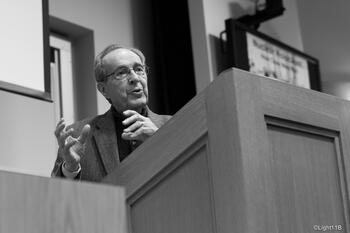
The following are remarks by Professor David Holloway at the Sid Drell Symposium on Fundamental Physics given at SLAC on 12 January 2018.


I want to thank the organizers for inviting me to speak at this conference. It’s a particular pleasure for me as a historian and political scientist to be a speaker at a symposium on Fundamental Physics. More seriously it is an honor for me to speak at a symposium in memory of Sid Drell, with whom I had the privilege to work for over thirty years. Sid agreed with Einstein that politics was much harder to study than physics. “The laws of physics stay the same,” he said. “The laws of politics change. And besides, you are supping with the Devil.”

Sakharov

My topic is Sid’s friendship with Andrei Sakharov, whom Sid greatly admired and more than once referred to as a saint. Sakharov was born in Moscow in 1921, five years before Sid. He died in 1989. I don’t want to go through Sakharov’s life, but I do want to mention a couple of things to provide context for Sid’s meetings with him and for their friendship. Sakharov’s mentor, Igor Tamm – a Nobel Prize-wining physicist – drew Sakharov into work on the design of thermonuclear weapons in 1948. From 1950 to 1968 Sakharov lived and worked in Arzamas-16 (now Sarov), the Soviet equivalent of Los Alamos. He played a key role in the development of Soviet thermonuclear weapons.

In 1968 Sakharov was removed from secret work after an essay he had written – Reflections on Progress, Peaceful Coexistence, and Intellectual Freedom – was published abroad. In the opening paragraph Sakharov states that his views were formed in the milieu of the scientific-technical intelligentsia, which was very worried about the future of humankind. Their concern, he continued, was all the stronger because what he called "the scientific method of directing politics, economics, art, education, and military affairs" had not yet become a reality. What did he mean by the "scientific method" in this context? His answer: "We consider 'scientific' that method which is based on a profound study of facts, theories, views, presupposing unprejudiced and open discussion, which is dispassionate in its conclusions." In other words, Sakharov wanted open discussion of important policy issues – something that did not happen in the Soviet Union.

Image
Drell, Yelena Bonner, and Sakharov, c.1976

In his essay Sakharov expressed ideas he had been coming to for some time, but the immediate stimulus to his writing the essay appears to have been that he was refused permission to publish an article about ABM systems. He (and other senior scientists at Arzamas-16) had come to the conclusion that “creating ABM defenses against massed attacks is not realistic, while for individual missiles it is difficult but possible.” Sakharov had written to Mikhail Suslov, an ideologically rigid Politburo member, whom he had met, expressing this view and asking for permission to publish an article on ABM systems. Suslov had denied him permission.

The publication of the essay abroad converted Sakharov from a scientist engaged in secret work into a world-famous figure. The essay sold 18 million copies in one year (it was printed in full in many newspapers).

I mention this episode and this essay to show that Sakharov, like Sid, was interested not only in physics but also profoundly interested in the application of science to policy, something that Sid had begun to do, starting in 1960 with Panofsky’s encouragement. It was the publication of the essay abroad that got Sakharov expelled from secret work. It is only then that he began to turn his attention to the defense of human rights in the Soviet Union, especially after 1970, when he met Elena Bonner, whom he married in 1972. In 1975 he was awarded the Nobel Peace Prize for his work for human rights. In his 1968 essay he had seen intellectual freedom as crucial for progress – how else could we deal with environmental degradation and the danger of thermonuclear war? In his Nobel lecture, Peace, Progress, and Human Rights, he named over one hundred of the political prisoners being held in the Soviet Union. He also made the general point that peace, progress, and human rights were indissolubly linked. For progress to be beneficial and peace secure, human rights (freedom of conscience, freedom of assembly, freedom of expression etc.) had to be protected. Thus the rights of the individual were intimately linked to our capacity to deal with global problems facing the human race.

Sid and Sakharov meet

In the early 1970s Sakharov was under intense pressure to curtail his activities, This came from the authorities and also from fellow members of the Academy of Sciences. That was the state of affairs in 1974 when he and Sid had their first meeting, which took place in Moscow, at a small conference on composite nucleon structure. Sid recalled “what I considered a great compliment to me, he apparently knew enough about me through whomever to sit down next to me at the meeting.” In his memoirs Sakharov writes of this meeting that Sid was a “young man,” “already a very well-known physicist.” They exchanged notes because Sakharov’s English was very poor and Sid’s Russian even worse. They could both get along a little bit in German. Sakharov then asked Sid about people in the West and invited Sid (and Viki Weisskopf) to dinner at his apartment on Chkalov Street (ulitsa Chkalova) where they met Elena Bonner and Bonner’s daughter Tanya Yankelevich, who was probably the person who made the conversation possible. 

At that first meeting Sid and Sakharov formed a bond. They met again two years later at a High Energy International Meeting in Tbilisi. Sakharov and Bonner were both there. Sid spent a week with them, forming a close and warm rapport.

Sid maintained a steady correspondence with both Sakharov and Bonner. In the late 1970s much of this correspondence had to do with the repression of human rights in the Soviet Union and the persecution of physicists (and others). Sid was particularly helpful to Elena Bonner’s children in Boston, Efrem and Tanya Yankelevich. He also did what he could to keep Sakharov’s name – and his plight – in the news. He made sure Sakharov’s papers were published in the West; he helped to organize conferences on Sakharov, and to keep Sakharov’s name in the public mind. He was not alone in this – there was an organization called SOS (Sakharov, Orlov, and Shcharansky) founded at Berkeley – but he was one of a few, and he was persistent.

There is a touching letter from Sakharov to Sid in June 1981:

“Dear Sidney, I want to write to you this time not an ‘open’ but a most ordinary letter, to thank you from the bottom of my heart. Lusia [Elena Bonner] and I feel all the time that in that infinitely distant world to which our children have been mislaid and where they now live, there are some (very few) people who have not forgotten them or us, and you are one of them.” And then Sakharov writes, perhaps rather slyly in view of Sid’s liking for Madras jackets: “I sense that almost physically, seeing you in my mind’s eye in your check suit (although perhaps you now dress differently.)”

In 1978 Sid wrote N.N. Bogoliubov to explain that he would not take part in a Dubna-sponsored symposium on Elementary Particle Theory because of the way the physicist Yuri Orlov was being treated. Orlov had been condemned to seven years in the GULAG for documenting Soviet infringements of human rights, contrary to Soviet commitments in the Helsinki Final Act of 1975. Sid told Bogoliubov that he was very sorry to miss what would doubtless be a stimulating symposium and that he hoped the conditions would soon return for normal scientific collaboration.

The “Open Letter”

 Sakharov was arrested in January 1980 and exiled to Gorkii for criticizing the Soviet intervention in Afghanistan. Gorkii was a closed city; foreigners could not travel there. Up to that point Sakharov had been able to use the prestige he had won by his role in nuclear weapons development to avoid arrest, though he had been under considerable social and political pressure from the authorities. In Gorkii he was cut off from Moscow, though Elena Bonner was able, at least initially, to travel back and forth from Gorkii to Moscow.

In 1982 Sid was invited by the Soviet government to visit Moscow to talk to high-level government and military officials about arms control. He made it a condition that he be allowed to see Bonner; and in fact he did so in a meeting arranged by the American Embassy. Sid gave her papers and copies of recent speeches he had made about arms control to take back to Gorkii.

Among those papers was a lecture Sid had given at Grace Cathedral and also recent Congressional testimony. Those statements prompted Sakharov to write one of his most important papers: “On the Danger of Thermonuclear War – an open letter to Dr. Sidney Drell,” which was published in the Summer 1983 issue of Foreign Affairs. The paper caused a great stir, because it intervened on a particular issue in an American debate about strategic weapons policy. Sakharov expressed qualified support for deployment by the US of the heavy MX ICBM.

Sid replied in a letter to Sakharov, pointing out the many areas of agreement between them that Sakharov had discussed in his letter: the dangers and the scale of disaster of nuclear war, which would be an act of suicide with no winners; the sole purpose of nuclear weapons being to deter nuclear aggression; the importance of parity in conventional arms in order not to feel driven to a nuclear “first use” policy; the grave dangers of escalation once the nuclear threshold was crossed; the overriding importance of arms negotiations and reductions; and the unlikelihood that a “star wars” ABM system would be practical.

Sid justified his opposition to the MX by noting that the silo-based system would be vulnerable to destruction in a Soviet first strike and therefore was essentially a first-strike weapon itself, because it would have to be used first if it were to be used at all.

In his memoirs Sakharov wrote: “I consider [Drell] a friend. For many years Drell was an advisor to the US government on questions of nuclear policy and disarmament. In a series of articles and presentations in recent years he has formulated his position on these questions. I fully share Drell’s basic principled positions, but I can’t completely agree with those assertions relating to recent actions, to assessments of the existing military and political situation, to the ways of attaining the goal of all reasonable people of eliminating the danger of nuclear war.” Then, in a note added in October 1983, he wrote that after reading Sid’s response he thought their differences were not so great after all.

After 1986

Through the years of Sakharov’s exile to Gorkii Sid kept up his activities on Sakharov’s behalf. In January 1986 he wrote an eloquent letter to Mikhail Gorbachev, who had become General Secretary in March the year before, urging him to allow Sakharov to return to Moscow from Gorkii. Gorbachev allowed Sakharov to come back to Moscow in December 1986. That Sid’s letter played a role in this decision seems unlikely, but the campaign for Sakharov in which Sid played such a large part surely was an important factor in Gorbachev’s decision, for it kept Sakharov in the public eye and meant that Gorbachev had to make a decision. Sid visited Moscow in the summer of 1987, seeing Sakharov for the first time in eleven years.

Sid made the comment that if you met Sakharov you would know he was an extraordinary person. Thanks to Sid, I had the opportunity to spend an evening with Sakharov in Moscow in June 1987, and my impression confirms Sid’s judgment. I talked to Sakharov about his role in the nuclear weapons program. I remember as I approached his front door thinking, “What am I doing here? This man has very important things to do in Russian public life. Why am I bothering him with my historical research?” Within a minute of his opening the door that feeling was gone. His personal charm made me feel totally at ease and he seemed very happy to talk about his life at Arzamas-16. Two impressions from that meeting: first, Sakharov did not speak quickly. If you asked a question, you could sense his mind turning like a searchlight and illuminating the issue you had brought up. Second, he had a clear, but detached, understanding of his own importance in Soviet history. I recalled at the time that one of the characteristics the Catholic Church looks for in a candidate for sainthood is the person’s awareness of their own holiness, but that awareness should be devoid of all arrogance. Humility does not mean denying one’s own gifts or role in life, but it does mean not taking the credit for oneself.

Drell, Sakharov, and Panofsky at Stanford,1989 Drell, Sakharov, and Panofsky at Stanford,1989

In August 1989 Sakharov and Bonner visited Stanford. There was a physics meeting, I think, but what I remember is the talk Sakharov and Elena Bonner gave at CISAC, in Galvez House. 1989 was a tempestuous year in Soviet politics. Sakharov had been elected in March to the new Congress of People’s Deputies and at the first session of the Congress he had been the focal point of several tumultuous debates. He and Elena Bonner talked about that and discussed three broader issues: the constitutional issue; the question of nationalities; and the question of property. It was an extraordinary session. Four months later Sakharov died in his sleep in his apartment, a huge loss for the Soviet Union and the world.

Conclusion

The friendship between Sid and Sakharov was a genuine and close one, though they did not meet often. But they had maintained a correspondence during the difficult years between 1976 and 1987, and Sid had done whatever he could to help Sakharov and his family. The two men were in some ways alike. Physicists of course, and theoretical physicists. They had similar views on nuclear weapons. They were both greatly interested in the implications of new technologies.

The main similarity that strikes me, however, is their integrity. They both took their ethical responsibilities seriously. They thought about what was right, but once they decided what that was, they stuck with it, even if it looked like stubbornness to others. They had a commitment to do what they thought was right, and that was especially important when you engaged in policy or in politics – for then, in Sid’s words, you were “supping with the Devil.” The situations in which Sid and Sakharov found themselves were of course very different, but I think that integrity was there in both of them. Sid greatly admired Sakharov’s moral courage – he saw it as heroic, tantamount to sainthood. And my sense is that Sakharov recognized the same quality in Sid.

I want to end by reading from a poem by Boris Pasternak, which I think captures that quality. It was written in 1956 and addressed to himself. But it can be applied to physicists too. Sakharov organized his obituary of his mentor, Igor Tamm, around this poem. And I hope you will agree that the qualities Sakharov admired in Tamm are qualities we saw in Sid too. It is a short poem, and I will read only part of it, in my own (inadequate) translation.

It’s not becoming to be famous,

For that is not what lifts us up.

So do not build yourself an archive

Or pore over your manuscripts.


To be creative, give of yourself.

Don’t seek sensation, or success.

It’s shameful, when you don’t signify,

To be on everybody’s lips.


But live your life without imposture,

And live it so that, in the end,

You hear the summons of the future

And draw love in from far and wide.


…….


And never for a single moment

Renounce your true self, or pretend.

But be alive, alive and only

Alive and only, to the end.


Boris Pasternak 1956


All News button
1
-

Please note that this event is canceled. We regret the inconvenience.

Abstract: Clean energy provides a number of benefits at scales from household to village to city and region. An unrealized and under-appreciated opportunity is to transition conflict regions from external fuel supply chains to local, clean and unpolluting energy. The benefits of this transition include local energy security to shared benefits from sustaining local generation capacity, which we term 'peace through grids'.  

Speaker bio: Daniel M. Kammen is a Professor of Energy at the University of California, Berkeley, with parallel appointments in the Energy and Resources Group where he serves as Chair, the Goldman School of Public Policy where he directs the Center for Environmental Policy, and the department of Nuclear Engineering. Kammen is the founding director of the Renewable and Appropriate Energy Laboratory (RAEL; http://rael.berkeley.edu), and was Director of the Transportation Sustainability Research Center from 2007 - 2015.

He was appointed by then Secretary of State Hilary Clinton in April 2010 as the first energy fellow of the Environment and Climate Partnership for the Americas (ECPA) initiative. He began service as the Science Envoy for U. S. Secretary of State John Kerry in 2016, but resigned over President Trump’s policies in August 2017. He has served the State of California and US federal government in expert and advisory capacities, including time at the US Environmental Protection Agency, US Department of Energy, the Agency for International Development (USAID) and the Office of Science and Technology Policy

Dr. Kammen was educated in physics at Cornell (BA 1984) and Harvard (MA 1986; PhD 1988), and held postdoctoral positions at the California Institute of Technology and Harvard. He was an Assistant Professor and Chair of the Science, Technology and Environmental Policy Program at the Woodrow Wilson School at Princeton University before moving to the University of California, Berkeley. Dr. Kammen has served as a contributing or coordinating lead author on various reports of the Intergovernmental Panel on Climate Change since 1999. The IPCC shared the 2007 Nobel Peace Prize.

Kammen helped found over 10 companies, including Enphase that went public in 2012, Renewable Funding (Renew Financial) a Property Assessed Clean Energy (PACE) implementing company that went public in 2014. Kammen played a central role in developing the successful bid for the $500 million energy biosciences institute funded by BP.

During 2010-2011 Kammen served as the World Bank Group’s first Chief Technical Specialist for Renewable Energy and Energy Efficiency. While there, Kammen worked on the Kenya-Ethiopia “green corridor” transmission project, Morocco’s green transformation, the 10-year energy strategy for the World Bank, and on investing in household energy and gender equity. He was appointed to this newly created position in October 2010, in which he provided strategic leadership on policy, technical, and operational fronts. The aim is to enhance the operational impact of the Bank’s renewable energy and energy efficiency activities while expanding the institution’s role as an enabler of global dialogue on moving energy development to a cleaner and more sustainable pathway. Kammen’s work at the World Bank included funding electrified personal and municipal vehicles in China, and the $1.24 billion transmission project linking renewable energy assets in Kenya and Ethiopia.

He has authored or co-authored 12 books, written more than 300 peer-reviewed journal publications, and has testified more than 40 times to U.S. state and federal congressional briefings, and has provided various governments with more than 50 technical reports. For details see http://rael.berkeley.edu/publications. Dr. Kammen also served for many years on the Technical Review Board of the Global Environment Facility. He is the Specialty Chief Editor for Understanding Earth and Its Resources for Frontiers for Young Minds.

Kammen is a frequent contributor to or commentator in international news media, including Newsweek, Time, The New York Times, The Guardian, and The Financial Times. Kammen has appeared on ‘60 Minutes’ (twice), NOVA, Frontline, and hosted the six-part Discovery Channel series Ecopolis. Dr. Kammen is a Permanent Fellow of the African Academy of Sciences, a fellow of the American Academy for the Advancement of Science, and the American Physical Society. In the US, he has served on several National Academy of Sciences boards and panels.

Daniel M. Kammen Professor of Energy University of California, Berkeley
Seminars
Authors
News Type
News
Date
Paragraphs

The same logic that kept a nuclear war from breaking out between the United States and former Soviet Union is the best strategy to now pursue with North Korea, several scholars said Tuesday at Stanford.

The panel, convened at Stanford’s Center for International Security and Cooperation (CISAC), included political scientist Scott D. Sagan of CISAC; political scientist Mira Rapp-Hooper of Yale University; and political scientist Vipin Narang of MIT. The moderator was James D. Fearon, a political scientist at the Freeman Spogli Institute for International Studies. The event was titled “Can the U.S. Deter a Nuclear North Korea” and held in the William J. Perry Conference Room in Encina Hall.

Nuclear decision-making

The discussion revolved around whether North Korea will have the ability to strike the U.S. with nuclear warheads, and can the U.S. depend on a deterrence strategy like it did during the Cold War?

Deterrence theory holds that nuclear weapons are intended to deter other states from attacking with their nuclear weapons, through the promise of retaliation and possibly mutually assured destruction 

Sagan, who recently wrote an essay in Foreign Affairs magazine on the North Korea nuclear crisis, said he has come to decide deterrence is the best approach to the issue.

“I am not one who gladly listens to the siren song of nuclear deterrence,” he said, noting that while he is a self-described dove on disarmament issues, he is more hawkish on allowing countries to obtain nuclear weapons, which deterrence implies. “I accept deterrence reluctantly.”

In North Korea, he said, no military alternatives exist to solve the problem. For example, even if a decapitation strike were successful – and several U.S. attempts have failed in the past with regard to Saddam Hussein and Muammar Gaddafi – there’s no way to know if North Korean leader Kim Jong-un has already given his generals the green light to unleash nuclear or powerful conventional attacks in the case of his demise.

For Sagan, deterrence is a more complicated issue today than during the Cold War when the U.S. and U.S.S.R. were rational actors with thousands of nuclear weapons. He is especially concerned with the rhetoric and the preventive war suggestions emanating from the Trump Administration.

Senior U.S. military leaders, Sagan said, have a duty not to follow “impaired-decision making” that might come from the president. He invoked the prospect of using the Cabinet and the 25th Amendment to halt such an order and remove the president from office. Currently, he belives the nuclear decision process is problematic, as the president alone can directly order the Strategic Air Command to launch nuclear weapons.

Sagan advises that a revised nuclear chain of command should include both the U.S. Secretary of Defense and the U.S. Attorney General. A U.S. Senate hearing, led by Sen. Bob Corker, is actually studying the nuclear authorization process due to concerns with Trump's rhetoric and escalation of the North Korean issue.

“We need more checks on how we decide to use nuclear weapons,” said Sagan, who studies nuclear strategy, ethics and war, public opinion about the use of force, and nuclear non-proliferation and arms control.

He noted that U.S. National Security Advisor H.R McMaster recently criticized his predecessor, Susan Rice, for saying the U.S. could "tolerate" nuclear weapons in North Korea the same way we tolerated nuclear weapons in the Soviet Union​.

He quoted McMaster: “'A regime that poses a continuous threat to the its neighbors in the region and now may pose a threat, direct threat, to the United States with weapons of mass destruction? A regime that imprisons and murders anyone who seems to oppose that regime, including members of his own family, using sarin nerve gas in a public airport?'”

But Sagan said we have long tolerated such authoritarian regimes that have nuclear weapons. 

Stumbling accidentally into war with North Korea also seems like a rising risk. On Sept. 27, several U.S. service members and their families received a fraudulent “noncombatant evacuation operation” order via text and social media, he said. The fake notices were quickly reported up the chain of command and the U.S. issued a statement denouncing their validity – the perpetrators have not been found. But Sagan says it illustrates how easy it is to create a situation where North Korea felt a U.S. invasion and attack is imminent – and as a result, could choose to unleash a nuclear first strike.

‘Western fantasy’

Narang, who was once a CISAC visiting assistant professor, studies nuclear proliferation and strategy, South Asian security, and general security studies.

“Deterrence is your friend,” he said in explaining why it can work with North Korea. If the U.S. believes North Korea seeks to preserve its regime – a status quo intention – then deterrence theory works much like it did with the former Soviet Union.

On the other hand, if the U.S. believes North Korea has darker motives, such as reunifying the Korean peninsula through an invasion, then that perspective could lead to a U.S. first strike. Also, the existing U.S. demand of rolling back North Korea’s nuclear program – “denuclearization” – is a “Western fantasy.” They will not give up nuclear weapons, he said.

He said the U.S. does not like to be deterred from making a first strike – as in preventive war – but that is what it must accept if it decides to follow the deterrence course. North Korea, once it possesses an ICBM capable of hitting the U.S. mainland, would pose such a deterrence in the balance of power between the two countries.

“The good news is that deterrence can work, coupled with coercive diplomacy,” Narang said. “We know how to play this game.”

He believes Jong-un is a rational actor, though a cruel dictator. “There’s nothing to suggest he’s crazy.” Ultimately, he said, an effective deterrence policy depends on clarity, consistency, coherence and communications.

U.S. nuclear shield, alliances

An expert on security in the Asia-Pacific region and alliance politics, Rapp-Hooper talked about the U.S. relationships, especially with Japan and South Korea, and the “nuclear shield” over these countries that those agreements offer. As a result, neither country has developed nuclear weapons.

This dynamic, however, could change if a North Korean missile could reach the U.S., said Rapp-Hooper, who earned a bachelor’s degree in history at Stanford.

“North Korea is eroding U.S. security guarantees over time,” she said, adding that once those missiles are capable of hitting a U.S. city, would the U.S. government still protect Seoul from attack and let an American city be hit?

The Korean situation, Rapp-Hooper said, is much different than Europe in the Cold War, when such an American nuclear shield existed against a Soviet invasion. Many different U.S. agreements exist now than during that time; no U.S. nuclear weapons are forwardly deployed in northeast Asia, like in Europe then; and the unilateral threats coming from the Trump Administration are unprecedented in nuclear diplomacy.

On the latter point, she called it the “Trump multiplier” effect. “That’s the most exacerbating thing of all,” she said, noting that elements of the White staff are pushing a “better-use-it-now” or preventive attack approach, whereas Secretary of Defense James Mattis and Secretary of State Rex Tillerson see North Korea as more concerned with preserving its regime.

Sagan also pointed out how President Trump’s speech at the United Nations in September led to a realization among the North Koreans that they had no choice but to continue to develop nuclear weapons.

That’s when the president said, “’Rocket Man is on a suicide mission for himself and for his regime,’” Sagan noted.

​He then recalled Kim Jong Un’s response to Trump’s speech, quoting the North Korean leader: “’His remarks which described the U.S. option through straightforward expression of his will have convinced me, rather than frightening or stopping me, that the path I chose is correct and that it is the one I have to follow to the last.’”​


Hero Image
gettyimages 847114660
The same logic – deterrence – that kept the United States and the former Soviet Union from nuclear war is the best option to deal with North Korea, scholars said Tuesday at Stanford.
Getty Images/Chung Sung-Jun
All News button
1
Authors
News Type
News
Date
Paragraphs

The Center for International Security and Cooperation now has more than 46 podcasts, dating all the way back to Oct. 19, 2016. Listen to them on the CISAC page on the iTunes website. Simply mouse over the title and click play. Open iTunes to download and subscribe to CISAC podcasts. Seminars and events at CISAC are routinely audiotaped for use as podcasts. Also, the Freeman Spogli Institute for International Relations offers the World Class podcast series, featuring scholars and experts from FSI, CISAC and beyond.

Hero Image
gettyimages 513740370 Getty Images/Blackzheep
All News button
1
Authors
News Type
News
Date
Paragraphs

CISAC's Siegfried Hecker this week won the Dwight D. Eisenhower award from the American Nuclear Society. He received the honor, along with former Senator Richard Lugar (R-IN) and former Senator Sam Nunn (D-GA), for his "historic achievements in the advancement of nuclear nonproliferation, arms control, and peaceful uses of nuclear energy." The annoucement from the American Nuclear Society noted:

"Dr. Siegfried Hecker, an international expert in plutonium metallurgy, is being recognized for his nuclear non–proliferation efforts during and following his tenure as the Director of the Los Alamos National Laboratory. Dr. Hecker was part of a historic visit by a U.S. delegation to Sarov, Russia, known as Arazamas-16 during the Cold War.  This was the first visit to the closed city by the U.S., and it laid the foundation for a series of programs aimed at securing nuclear materials in Russia and all of its former republics. Dr. Hecker’s current research at Stanford University’s Center for International Security and Cooperation is focused on reducing the risks of nuclear terrorism worldwide, the nuclear challenges in India, North Korea, Pakistan, and the nuclear aspirations of Iran."

Hero Image
26183981372 1cabdb35f7 k Courtesy of CISAC
All News button
1
News Type
News
Date
Paragraphs

CISAC co-director Amy Zegart wrote the following essay in the Oct. 25 online edition of The Atlantic:

Pity the professionals. In the past month, President Trump has sideswiped certification of the Iran nuclear deal, sandbagged his own secretary of state’s diplomatic efforts with North Korea, and even provoked the ever-careful Senate Foreign Relations Committee Chairman, Bob Corker, to uncork his deepest fears in a series of bombshell interviews. “The volatility, is you know, to anyone who has been around, is to a degree alarming,” Corker told the Times earlier this month, revealing that many in the administration were working overtime to keep the president from “the path to World War III.” He doubled down on those comments a few weeks later, declaring that Trump, among other things, was “taking us on a path to combat” with North Korea and should “leave it to the professionals for a while.”

The professionals sure have their hands full. So far, the Trump Doctrine in foreign policy appears to consist of three elements: baiting adversaries, rattling allies, and scaring the crap out of Congress. The administration has injected strategic instability into world politics, undermining alliances and institutions, hastening bad trends, and igniting festering crises across the globe. “America first” looks increasingly like “America alone.” The indispensable nation is becoming the unreliable one. Even without a nuclear disaster, the damage inflicted by the Trump presidency won’t be undone for years, if ever.

But it’s also important to understand that today’s foreign-policy challenges— whether it’s Iran’s hegemonic ambitions in the Middle East, North Korea’s breakneck nuclear breakout, China’s rise, Russia’s nihilism, Europe’s populism and fragmentation, Syria’s civil war, or transnational terrorism and cyber threats—did not start with Trump. This is the most challenging foreign-policy environment any White House has confronted in modern history.

Three swirling complexities explain why.

Threat complexity

Take a look at any of the annual threat assessments issued by the Director of National Intelligence over the past few years. They will make your head spin. They are filled with rising states, declining states, weak states, rogue states, terrorists, hackers, and more. Bad actors don’t just threaten physical space these days. Adversaries are working on ways to cripple America in cyberspace and even outer space—by compromising all those satellite systems on which its digital society depends. In this threat landscape, the number, identity, magnitude, and velocity of dangers facing America are all wildly uncertain. Exactly how many principal adversaries does the United States have? Who are they and what do they want? What could they do to us? How are these threats changing and how can we keep up without spending ourselves into oblivion or leaving ourselves vulnerable to other nasty surprises? These are fundamental questions. There are no consensus answers. Uncertainty is what fuels America’s foreign-policy anxieties today.

The Cold War was different. Then, certainty was what fueled American foreign-policy anxieties. It was clear to all that the U.S. faced a single principal adversary. The Soviet Union had territory on a map and soldiers in uniforms. Thanks to U.S. intelligence, Soviet intentions and capabilities were fairly well understood. The threat landscape was deadly but slower-moving: Communists never met a five-year plan they didn’t like. And while superpower nuclear dangers were terrifying, they were also constraining in a helpful but insane sort of way. In 1961, President Kennedy invoked the specter of a “nuclear sword of Damocles, hanging by the slenderest of threads” over the earth. Every American foreign-policy decision had to consider the question: What would Moscow think of that? Today, the nuclear sword of Damocles is still hanging—indeed, China, India, Pakistan, and North Korea have all successfully tested nuclear devices since 1961—but no singular threat guides U.S. foreign policy as the Soviet Union once did.

Organizational complexity

As threats have grown more complex, organizational arrangements to deal with them have, too. Coordinating Soviet policy was one thing. Developing coherent U.S. foreign policy in the face of so much uncertainty across so many issues is quite another. Little wonder special advisers, envoys, commissions, boards, initiatives, czars, and new agencies have been growing like mushrooms. This may not sound so bad. But it is. Every new agency or czar or special arrangement says, “the regular process here ain’t working.” The crux of the problem is that bureaucracies are notoriously hard to kill or change. Ronald Reagan famously quipped that bureaucracy is the closest thing to immortal life on earth. Whenever a crisis hits, the natural response is to add a new organization and stir. But if today’s chief challenge is developing coherent, coordinated policy in the face of complexity, creating more organizations to coordinate doesn’t get you very far. Over time, the whole bureaucratic universe just keeps growing bigger, filled with obsolete organizations alongside new organizations; fragmented jurisdictions, overlapping jurisdictions, and unclear jurisdictions; and silos so specialized that nobody can see across all the key issues easily.

Cognitive complexity

Humans are not superhuman. Research finds that most people can remember at most seven items at a time, fewer as they grow older. Even the biggest brains have limits. In 2001, Peter Pronovost of Johns Hopkins noticed that highly trained medical teams at the university’s medical center were screwing up insertions of central line catheters, causing infections in critically ill patients at alarming rates. Why? Because they often forgot one of just five simple steps (like washing their hands) before starting the procedure. (Pronovost instituted a checklist that has since become widely used and is credited with saving thousands of lives.)

In foreign policy, too, the stakes are high and humans are frequently overloaded by complexity, resulting in catastrophic errors that nobody ever intended. One of the chief findings of the 9/11 Commission, for example, was that many inside the FBI simply didn’t know or couldn’t remember all the legal requirements and rules for sharing intelligence and law-enforcement information. Even the Bureau’s own 1995 guidelines were “almost immediately misunderstood and misapplied,” the commission concluded. As a result, clues to the terror plot emerged weeks before 9/11 but were marooned in different parts of the bureaucracy.

In 1935, an advanced bomber nicknamed “the Flying Fortress” crashed during a test flight. The Army Air Corps investigation found that the machine worked fine. The problem was the human. The airplane was so sophisticated, flying required the pilot to remember too many things, and he forgot one of them: unlocking the rudder and elevator controls during takeoff. It was “too much airplane for one man to fly,” one reporter later wrote. That crash sparked the invention of pilot checklists which have been used for nearly a century, transforming global aviation.

U.S. foreign policy is becoming too much airplane for one person to fly. “The professionals” surrounding Trump—Secretaries James Mattis and Rex Tillerson, Chief of Staff John Kelly, National-Security Adviser H.R. McMaster, and others—are trying to keep the whole thing from crashing with a pilot who has never flown before. Let’s hope they can.

America’s approach to the world is a complicated mess, for reasons that predate the current president.

Amy Zegart is co-director of the Center for International Security and Cooperation and professor of political science, by courtesy. She is also the Davies Family Senior Fellow at the Hoover Institution and directs the Cyber Policy Program. She wrote this essay as a contributing editor to The Atlantic.


Hero Image
gettyimages 600691942 Getty Images/tzahiV
All News button
1
Authors
News Type
News
Date
Paragraphs

Deep policy discussions between journalists and top Stanford scholars highlighted a recent media roundtable at the Hoover Institution.

The event drew about 30 members of the national media from a variety of print and broadcast outlets, including CNN, CBS, The New York Times, Wall Street Journal, MSNBC, The Washington Post, and Politico.  The two-day media roundtable on Oct. 15-16 was titled, “Outside the Beltway.”

Over the course of the two-day conference, participants engaged in robust discussions with Hoover Institution fellows and Freeman Spogli Institute for International Studies scholars, including former U.S. Secretary of State and Hoover and FSI senior fellow Condoleeza Rice, who kicked off the event with a foreign policy conversation.

Drones and cybersecurity, for example, were topics of conversation for Amy Zegart and Herb Lin from the Center for International Security and Cooperation (CISAC).

Drones and new warfare

Zegart said, “New technology is being used in ways never imagined ... The question is, could drones be next?”

Drones are possible “coercion tools,” more effective than people would believe, Zegart said. “We need to figure out how the logic works with coercion, in regard to states.”

How do you get others to back down without a fight? You need to issue a costly threat, she said. For example, “trip-wire” forces of more than 20,000 in South Korea represent such a credible threat to North Korea. “Low-cost is low credibility,” or “cheap talk,” on the other hand.

Drones lower the cost of coercion, Zegart said. One point is that such strikes have huge public support, as the risk of U.S. casualties are very low, according to polls – 62 percent favor such drone strikes.

Zegart said drones could shift the “relative costs” of war and are better able to sustain military action over a lengthy time frame. They also affect the “psychology of punishment.” Hovering over a target for long periods of time, decapitation strikes against regime leaders, and the constant state of “near-ambush” changes the character of war and for a military campaign to stay the course.

“Certainty of punishment is a very powerful way to change the behavior of the adversary,” moreso than “severity of punishment, said Zegart, who has affirmed these conclusions through surveys with foreign military officers. That research also showed that domestic political support for military reaction is the most popular reason for making threats credible. But a deeper dive into such issues is urged, she added.

“We’re really behind the curve in figuring out how to make military threats credible in the world,” said Zegart. “Lots of questions remain.”

Hacking, information attacks

Lin spoke about the recent Equifax data hacking, among other topics.

He said, “The harm we all feel is both tangible and intangible” in regard to such hacks. In other words, there is both material threat and a peace of mind threat, he explained.

The “Internet-of-Things” is another looming problem, Lin said. In the future, liability issues will factor into how all these devices are connected and who is responsible in case of misdeeds, he said.

In the case of health care, confidentiality is a critical societal goal, but hacking creates numerous scenarios: “Would you prefer your blood type posted online or changed in your medical records,” Lin said, explaining the different ways information misuse may affect people.

On the global security front, “cyber war” takes advantage of the flaws of information technology (IT), and “information warfare” takes advantage of the virtues of IT, he noted. Such efforts begin to level the playing field between international actors and agencies.

“You give large megaphones to small players,” Lin said.

In Russia, information warfare is actually studied as a theory of warfare. And the results show that it works – it’s easier to destroy democratic  values online than create or reinforce them, Lin said. For example, Russia’s meddling in the 2016 elect stoked political polarization in America.

One media member asked Lin how the U.S. could prevent Russia from using cyber and information warfare in upcoming U.S. elections.

Lin said, “It’s not clear to me that the U.S. government is really going to be willing to do anything,” but some public pressure may move entities like media companies to respond more effectively.

And Zegart noted, “The Russians are still here.” They are present right now in any number of settings, from social media to traditional media and in public spheres, for example, she said.

“Attacking brains” was how Zegart described Russia’s goal. For American social media companies, she suggested, “Think about battleground states” and focus on “triaging” these areas.

WWII, Russia

The media also heard presentations from Hoover's Kori Schake on defense policy; Hoover's Victor Davis Hanson on “The Second World Wars,” his new book; Hoover's Michael Auslin on the Asian century; Hoover and FSI's Michael McFaul discussed the U.S-Russia relationship; and Hoover and FSI's Larry Diamond on democracy in the world order.

McFaul spoke about the hot spots in the relationship between the U.S. and Russian governments, his time as the U.S. ambassador to Russia during the Obama administration, and his suggested approaches to today’s engagement with Russia. He noted how Russia's President Vladimir Putin has prevailed on many recent occasions against the best interests of the U.S. One instance is Syria and how complicated that issue was for foreign policy makers during his tenure.

"The objective we sought to achieve -- the end of the civil war -- our policies did not achieve," said McFaul, who urges stronger U.S. action against Russian cyber attacks on the U.S. electoral process, now and into the future.

Hanson said that people today often fail to appreciate the deadly scope of the WWII conflict. For example, he pointed out that more people died in that conflict than any in human history, with 27,000 people dying every day in WWII. It was also the first time that more civilians were killed than soldiers. Of all the six major powers involved in the conflict, Japan killed about 10 people for every person they lost.

Lessons from WWII? “Things change very quickly in a war,” Hanson said. In 1942, it looked like the Axis powers had the upper hand; the next year, the Allies were surging. Also, a country should rely on a formidable deterrence strategy to discourage would-be attackers.

Once you lose it, “deterrence is very, very hard to recapture,” Hanson said.

MEDIA CONTACTS:

Clifton B. Parker, Center for International Security and Cooperation: (650) 725-6488, cbparker@stanford.edu


Hero Image
dsc 2978a
Amy Zegart, right and Herb Lin talk about drone strikes and cybersecurity at the Hoover Institution media roundtable on Oct. 16.
Rod Searcey
All News button
1
Authors
News Type
News
Date
Paragraphs

At 90, William J. Perry has seen a lot in this world.

Maybe, in fact, too much. When it comes to nuclear warfare and annihilation, few people alive have contemplated such tragic outcomes quite like Perry, a senior fellow at the Center for International Security and Cooperation (CISAC), a former U.S. secretary of defense, and one of the world’s top nuclear weapons experts.

Perry, who becomes a nonagenarian on Oct. 11, has been called America’s “nuclear conscience.” He has sometimes referred to himself as a “prophet of doom,” and certainly not in a congratulatory sense, but more as a scientist on a mission. A brilliant mathematician who's worked with nearly every administration since Eisenhower, Perry's been up-close to nuclear weapons and near-miss crises for the last several decades.

Today, Perry is devoted to education on the subject of nuclear weapons – he understands exactly how much horror they would wreak on humanity and beyond.

And while no one would call Perry a crusader type (he is pragmatic, modest and private), there’s no doubt he’s on an energetic crusade for a nuclear-free world. Reaching young minds – those who will inherit the leadership of this world – is his calculus in the formula of world peace.

So, Perry reaches out in ways that resonant with youth. Last year created a series of virtual lectures, "Living at the Nuclear Brink," known as a MOOC, or massive open online course. His new online course, "The Threat of Nuclear Terrorism," launches Oct. 17.  

“Nuclear weapons may seem like 20th century history, but the choices we make about these weapons in the 21st century will decide your future in truly fundamental ways,” Perry wrote in the earlier course's introduction.

Conversations with conscience

An engineer and policy maker, Perry has academic affiliations that range widely across the Stanford campus. He is the Michael and Barbara Berberian Professor (emeritus), a senior fellow at the Freeman Spogli Institute for International Studies, and a senior fellow at the Hoover Institution. He's always in demand for a panel discussion or speaker event.

On Nov. 1, he's the featured subject of a CISAC event, "A Conversation with William J. Perry: Assessing Nuclear Risk in a New Era." That talk will include a Perry discussion with CISAC co-director Amy Zegart and another panel discussion, led by CISAC co-director Rod Ewing, with scholars Siegfried Hecker, David Holloway and Scott Sagan.

Perry's been known to participate in “Ask Me Anything” chats on Reddit, a place popular with youth. He connects with all types of audiences, conveying in direct encounters the exact nature of the nuclear dangers now facing civilization, and what can be done to reduce those dangers. This mission to educate led him to write a memoir, My Journey at the Nuclear Brink, all the while giving countless media interviews and delivering major speeches before major think tanks, nongovernmental organizations and policymakers.

One core Perry message is that U.S. foreign policies do not reflect the existing danger of nuclear threats -- the reason is that this risk isn’t widely recognized across society. And young people need to understand this dynamic that creates a distorted, too complacent view of a very real nuclear weapons problem throughout the world.

Perry, with the help of both his daughter, Robin Perry, his son, David Perry, granddaughter, Lisa Perry, and grandson Patrick Allen, established the William J. Perry Project, which informs the public about the role of nuclear weapons in today's world, while urging the elimination of these weapons.

It’s a family on a mission, and the Perrys believe the only way to avoid nuclear war is by directly contemplating the scenario in a personal, direct sense through learning and education.

"We're really just out there trying to reach a generation that isn't engaged on this issue right now," said Lisa Perry in an article on the Perry Project web site. She is the digital media manager for the project. "It's something we learned in history class. There was no conversation about what's happening now."

As her grandfather explained, "The dangers will never go away as long as we have nuclear weapons. But we should take every action to lower the dangers, and I think it can be done."

Early entrepreneurship days

Perry was born in Vandergrift, Pennsylvania, in 1927, the year that Charles Lindbergh completed the first solo flight across the Atlantic.

As a child, Perry fell in love with math. Math for him represented analytical discipline and the beauty of overcoming challenge. By solving math problems, one can master not only numerical problems, but other seemingly all-too difficult challenges. The key, as Perry discovered, was breaking down the larger problem into smaller parts. This evolved complexity into simplicity, which is more easily understood. Perry went on to cultivate this problem-solving mindset the rest of his life.

Image
13890188286 6fd142cd4b k
Perry saw the world as a young man – he left college at 18 to enlist in the U.S. Army, serving in the army of occupation of Japan. There he witnessed firsthand the devastating aftermath of the conventional and nuclear bombings in Japan. Those experiences in Japan shaped his perspectives forever on issues like arms control and national security.

After his military service, Perry received his B.S. (1949) and M.A. (1950) degrees from Stanford, and a Ph.D. in mathematics from Pennsylvania State University in 1957. He chose a career in defense electronics, and became one of the Silicon Valley’s early entrepreneurs, founding a company that pioneered digital technologies to analyze the Soviet nuclear missile arsenal. And so, he was often asked to counsel the federal government on national security.

In October 1962 during the Cuban missile crisis, Perry received an urgent request from the U.S. government to help analyze U-2 photos of the Soviet installation of nuclear-armed missiles in Cuba. Perry later recollected that he thought the world could end during that crisis, and that those days might well be his last.

From 1977 to 1981 during the Carter administration, Perry served as the Pentagon’s undersecretary of defense for research and engineering, where he oversaw weapon systems and research. After leaving the Pentagon in 1981 to work in the private sector, Perry became a Stanford engineering professor and a co-director of the Preventive Defense Project at Stanford's Center for International Security and Cooperation (CISAC).

He was the co-director of CISAC from 1988 to 1993. Today, he is the Michael and Barbara Berberian Professor emeritus at Stanford, with a joint appointment at the Freeman Spogli Institute for International Studies and the School of Engineering. He is also a senior fellow at the Hoover Institution.

In 1994, President Bill Clinton tapped Perry to become the 19th U.S. Secretary of Defense. However, it was not so easy for the White House to recruit him.

Perry treasured his privacy so much that he originally turned down the job of defense secretary. Only when Clinton and Al Gore assured him that his family’s privacy could be maintained, he finally accepted the offer. With the Cold War having ended a fear years earlier, he found it would become a historic time to serve as America’s defense secretary.

Years later he recalled standing with his Russian and Ukrainian counterparts as their teams destroyed missile silos in the former Soviet Union. By the end of the 1980s, Perry thought the world had survived the horrific prospect of nuclear annihilation – and that it was behind everyone, left in the ashes of the Cold War.

Not so fast. Welcome to 2017.

Beyond doomsday

Today, Perry believes, the world is arguably more dangerous than ever before. His view is supported by The Bulletin of Atomic Scientists, which announced in January 2017 that the Doomsday clock now stands at two-and-a-half minutes to midnight, suggesting that existential threats now pose a greater danger to humanity than they have at any time since the height of the Cold War.

In fact, in 2016, Perry warned that the Doomsday clock should stand at five minutes to midnight for nuclear war – but only one minute to midnight for the threat of nuclear terrorism. He said during that press conference that the clock now issued a “more dangerous, more ominous forecast than two thirds of the years during the Cold War.”

As a result, Perry’s profile has risen higher than ever as the world confronts increasingly unsettling nuclear threats like a war between the U.S. and North Korea, reckless nuclear rhetoric by state leaders, and the possibility that terrorists may use nukes.

On North Korea in particular, Perry has urged a return to deterrence on the part of the United States:

“The threat to use nuclear weapons has always been tied to deterrence or extended deterrence; historical U.S. policy is that the use of nuclear weapons would only be in response to the first use of nuclear weapons against the United States or an ally covered by our extended deterrence,” he said in a statement.

With North Korea, Perry notes that the U.S. should not make empty threats, because empty threats weaken America’s credibility and reduce the ability to actually take strong action. “As Theodore Roosevelt said, ‘Speak softly but carry a big stick,’” he said.

During the early Cold War, he said, when the Soviets used “shrill” language, U.S. presidents like Eisenhower merely responded in tempered, moderate tones. “Just as in those tense times, today’s crisis also calls for measured language,” Perry said.

On top of this, Perry said the U.S. and Russians seem to be “sleepwalking into this new nuclear arms race,” and that while a new Cold War and arms race may look different than the prior one in U.S.-Soviet history, they are both dangerous and “totally unnecessary.”

Whether on the North Korean peninsula or elsewhere, a miscalculation could be catastrophic, Perry warns. That’s one reason he joined other former "Cold Warriors" like George Schulz, Henry Kissinger and Sam Nunn to write an op-ed in the Wall Street Journal in 2007. They argued that the goal of U.S. nuclear policy should be not merely the reduction and control of atomic arms, but the ultimate elimination of all nuclear weapons everywhere.

What type of world does Perry dream about in his brightest visions? One without nuclear weapons. He believes collective humanity must “delegitimize” nuclear war as an acceptable risk of modern civilization. A safer world, one that requires great purpose, persistence, and patience to make a reality, is possible, if people understand the threats and take action to reduce them, Perry has said.

“This global threat requires unified global action,” Perry wrote in July 2017 in support of a new United Nations treaty banning the use of nuclear weapons.

Education and knowledge – that’s how Perry believes humanity can safely evolve past its nuclear phase.

MEDIA CONTACT:

Clifton B. Parker, Center for International Security and Cooperation: (650) 725-6488, cbparker@stanford.edu


Hero Image
9151555321 239e92093f k
William J. Perry talks with Stanford students in 2013. Perry, who turns 90 on Oct. 11, has been called America’s “nuclear conscience." The Stanford professor emeritus has led a decades-long educational effort to teach people, especially the young, about nuclear dangers.
Courtesy of CISAC
All News button
1
Authors
News Type
News
Date
Paragraphs

A new biosecurity initiative at the Freeman Spogli Institute for International Studies (FSI) aims to identify and mitigate biological risks, both natural and man-made, and safeguard the future of the life sciences and associated technologies.

The initiative will be led by David A. Relman, a senior fellow at the Center for International Security and Cooperation and FSI. Relman, the Thomas C. and Joan M. Merigan Professor in the Departments of Medicine, and Microbiology & Immunology, has served as the science co-director at CISAC for the past four years. He will leave this position on Aug. 31 to lead the new initiative.

Michael McFaul, director and senior fellow at FSI, said, “With exceptional leadership skills, valuable experience and abundant energy, David Relman is ideally positioned to work with scholars from across campus who offer critical expertise in biosecurity. This is an exciting, challenging and important new initiative for FSI that is designed to protect public health from the many new risks now accelerating.”

Relman said the biosecurity initiative will seek to advance the beneficial applications of the life sciences while reducing the risks of misuse by promoting research, education and policy outreach in biological security. His CISAC leadership gives him the know-how to lead such a wide-ranging effort across diverse disciplines and communities.

Relman said, “The opportunity to serve as co-director at CISAC has been a wonderful experience, one that has afforded me the chance to get to know outstanding faculty and staff, their scholarship, and critical policy-relevant work, all of which I had not fully appreciated sitting across campus. This experience has made clear the unusual qualities of Stanford University, and the great people that work here. I am now greatly looking forward to this new opportunity at FSI.”

Biosecurity collaborations

During Relman’s term as CISAC’s science co-director from 2013-2017, he led an expansion of the transdisciplinary work in science and security to include biology, biological and other areas of engineering, medicine, and earth and environmental sciences.

The foundations for work in biological science, technology and security were established at CISAC, especially in the hiring of Megan Palmer, a senior research scholar at CISAC and FSI. Both Relman and Palmer worked together on engagements and discussions with a growing network of more than 20 faculty involved in biosecurity across Stanford.

Palmer said, “Stanford has an opportunity and imperative to advance security strategies for biological science and technology in a global age. Our faculty bring together expertise in areas including technology, policy, and ethics, and are deeply engaged in shaping future of biotechnology policy and practices.”

New insights, new risks

In his new post, Relman said he intends to build on this foundation by creating an initiative that consolidates and focuses activity in biosecurity, develops research and educational programs, attracts new resources, and looks outward at opportunities for policy impact and changing practices across the globe.

Relman said that “new capabilities and insights are reshaping important aspects of the life sciences and associated technologies, and are accompanied by a host of new risks.” If misused, whether by malice or accident, “they pose the potential for large-scale harm,” he noted.

Relman added that the initiative will bring together interest and expertise across the centers and programs of FSI in partnership with Schools and Departments across the university.

At FSI, CISAC will co-sponsor the biological security initiative, which will leverage Stanford expertise in the life sciences, engineering, law and policy.  Key partners will include Tim Stearns (biology), Drew Endy (bioengineering), Mildred Cho (bioethics), and Hank Greely (law), according to Relman. The biosecurity group will also partner with another new program at FSI in global health and conflict, which is led by Paul Wise, Frank Fukuyama, Steve Stedman, Steve Krasner, and others, he added.

Stanford’s School of Medicine and Department of Medicine will also co-sponsor the initiative, thanks to leadership from Lloyd Minor, Michele Barry and Robert Harrington. Relman looks forward to establishing similar relationships with other schools and departments, he said.

 “These partnerships are critical. I’m excited to work with a growing community both within and beyond Stanford towards the goal of a peaceful and prosperous world in the century of biology,” he said.

MEDIA CONTACTS:

David Relman, Center for International Security and Cooperation: relman@stanford.edu

Megan Palmer, Center for International Security and Cooperation:  mjpalmer@stanford.edu

Clifton B. Parker, Center for International Security and Cooperation: (650) 725-6488, cbparker@stanford.edu


Hero Image
13977381286 015f52bc0e z
The Stanford Biosecurity Initiative will be led by David A. Relman, senior fellow at CISAC and FSI.
Courtesy of CISAC
All News button
1
News Type
News
Date
Paragraphs

Siegfried S. Hecker wrote the following essay for Politico Magazine on the subject of the Trump administration's approach to North Korea:

Now that the nuclear crisis on the Korean Peninsula has been at least temporarily defused thanks to Kim Jong Un’s announcement that he would wait and see before launching missiles toward Guam—despite ominous North Korean propaganda as the U.S. and South Korea launch their latest joint military exercises—it’s time to step back and ask ourselves the big questions about just how useful our approach to North Korea’s nuclear program has been so far. 

My answer: Not very useful at all. During the past 15 years, North Korea first built the bomb and then expanded it to a nuclear arsenal that threatens the region, while Washington has continued to deny reality with its call for complete denuclearization. Which is why it’s time to take a long and serious look at the next option: talking with North Korea.

Although a Wall Street Journal op-ed by Secretaries Jim Mattis and Rex Tillerson earlier this month served to lower tensions by stating that the United States was still pursuing peaceful denuclearization, it does not introduce any new elements that could bring the two sides closer to ending the nuclear crisis. The op-ed, which reassured Kim that “the U.S. has no interest in regime change or accelerated reunification of Korea,” is a welcome relief from Mr. Trump’s “fire and fury” warning to Kim. But this approach is likely to fare no better in compelling Pyongyang give up its nuclear weapons than the Obama administration’s “strategic patience.”

So—how can we make real progress?

Washington should drop its preoccupation with North Korea’s intercontinental ballistic missile (ICBM) threat. It is misplaced and dangerous. Instead, Trump administration officials should talk with Pyongyang, face to face, without any preconditions, to avert what I consider the greatest North Korean nuclear threat—that of stumbling into an inadvertent nuclear war on the Korean Peninsula, which may lead to hundreds of thousands deaths including thousands of American citizens.

It’s important to understand why Kim is so obsessed with these weapons: to deter the United States from attacking North Korea and what Pyongyang calls “hostile policies.” Striking the U.S. with a nuclear-tipped missile would be suicide, and there’s no evidence that Kim is suicidal.

What’s more, there’s a lot to indicate that North Korea isn’t close enough to developing ICBM-capable missiles to strike the United States even if it wanted to. The panic over North Korea’s missiles was elevated recently when leaked classified U.S. intelligence estimates were reported to indicate that Pyongyang has already achieved such capabilities, in addition to possessing as many as 60 nuclear weapons in its arsenal. But I don’t concur with those estimates.

Based on my 50 years of experience with nuclear technologies and nuclear weapons, combined with what I saw and learned during my seven visits to North Korea beginning in 2004, I don’t believe Pyongyang has yet mastered the key elements of delivering a nuclear-tipped ICBM to the continental United States. Although North Korea demonstrated significant progress in the missile field with two launches in July, experts have raised serious questions about whether it has demonstrated all the missile and re-entry vehicle technologies that will protect the nuclear warheads during the fiery plunge into the Earth’s atmosphere.

Moreover, the nuclear warhead that must be mounted on the missile is the least developed and least tested part of North Korea’s nuclear ICBM ambitions. It must survive the extreme temperatures and mechanical stresses involved during launch, flight and re-entry into the atmosphere. It must detonate above the target by design, not accidentally explode on launch or burn up during reentry. More missile tests are needed that mirror real ICBM conditions to permit measurements that more accurately define the extreme conditions that the delicate materials such as plutonium, highly enriched uranium and chemical high explosives experience inside the warheads. It is much simpler to detonate a nuclear device in an underground tunnel under controlled conditions than to simulate all of the conditions a warhead experiences on the way to its target. 

What makes matters even more challenging for Pyongyang is that it has very little plutonium and highly enriched uranium. I have estimated that North Korea has 20 to 40 kilograms plutonium and 200 to 450 kilograms highly enriched uranium. My analysis is based on what I saw during my visits to the Yongbyon nuclear complex and on extensive discussions with their nuclear experts. These stocks have to serve multiple uses: They must be shared between experiments required to understand the world’s most complex elements, nuclear tests to certify the design of the weapons and stock for the arsenal. My best estimate, albeit with considerable uncertainty, is that the North’s combined inventories of plutonium and highly enriched uranium suffice for perhaps 20 to 25 nuclear weapons, not the 60 reported in the leaked intelligence estimate.

North Korea will need a few more nuclear tests because its experience with either material, plutonium or highly enriched uranium, for warheads is too limited for ICBM use. Nuclear test site preparations appear complete, but Pyongyang is most likely weighing the technical benefits against the political risks of conducting such tests. Whereas I believe North Korea has insufficient test data for ICBM warheads, we must assume it has already learned enough to mount a warhead on its shorter-range missiles that can reach all of South Korea and Japan because these missiles are able to accommodate bigger nuclear warheads and these would experience less stringent operational conditions.

In other words, the North still has a ways to go to pose a serious ICBM threat, but it is clearly working in that direction. The danger is that in his drive to achieve a greater balance with the United States by perfecting a missile capable of delivering a nuclear weapon to the continental U.S., Kim could miscalculate where Trump’s red line actually is, triggering a retaliatory action by Trump that could escalate to a nuclear war on the Korean Peninsula. Our problem is that we know nothing about Kim and the military leaders who control his nuclear arsenal and drive the missile and nuclear development programs. It’s time to talk and find out.

And we have to talk now, without demanding that North Korea agree to any preconditions, such as those suggested by Mattis and Tillerson – namely, an immediate cessation of its provocative threats, nuclear tests, missile launches and other weapons tests. Pyongyang is not about to make unilateral concessions before talks. One should read Kim’s announcement that he will wait with the missile launches as a positive signal, although he added that the U.S. must stop its “arrogant provocations.”

The diplomatic opening created last week on both sides makes such talks possible. President Trump should send a small team of senior military and diplomatic leaders to talk to Pyongyang. These talks would not be negotiations—not yet. Importantly, these talks would not be a reward or a concession to Pyongyang and should not be construed as signaling acceptance of a nuclear-armed North Korea. Talking would, however, be a necessary step toward re-establishing critical links of communication to avoid a nuclear catastrophe. The dialogue should stress the need for mechanisms to avoid misunderstanding, miscalculation or misinterpretation of actions that could quickly bring us over the cliff into a nuclear war.

The talks would provide an opportunity to convey Secretary Tillerson’s message that Washington does not seek regime change face to face in Pyongyang. In simplest terms, the team could underline the message that Washington is deterred from attacking the North, but not from defending the United States and its allies. It should reiterate that any attack on South Korea or Japan, be it with conventional, chemical or nuclear weapons, would bring a devastating retaliatory response upon North Korea.

The team can also impress upon Pyongyang that ensuring the safety and security of nuclear weapons is an awesome responsibility. These two issues are becoming more challenging as North Korea strives to make its nuclear arsenal more combat-ready. A nuclear-weapon accident in the North would be disastrous, as would a struggle to control the North’s nuclear weapons in the case of attempted regime change from within or without. All indications are that such talks would be strongly supported by the North’s two most important neighbors, South Korea and China, particularly if Washington consults them before.

For too long, America’s policy toward North Korea has been based on impractical goals. Complete, verifiable and irreversible denuclearization was a hallmark of the George W. Bush administration’s approach to North Korea and was also pursued by the Obama administration. Whereas complete and verifiable denuclearization might be realistic long-term goals, irreversible is impossible short of the total loss of human memory. The U.S. Manhattan Project produced the bomb in 27 months more than 70 years ago, and that was without knowing with certainty at the outset that it was even possible.

It was under Bush that North Korea first built the bomb and under Obama that it expanded to a threatening nuclear arsenal. Both presidents failed to address the root cause of Pyongyang’s determined effort to build a nuclear weapons arsenal—assuring the Kim regime’s security. Now, Trump faces a North Korea with the ability to inflict unacceptable damage to U.S. allies and U.S. assets in the region, while it also continues its drive to threaten the continental U.S. Perhaps, much as Dwight Eisenhower talked to Nikita Khrushchev, Richard Nixon to China’s Mao Zedong, and Ronald Reagan to Mikhail Gorbachev, Trump can take the next step with North Korea, and talk now to avert a nuclear catastrophe.

Hero Image
gettyimages 660132300 2
Siegfried Hecker writes in a new Politico Magazine essay that if Nixon went to China, then the Trump administration can talk to North Korea.
Getty Images/donfiore
All News button
1
Subscribe to Energy