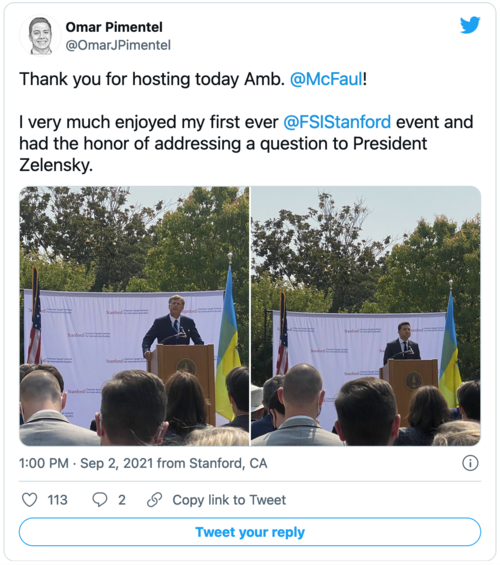
An Address by Ukrainian President Volodymyr Zelensky
This event is publically available via Zoom. Please register in advance.
Register: https://bit.ly/3DdkPzL
FSI researchers strive to understand how countries relate to one another, and what policies are needed to achieve global stability and prosperity. International relations experts focus on the challenging U.S.-Russian relationship, the alliance between the U.S. and Japan and the limitations of America’s counterinsurgency strategy in Afghanistan.
Foreign aid is also examined by scholars trying to understand whether money earmarked for health improvements reaches those who need it most. And FSI’s Walter H. Shorenstein Asia-Pacific Research Center has published on the need for strong South Korean leadership in dealing with its northern neighbor.
FSI researchers also look at the citizens who drive international relations, studying the effects of migration and how borders shape people’s lives. Meanwhile FSI students are very much involved in this area, working with the United Nations in Ethiopia to rethink refugee communities.
Trade is also a key component of international relations, with FSI approaching the topic from a slew of angles and states. The economy of trade is rife for study, with an APARC event on the implications of more open trade policies in Japan, and FSI researchers making sense of who would benefit from a free trade zone between the European Union and the United States.
This event is publically available via Zoom. Please register in advance.
Register: https://bit.ly/3DdkPzL
How will US-Russia relations develop within the next few years? Are we on the verge of a new cold war? What is needed to maintain strategic stability after the New START expires in 2026? What should be the format and aspects of the follow-on treaty? Do we really need depoliticization of negotiations? Is the elimination of all nuclear weapons is a realistic goal today? Can a nuclear-weapons-free world be really achieved? What will be the US policy on China within the next few years?
Pifer addresses these key international security questions.
Watch with LuxembourgForum
Steven Pifer, an affiliate of the Center for International Security and Cooperation, answers questions on strategic stability and arms control for the International Luxembourg Forum.
*For fall quarter 2021, CISAC will be hosting hybrid events. Many events will offer limited-capacity in-person attendance for Stanford faculty, staff, fellows, visiting scholars, and students in accordance with Stanford’s health and safety guidelines, and be open to the public online via Zoom. All CISAC events are scheduled using the Pacific Time Zone.
(Open to all)
About the Event: According to the Theory of the Nuclear Revolution (TNR), nuclear weapons have stabilized relations between great powers, making deterrence easier than compellence. This view is currently under attack. Recent work has documented Washington’s competitive approach to arms control agreements and the fragility of the nuclear stalemate. However, these critiques have not explained how policymakers could hope to extract coercive benefits from nuclear weapons. This paper revisits this question using a game-theoretic model. It shows that if the compellent state is able to bolster the credibility of its threat through standard techniques, i.e. burning bridges, probabilistic threats, or the rationality of irrationality, then compellence may succeed. However, greater military capabilities bolster coercion by increasing the risk of disaster, with first-strike capabilities being especially destabilizing. TNR was correct to warn about the risks of nuclear competition.
About the Speaker:
Alexandre Debs is Associate Professor of Political Science at Yale University.
His research focuses on the causes of war, nuclear proliferation, and democratization, and it has appeared in top journals such as the American Political Science Review, the American Journal of Political Science, the Journal of Politics, International Organization, and International Security. He wrote with Nuno Monteiro the book Nuclear Politics: The Strategic Causes of Proliferation (2017, Cambridge University Press).
Alexandre received a Ph.d. in Economics from M.I.T., an M.Phil. in Economic and Social History from the University of Oxford as a Rhodes scholar, and a B.Sc. in Economics and Mathematics from Universite de Montreal.
Virtual Only. This event will not be held in person.
* Please note all CISAC events are scheduled using the Pacific Time Zone.
This event is hosted by the Hoover Institution and co-sponsored by CISAC.
Registration required to attend in person.
Event and Registration Link: https://www.hoover.org/events/spies-lies-and-algorithms
About the Event: Spying has never been more ubiquitous―or less understood. The world is drowning in spy movies, TV shows, and novels, but universities offer more courses on rock and roll than on the CIA and there are more congressional experts on powdered milk than espionage. This crisis in intelligence education is distorting public opinion, fueling conspiracy theories, and hurting intelligence policy. In Spies, Lies, and Algorithms, Amy Zegart separates fact from fiction as she offers an engaging and enlightening account of the past, present, and future of American espionage as it faces a revolution driven by digital technology.
Drawing on decades of research and hundreds of interviews with intelligence officials, Zegart provides a history of U.S. espionage, from George Washington’s Revolutionary War spies to today’s spy satellites; examines how fictional spies are influencing real officials; gives an overview of intelligence basics and life inside America’s intelligence agencies; explains the deadly cognitive biases that can mislead analysts; and explores the vexed issues of traitors, covert action, and congressional oversight. Most of all, Zegart describes how technology is empowering new enemies and opportunities, and creating powerful new players, such as private citizens who are successfully tracking nuclear threats using little more than Google Earth. And she shows why cyberspace is, in many ways, the ultimate cloak-and-dagger battleground, where nefarious actors employ deception, subterfuge, and advanced technology for theft, espionage, and information warfare.
About the Speaker:
Amy Zegart is the Morris Arnold and Nona Jean Cox Senior Fellow at the Hoover Institution and Professor of Political Science (by courtesy) at Stanford University. She is also a Senior Fellow at Stanford’s Freeman Spogli Institute for International Studies, Chair of Stanford’s Artificial Intelligence and International Security Steering Committee, and a contributing writer at The Atlantic. She specializes in U.S. intelligence, emerging technologies and national security, grand strategy, and global political risk management.
In person at Hauck Auditorium Hoover Institution and Livestreamed at https://www.hoover.org/events/spies-lies-and-algorithms
Professor Stacie Goddard is the Betty Freyhof Johnson ‘44 Professor of Political Science and Associate Provost for Wellesley in the World at Wellesley College. Her research and teaching focuses on questions of great power competition and international order. Her latest book, When Right Makes Might: Rising Powers and World Order was published by Cornell University Press in 2018. Other writing has appeared in International Organization, International Security, and Security Studies, as well as Foreign Affairs, the New York Times and the Washington Post. She is a series editor for Columbia University Press.
All CISAC events are scheduled using the Pacific Time Zone. This event is part of the year-long initiative on “Ethics & Political Violence” jointly organized by the Center for International Security and Cooperation (CISAC) and The McCoy Family Center for Ethics in Society. This event is hosted by CISAC and is co-sponsored by Society for International Affairs at Stanford, McCoy Family Center for Ethics in Society, Center for South Asia.
About the Event: The dramatic scenes the world witnessed during the fall of Kabul in 2021 following the withdrawal of US and allied forces from Afghanistan nearly coincided with the twentieth anniversary of the 9/11 attacks by Al Qaeda and the subsequent US and allied invasion of Afghanistan. The United States committed trillions of dollars, dispatched soldiers, diplomats and spies across the globe, and made dramatic alterations to domestic and international law to combat terrorism. The material, humanitarian and normative consequences of two decades of war have been significant, both globally and in Afghanistan specifically. In this panel, Dr. Felter, Dr. Mir and Professor Zegart will assess U.S. responses during the global war on terror, identify unexpected outcomes and lessons learned, and ultimately weigh the costs and benefits of this two-decade struggle against terrorism.
About the Speakers:
Joe Felter is a William J. Perry Fellow at the Center for International Security and Cooperation and research fellow at the Hoover Institution. From 2017 to 2019, Felter served as US deputy assistant secretary of defense for South Asia, Southeast Asia, and Oceania. There he was the principal advisor for all policy matters pertaining to development and implementation of defense strategies and plans in the region and responsible for managing bilateral security relationships and guiding Department of Defense (DoD) engagement with multilateral institutions.
Asfandyar Mir is a senior expert in the Asia Center at USIP. Previously, heheld various fellowships at the Center for International Security and Cooperation at Stanford University. His research interests include the international relations of South Asia, U.S. counterterrorism policy and political violence — with a regional focus on Afghanistan and Pakistan. Asfandyar Mir’s research has appeared in peer-reviewed journals, such as International Security, International Studies Quarterly and Security Studies. He received his doctorate in political science from the University of Chicago and a master’s and bachelor’s from Stanford University.
Amy Zegart is the Morris Arnold and Nona Jean Cox Senior Fellow at the Hoover Institution and Professor of Political Science (by courtesy) at Stanford University. She is also a Senior Fellow at Stanford’s Freeman Spogli Institute for International Studies, Chair of Stanford’s Artificial Intelligence and International Security Steering Committee, and a contributing writer at The Atlantic. She specializes in U.S. intelligence, emerging technologies and national security, grand strategy, and global political risk management.
Virtual to Public. Only those with an active Stanford ID with access to William J Perry Conference Room in Encina Hall may attend in person.
Asfandyar Mir is an affiliate with the Center for International Security and Cooperation, Stanford University. Previously he has held predoctoral and postdoctoral fellowships at the center. His research interests are in the international relations of South Asia, US counterterrorism policy, and political violence, with a regional focus on Afghanistan and Pakistan. His research has appeared in peer-reviewed journals of International Relations, such as International Security, International Studies Quarterly and Security Studies, and his commentary has appeared in Foreign Affairs, Foreign Policy, H-Diplo, Lawfare, Modern War Institute, Political Violence at a Glance, Politico, and the Washington Post.
Asfandyar received his PhD in political science from the University of Chicago and a masters and bachelors from Stanford University.
CISAC
Stanford University
Encina Hall, E216
Stanford, CA 94305-6165
Dr. Amy Zegart is the Morris Arnold and Nona Jean Cox Senior Fellow at the Hoover Institution. The author of five books, she specializes in U.S. intelligence, emerging technologies, and national security. At Hoover, she leads the Technology Policy Accelerator and the Oster National Security Affairs Fellows Program. She also is an associate director and senior fellow at the Stanford Institute for Human-Centered AI; a senior fellow at the Freeman Spogli Institute; and professor of political science by courtesy, teaching 100 students each year about how emerging technologies are transforming espionage.
Her award-winning research includes the leading academic study of intelligence failures before 9/11: Spying Blind: The CIA, the FBI, and the Origins of 9/11 (Princeton, 2007) and the bestseller Spies, Lies, and Algorithms: The History and Future of American Intelligence (Princeton, 2022), which was nominated by Princeton University Press for the Pulitzer Prize. She also coauthored Political Risk: How Businesses and Organizations Can Anticipate Global Insecurity, with Condoleezza Rice (Twelve, 2018). Her op-eds and essays have appeared in Foreign Affairs, Politico, the New York Times, the Washington Post, and the Wall Street Journal.
Zegart has advised senior officials about intelligence and foreign policy for more than two decades. She served on the National Security Council staff and as a presidential campaign foreign policy advisor and has testified before numerous congressional committees. Before her academic career, she spent several years as a McKinsey & Company consultant.
Zegart received an AB in East Asian studies from Harvard and an MA and a PhD in political science from Stanford. She serves on the boards of the Council on Foreign Relations, Kratos Defense & Security Solutions, and the American Funds/Capital Group.
On August 9, 2020 citizens in the Republic of Belarus went to the polls to vote for their next president. The incumbent was Alexander Lukashenko, a 67-year-old military officer who has kept an iron grip on the presidency for the entire 26 years Bealrus has held elections. But the challenger was an unexpected, new face. Sviatlana Tsikhanouskaya is a 38-year-old English teacher, mother and pro-democracy activist who stepped into a campaign following her husband's arrest and imprisonment in May 2020 for political dissension. In four short months, she galvanized the nation with a message of democracy, freedom and fair elections that reached across opposition factions and gained enough momentum to become a serious contender for the presidency.
On election day, projections estimated an initial win for Tsikhanouskaya at 60%. But when the country's Central Elections Commission announced the election results, Lukashenko carried 80% of the vote, and Tsikhanouskaya a mere 10%. Given the long history of election engineering in Belarus, the results were expected. But what happened next was not. Outraged by the fraud, Tsikhanouskaya's supporters poured into city centers in Brest and Minsk by the tens of thousands, instigating the largest public protests in the history of post-Soviet Belarus. Caught off-guard, the regime hit back with a ruthless wave of violence and political imprisonments, prompting the European Union, NATO and other countries to impose sanctions and condemn Lukashenko as an illegitimate leader.
While Tsikhanouskaya's presidential campaign ended last August, her role as a democratic leader in Eastern Europe has not. In the year since the election, she has traveled the globe to meet with lawmakers, policy experts and heads of state to speak out against the ongoing repression of Lukashenko's regime and advocate for support of Belarus by the international community. The Freeman Spogli Institute for International Studies (FSI) was honored to host Tsikhanouskaya and her delegation at Stanford for a roundtable discussion on the challenges that lay ahead in preparing Belarus for a democratic transition. Director Michael McFaul hosted the discussion, which brought together scholars from across FSI, the Hoover Institute and the Belarusian expatriate community. The full recording is below.
Rather than holding a typical press conference, Tsikhanouskaya's visit at FSI gave members of the Belarusian delegation an opportunity to engage in back-and-forth dialogue with an interdisciplinary panel of experts on governance, history and policy. Tsikhanouskaya and her senior advisors shared their perspectives on the challenges they are facing to build and maintain pro-democracy efforts, while Stanford scholars offered insights from their extensive research and scholarship.
As leader of the delegation, Sviatlana Tsikhanouskaya gave an overview of the brutality of Lukashenko's regime and the lawlessness that has enveloped the country. But she also reaffirmed the commitment of everyday Belarusians to defending their independence and continuing the work of building new systems to push back against the dictatorship, and encouraged the support of the international democratic community.
"Belarusians are doing their homework. But we also understand that we need the assistance and help of other democratic countries," said Tsikhanouskaya. "That support is vital, because our struggle relates not just to Belarusians, but to all countries who share these common values."
Speaking to the work that Belarusians have already undertaken, Franak Viačorka, a senior advisor to Sviatlana Tsikhanouskaya, described how citizens are creating new means of protesting and organizing. Though they learned some tactics from recent protests in Hong Kong and classic theories by political scientists like Gene Sharp, organizers in Belarus quickly realized that they needed to innovate in order to keep ahead of Lukashenko's crack-downs. Today the opposition is a tech-driven movement that spreads awareness and support quickly through digital spaces and underground channels while avoiding large in-person gatherings that attract government brutality.
By Tanya Bayeva's assessment, these methods of organizing have been effective in capturing widespread support amongst people. A member of the Belarusian diaspora, Bayeva described the sense of empowerment she felt in coming together in a common cause with like-minded people.
"By coming out like this, people have started realizing that it is up to us, the people, and our individual willpower to make a difference," said Bayeva. "We are realizing that the king has no clothes, and that working together we can forward the process of democratization."
But there is still plenty of work ahead. In order to facilitate a more peaceful future transition to a democratic system, there will need to be frameworks in place to bridge the divide between old systems and new. Valery Kavaleuski, the representative on foreign affairs in Sviatlana Tsikhanouskaya's delegation, is focusing extensively on these issues, such as reconciliation processes and plans for future investments between Belarus and the European Union.
"These are political moves that reinforce hope among Belarusians and tells that that they are not alone and that when the change comes, they will have friends by their side to overcome the challenges of the transition period," said Kavaleuski.
Responding to the Belarusian delegation's questions and comments, the faculty from FSI and the broader Stanford community offered insights and considerations from a variety of perspectives and disciplines on 'next steps' for the pro-democracy movement.
Francis Fukuyama, the Olivier Nomellini Senior Fellow at FSI and Mosbacher Director at the Center on Democracy, Development and the Rule of Law (CDDRL), cautioned against the impulse to immediately take down the state and bureaucratic systems of the existing regime. While dismantling the mechanisms from the old state may feel emotionally satisfying, examples from history such as post-Nazi Germany and post-invasion Iraq illustrate the crippling effect on efficiency, functionality and the ability of the new order to govern in a vacuum of bureaucratic expertise.
FSI's Deputy Director, Kathryn Stoner, gave similar advice in regard to drafting and implementing a new constitution and conventions.
"People care to a great degree [about a new constitution], but not to months and months of debate and politicians yelling at one another. People can't eat constitutions," said Stoner. "You have to demonstrate that your system is going to be better than what was. When things have not gone well in transitioning countries, it's been because people don't see concrete change. So have a constitutional convention, but make it fast."
Amr Hamzawy, a senior research scholar for the Middle East Initiative at the Center for Democracy, Development and the Rule of Law, also pointed to the importance of engaging the public and building alliances within both the old and new political systems. Based on his observations of the failed Egyptian and Tunisian efforts at democratic transition, he cautioned against discussions of impunity, arguing that while politically and morally symbolic, this practice often backfires and alienates important factions of the state apparatus which are vital for the function and success of a new government.
Hamzawy similarly encouraged carefully blending nationalism and populism to keep divisions within the public sector in check. Imbuing such narratives with pro-democracy rhetoric, he believes, can create a powerful tool for unifying the population around the new government and emerging national identity.
The advice from the Europe Center's director, Anna Grzymala-Busse, succinctly brought together many of the points made by the faculty panel: "No post-transitional government can achieve all the promises they've made right away," said Grzymala-Busse. "So make the transition about processes rather than specific outcomes, about ensuring the losers are heard along with the winners, and about making sure all people can participate."
Additional participants in the roundtable discussion not noted above include Hanna Liubakova, a journalist and non-resident fellow at the Atlantic Council, Dmytro Kushneruk, the Consul General of Ukraine in San Francisco, and Stanford scholars Larry Diamond, David Holloway, Norman Naimark, Erik Jensen, Kiyoteru Tsutsui and John Dunlop.
Democratic leader Sviatlana Tsikhanouskaya and her delegation joined an interdisciplinary panel of Stanford scholars and members of the Belarusian community to discuss the future of democracy in Belarus.
Jim Dempsey is senior policy advisor to the Stanford Program on Geopolitics, Technology and Governance and a lecturer at the UC Berkeley School of Law, where he teaches a course on cybersecurity law in the LLM program. Until May 2021, Jim was Executive Director of the Berkeley Center for Law & Technology. In 2012, after Senate confirmation, he was appointed by President Barack Obama as a part-time member of the U.S. Privacy and Civil Liberties Oversight Board, an independent agency within the federal government charged with advising senior policymakers and overseeing the nation’s counterterrorism programs. He served in that position until January 2017, while also running BCLT.
From 1997 to 2014, Dempsey was at the Center for Democracy & Technology (CDT), a non-profit public policy organization focused on privacy and other issues affecting the internet, where he held a number of leadership positions. Prior to that he was deputy director of the Center for National Security Studies (1995-1997) and assistant counsel to the House Judiciary Committee (1985-1995), focusing on privacy, FBI oversight, and surveillance issues.
Jim graduated from Yale College and Harvard Law School.
Please join our partners at APSIA for their 2021 online grad school fair. Representatives from across the Freeman Spogli Institute for International Studies and other top-line graduate programs in international studies at leading universities will be online to answer your questions and provide resources on the application process.
Whether you are an undergrad student trying to decide what comes next in your academic journey or a professional looking to advance your career, this is an excellent opportunity to network and gain insight into reaching your goals.
Register: https://bit.ly/apsiafair2
Cross-strait deterrence is arguably weaker today than at any point since the Korean War. Impressive Chinese military modernization, U.S. failure to build robust coalitions to counter Chinese regional aggression, and Xi Jinping’s personal ambition, all coalesce to create a situation in which Chinese leaders may see some aggregate benefit to using force. Mastro supports this assessment in her response to the Commission’s specific questions.