error

  • Could not retrieve the oEmbed resource.
0
Affiliate
betsy_cooper_headshot.png

Betsy Cooper is the founding Director of the Aspen Policy Academy. A cybersecurity expert, Dr. Cooper joined the Aspen Institute after serving as the Executive Director of the Berkeley Center for Long-Term Cybersecurity at the University of California, Berkeley. 

Previously, Dr. Cooper served at the U.S. Department of Homeland Security as an attorney advisor to the Deputy General Counsel and as a policy counselor in the Office of Policy. She has worked for over a decade in homeland security consulting, managing projects for Atlantic Philanthropies in Dublin, the Prime Minister’s Strategy Unit in London, and the World Bank, and other organizations. 

In addition, Dr. Cooper has clerked for Berkeley Law professor and Judge William Fletcher on the Ninth Circuit Court of Appeals. She completed a postdoctoral fellowship at Stanford’s Center for International Security and Cooperation (where she currently is a nonresident affiliate), as well as a Yale Public Interest Fellowship. Dr. Cooper has written more than twenty manuscripts and articles on U.S. and European homeland security policy. She is also a Senior Advisor at Albright Stonebridge Group. 

Dr. Cooper earned a J.D. from Yale University, a D.Phil. in Politics from Oxford University, an M.Sc. in Forced Migration from Oxford University, and a B.A. in Industrial and Labor Relations from Cornell University. She speaks advanced French. She is based in the San Francisco Bay Area.

Date Label
Authors
News Type
News
Date
Paragraphs


Journalist Barton Gellman had left his job at The Washington Post and was working on a book about surveillance and privacy in America when he was contacted last year by someone using the code-name VERAX, or “truth teller” in Latin.

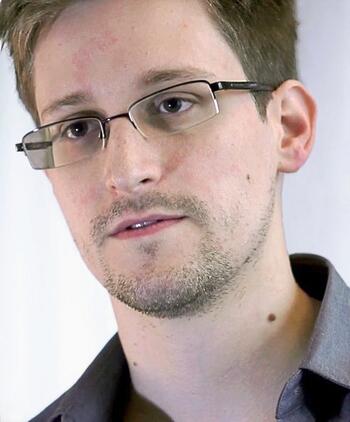
So began one of the most dramatic chapters in the history of modern American journalism – and government surveillance. In the spring of 2013, Gellman began having remote, encrypted exchanges with someone who clearly had inside knowledge of the NSA's global and domestic surveillance programs. 

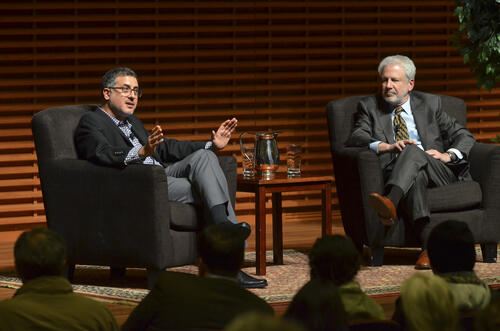
“He was trying to figure out whether he could trust me and ... I was trying to figure out if he was for real,” Gellman told a packed Stanford audience Monday night.

Last December, he traveled to Moscow to put a face to the code-name and determine whether the information he was providing was accurate.

“All extraordinary claims require extraordinary evidence – and he was providing that.," Gellman said of former NSA contractor Edward Snowden. "I was convinced fairly early on that I was dealing with something fairly serious.”

So Gellman went back to The Washington Post, where he had been on teams that won two Pulitzer Prizes for their coverage of the 9/11 terrorist attacks and the power and influence of Vice President Dick Cheney during the Bush administration.

“I went there because I trusted them and because I wanted their resources and their advice,” he told the audience of some 600 people at the CEMEX Auditorium on Monday. The Washington Post would go on to win the 2014 Pulitzer Prize for Public Service, shared with The Guardian US, for their reporting on the Snowden materials and the NSA.

Gellman today is a senior fellow at The Century Foundation and a visiting professional specialist and author-in-residence at Princeton’s Woodrow Wilson School of Public and International Affairs. He is the author of Angler: The Cheney Vice Presidency and is currently working on a book about the Snowden affair.

Snowden’s explosive disclosures about the National Security Agency’s intelligence-collection operations have ignited an intense debate about the appropriate balance between security and liberty in America.

In a special series this academic year at Stanford University, nationally prominent experts are exploring the critical issues raised by the NSA’s activities, including their impact on our security, privacy and civil liberties.

Amy Zegart, co-director of CISAC and a senior fellow at the Hoover Institution, launched the “Security Conundrum” series in October with its first speaker, Gen. Michael Hayden, the former director of the NSA and CIA who defended the government surveillance programs. The metadata collection “is something we would have never done on Sept. 9 or Sept. 10,” Hayden told Zegart during their conversation on Oct.  8. “But it seemed reasonable after Sept. 11. No one is doing this out of prurient interests. No – it was a logical response to the needs of the moment.”

Zegart, in introducing Gellman, said: “Tonight, we move from inside the NSA to inside the newsroom, which played a key role in revealing the NSA’s secret activities over the past year.”

All Photos by Rod Searcey

Image
gellman phil


In the second lecture in the “Security Conundrum” series, Gellman was in conversation with Philip Taubman, former correspondent and Washington and Moscow bureau chief for The New York Times and a consulting professor with Stanford’s Center for International Security and Cooperation (CISAC). Taubman teaches the class Need to Know: The Tension Between a Free Press and National Security Decision Making.

Gellman recounted his dealings with Snowden and described how he and his editors weighed the Snowden materials. Few questions are more difficult for American journalists than determining how far a free press can venture in disclosing national security secrets without imperiling the nation’s security.

“I asked him very bluntly, `Why are you doing this?’” Gellman said of Snowden.

“He gave me very persuasive and consistent answers about his motives. Whatever you think of what he did or whether or not I should have published these stories, I would claim to you that all the evidence supports his claim that he had come across a dangerous accumulation of state power that we, the people, needed to know about.”

One of the first Snowden revelations, Gellman said, was the top-secret PRISM surveillance program, in which the NSA is allowed to tap into the servers of nine large U.S. Internet companies, including Google, Microsoft, Yahoo, Facebook and Skype. Snowden believed the extent of mass data collection about American citizens was far greater than what the public knew.

The Post reported that PRISM allows the U.S. intelligence community to gain access from the Silicon Valley firms to a wide range of digital information, including audio, video chats, photographs, emails and stored data that enable analysts to track foreign targets. The program does not require individual warrants, but instead operates under the broader authorization of the federal Foreign Intelligence Surveillance Act court.


Image
dsc 8126


The FISA Court had also been ordering a subsidiary of Verizon Communications to turn over to the NSA logs tracking all of its customers’ telephone calls.

Gellman said Snowden asked for a guarantee the Post would publish the full text of a PowerPoint presentation that he had obtained describing the PRISM program. Gellman told him that his editors would not make any guarantees about what they would publish and in the end the paper only reproduced several slides so as not to harm national security.

Taubman asked Gellman what gives any journalist the right to publish classified documents and not hand those papers back to the NSA.

“I’m not accountable to anyone for my decisions about what is in the interest or not in the interest of the national security of the United States,” Gellman said. “What happens is the government tries to keep information a secret and I try to find it out – and then when that spillage happens, well, then we talk.”

In the case of PRISM, he sent emails to two “quite senior people” in the government and told them this was the type of email he only sends once every several years, when he is onto a big story they would want to know about. But he didn’t want to do anything over email, so when the senior officials called, Gellman gave them the title of the document about which he was going to write.

Image

That started the negotiations with the government and The Washington Post. In the end, the paper only published several of the government’s PowerPoint slides that explained the PRISM program because they were concerned about harming national security.

“We had no interest in doing that; we only had an interest in writing about the public policy question on a program that had secretly expanded in ways that almost no one knew about,” Gellman said. “To the extent that it involves drawing new boundaries allowing the government to spy on its citizens and the citizens never get to know that – that is quite relevant to know when you’re trying to decide whether you like what your government is doing.”

In a statement responding to the PRISM revelations by the Post, Director of National Intelligence James Clapper said information collection under the program “is among the most important and valuable foreign intelligence information we collect, and is used to protect our nation from a wide variety of threats.”

Clapper called the Snowden leaks about the legal program “reprehensible and risks important protections for the security of Americans.”

Gellman said Snowden has turned down million-dollar book and movie deals and lives in  “ascetic” asylum in Russia. Snowden told NBC News earlier this year that he was on his way from Hong Kong to Latin America, via Moscow, when his passport was confiscated and that Russia then granted him a one-year asylum.

“He is fascinating to me because he’s an unusual figure,” Gellman told Taubman, who had asked him what Snowden was like. He said the 31-year-old former systems administrator for the CIA did something most Americans would not: He gave up his personal freedom and changed the course of his life to make public the government surveillance programs that he believes are a danger to the American people.

“He described himself to me once as an indoor cat,” Gellman said. “He lives in a virtual world; there’s not a whole lot of difference for Snowden whether he’s living in Moscow or Hawaii – he’s is what I would call a net native. He has an ascetic personality; he doesn’t have or want very much stuff.”

Gellman added: “He is sort of Zen-like in his confidence that he has done the right thing.”

***

The Security Conundrum series is co-sponsored by CISAC, Hoover, and the Freeman Spogli Institute for International Studies, Stanford Continuing Studies, Stanford in Government and the Stanford Law School.

Other nationally prominent speakers will include Reggie Walton, the former presiding judge of the Foreign Intelligence Surveillance Court, and U.S. Sen. Dianne Feinstein, chairman of the Senate Select Committee on Intelligence.

Hero Image
gellman hand Rod Searcey
All News button
1
News Type
News
Date
Paragraphs


CISAC's Siegfried Hecker is working on a book about his 20-year collaboration with Russian nuclear scientists.

In this New York Times "Room for Debate" commentary, he argues that abandoning cooperation between Moscow and Washington will diminish security and exacerbate other common concerns, such as nuclear terrorism and proliferation. And in this NPR All Things Considered interview, the former head of the Los Alamos National Laboratory says there has been extraordinary cooperation between American and Russian scientists in securing loose nuclear materials and upgrading former Soviet nuclear test sites. But the United States is making it harder for Russian scientists to get visas to come here - and Moscow likewise is not cooperating.
 
"Hopefully, the book will demonstrate to both governments it was absolutely essential for us to work together over these past 20 years - and that we're not done," Hecker tells NPR's Michele Keleman. Yet, Hecker concedes, this cooperation has all but ended in the wake of the disputes over Ukraine and Crimea.
 
 
And you can read about Hecker's two-decade collaboration with his Russian counterparts in this story.


Hero Image
obama putin
President Barack Obama, Russian President Vladimir Putin and Chinese President Xi Jinping attend a plenary session during the Asia Pacific Economic Cooperation (APEC) Summit in Beijing, Nov. 11, 2014.
Reuters
All News button
1
Authors
News Type
News
Date
Paragraphs

Michael McFaul, a Stanford political scientist and former U.S. ambassador to Russia, has been selected as the next director of the university’s Freeman Spogli Institute for International Studies.

The announcement was made Wednesday by Stanford Provost John Etchemendy and Ann Arvin, the university’s vice provost and dean of research. McFaul will succeed Mariano-Florentino Cuéllar, who was nominated in July as an associate justice of the California Supreme Court and elected Tuesday.

McFaul takes the helm of FSI in January.

"Stanford has long been a home for scholars who connect academia to policy and public service, and Professor McFaul is the embodiment of that model," Etchemendy said. "We are grateful for Mike's service and confident he will be a strong leader for FSI."

Arvin said McFaul is a strong fit for the position.

“Professor McFaul’s background as an outstanding scholar and his service as an influential ambassador give him a vital perspective to lead FSI, which is Stanford’s hub for studying and understanding international policy issues,” she said. “His scholarship, experience and energy will keep FSI and Stanford at the forefront of international studies as well as some of the most pressing global policy debates."

McFaul has been a faculty member in the department of political science at Stanford since 1994.  He joined the Obama administration in January 2009, serving for three years as Special Assistant to the President and Senior Director for Russian and Eurasian Affairs at the National Security Council at the White House. He then served as U.S. Ambassador to the Russian Federation from 2012 to 2014.

McFaul already has a deep affiliation with FSI. Before joining the government, he served as FSI deputy director from 2006 to 2009.  He also directed FSI’s Center on Democracy, Development, and the Rule of Law (CDDRL) from 2005 to 2009.

During his four years leading CDDRL, McFaul launched the Draper Hills Summer Fellowship program for mid-career lawyers, politicians, advocates and business leaders working to shore up democratic institutions in their home countries. He also established CDDRL’s senior honors program.  From 1992-1994, McFaul also worked as a Senior Research Fellow at FSI’s Center for International Security and Cooperation (CISAC).

“I am thrilled to be assuming a leadership role again at FSI,” McFaul said.  “FSI has become one of the premier institutions in the country for policy-relevant research on international affairs.  I look forward to using my recent government experience to deepen further FSI’s impact on policy debates in Washington and around the world.”

Arvin said McFaul’s previous positions at FSI and CDDRL will make for a smooth transition in the institute’s leadership.

“His familiarity with FSI’s history and infrastructure will allow him to start this new position with an immediate focus on the institute’s academic mission,” she said.

McFaul is also the Peter and Helen Bing Senior Fellow at the Hoover Institution, and plans to build on his long affiliations with both Hoover and FSI to deepen cooperation between these two premier public policy institutions on campus.

He has written and co-authored dozens of books including Advancing Democracy Abroad: Why We Should, How We CanTransitions To Democracy: A Comparative Perspective (with Kathryn Stoner); Power and Purpose: American Policy toward Russia after the Cold War (with James Goldgeier); and Russia’s Unfinished Revolution: Political Change from Gorbachev to Putin.

“In so many ways, Mike represents the best of FSI,” said Cuéllar, who has held leadership positions at FSI since 2004 and begins his term on the California Supreme Court in January. “He knows the worlds of academia and policy extremely well, and will bring unique experience and sound judgment to his new role at FSI.”

McFaul currently serves as a news analyst for NBC News, appearing frequently on NBC, MSNBC, and CNBC as a commentator on international affairs. He also appears frequently on The Charlie Rose Show and The Newshour, as well as PBS and BBC radio programs. He has recently published essays in Foreign AffairsThe New York TimesPolitico, and Time

McFaul was one of the first U.S. ambassadors to actively use social media for public diplomacy. He still maintains an active presence on Facebook at amb.mcfaul and on Twitter at @McFaul.

McFaul received his B.A. in International Relations and Slavic Languages and his M.A. in Russian and East European Studies from Stanford University in 1986.  As a Rhodes Scholar, he completed his D. Phil. in International Relations at Oxford University in 1991.

“Since coming here in 1981 as 17-year-old kid from Montana, Stanford has provided me with tremendous opportunities to grow as a student, scholar, and policymaker,” McFaul said. “I now look forward to giving back to Stanford by contributing to the development of one of the most vital and innovative institutions on campus.” 


Hero Image
mcfaul color large
All News button
1
News Type
News
Date
Paragraphs

In war zones, private contractors can outnumber U.S. troops. But who controls them? NPR's Rachel Martin speaks with CISAC senior research scholar and Ret. U.S. Army Col. Joseph Felter, and journalist Pratap Chatterjee about current safeguards. Four military contractors with the firm Blackwater were convicted for killing 17 Iraqis back in 2007. The verdict on Oct. 22, 2014, has again put military contractors in the spotlight and raised questions about where and when the U.S. uses them.

Felter argues that as the U.S. draws down its military operations in Iraq and Afghanistan, outsourcing safety will continue, but that the U.S. military should start to integrate the paid security units into its command and control structures and include them in military preparations.

You can listen to the story here, on NPR's website.


Hero Image
felter
All News button
1
News Type
News
Date
Paragraphs

Watch the live-streaming of the conference: "Intelligence Reform and Counterterrorism After a Decade: Are We Smarter and Safer?"

FSI's Tom Fingar will be a panelist and the keynote address will be given by James Clapper, director of national intelligence.

The conference is being held at the University of Texas at Austin's and sponsored by the Clements Center.

The panel can be watched live on CISAC's Facebook Page at 3 p.m. on Thursday, Oct. 16.


Hero Image
ni logo
All News button
1
Authors
News Type
News
Date
Paragraphs

The heated debate over the line between liberty and national security took center stage as Gen. Michael Hayden, former director of the National Security Agency and CIA, defended government surveillance programs at Stanford’s launch this week of “The Security Conundrum” speaker series.

If such surveillance methods were further restricted, “that smaller box, in my professional judgment, would make the job of the NSA harder and would probably make you less safe,” Hayden told a packed audience at the event co-sponsored in part by the university’s Freeman Spogli Institute for International Studies (FSI) and the Center for International Security and Cooperation (CISAC).

Hayden admitted to being “prickly” as he discussed privacy concerns over NSA’s collection and storage of phone and email metadata covering billions of calls and messages by American citizens. The surveillance programs, which were exposed last year by leaks from NSA contractor Edward Snowden, were only used after the Sept. 11 terrorist attacks, given “the totality of the circumstances,” Hayden explained.

Hayden was director of the NSA from 1999 to 2005. He then led the CIA from 2006 to 2009.


The metadata collection “is something we would have never done on Sept. 9 or Sept. 10. But it seemed reasonable after Sept. 11,” he said. “No one is doing this out of prurient interests. No, it was a logical response to the needs of the moment.”

Amy Zegart, CISAC’s co-director and a senior fellow at the Hoover Institution, led the conversation with the four-star general. She pointed out that a majority of Americans distrusts the NSA and believes the agency is lying.

Hayden stressed that the phone records were similar to billing statements – detailing who made the calls and when. “There is no content. It is not electronic surveillance. Not at all.”


zegart hayden CISAC Co-Director Amy Zegart leaders a talk with former NSA and CIA Director Michael Hayden at the inaugural "Security Conundrum" speakers series on Oct. 8, 2014.


Though he understands why the operation is “theoretically frightening,” in reality, it’s designed to aid in the capture of terrorists within the United States, Hayden said.

“To listen to the content of the calls would violate the laws of the United States. It would violate the laws of physics,” he said. He challenged if anyone could offer “concrete evidence” of harm stemming from the phone data collection.

In defining the right to privacy, Hayden cited his philosophy behind the balancing act between security and liberty.

“Privacy is the line we continually negotiate for ourselves as unique creatures of God and as social animals,” he said. “There are some things that the community has the right to know – and there are other things that they clearly do not have the right to know.”

The debate is over where that line is drawn, between “what is mine” and “what is owed the collective,” he said.

Hayden noted that the phone and email metadata collection programs are only a small part of the larger issues the nation faces as it deals with increasingly adept enemies and the surveillance abilities of other nations.


“I’m just simply saying – who knows more about you? One of the least of your worries is the government,” he said, half-jokingly. He noted that Google knows more about Americans than does the U.S. government, and the Silicon Valley company uses that data for commercial purposes.

Addressing how tech companies are becoming more reluctant to cooperate with government requests for email communication data, Hayden said he didn’t have an answer about how to address the relationship.

There is a call for transparency of what the government is doing, but Hayden said “translucency” might be the better option, so as to not reveal all that the U.S. does for foreign intelligence.

“This is an enterprise that’s based on absolute secrecy,” he said of the NSA.

Image
“We have to give American people enough information to be at least tolerant, if not supportive, of what the American government is doing.”

But to achieve that, “it’s not transparency,” he said. “We actually have to be translucent … where you have the glass … and you get the broad patterns of movemen

The danger of not being able to target emails, Hayden said, would be that emails become a safe haven for enemies. “If we don’t’ do it, if you’re not going to let us do this stuff … over the long term, it puts your liberty at risk because bad stuff will happen.”

“The Security Conundrum” speaker series looks behind and beyond the headlines, examining the history and implementation of the NSA operations, the legal questions generated by them, the media’s role in revealing them, and the responsibility of Congress to oversee them.

Each guest speaker, in conversation with Stanford scholars, will probe the problems from different vantage points to explain the political, legal and technological contours of the NSA actions, as well as outline ways to preserve the nation’s security without sacrificing our freedoms.

On Nov. 17, journalist Barton Gellman will be the featured speaker. He is known for his Pulitzer Prize-winning reports on the 9/11 attacks and has led the Washington Post's coverage of the NSA. On April 10, Reggie Walton, the former presiding judge of the Foreign Intelligence Surveillance Court, will take the stage as the speaker on April 10.

Along with FSI and CISAC, the series is also co-sponsored by the Hoover Institution, Stanford Continuing Studies, Stanford in Government, and the Stanford Law School.

Image
hayden packed

Hero Image
14341 security news
All News button
1
0
benvalentino.jpg PhD

Benjamin Valentino is a Professor of Government at Dartmouth College and Chair of the Government Department. His research interests include the causes and consequences of violent conflict and American foreign and security policies. At Dartmouth he teaches courses on international relations, international security, American foreign policy, the causes and prevention of genocide and serves as co-director the Government Department Honors Program. He is also the faculty coordinator for the War and Peace Studies Program at Dartmouth’s Dickey Center for International Understanding. Professor Valentino’s book, Final Solutions: Mass Killing and Genocide in the 20th Century, received the Edgar S. Furniss Book Award for making an exceptional contribution to the study of national and international security. His work has appeared in outlets such as The New York Times, The Wall Street Journal, Foreign Affairs, The American Political Science Review, Security Studies, International Organization, Public Opinion Quarterly, World Politics and The Journal of Politics. He is currently working on several research projects focusing on public opinion on the use of force and developing early warning models of large-scale violence against civilians.

Affiliate
CV
Subscribe to The Americas