The conference is designed to illustrate the scope and variety of the security challenges we face and I commend both the organizers and the presenters. I have learned much and am confident you have as well. Others have addressed specific challenges; my assignment is to provide a big picture perspective that will provide context and a framework for understanding the nature of the world we live in and the types of challenges we face.
Toward that end, I will organize my remarks around three interrelated questions:
Why do we characterize the world and our present era as turbulent?
Why do we consider the security challenges we face to be different, and perhaps more dangerous, than those confronted by previous generations of Americans?
And finally, which of the many perceived and proclaimed security challenges are most important, and what should we do about them?
Each of these questions warrants an entire lecture—or conference—but you don’t have that much time so I hope you will allow me to discuss them in highly abbreviated fashion. We can dig deeper in the question and answer period if you wish [...]
Former U.S. Sen. Mark Udall remembers how members of Congress gathered on the steps of the Capitol Building on the day of the 9/11 terrorist attacks. They clasped one another’s hands and spontaneously broke out singing, “God Bless America.”
It was a moving moment of patriotic bipartisanship. “It was our generation’s Pearl Harbor,” he recalled, and politics were momentarily subsumed by love of nation.
Then it was time to investigate and bring those responsible to justice.
“For many of us who were policymakers, it was time to take a crash course in understanding the tools of terrorism, trying to penetrate who al-Qaida was, who was this figure, Osama bin Laden – and then how do we respond?”
But the government went into overdrive, the Colorado Democrat believed, and put civil liberties at risk. He recalled other decisions in American history – such as the internment of Japanese-Americans during World War II – that were made in panic and secrecy.
“It became clear to me that bin Laden’s motive was to create greater suspicion in the world, to incent us to build higher and higher walls,” he told a sold-out crowd at CEMEX Auditorium on Thursday night. His talk was part of Stanford “Security Conundrum” lecture series co-sponsored by CISAC, the Hoover Institution, the Law School, Stanford in Government and Continuing Studies.
“And in an interesting way, it led me to look at civil liberties and civil rights, which are the biggest, baddest weapons that we have,” he said in conversation with Philip Taubman, a CISAC consulting professor and a former reporter at The New York Times.
Taubman is one of the organizers of the special series has brought together nationally prominent experts this academic year to explore the critical issues raised by the National Security Agency's activities, including their impact on security, privacy and civil liberties.
Udall told the audience that in the powerful wake of fear that swept the nation following the 9/11 attacks, the House was presented with the Patriot Act “to strengthen and broaden our capacity to surveil those who might do us harm.”
Image
Udall was a congressman from 1999 to 2009 and then senator from 2009 until losing his seat in the mid-term elections last year. He had been a one-term congressman when the Bush administration put the Patriot Act to a vote on Oct. 24, 2001.
He was one of only 66 House members to vote against the act. It would then also pass through the Senate the following day.
Udall called his no-vote an unpopular one and a lonely period of his political life. But he believed the Act had been hastily drafted without due process and that some of the law’s provisions could lead to violations of privacy and freedoms.
“I was very conscious of what Ben Franklin famously said. He said that a society that trades essential liberties for short-term security deserves neither,” Udall said. “And I believed that we were strong enough to stand behind the civil liberties included in the First Amendment, the Fourth Amendment and the Fifth Amendment – including the explicit right to privacy – and that we would outlast these adversaries that were in front of us by hewing to those principles, not abandoning those principles.”
Udall also voted against the Obama administration’s four-year extension of three key provision of the act in 2011, which included roving wiretaps, searches of business records and conducting surveillance of those suspected of terrorist-related activities.
He would then gain notoriety for his vocal opposition to NSA surveillance programs in the wake of the Edward Snowden disclosures of June 2013. He became one of the staunchest critics of the U.S. spy agency for conducting massive, warrantless data grabs on millions of Americans without their knowledge.
Udall said the NSA gathers more than 700 million data sets from phone calls each day.
“I was told, don’t worry Mark, this is metadata. We just collect it; we don’t do anything with it,” Udall said. “But I realized that it wasn’t just metadata, that it was how that metadata was being used and the fact that it was a secret program and under a secret interpretation of the law.”
Udall said the metadata can be manipulated for form a pattern of an individual’s behavior, of his religious and political beliefs, his medical issues, his likes and dislikes.
“We haven’t done anything with this data and that’s all well and good,” he said. “But history shows us that the government will overreach, particularly when it operates in secret. The Fourth Amendment was put in place for a reason.”
He also worries the metadata program has undercut the trust in the intelligence community.
“I want to be clear: We need to gather intelligence,” he said. “There are forces at play in the world that would do us great harm. But again, we ought to gather that intelligence in ways that fit with what the public understands.”
Udall called on the audience to push for transparency reforms to the FISA court – which oversees requests by the NSA and FBI to issue surveillance warrants against suspected foreign intelligence agents. From 1999 to 2012, the court has granted nearly 34,000 warrants; only 12 have been denied.
Udall believes that privacy, which is implicit in the Bill of Rights, is essential to all other American freedoms that are protected by law.
“This has long-term and important ramifications about how we look at ourselves as Americans,” he said. “We all need to be in the mix; we all need to be having these discussions to be ever-vigilant and protect these fundamental freedoms.”
Hero Image
Former U.S. Sen. Mark Udall addresses "Security Conundrum" talk on NSA surveillance programs at CEMEX Auditorium on April 2, 2015. | Rod Searcey
Much has happened in the three years since the FAA Modernization and Reform Act of 2012 (FMRA) was signed into law. Under the FMRA, the FAA was directed to “develop and implement operational and certification requirements for the operation of public unmanned aircraft systems in the national airspace system” by the end of 2015. In addition, the FAA was directed to “provide for the safe integration of civil unmanned aircraft systems into the national airspace system as soon as practicable, but not later than” the end of September 2015. CISAC affiliate John Villasenor gives testimony before the Senate Committee on Commerce, Science, and Transportation Subcommittee on Aviation Operations, Safety, and Security about key considerations of safety, innovation, economic impact and privacy when it comes to drones.
U.S. Navy Adm. Cecil D. Haney, the U.S. Strategic Command commander, hosted CISAC Co-Directors David Relman and Amy Zegart as well as CISAC faculty and fellows at Offutt Air Force Base in Nebraska on March 30-31, 2015, to promote military-to-university cooperation and innovation, and provide a better understanding of USSTRATCOM’s global missions.
The visit follows Haney’s trip to Stanford last year, during which he held seminars and private meetings with faculty, scholars and students to discuss strategic deterrence in the 21st century. Those discussions focused on reducing the U.S. nuclear weapons stockpile while maintaining an effective deterrent, the integration of space and cyberspace in nuclear platforms and the congested, contested and competitive operating environment in space.
“Developing and maintaining partnerships with security experts from the private sector and academic institutions like CISAC enables USSTRATCOM to view the strategic environment from a different perspective and adjust our decision calculous accordingly,” Haney said. “We are excited about this unique opportunity to exchange ideas and share information with this prestigious organization.”
Haney opened the discussions by presenting a command mission brief, in which he described USSTRATCOM’s nine Unified Command Plan-assigned missions, his priorities as commander and his ongoing effort to build enduring relationships with partner organizations to exchange ideas and confront the broad range of global strategic challenges.
Zegart, who is also a senior fellow at Stanford’s Hoover Institution, said getting to see and experience how USSTRATCOM operates first-hand was “an eye opener.”
“It’s one thing to think about deterrence, it’s another to live it,” she said. “When you go to each other’s neighborhoods, you gain a better understanding of where each side is coming from … and that’s enormously important to us in how we think about deterrence and what we can do to help USSTRATCOM and its mission.”
“These kinds of exchanges have cascade effects on young people; how they think about civil-military relations [and] how they understand what our military is doing,” she added.
Image
The delegation also received a tour of USSTRATCOM’s global operations center and held discussions with subject matter experts on strategic deterrence, cyber responsibility and nuclear modernization.
“As a cybersecurity fellow, it was fascinating to visit the global operations center and the battle deck to see the role that cybersecurity and information technology plays in the strategic deterrence mission,” said Andreas Kuehn, a CISAC pre-doctoral cybersecurity fellow from Switzerland. “At CISAC, we often discuss deterrence from a theoretical perspective, so it was very insightful to hear from people who work in [this field] and see how they deal with deterrence in an operational manner.”
The two-day visit concluded with an open discussion, during which CISAC and USSTRATCOM members discussed the most effective means to share information, plan future engagements and continue working to build on the mutually beneficial relationship between the two organizations.
“Sometimes people talk [about strategic issues] in the abstract and it becomes difficult to understand what is happening on the ground and in the real world,” Kuehn said. “I think [USSTRATCOM] took extra steps to keep the conversations open and concrete.”
USSTRATCOM is one of nine Department of Defense unified combatant commands charged with strategic deterrence, space operations, cyberspace operations, joint electronic warfare, global strike, missile defense, intelligence, surveillance and reconnaissance, combating weapons of mass destruction, and analysis and targeting.
Hero Image
U.S. Navy Adm. Cecil D. Haney (center), U.S. Strategic Command commander, presents a USSTRATCOM mission briefing to the leadership, faculty members and fellows from Stanford University’s Center for International Security and Cooperation, during their visit to Offutt Air Force Base, Neb., March 30, 2015. | USSTRATCOM Photo by U.S. Air Force Staff Sgt. Jonathan Lovelady
Retired Army Lt. Gen. Karl Eikenberry stood before a team of soldiers preparing to deploy to Afghanistan. Their mission would be quite different from the ones he led in the South Asian country during the height of the war.
The officers of the U.S. Army’s 3rd Bridge Combat Team, 101st Airborne Division, in Fort Campbell, Ky., would soon be leading a team of about 2,000 soldiers to provide operational support and advise Afghan national forces as the U.S.-led Coalition forces withdraw and the country takes over the battle against the Taliban.
“I spoke to them about the history of the U.S. diplomatic, development and military activities in Afghanistan since 9/11,” said Eikenberry, now the William J. Perry Fellow in International Security at the Center for International Security and Cooperation.
Eikenberry was a military commander in Afghanistan from 2002-2003 and then again from 2005-2009. He would later serve as U.S. ambassador to Kabul from 2009 to 2011.
Col. J.B. Vowell, a former CISAC Senior Military Fellow (2012-2013), was leading the brigade, which deployed in late January for a nine-month tour. He had invited Eikenberry to speak to his troops, having met him while he was at Stanford.
The mission of his tour is to advise and protect advisors and, if necessary, support Afghan forces in extreme combat situations. Though a brigade typically has 5,000 soldiers, Vowell’s smaller, tailored team is a sharp departure from previous missions.
Former CISAC military fellow and U.S. Army Col. J.B. Vowell, left, and Ret. U.S. Army Lt. Gen. Karl Eikenberry, at Fort Campbell, Ky., on Jan. 13, 2015.
“So they’ve had to think hard about not only their advisory role, but also who they will protect their own forces with, and what to do if they are called upon to support Afghan forces in an exceptionally dire situation,” said Eikenberry.
These types of operations are part of the central challenges facing the U.S. military today, Eikenberry said, adding that Vowell’s time as a senior military fellow at CISAC helped prepare him for his mission.
“The resources available at FSI help prepare officers for these challenges,” said Eikenberry, who is also an affiliate of FSI's Center on Democracy Development and the Rule of Law. “CISAC does very sophisticated studies in contemporary security problems; CDDRL does very interesting work in the development of political institutions in difficult environments. These are resources military fellows can draw upon.”
Military Fellow Program launched in 2009
When former Secretary of Defense William J. Perry returned to Stanford after his service in Washington, he and current Secretary of Defense Ashton Carter started the Preventative Defense Project at Harvard and Stanford. The project focuses on forging nongovernmental, Track II security partnerships with Russia and its neighbors, engaging China and addressing the lethal legacy of Cold War weapons of mass destruction.
Deborah Gordon, executive director of the project and manager of the military fellows program, said Perry believed that bringing in acting military officers to learn more about strategic defense policy would aid the mission to prevent future threats to global security.
“Perry started asking the various heads of the military services to allow a fellow to come to CISAC and be more broadly engaged in the university,” she said.
The Freeman-Spogli Institute for International Studies (FSI), the umbrella organization for CISAC and other research centers, hosted its first senior military fellow in 2009. FSI now hosts five, three from the Air Force and two from the Army. Fellows go through a rigorous selection process and attend Stanford for one year to conduct research.
CISAC Senior Research Scholar and retired U.S. Army Col. Joseph Felter helped secure the Army officers for the first fellowships. He had attended Stanford as an active duty officer from 2002-2005 and has a Ph.D. in political science from the university.
“When I came back to do a War College fellowship from 08-09, the only sponsored spots were at Hoover,” he said, referring to the Hoover Institution at Stanford. “It’s a great institution but it struck me as a bit insulated from the rest of the campus. With the support of the Army War College I volunteered to take the lead on putting together a proposal.”
He persuaded the War College that there was demand for fellows and they approved the establishment of two new fellowships at CISAC. Felter, Gordon and others at CISAC knew that civilian scholars and students at the university would in turn benefit from interacting with active-duty officers for their perspective on the U.S. military around the world.
Among the first fellows were Viet Luong, who is now a one-star general and deputy commander of the 1st Cavalry Division, and Charlie Miller, who is working directly for Chairman of the Joint Chiefs of Staff General Martin Dempsey as his senior advisor.
Former CISAC Military Fellow Viet Luong, now a one-star general, teaches a simulation class during his 2011-2012 fellowship.
In addition to meeting current and former government and military leaders and conducting research, fellows participate in Stanford classrooms and seminars.
Army Lt. Col. Dennis Heaney is a senior military fellow at CISAC this academic year. His research focuses on the strategic policy of the Regionally Aligned Forces (RAF), soldiers from all units of the U.S. Armed Forces that support combatant commands.
Heaney is working to delineate out the costs of altering the role of conventional forces - traditionally trained to fight against other national militaries - to fight unconventional wars that are not restricted to any particular geographic zone.
“The real dilemma is conventional Army forces are made for land warfare against other forces. They are not really cut out for irregular warfare,” Heaney said of the RAF. “When you try to do regional engagement it takes you away from your main mission. I may help you, but there is an opportunity cost. Trying to prepare for both regular and irregular warfare takes away from each one. It’s kind of a zero-sum game. So I’m trying to critique that and make recommendations.”
Heaney has been in the Army for 24 years. He started out in the infantry as an officer and then entered the Special Forces in 1997. He is likely to deploy to Afghanistan with the Special Operations Joint Task Force after he completes his fellowship.
“The biggest benefit of being a fellow at Stanford is exposure to high-level folks like Karl Eikenberry, Gen. James Mattis at Hoover, Adm. James Ellis, and former Defense Secretaries William Perry and George Schultz, as well as current Secretary of Defense Ash Carter when he was here for a short time,” Heaney said.
Carter was a visiting scholar at FSI last year, until he became the nation’s 25th secretary of defense in February.
Heaney participated in CISAC’s signature class, “International Security in a Changing World,” playing the role of military commander during simulations that are the hallmark of the class.
“One simulation was about deciding between ground or air options for a high-value target in Afghanistan,” Heaney said. “Last week we did a simulation about the Islamic State and what options exist.”
Even after they leave, military fellows maintain close ties to Stanford.
Eikenberry is slated to teach a course next term about America’s post-9/11 intervention in Afghanistan.
“I’m hopeful that we’ll be able to Skype-in to Col. Vowell’s headquarters,” he said. “I think it would be powerful for the students, after reading essay after essay about the Afghanistan intervention, to actually talk to one of our military leaders currently operating there on the ground.”
There is an effort underway to expand the military fellows program beyond FSI.
“We envision a future where military fellows can embed in the professional schools, like law and business, or in departments like engineering and political science – and even private tech companies like Google and Palantir,” Gordon said. “We want to engage Stanford and Silicon Valley in helping solve our national security problems.”
Joshua Alvarez was a CISAC Honors Student in the 2011-2012 academic year.
Hero Image
Former CISAC military fellow and U.S. Army Col. J.B. Vowell, left, and Ret. U.S. Army Lt. Gen. Karl Eikenberry, at Fort Campbell, Ky., on Jan. 13, 2015.
Former U.S. Sen. Mark Udall gained notoriety for his vocal opposition to National Security Agency surveillance programs in the wake of the Edward Snowden disclosures of June 2013.
Before losing his seat in the mid-term elections last year, the senior senator from Colorado had become one of the staunchest critics of the U.S. spy agency for conducting massive, warrantless data grabs on millions of Americans without their knowledge.
Even before the Snowden leaks, Udall had warned on the Senate floor in 2011 that the Patriot Act was being interpreted in a way to allow domestic surveillance activities that many members of Congress and the American public do not understand.
"Americans would be alarmed if they knew how this law is being carried out," he told fellow senators before he introduced amendments to the Patriot Act that would have secured tougher privacy mechanisms. The act was renewed without the amendments.
Udall – who served on the Senate's Intelligence and Armed Services committees – will be in conversation with Center for International Security and Cooperation Co-Director Amy Zegart Thursday, April 2, at 7:30 p.m. in CEMEX Auditorium as part of Stanford's Security Conundrum lecture series. The event is open to the public but an RSVP is required by 5 p.m. April 1.
The special series has brought together nationally prominent experts this academic year to explore the critical issues raised by the NSA's activities, including their impact on security, privacy and civil liberties. The series ends April 10 with a public conversation with Judge Reggie Barnett Walton, former presiding judge of the Foreign Intelligence Surveillance Court, known as the FISA court.
The Foreign Intelligence Surveillance Act of 1978 empowered the FISA court to oversee government requests for surveillance of foreign intelligence agencies. During its existence, the court has granted more than 30,000 warrants; it has denied only 11.
Walton, in conversation with Stanford Law School Professor Jenny Martinez, will explain the role that the secretive institution attempts to play in maintaining the balance between civil liberties and national security.
"We're delighted to end the Security Conundrum series with a view from Congress and the courts," said Zegart, who is also a senior fellow at the Hoover Institution. "Holding serious campus-wide conversations about issues of national importance is an essential part of the Stanford experience."
Zegart said CISAC and Hoover would conduct a similar series on international cybersecurity challenges in the coming academic year.
Udall, the third speaker in the series, also advocated for the declassification of the Senate Intelligence Committee's study on the CIA's enhanced interrogation program. The post-9/11 program allowed the government to ship suspected terrorists to secret overseas prisons and subject them to waterboarding and other torture techniques.
Gen. Michael Hayden, the former director of the NSA and CIA who has defended the government surveillance programs, kicked off the Security Conundrum series in October. In that talk, he said the metadata collection "is something we would never have done on Sept. 9 or Sept. 10. But it seemed reasonable after Sept. 11. No one is doing this out of prurient interests. No – it as a logical response to the needs of the moment."
The second speaker in the series, journalist Barton Gellman, gave a detailed account of his relationship with former NSA contractor Snowden and how he worked with him to reveal the details of the NSA's global and domestic surveillance programs.
One of the first Snowden revelations, Gellman said, was the top-secret PRISM surveillance program, in which the NSA tapped into the servers of nine large U.S. Internet companies, including Google, Microsoft, Yahoo and Facebook. Snowden said he believed the extent of mass data collection on American citizens was far greater than what the public knew.
The PRISM program allows the U.S. intelligence community to gain access from the tech companies to a wide range of digital information, including audio, video chats, photographs, emails and stored data, that enables analysts to track foreign targets. The program does not require individual warrants, but instead operates under the broad authorization of the FISA court.
"I asked him very bluntly, 'Why are you doing this?'" Gellman said of Snowden.
"He gave me very persuasive and consistent answers about his motives. Whatever you think of what he did or whether or not I should have published these stories, I would claim to you that all the evidence supports his claim that he had come across a dangerous accumulation of state power that the people needed to know about."
International Security in a Changing World has been CISAC’s signature course since its inception in 1970. Thousands of Stanford students have taken the popular class, which has changed over time from a course focused on U.S.-Soviet arms control to one that analyzes an array of international security challenges and includes a two-day simulation of an emergency session of the U.N. Security Council.
In a series of videotaped lectures packaged on a new YouTube channel, Security Matters, some of Stanford’s leading professors, former government officials and other scholars from around the world lecture on everything from cybersecurity to lessons learned from the Cold War.
The 30 classroom and office lectures – broken into 157 shorter clips – are free and are for curious minds of all ages and professions. The lectures come almost entirely from the 2014 winter term of International Security (PS114S), co-taught by Zegart and Crenshaw.
“This series is the first in what we hope will be a continuing experiment of new modes and methods to enhance our education mission,” said Zegart. “We have two goals in mind: The first is to expand CISAC's reach in educating the world about international security issues. The second is to innovate inside our Stanford classrooms.”
The lectures survey the most pressing security issues facing the world today. Topics include cybersecurity, nuclear proliferation, insurgency and intervention, terrorism, biosecurity, lessons learned from the Cold War and Cuban Missile Crisis – as well as the future of U.S. leadership in the world.
CISAC co-director David Relman, a Stanford professor of microbiology and immunology, co-chaired a widely cited study by the National Academy of Sciences on globalization, biosecurity and the future of the life sciences. In his lecture, “Doomsday Viruses,” Relman talks about the dark side of the life sciences revolution and his concerns that biological knowledge in the wrong hands could threaten human life on a large scale.
The video modules are part of a new living-lecture library that would enable future Stanford students to learn from lectures that came before them.
“Imagine comparing what Martha Crenshaw had to say about terrorism in 2005 to 2015,” Zegart said, “or assigning an online module from one speaker as homework and hearing a contending perspective from an in-person lecture the following class. These modules make it possible for us to capture analysis of pressing international security issues at key moments in time and harness them for future learning.”
Zegart, who is also a senior fellow at the Hoover Institution, notes that all the lecturers involved in the Security Matters series volunteered their time so that not only Stanford students could learn from them, but viewers from around the world.
“Whether you’re a policymaker or an interested citizen, an avid follower of politics or a curious newcomer … this series is intended for you,” she tells prospective online students in this lecture overview:
Each lecture is introduced with a brief overview of the key points and a bit of background about the speaker.
The Security Matters videos have been packaged under these five themes:
Crenshaw, who has been teaching for more than four decades, said this is her first foray into the world of online education.
“We hope that you’ll find these discussions as stimulating as we do and as generations of Stanford students have done over the years,” she tells prospective online students in the series overview. “But unlike our Stanford students – you won’t have to take a final exam.”
Follow the Twitter hashtag #SecurityMatters for updates on the @StanfordCISAC Twitter feed as we roll out the lectures. Or dip into the entire lecture series here on our YouTube channel, Security Matters, and then check the playlist for topics.
By emphasizing casualty reduction as a goal without regard to the importance of battlefield victory, the U.S. Army risks developing inappropriate military doctrine.
On December 7, 2011–the seventieth anniversary of the attack on Pearl Harbor–the Academy convened a panel of scholars at Stanford University to discuss the military and international relations. The article provides an edited transcript of the discussion, which served as the Academy’s 1979th Stated Meeting.
This article draws from the annual lecture in ‘U.S. Security in the 21st Century Series,’ sponsored by the National Committee on American Foreign Policy; it was delivered by the author on September 27, 2012, in New York City. It explores the U.S. military’s role in the making of American foreign policy by examining the degree of influence, identifying reasons why policy formulation may be imbalanced, and speculating on possible long-term consequences of excessive reliance on military power. Central to the arguments presented is the erosion of appropriate levels of executive, congressional, and media oversight of the American armed forces.


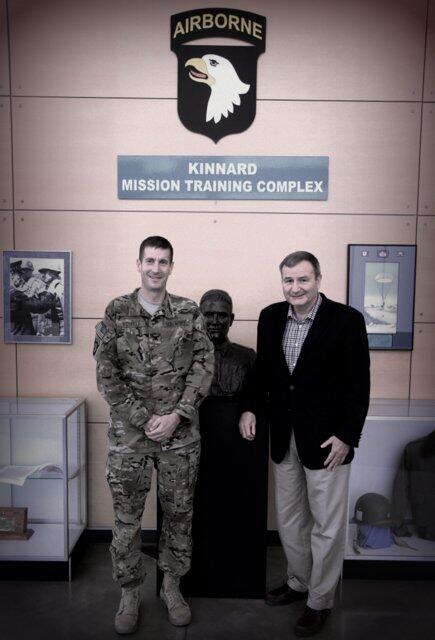 Former CISAC military fellow and U.S. Army Col. J.B. Vowell, left, and Ret. U.S. Army Lt. Gen. Karl Eikenberry, at Fort Campbell, Ky., on Jan. 13, 2015.
 Former CISAC Military Fellow Viet Luong, now a one-star general, teaches a simulation class during his 2011-2012 fellowship.


