-

Sorry, we've reached registration capacity. Please contact us if you would like to be added to the waitlist.


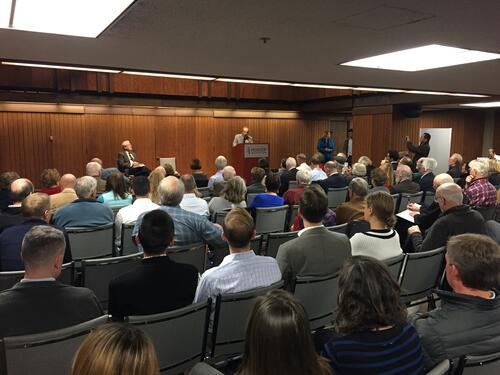
Barack Obama is not the first U.S. president to deal with the problem of overcommitment abroad.  How does his record compare with earlier cases?  Can the past help us understand the foreign policy debate of 2016?  Can it tell us how, when—and whether—today’s retrenchment will end?


Stephen Sestanovich is a professor of international diplomacy at Columbia University's School of International and Public Affairs and a senior fellow at the Council on Foreign Relations. He is the author of Maximalist: America in the World from Truman to Obama (Knopf 2014). 

From 1997 to 2001, Sestanovich was the U.S. State Department's ambassador-at-large for the former Soviet Union.  In previous government assignments, he was senior director for policy development at the National Security Council, a member of the State Department’s policy planning staff, and legislative assistant to Senator Daniel Patrick Moynihan. He has also worked at the Carnegie Endowment for International Peace and the Center for Strategic and International Studies. 

Ambassador Sestanovich received his BA summa cum laude from Cornell University and his PhD from Harvard University. He has written for Foreign AffairsThe New York TimesThe Wall Street Journal and other publications. He is a member of the board of directors of the National Endowment for Democracy.     


Event co-sponsored by the Center for International Security and Cooperation

Stephen Sestanovich Columbia University
Lectures
-

Click below to view the recording:


Please join us for the upcoming Payne Distinguished Lecture, “NATIONAL SECURITY CHALLENGES FOR THE NEXT PRESIDENT," with R. Nicholas Burns, former Under Secretary of State for Political Affairs and the Roy and Barbara Goodman Family Professor of the Practice of Diplomacy and International Relations, Harvard Kennedy School of Government. 

The lecture will take place on Friday, April 29 at 12 noon in the Bechtel Conference Center, Encina Hall.  Please RSVP to Scott Nelson at snelson@stanford.edu.

Lectures
0
jamiljaffer_2016_full_headshot_4.0_11.1.16.png

Jamil N. Jaffer is the Founder and Executive Director of the National Security Institute at the Antonin Scalia Law School at George Mason University where he also serves as an Assistant Professor of Law, Director of the National Security Law and Policy Program, Director of the Cyber, Intelligence, and National Security LL.M. Program, and runs the NSI Cyber & Tech Center. Jamil also teaches classes on artificial intelligence, counterterrorism, intelligence, surveillance, cybersecurity, and other national security matters, as well as a summer course held abroad with U.S. Supreme Court Justice Neil M. Gorsuch.  Jamil was recently appointed to serve as a member of the Cyber Safety Review Board at the Department of Homeland Security as well as to the Governor’s Task Force on Artificial Intelligence for the Commonwealth of Virginia.  Jamil is also affiliated with Stanford University’s Center for International Security and Cooperation and previously served as a Visiting Fellow at the Hoover Institution from 2016 to 2019.

Jamil is also a Venture Partner and Strategic Advisor with Paladin Capital Group, where he assists the firm with investments across the full range of its themes and theses, including a focus on dual-use national security technologies.  Jamil also serves on the board of directors of RangeForce, an interactive cybersecurity team training and upskilling startup, and Tozny, a digital identity startup, as well as on the advisory boards of U.S. Strategic Metals, North America’s largest primary producer of cobalt, a critical mineral used in EV batteries, aerospace, and other national security applications; and Constella Intelligence, a deep and dark web intelligence startup.  Jamil also serves as an advisor to Beacon Global Strategies, a strategic advisory firm, and Duco, a technology platform startup that connects corporations with geopolitical and international business experts.  Jamil is also the managing director of Trigraph Caveat Capital, a private investment firm.

Among other things, Jamil currently serves on the Advisory Board of the Foundation for the Defense of Democracies’ Center on Cyber and Tech Innovation and previously was a member of the Center for a New American Security’s Artificial Intelligence and National Security Task Force from 2018 to 2023 and the CNAS Digital Freedom Forum from 2019 to 2022.  Jamil is also a member of the Board of Directors of Speech First, the Advisory Board of the International Institute for Justice and the Rule of Law, the Executive Committee of the International Law and National Security Practice Group of the Federalist Society.

Immediately prior to his current positions, from 2015-2021, Jamil served as a senior business leader at IronNet Cybersecurity, helping take the company from a bootstrapped first-year technology products startup through two rounds of venture capital fundraising, growing from approximately 30 employees to over 300, and through its listing on New York Stock Exchange.  In his role as IronNet's Senior Vice President for Strategy, Partnerships & Corporate Development, Jamil worked directly for the co-CEOs of the company, Gen (ret.) Keith B. Alexander, the former Director of the National Security Agency and Founding Commander of U.S. Cyber Command, and Bill Welch, the former COO of Zscaler and Duo; in that role, Jamil led all of the company’s strategic and technology partnership efforts, including developing go-to-market and technology integration plans with some of the largest cloud platforms and cybersecurity companies in the market, evaluating potential acquisition targets, and developing overall corporate strategy and thought leadership around collective security and collaborative defense in the cyber arena.

Prior to his time at IronNet, Jamil served on the leadership team of the Senate Foreign Relations Committee as Chief Counsel and Senior Advisor under Chairman Bob Corker (R-TN), where he worked on key national security and foreign policy issues, including leading the drafting of the proposed Authorization for the Use of Military Force against ISIS in 2014 and 2015, the AUMF against Syria in 2013, and revisions to the 9/11 AUMF against al Qaeda.  Jamil was also the lead architect of the Iran Nuclear Agreement Review Act and two sanctions laws against Russia for its first intervention in Ukraine.

Prior to joining SFRC, Jamil served as Senior Counsel to the House Permanent Select Committee on Intelligence under Chairman Mike Rogers (R-MI) where he led the committee’s oversight of NSA surveillance, NRO intelligence issues, and NGA analytic and collection matters, as well as intelligence community-wide counterterrorism issues.  Jamil was also the lead architect of the Cyber Intelligence Sharing and Protection Act, the nation’s first cyber threat intelligence sharing legislation that was signed into law in 2015.

In the Bush Administration, Jamil served in the White House as an Associate Counsel to the President, handling Defense Department, State Department, and intelligence community matters, and serving as one of the White House Counsel’s primary representatives to the National Security Council Deputies Committee.

Prior to the White House, Jamil served on the leadership team of the Justice Department’s National Security Division as Counsel to the Assistant Attorney General for National Security, where he focused on counterterrorism and intelligence matters. At NSD, Jamil helped lead the division’s work on In re: Directives, the first ever two-party litigated matter in the FISA Court and the second case before the FISA Court of Review in its 30-year history.  Jamil also led NSD’s efforts on the President’s Comprehensive National Cybersecurity Initiative (CNCI), including the drafting of NSPD-54/HSPD-23, and related classified matters, and advised the National Security Agency (NSA) and U.S. Cyber Command’s predecessor organization, the Joint Function Component Command for Network Warfare (JFCC-NW), on matters related to cyber intelligence collection and offensive cyber activities.  For his work on these matters, Jamil was awarded the Assistant Attorney General’s Award for Special Initiative and was among the group of lawyers awarded the Director of National Intelligence’s 2008 Legal Award (Team of the Year – Cyber Legal).

Jamil also served in other positions in the Justice Department, including in the Office of Legal Policy, where he worked on the confirmations of Chief Justice John G. Roberts, Jr. and Justice Samuel A. Alito, Jr. to the United States Supreme Court.

Jamil also served as a lawyer in private practice at Kellogg Huber, a Washington, DC-based litigation boutique, as a policy advisor to Congressman Bob Goodlatte (R-VA), and as a staff member or senior advisor on a number of political campaigns, including two presidential campaigns and a presidential transition team.  While in law school, Jamil was a member of the University of Chicago Law Review, managing editor of the Chicago Journal of International Law, and National Symposium Editor of the Harvard Journal of Law & Public Policy.  Following law school, Jamil served as a law clerk to Judge Edith H. Jones of the United States Court of Appeals for the Fifth Circuit and, later in his career, as a law clerk to then-Judge Neil M. Gorsuch when he first joined the United States Court of Appeals for the Tenth Circuit as well as a law clerk to Justice Neil M. Gorsuch when he joined the U.S. Supreme Court.

Jamil has published multiple op-eds and academic articles on national security, foreign policy, cybersecurity, counterterrorism, encryption, and intelligence matters, and is the co-author of a book chapter with former NSA Director Gen. (Ret.) Keith B. Alexander on national security and the press in National Security, Leaks, and the Freedom of the Press:  The Pentagon Papers Fifty Years On (2021) and a book chapter with former CIA Director Gen. (ret.) Mike Hayden on ISIS, al Qaeda, and other international terrorist groups in Choosing to Lead: American Foreign Policy for a Disordered World (2015). Jamil has also written book chapters on cybersecurity and surveillance, as well as op-eds and policy papers with former Attorney General Michael B. Mukasey, former National Counterterrorism Center Director Matt Olsen, and Congressman Mike Waltz (R-FL), among others.

Jamil previously taught graduate-level courses in intelligence law and policy at George Washington University’s Elliott School of International Affairs and the National Intelligence University, served an outside advisor to the Cyberspace Solarium Commission, and has recently testified before committees of the U.S. Senate and House of Representatives on the Ukraine-Russia conflict, the Israel-Hamas conflict, China, software supply chains, cybersecurity, counterterrorism, and other national security matters.  Jamil has also recently appeared on a range of national television and radio outlets including CNN, Fox News, Fox Business, MSNBC, Bloomberg, PBS, Voice of America, and National Public Radio, and in various print and online publications, including the Wall Street Journal, New York Times, and the Washington Post on a range of national security matters including cybersecurity, counterterrorism, surveillance, encryption, privacy, and foreign policy issues.

Jamil holds degrees from UCLA (B.A., cum laude), the University of Chicago Law School (J.D., with honors), and the United States Naval War College (M.A., with distinction).

Founder & Executive Director, National Security Institute; Assistant Professor of Law & Director, National Security Law & Policy Program, George Mason University Law School.
CV
Date Label
Authors
News Type
News
Date
Paragraphs

Stanford foreign policy experts discussed flashpoints around the world at an OpenXChange event this week.


Three of Stanford's most seasoned international affairs experts discussed foreign policy and diplomacy – and practiced a bit of it on stage, too – as they tackled the topics of refugees, Russia and other politically thorny issues at a campus forum March 1.

The event, "When the World Is Aflame," featured Condoleezza Rice, a Stanford political science professor and former U.S. secretary of state; Michael McFaul, director of Stanford's Freeman Spogli Institute for International Studies and former U.S. ambassador to Russia; and Jeremy Weinstein, a Stanford political science professor and former director for the National Security Council.

Janine Zacharia, a Stanford visiting lecturer in communication and former Jerusalem bureau chief and Middle East correspondent for the Washington Post, was the moderator.

The event was hosted by OpenXChange, a campus initiative to provide a forum for students and community members to focus on today's societal challenges.

"So you were resetting some of my policy?" Rice half-jokingly interjected, as McFaul discussed the objectives behind the U.S. trade talks with Russia a few years ago.

"It was not about making friends with the Russians – I want to make that clear," McFaul continued after the laughter in the audience died down. "And it wasn't that we needed to correct the wrongs from the previous period," he said, casting a quick glance over at Rice. "The Russians had an interest in giving the Iranians a nuclear weapon. Our answer was, no, and let's work with them to prevent that."

A series of trade sanctions with Russia were eventually accomplished, but as it turns out, McFaul noted, the political environment has since changed with Russia's aggression in Crimea, Ukraine and Syria.

Today's conflict in Syria was laid about four years ago, the panelists agreed, when the United States decided to aid the rebels and not overtly attack the current regime.

"There were reasons our president and others did not go down that path, but it was an invitation to others to play games in that environment," Weinstein said. "What their endgame is, we don't know."

Rice added that Russian President Vladimir Putin "does not mind countries that basically don't function." As such, "a stable, functioning Syria was never his definition of success."

Zacharia asked, "Are you saying we have yielded the endgame to the Russians in Syria? There is nothing we can do? And we're playing defense?"

"Yes," Rice answered.

"Wait, there is no endgame," McFaul said. "It's not that we yielded the endgame."

"Right," Rice replied.

Though the panelists' opinions differed at times, the trio of political science professors agreed on many points, including that international order is being tested, and that the refugee crisis is an overwhelming problem – one that the United States should help resolve.

"I'm a firm believer that America has a moral obligation to take [refugees]," Rice said. "But let's remember that we have to have a way to take them that is actually going to work within the system."

"We have a humanitarian architecture that simply isn't up to the task," Weinstein said. Securing congressional funding to reform the system will be a challenge.

What's more problematic, McFaul added, is that the current political rhetoric about how the United States should handle refugees is "based on fear."

"We're not having a rational debate about this in my opinion," McFaul said. "We have to fill the debate with empirical facts instead."

Public fears will continue as long as extreme Islamic State terrorist groups remain influential, "inspiring lone wolves like [those] in San Bernardino," Rice said, referring to the December 2015 terrorist attack there that killed 14 and injured 22 people.

"Somebody has got to defeat ISIS in its crib," Rice said. "They march in columns; they don't hide in caves like al-Qaeda. If CBS News can find them, then the American military can find them."

The tougher challenge, however, will be the task of influencing sectarian politics and creating a more stable state in the long term, Weinstein said.

Stanford – with its cache of expertise – should strive to shape the national dialogue with concrete facts and analyses, McFaul said. Inspiring students and giving them the foundational tools to become the new generation of policy leaders is also part of that, he said. Adding a course on Russian politics would also be an improvement, he said.

Weinstein is a senior fellow at the Freeman Spogli Institute. Rice, a former Stanford provost, is the Denning Professor in Global Business and the Economy at Stanford Graduate School of Business and the Thomas and Barbara Stephenson Senior Fellow at the Hoover Institution.

The panelists urged students to gain a deep knowledge of the areas and issues they care about.

"Know your facts," Rice emphasized.

"When you're making policy decisions at the table, the people who understand these places and understand the political dynamics – those are the people whose voices are second to none around the table," Weinstein said.

"And we need to get you prepared for that in a more robust way," McFaul said, inviting students to pass any ideas about this to him.

In terms of career choices, "there's nothing greater" than public service, he said. "Sometimes I would get goose pimples when I could stand in front of Russians with the American flag behind me, representing the United States of America."

Hero Image
16193 condi mike L.A. Cicero
All News button
1
Authors
News Type
News
Date
Paragraphs

The U.S. Senate summary report on the allegations of CIA torture during the "war on terror" failed to live up to its original purpose, according to Amy Zegart, co-director of Stanford's Center on International Security and Cooperation (CISAC).

In a new journal article, Zegart wrote that the report has "not changed minds on either side of the torture debate and is unlikely to do so."

In December 2014, after five years of research, the U.S. Senate Select Committee on Intelligence issued a summary report of its investigation into the Central Intelligence Agency's terrorist detention and interrogation program between 2001 and 2006.

As Zegart noted, the Senate's summary released to the public amounted to less than a tenth of the full report, most of which remains classified. In an interview, she said the issue at hand should concern all Americans.

"How do secret agencies operate in a democratic society? Were the CIA's interrogation methods effective? Were they legal or moral? What role should the Congress have played when decisions about detainees were being made? All of these are vital questions which, sadly, remain unanswered and hotly contested – in large part because they have been caught in the maw of politics on both sides," said Zegart, the co-director of the Center for International Security and Cooperation at Stanford and a senior fellow at the Hoover Institution.

'A tiny portion of the full study'

Zegart explained that four key errors have doomed the Senate report to "eternal controversy."

"It was not bipartisan, took too long to write, made little effort to generate public support along the way and produced a declassified version that constituted a tiny portion of the full study," she said.

In contrast, Zegart said, the U.S. Senate's 1975-76 Church Committee investigation of intelligence abuses made different calls on all four issues, which helped it achieve significantly more impact. That committee was formed in the wake of Watergate and disclosures in the New York Times that U.S. intelligence agencies had engaged in a number of illegal activities for years, including widespread domestic surveillance on American citizens.

[[{"fid":"221516","view_mode":"crop_870xauto","fields":{"format":"crop_870xauto","field_file_image_description[und][0][value]":"","field_file_image_alt_text[und][0][value]":"","field_file_image_title_text[und][0][value]":"The cover of the U.S. Senate Select Committee on Intelligence's report on the CIA's detention and interrogation program.","field_credit[und][0][value]":"","field_caption[und][0][value]":"","field_related_image_aspect[und][0][value]":"","thumbnails":"crop_870xauto"},"type":"media","attributes":{"title":"The cover of the U.S. Senate Select Committee on Intelligence's report on the CIA's detention and interrogation program.","width":"870","style":"width: 350px; height: 521px; float: right;","class":"media-element file-crop-870xauto"}}]]She said the Church Committee was bipartisan and finished its job in 16 months. As a result, Congress passed new laws aimed at curbing aggressive spying on Americans and political assassinations abroad, among other measures.

Zegart wrote, "This was deliberate: As one Church Committee source told the New York Times in December 1975, 'If you wait too long, both the public and the members of Congress forget what you're trying to reform.' He was right."

On the other hand, she said, the Senate committee investigating CIA torture consisted entirely of Democrats and took five years to deliver what turned out to be a heavily redacted report. U.S. Sen. Dianne Feinstein (D-Calif.) chaired the committee.

While Feinstein's staff worked from 2009 to 2014, Zegart said, public outrage about torture faded – in fact, public support for coercive techniques actually increased. According to Zegart, a 2007 Rasmussen poll showed that 27 percent of Americans said the U.S. should torture captured terrorists, while 53 percent said the U.S. should not. A 2012 YouGov national poll conducted by Zegart found that support for torture rose 14 points while opposition fell 19 points.

Another problem was that the investigation did not hold a single public hearing to generate public attention or support, she said. In contrast, Church's investigation held 21 public hearings in 15 months.

Finally, the Senate report is still almost entirely classified, Zegart said.

"The 'report' released in December 2014 was a redacted executive summary of 500 pages – that's less than 10 percent of the 6,700-page report. No one knows when the other 6,200 pages will see the light of day," she wrote.

'Extraordinary resistance'

The aforementioned factors gave CIA defenders the upper hand when the report was eventually issued, she said.

"When the summary was released, former CIA officials launched an unprecedented public relations campaign replete with a web site, op-ed onslaught, and even a 'CIAsavedlives' Twitter hashtag," Zegart wrote.

And so, the episode represented one of the controversial episodes in the history of the CIA's relationship with the U.S. Senate, Zegart said.

"They [the Senate] faced extraordinary resistance from the CIA that included spying on the investigation; stonewalling and whittling away what parts of the report would be declassified; and a publicity campaign to discredit the study as soon as it was released," she wrote.

Zegart said the Feinstein investigation serves as a "cautionary tale" for Congress in its constitutional role of intelligence oversight.

"Even those who consider the interrogation and detention programs a dark mark on American history should be wary of calling the Senate report the definitive account of the subject or a model of intelligence oversight success," she wrote.

Hero Image
dianne feinstein senate cia report 12 09 14
U.S. Senate Intelligence Committee Chairman Dianne Feinstein holds a copy of a summary report on the CIA's detention and interrogation program on the day of its public release – December 9, 2014.
U.S. Senate
All News button
1
Authors
News Type
News
Date
Paragraphs

Lynn Eden has announced her retirement after 25 years as a senior research scholar at Stanford’s Center for International Security and Cooperation.

She has also been associate director for research since 2002, except for 2008-2009 when she was acting co-director—with co-director Sig Hecker on the science side.

“All the people who have been associated with CISAC for the last 25 years have benefited from her wise counsel,” said CISAC colleague Sig Hecker, research professor of Management Science and Engineering.

“She really has been the heart and soul of this place.”

Colleagues and former fellows said it would be hard to imagine CISAC without Eden.

“Most of us, even long-timers, have never known CISAC without her,” said CISAC co-director Amy Zegart.

“Lynn has been pivotal to both fostering and embodying the intellectual culture we know and love at CISAC: discussion that is rigorous and kind; candid and constructive; penetrating and interdisciplinary.”

Many said Eden’s most enduring legacy at CISAC would be her mentorship of young scholars during their formative years as CISAC fellows.

“She’s a wonderful mentor and a central figure in creating the intellectual community here at CISAC,” said David Holloway, Raymond A. Spruance Professor of International History.

Michael McFaul, director of the Freeman Spogli Institute for International Studies, said Eden had a tremendous impact on his development as a young academic.

"As a visiting fellow at CISAC very early in my academic career, I benefited tremendously from Lynn Eden's mentorship, intellect, and friendship," McFaul said.

"I am simply amazed at how many people enjoyed the same kind of mentorship with Lynn as I did as a young scholar. I thought I was special! It turned out that I was just one of dozens, if not hundreds, of Lynn's pupils."

Mariano-Florentino Cuéllar, former FSI and CISAC director and current California Supreme Court Associate Justice, said he had also benefited from Lynn's guidance over the years.

"Many dozens of scholars are who they are -- and have achieved as much has they have -- because of Lynn," said Cuellar.

"I am among them. I benefited from Lynn's contributions when I was a graduate student, a junior faculty member, a tenured professor, honors program director, CISAC co-director, and FSI's Director."

FSI/CISAC senior fellow Martha Crenshaw said no matter where she traveled in the world to speak at conferences on international security, she invariably encountered former fellows who recalled the positive influence Eden had on their experiences at CISAC.

“She’ll always be pretty much the first person they mention,” Crenshaw said.

“Her role as a mentor has been so important to the many people who come through this place.”

Crenshaw’s observation was echoed by Rod Ewing, Stanford professor in the School of Earth Sciences and the inaugural Stanton Professor in Nuclear Security Studies at CISAC.

“Before I arrived at Stanford, I already had heard of Lynn from past fellows,” Ewing said.

“All were deeply in debt to Lynn for her efforts to shape their thinking and their projects.  I have never seen any single person have such an impact on so many fellows.”

[[{"fid":"221270","view_mode":"crop_870xauto","fields":{"format":"crop_870xauto","field_file_image_description[und][0][value]":"","field_file_image_alt_text[und][0][value]":"","field_file_image_title_text[und][0][value]":"Lynn Eden talks about nuclear war and fire effects to students at Castilleja School in Palo Alto","field_credit[und][0][value]":"","field_caption[und][0][value]":"","field_related_image_aspect[und][0][value]":"","thumbnails":"crop_870xauto"},"type":"media","attributes":{"title":"Lynn Eden talks about nuclear war and fire effects to students at Castilleja School in Palo Alto","width":"870","style":"width: 450px; height: 299px; float: left; margin-right: 15px;","class":"media-element file-crop-870xauto"}}]]You only need to do a quick survey of the dissertations and books produced by CISAC fellows to understand the scope of Eden’s impact, according to Scott Sagan, Caroline S.G. Munro professor of political science.

“Lynn has been a mentor par excellence for dozens of CISAC fellows over the years,” Sagan said.

“Indeed, if there was an “Social Science Acknowledgement Citation Index” (like the well-known Social Science Citation Index), my guess is that Lynn Eden's count would be the highest in all of international security studies.”

And her mentorship wasn’t limited to the social sciences.

“Lynn has mentored a stunning breadth of scholars, including political scientists, sociologists, anthropologists, physicists, computer scientists, and biologists,” said former CISAC fellow Rebecca Slayton, who is now on the faculty at Cornell University.

Other former fellows said they deeply valued Eden’s thoughtful feedback on their academic work.

“Lynn read my work with great care, and offered commentary that was on point, useful, and kind,” said Kimberly Marten, professor of political science at Barnard College and a faculty member at Columbia University.

“She was also a real friend, who cared about me not only as a budding scholar but as a person. She remains a role-model for me of what mentorship is all about.”

Colleagues said they also admired Eden’s contributions to the field of nuclear scholarship.

Image
“Her own work, notably her award-winning book Whole World on Fire: Organizations, Knowledge and Nuclear Weapons Devastation, has made an original and important contribution to the study of nuclear weapons and nuclear policy through the lens of organizational theory,” Holloway said.

History professor Norman Naimark said he valued Eden’s “uncompromising intellectual honesty.”

“She wants to know; she wants to understand; she does not put up with artifice or entangled arguments; she tries as best she can to barrel in on the “truth,” whatever that might be,” Naimark said.

James E. Goodby first met Eden when they both served on the faculty at Carnegie Mellon University, before he moved to Stanford as an Annenberg distinguished visiting fellow at the Hoover Institution.

“She came as close to pure, unbiased intellect as anyone I have ever worked with,” Goodby said.“

CISAC co-director David Relman said Lynn had helped shape and guide the intellectual discourse at CISAC.

“I’ve deeply valued Lynn for the rigor of her thinking, her love of teaching and mentoring of trainees and students, and the smile she brings to everyone’s face during any conversation,” said David Relman, CISAC co-director.

Elizabeth Gardner, FSI associate director for partnerships and special projects, worked alongside Eden at CISAC for more than a decade.

She said Eden helped make CISAC a place people wanted to come back to.

“CISAC is legendary for its “boomerangs” – people who return to the Center after their initial stint because they liked it so much the first time around,” Gardner said.

“The reason many of those people return is Lynn. It's her warmth, willingness to help with the hardest problems and her laser-like intellect that kept people coming back.”

Eden said she would continue her academic writing after retiring from CISAC, on “how organizational processes have enabled U.S. policymakers and nuclear war planners to make real plans that if enacted would result in the very thing no one possibly wants—the end of the world.”

Eden will also attend a variety of CISAC seminars when she can, and particularly the social science seminar series David Holloway and she founded 20 years ago.

Eden’s retirement party is scheduled to be held in CISAC’s Central Conference Room from 12noon–1:30pm on Thursday, December 3.

Hero Image
14217557985 6349e77a26 o
Lynn Eden talks with alumni attendees of the International Studies Association conference at an event in San Francisco.
All News button
1
Authors
News Type
News
Date
Paragraphs

Former U.S. Secretary of Defense William J. Perry said he was concerned that the Islamic State in Iraq and Syria (ISIS) could buy, steal or build a nuclear weapon capable of killing a hundred thousand or more people in a single strike.

And, he said, stopping the flow of oil money to ISIS should be the main, short-term objective of the United States and its allies in the fight against the terrorist organization.

“They have demonstrated their objective is just killing as many Americans as they can, or Europeans as the case may be…and there is no better way of doing that than with nuclear weapons,” Perry said.

Image
Perry made his comments in front of a crowd gathered at Stanford University to celebrate the launch of his new memoir “My Journey at the Nuclear Brink.”

“If they can buy or steal a nuclear bomb, or if they could buy or steal fissile material, they could probably make a bomb – a crude improvised bomb,” he said.

Even a crude nuclear weapon could have an explosive power equivalent to around fifteen thousand tons of TNT – similar to the bomb that destroyed the Japanese city of Hiroshima near the end of World War II.

Perry said there was evidence that Al Qaeda had actively tried to get nuclear weapons, and he said it was likely that ISIS was also pursuing its own nuclear strategy.

“The big difference between ISIS and Al Qaeda in that respect is that ISIS has access to huge amounts of resources through the oil that they now control,” Perry said.

“I believe that our primary objective in dealing with ISIS should be to stop that flow of money, stop the trading they’re doing in oil which is giving them the resources.”

U.S. warplanes reportedly destroyed 116 trucks in Eastern Syria on Monday that American officials said were being used to smuggle crude oil.

U.S. fighter jets dropped leaflets before the attack, warning the drivers to abandon their vehicles, according to a report in The New York Times.

The Russian Air Force also claimed its planes had struck around 500 oil tankers that were carrying oil from Syria to Iraq for processing.

Perry said that combating ISIS over the long run was a “hugely difficult problem” for Western powers.

“To really stop ISIS completely it would be a long and brutal and ugly fighting on the ground, which I don’t believe we’re going to want to do again,” he said.

“What we can do however, a more limited objective is stopping the resources they’re getting, stopping their access to this oil money. And that limits quite a bit what they can do…That can be done I think in more of a targeted and effective way, and without having to put armies on the ground to do it.”

Hero Image
isis flag reuters rtr4fed5
Smoke rises behind the Islamic State flag after a battle with Iraqi security forces and Shiite militia in the city of Saadiya in November, 2014.
Reuters
All News button
1
Authors
News Type
News
Date
Paragraphs

The deadly terrorist attacks in Paris last Friday that killed 129 people and wounded around 350 more signaled a significant change in strategy for the Islamic State in Iraq and Syria (ISIS), the radical jihadist organization that has claimed responsibility.

“It underscores that this threat is real and that ISIS is not going to be content to consolidate its power in Iraq and Syria,” said Joe Felter, a former Colonel in the U.S. Army Special Forces and senior research scholar Stanford’s Center for International Security and Cooperation (CISAC).

“They have demonstrated their ability to project power into foreign countries and conduct what I would call an “asymmetric strategic bombing capacity” in the form of these home-grown Western citizens who are willing to strap on suicide vests and blow up targets in support of ISIS directed objectives.

“They’re able to launch attacks with centralized planning and decentralized execution in a way that makes anticipating and interdicting them very difficult.”


French President François Hollande said that the attacks were “planned in Syria, organized in Belgium, perpetrated on our soil with French complicity.”

CISAC senior fellow Martha Crenshaw said the Paris attacks represented “a shift in strategy” for ISIS with the group “taking a more Al Qaeda-like stance and striking Western countries.”

However, she emphasized that the carefully planned nature of the coordinated strikes, where multiple teams carried out simultaneous attacks in three locations across downtown Paris, indicated that this new strategy had been secretly underway for some time.

“These attacks were planned a long time ago,” said Crenshaw, whose Mapping Militants Project includes more information on groups like ISIS.

“You shouldn’t think they’re reacting to very recent circumstances…It’s not like we bombed them one day and the next day they planned these attacks.”

Apocalyptic visions

ISIS has long advocated a plan of provoking the West into a larger confrontation that would lead to an apocalyptic victory for Islam, according to Abbas Milani, director of Iranian studies at Stanford and an affiliate at the Center for Democracy Development and the Rule of Law.

“There’s a lot of method to this madness,” Milani said.

“If you read their literature, they have always talked about creating this sort of mayhem.”

ISIS’s propaganda magazine Dabiq, which is available online in Arabic and English, is named after a village in Syria with important symbolism for jihadists.

“They claim that the prophet has predicted that if you can get the West to come and fight the Muslims at Dabiq, then Islam will conquer the world,” Milani said.

Unlike France’s earlier battles against extremists in Algeria, it cannot rely on a proxy state to take the fight to the terrorists, according to Crenshaw.

“When terrorism in France has its origins in Algeria, France could rely on the Algerian state to crack down on these groups,” she said.

“Now you’ve got a situation where the planners are in a country where you don’t have a reliable state to go in and get them for you and wrap up their networks.”

With French warplanes already bombing targets in the Syrian city of Raqqa, Felter warned against the limits of air power in the fight against ISIS.

“There’s a risk that as we ramp up the bombing campaign and increase civilian casualties, this does play into the narrative of these extremists,” he said.

“It’s a very difficult targeting process. ISIS has occupied urban areas full of non-combatants and civilians…It’s the ultimate human shield.”

Felter acknowledged that increasing the number of US ground forces sent to interdict ISIS in Iraq and Syria may ultimately be necessary, but also that this increased presence, if not managed carefully, could backfire.

“At some level, they want to bring Western military forces to occupy these lands, because that will help turn popular opinion against the West and aid in their propaganda and recruitment,” he said.

The fight against ISIS is not limited to the territories it claims in the Middle East. It must be a global effort and include increased international cooperation and information sharing across intelligence, law enforcement and other agencies around the world, Felter said.

ISIS wants to drive a wedge between Europeans and the growing Muslim communities in their countries, so recruiting French citizens to participate in the Paris attacks served a dual purpose, Milani said.

“Using French citizens helps them with logistics, but it also helps them in terms of their strategy in that it makes it difficult for Muslims to live in a non-caliphate context,” he said.

Failed states problem

In the wake of the attacks, European nations are working to create legislation that would toughen criminal penalties for citizens who travel abroad to fight with designated terrorist organizations such as ISIS, or strip them of their citizenship, according to CISAC affiliate Anja Dalgaard-Nielsen, a former executive director of the Danish Security and Intelligence Service.

Individuals who are seen as inciting people to travel to Syria and Iraq to join the jihad could also face tougher sanctions, she said.

The emergence of ISIS and its nihilistic theology is a symptom of broader underlying problems in the Middle East, which is grappling with failed and failing states across North Africa and in Syria, Iraq, Afghanistan and Pakistan, according to Milani.

“ISIS is the most militant and brutal manifestation of something deeper that’s going wrong,” he said.

“I honestly have never seen the Middle East as perilously close to complete chaos as it is now… [and] I don’t think we’ve seen the worst of it yet.”

Resources & links

Get more background on the Islamic State and its leaders from Martha Crenshaw’s Mapping Militants Project

Is There a Sunni Solution to ISIS? – The Atlantic | By Lisa Blaydes & Martha Crenshaw

Airstrikes Can Only Do So Much to Combat ISIS – New York Times | By Joe Felter

The Super Smart Way to Dismantle ISIS – The National Interest | By Eli Berman, Joe Felter & Jacob Shapiro

The Rise of ISIS and the Changing Landscape of the Middle East – Commonwealth Club of California | Abbas Milani

Hero Image
french soldiers patrol eiffel tower reuters rts6zju
Police patrol near the Eiffel Tower the day after a series of deadly attacks in Paris.
Reuters
All News button
1
News Type
News
Date
Paragraphs

Forty-eight national security and foreign policy leaders urged U.S. government and businesses to take action to fight climate change in a statement released by the Partnership for a Secure America. Thomas Fingar, a distinguished fellow in the Freeman Spogli Institute for International Studies, is a signatory. The statement can be accessed by clicking here.

Hero Image
5811865885 d45256bd02 o
A sergeant operates a sling on a UH-60 Blackhawk above a swollen Missouri River near North Sioux City, South Dakota. Flight crews are helping deliver sand bags to areas affected by flooding.
Flickr/U.S. Department of Defense
All News button
1
Authors
News Type
News
Date
Paragraphs

The Freeman Spogli Institute for International Studies has welcomed five new senior military fellows, including three active duty lieutenant colonels from the U.S. Air Force and two from the U.S. Army, who will spend the next academic year at Stanford pursuing self-directed study of important national issues.

Former U.S. Secretary of Defense and CISAC faculty member Bill Perry created the program to give military officers the opportunity to take a deep dive into an area of strategic interest.

The fellows will be considering a diverse range of topics, from how to adapt Silicon Valley’s innovative work culture to the Army, to China’s actions in the South China Sea, and the effectiveness of U.S. economic sanctions against North Korea.

You can learn more about our fellows’ military backgrounds and the intended focus of their studies from the brief bios below.

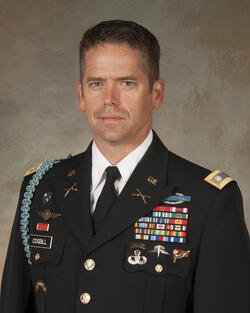
John Cogbill and Scott Maytan will be assigned to the Center for International Security and Cooperation.

John Chu, Ryan Blake and Jose Sumangil will be based at the Walter H. Shorenstein Asia-Pacific Research Center.


LTC John Cogbill

LTC John Cogbill was commissioned as an Infantry officer from the United States Military Academy in 1994 and has held a variety of positions in both conventional and special operations units. John’s first assignment was as a Platoon Leader and Executive Officer in the 82nd Airborne Division. John then served two years in the 1st Battalion, 75th Ranger Regiment as a Platoon Leader and Civil-Military Affairs Officer. Next, John served three years in Alaska as an Airborne Rifle Company Commander and the Aide-de-Camp to the Commanding General. After earning his MPA from the Harvard Kennedy School, John taught Economics in the Social Sciences Department at West Point. Following the Command and General Staff College, he spent two years as a Combined Arms Battalion Executive Officer in the 1st Cavalry Division. He then served as the Strategic Plans and Requirements Officer for the 75th Ranger Regiment. Most recently, John commanded the Reconnaissance and Surveillance Squadron for the U.S. Army Third Corps. John has deployed on three combat and two peacekeeping missions, including two tours in Iraq, one tour in Afghanistan, one tour in Haiti, and a recent tour in Kosovo. He will be exploring how the Army can encourage innovation and use emerging technologies to achieve and maintain a competitive advantage on the battlefield.


lt col scott maytan 5x7 Lt Col Scott Maytan, U.S. Air Force

Lt Col Scott Maytan was the commander of a B-52H operational bomb squadron, responsible for ensuring combat mission readiness for any worldwide nuclear or conventional tasking. Lt Col Maytan is a navigator with over 2500 flying hours, primarily in the B-52H, and is a graduate of both the Command and General Staff College (U.S. Army) and the U.S. Air Force Weapons School. He has served four operational assignments, as an advanced tactics instructor, and also a tour at the Pentagon where he developed Air Force positions concerning long-range strike and aircraft nuclear requirements. Lt Col Maytan has served three combat deployments for Operations Desert Fox (Southern Watch), Allied Force and Iraqi Freedom and has also deployed four times supporting USPACOM’s Continuous Bomber Presence mission. Maytan will be studying the “red-lines” that shape Western deterrence posture, and how strategic action and deterrence posture in one region affects others.


LTC John Chu, U.S. Army

LTC John Chu is an active duty officer in the United States Army. Chu has held a variety of leadership and staff positions in his 20 year career. Most recently, he served as the Chief of Intelligence Training at the Department of the Army. Chu has twice been deployed to Iraq and once to Bosnia, with multiple assignments to South Korea, Germany and Turkey. Born in Seoul, he grew up in California and graduated from West Point in 1995. At Stanford, Chu is researching the Korean armistice agreement and the United Nations mission to South Korea. He will also examine U.S. policy toward North Korea, particularly analyzing the “brink of war” tension and developing strategic deterrence measures to reduce risk of unwanted military escalation on the Korean Peninsula. For both research streams, Chu aims to produce analyses and recommendations that could inform a policy audience.


Lt Col Ryan Blake, U.S. Air Force

Lt Col Ryan Blake is an active duty officer in the United States Air Force. Blake was the commander of a flight test squadron where he was responsible for the flight test of new Air Force programs. He has over 2,400 flying hours in over 40 types of aircraft, and has held two operational F-15E assignments, including combat deployments in support of Operations Southern Watch, Iraqi Freedom and Enduring Freedom. He had also been positioned at the Pentagon in defense acquisition and the Office of Security Cooperation in Baghdad. At Stanford, Blake is researching the U.S. policy toward China and its relation to Northeast Asia. He aims to discover areas of cooperation between the U.S. and Chinese militaries.


Lt Col Jose “Ed” Sumangil, U.S. Air Force

Lt Col Jose “Ed” Sumangil is an active duty officer in the United States Air Force. During his career, Sumangil has served in a range of operational assignments, including joint staff officer at U.S. Strategic Command where he was a lead planner of the command’s space campaign. Before coming to Stanford, he was the commander of a B-1 squadron and led airmen through combat deployments in support of Operations Enduring Freedom, Inherent Resolve and Freedom’s Sentinel. At Stanford, Sumangil is examining China’s actions in the South China Sea and the Philippines arbitration case regarding Chinese actions there. He seeks to offer perspectives and policy and strategy options to maintain peace and stability in the South China Sea.


Hero Image
ennica hall exterior ws
All News button
1
Subscribe to The Americas