-

Seminar Recording: ​https://youtu.be/vwmgYCTUJ3o


About this Event: Scholars and practitioners have long argued that compliance with international rules often requires building institutions or other mechanisms to ease access to information about possible violations. This book introduces a different information problem -- disclosure dilemmas -- that requires equipping IOs with secrecy. States and firms often possess private information that sheds detailed light on the compliance of others with international rules. Yet fears of revealing intelligence sources or helping commercial rivals can deter them from disclosing it. Building a “confidentiality system” in an international organization can allow the institution to receive and protect such sensitive details, enabling disclosure without wider dissemination. This, in turn, elicits the sharing of unique and sensitive information which fills evidentiary gaps and makes cooperation more effective. For example, targeted intelligence disclosures to the IAEA can fill in gaps about hidden nuclear weapons programs. Similarly, targeted disclosures of internal firm documentation to the WTO can clarify whether trade barriers have caused damage to foreign firms. The book offers a unified, multi-method approach to understanding international cooperation and how institutions work, spanning economic and security domains from nuclear proliferation to trade to human rights. In addition to practical lessons about how to improve compliance with international rules, the book recasts the role of institutions in International Relations and identifies a source of tension between cooperation and normative goals like global governance transparency.


Speaker's Biography: Austin Carson is assistant professor in the Department of Political Science at the University of Chicago. His first book, Secret Wars: Covert Conflict in International Politics (Princeton UP 2018), argues that secrecy helps great powers meddle in conflicts while keeping war limited. It was recently award the Lepgold Book Prize for best book in 2018. A second book with Allison Carnegie, Secrets in Global Governance: Disclosure Dilemmas and the Challenge of International Cooperation (Cambridge UP forthcoming), shows how secrecy allows international organizations to use sensitive information to assess compliance. His research has appeared in International Organization, American Journal of Political Science, and Security Studies.

Austin Carson University of Chicago
Seminars
-

Livestream: This event will not be live-streamed or recorded.


Abstract: State nuclear enterprises are shrouded in secrecy. This fact alone makes nuclear security scholarship difficult. Yet recent scholarship has begun to explain variation in the secrecy of international politics. This panel will investigate the strategic uses of  secrecy and deniability both within and between states in the nuclear domain. We will discuss the role of secrecy in coercive bargaining, the relationship between secrecy, deniability, and dual-use technologies, and assess their value and limitations in matters of nuclear security. Pauly will present ongoing research into the constructive opacity of the nuclear nonproliferation regime. Das will present evidence on the role of secrecy and deniability in the sales of nuclear delivery systems that undercut the nonproliferation regime. And Borja will present work on how uncertainty in cyberspace affects the U.S. nuclear arsenal.


Speakers' Biography: 

Lauren Borja is a Stanton Postdoctoral Fellow at CISAC, where her research will focus on the cyber insider threat to the U.S. nuclear arsenal. She is broadly interested in the effect of new technology on nuclear security issues, leveraging her technical skills as a scientist to inform and contribute to the issues in nuclear policy. She received her Ph.D. from the University of California, Berkeley, where she constructed an ultrafast laser apparatus for studying fundamental interactions inside semiconductor materials with unprecedented resolution. Lauren completed her Ph.D. in December 2016 and is currently a Simons Foundation Postdoctoral Research Fellow at the University of British Columbia, where she studies nuclear disarmament and risk. She has authored articles on the Nuclear Ban Treaty, nuclear false alarms, and cybersecurity risks in the nuclear arsenal that have appeared in the Vancouver Sun, American Physical Society’s Physics and Society newsletter, and Bulletin of the Atomic Scientists.


Debak Das is a MacArthur Nuclear Security Pre-doctoral Fellow at CISAC. He is a PhD candidate in Political Science at the Department of Government, Cornell University. His doctoral dissertation examines how regional powers build their nuclear force structures. This research is based on extensive fieldwork in India, the United Kingdom, and France. Debak is also interested in historical archives, public opinion and foreign policy, and South Asian politics. His research has been supported by the Judith Reppy Institute for Peace and Conflict Studies, the Wilson Center, Cornell University’s Graduate School, the Cornell Institute for European Studies, and the Chateaubriand Fellowship in Humanities and Social Sciences. Debak received his M.Phil in Diplomacy and Disarmament, and his M.A. in Politics and International Relations from Jawaharlal Nehru University, New Delhi. He also holds a B.A. (Honors) in History from Presidency College, Kolkata. Debak has formerly held research positions at Institute of Peace and Conflict Studies and the Centre for Dialogue and Reconciliation, New Delhi. His prior work includes organizing extensive Track II Dialogues between India and Pakistan specifically on nuclear and other related security issues. 


Reid Pauly is a Stanton Postdoctoral Fellow at CISAC. His scholarship focuses on coercion and nuclear weapons proliferation, especially the causes of credible coercive assurance—why and how targets of coercion believe that they will not be punished after they comply with demands. His broader research interests include wargaming and crisis simulations, nuclear strategy, and tacit cooperation between adversaries. Reid is a PhD candidate in Political Science at MIT and a member of the Security Studies Program. He was also a predoctoral fellow at the International Security Program and the Project on Managing the Atom at the Harvard Kennedy School's Belfer Center for Science and International Affairs. Prior to graduate school, Reid was a research assistant at the Center for International Security and Cooperation at Stanford University and earned a B.A. in History and Government from Cornell University.

 
Lauren Borja, Debak Das, and Reid Pauly
-

This event is co-sponsored by the Program in History and Philosophy of Science; Program in Science, Technology, and Society; and Stanford Center for Law and History.


Livestream: This event will not be live-streamed or recorded


Abstract: How have national practices of nuclear security produced local conditions of insecurity? After World War II, the United States’ nuclear testing program transformed the Marshall Islands into an experimental site for testing both new weapons and forms of territorial governance. During the same period, the Hunters Point Shipyard in southeast San Francisco became the launching point and return site for ships, scientists, and military personnel circulating between the mainland and the Pacific tests. These activities not only incorporated the Marshall Islands and Hunters Point into networks of militarization and scientific knowledge production, but also resulted in widespread radiological contamination. Professors Mary Mitchell and Helen Kang will discuss the entangled legal, environmental, and social legacies of radiological contamination at these two sites, shedding light on the consequential damages of the Cold War and ongoing efforts to demand accountability from the United States government.


Helen Kang Biography: Helen H. Kang is Professor of Law at Golden Gate University School of Law and Director of the school’s Environmental Law and Justice Clinic, which has received recognition for its work from the American Bar Association and the Clinical Legal Education Association, among others. She has devoted most of her legal career to environmental protection, first as Trial Attorney with the Environmental Enforcement Section of the U.S. Department of Justice. Since joining the clinic in 2000, she and her students have successfully represented community and environmental groups, prevailing against agencies such as U.S. EPA and large sources of pollution, including power plants. The clinic’s work has contributed to developments in environmental law, reducing pollution in communities most affected by pollution in California and beyond, and improving public participation and regulatory accountability. Helen’s achievements include successfully arguing in the California Supreme Court to defend the California Environmental Quality Act from federal preemption and compelling California, after decades of abdication, to meaningfully regulate agricultural pollution. She graduated from Berkeley Law, University of California at Berkeley, and Yale University.


Mary Mitchell Biography: Mary X. Mitchell is an Assistant Professor of History at Purdue University where she works on issues at the intersection of environmental inequality and law. During the spring of 2020, Mitchell will be a faculty fellow at Princeton University's Shelby Cullom Davis Center. She earned her PhD in History and Sociology of Science from the University of Pennsylvania in 2016 and was an Atkinson Fellow in Sustainability at Cornell University from 2016-2018. Previously, she practiced law in Pennsylvania and served as a law clerk to Judge Anthony J. Scirica of the United States Court of Appeals for the Third Circuit.


Helen Kang Professor of Law Golden Gate University School of Law
Mary Mitchell Assistant Professor of History Purdue University
Seminars
Authors
Melissa K. Griffith
News Type
Commentary
Date
Paragraphs

Image
screen shot 2019 11 20 at 9 08 20 am

Given much of the recent coverage surrounding security and the fifth generation (5G) of cellular networks, you would be forgiven for assuming that security concerns are largely limited to China in general and Huawei in particular.

This is not the case.

Equally important are the concerns for United States’ security that extend beyond Huawei’s role in the development and deployment of 5G technology. Notably, while Huawei amplifies many pre-existing areas of concern, 5G would represent a significant challenge for American national security even if China was not a peer competitor in the market. 


Read the rest at The Wilson Center

Hero Image
melissa griffith 0
All News button
1
Authors
News Type
News
Date
Paragraphs

Two former Department of Defense (DoD) officials shared the stage at the Freeman Spogli Institute for International Studies (FSI), where they discussed the decision to remove U.S. troops from northern Syria, women in the military, and the importance of public service.

Ash Carter — who served as secretary of defense from 2015 to 2017 — told Joe Felter — former deputy assistant secretary of defense for South and Southeast Asia — that he emphasized the importance of tradition and had high standards for good conduct from his employees when he was at the head of the DoD, which had 1.3 million active-duty employees in 2016, and is the largest employer in the world.

[Get stories like this delivered to your inbox by signing up for FSI email alerts]

“Even if you come into an organization and take over and your judgement is that it’s really quite broken, it’s still worth finding the things that it is good at and making the people proud of the things that they are already good at,” Carter said.


Felter asked Carter about a topic on the minds of some in Silicon Valley — the possible development of autonomous weapons — and whether the liability for harm should lie with the developer of technology, or those who make the decision to execute the use of the weapon.

“It’s going to be a shared responsibility,” Carter said. “The key thing is not to get lost in AI is human responsibility — AI is an aid to human decision-making, but at the end of the day, somebody is responsible.”


When asked about the relationship between tech companies and the government, Carter said he had encountered some tech leaders who didn’t think government mattered during the earlier days of his government service, but added that he has noticed a different attitude from young people today.

“My students know that something’s wrong in the relationship between tech and society… it brings a lot of great stuff, but it has brought some real darkness too, and we need to get on top of that,” Carter said. “And that’s how they want to spend their lives.”


When Felter asked Carter what he would say to a graduating Stanford student to encourage him or her to pursue a career in public service, Carter didn’t have to think twice before responding.

“I’d say, ‘Look, the building smells like your high school, the pay is terrible, and work conditions can be awful. But the mission is the best. And you’ll wake up every morning and be a part of something that is meaningful.’”


[Find more upcoming events with experts on international affairs on the FSI website]

Hero Image
ash carter cropped
Former Secretary of Defense Ash Carter talks to former Deputy Assistant Secretary of Defense for South and Southeast Asia Joe Felter about his career in service at the Freeman Spogli Institute for International Studies. Photo: Alice Wenner
All News button
1
-

This event is cosponsored with the Stanford Woods Institute for the Environment


Seminar Recording: https://youtu.be/yMVJu1gmRFk


Abstract: Joshua Busby, University of Texas-Austin, will present the main argument and empirical work from his draft book manuscript. Over the past decade, a rich literature on the connections between climate change and security emerged, much of it quantitative on the links between climate change and violent internal conflict. In this book manuscript, Busby seeks to widen the aperture of security concerns to include major humanitarian emergencies. Through the study of paired cases, he explores why countries that face similar physical exposure to climate hazards experience different outcomes. His argument combines state capacity, the degree of political inclusion, and the role of international assistance to explain differences between countries as well as within countries over time. Countries with low state capacity, high political exclusion, and where assistance is denied or delivered in a one-sided manner are expected to have the worst security outcomes in the wake of exposure to climate hazards. While assistance can sometimes compensate for weak state capacity, improvements in capacity and inclusion can diminish the risks of climate-related emergencies and conflict. In this talk, Busby will compare the experience of Bangladesh, India, and Myanmar to cyclones.


Speaker's Biography:

Joshua Busby is an Associate Professor at the LBJ School of Public Affairs at the University of Texas-Austin. He is also a Senior Research Fellow at the Center for Climate and Security. He has been part of two U.S. Department of Defense-funded research projects on climate and security and his work on the topic has been published in Foreign Affairs, World Development, Climatic Change, Political Geography, International Security, Security Studies, among other publications.


Joshua Busby Associate Professor University of Texas-Austin
Seminars
-

This event is co-sponsored with The Freeman Spogli Institute for International Studies


Seminar Recording: https://www.youtube.com/watch?v=-vHBvzWHcpw&feature=youtu.be


Abstract: The world’s largest organization is also one of its most mysterious. The Department of Defense (DOD) employs more men and women than Amazon, McDonald’s, FedEx, Target, and General Electric combined. Yet most Americans know little about it beyond its $700 billion budget and iconic five-sided headquarters. Now, the leader who knows the Pentagon best pulls back the curtain on an institution that many regard with a mix of awe and suspicion, revealing not just what it does but why, and why it matters. Former Secretary of Defense Ash Carter will offer an insider’s account of how America’s military works—and how it should work. It is also a timely reassessment of U.S. foreign policy and national security strategies in a rapidly changing world, and a timeless reflection on the leadership qualities essential to not only run but also reform a dauntingly complex organization. 


Speaker's Biography:

Image
2164204 carter ash1
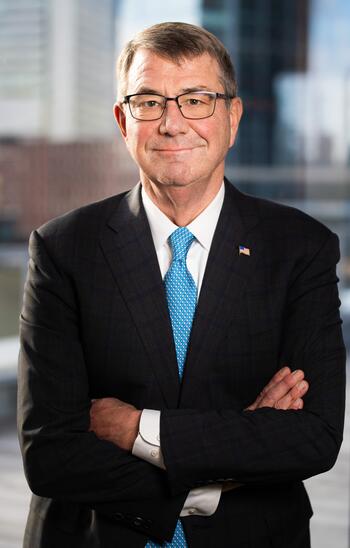
For or over thirty-five years Ash Carter served in numerous jobs in the Department of Defense, mostly recently as the twenty-fifth Secretary of Defense under President Obama. He currently serves as the Director of the Belfer Center for Science and International Affairs at Harvard Kennedy School and an innovation fellow at MIT. He also is a Rhodes scholar with a PhD in nuclear physics.

Ash Carter 25th Secretary of Defense
Seminars
Authors
News Type
News
Date
Paragraphs

Following the death of ISIS leader Abu Bakr al-Baghdadi and the decision by President Donald Trump to remove U.S. troops from northern Syria, there are many questions surrounding the future of the region, which is controlled in part by Al-Qaeda-affiliated extremists, former Special Presidential Envoy for the Global Coalition to Defeat ISIS Brett McGurk told Freeman Spogli Institute for International Studies Director Michael McFaul on the World Class podcast.


ISIS initially gained momentum in Syria in 2012, when the government had eroded and a state of anarchy was developing, said McGurk, who is the Payne Distinguished Lecturer at the Center for International Security and Cooperation. “Starting in 2012 and 2013, thousands of foreign extremist fighters were pouring into Syria, looking for extremist groups to join. And Baghdadi’s guys — which became ISIS — basically took advantage of this.”

By 2014, ISIS controlled a territory with about eight million people and had revenues of about $1 billion a year, McGurk noted.

“I was an early advocate that we needed military force almost immediately,” he said. “To get someone recruited right into Syria, then go blow himself up at a kid’s soccer game, or an ice cream shop — if you have that pipeline, you know you have something pretty serious.” 

[Get stories like this delivered to your inbox by signing up for FSI email alerts]

The Anti-ISIS Strategy
In the summer of 2014, President Barack Obama decided to take action, with a few conditions: first, that the coalition against ISIS would be broad, and include countries outside of the United States; second, that U.S. troops would work with local partners in Iraq and Syria to fight the terror group; and third, that the coalition would share the costs and burdens associated with the military campaign.

“The campaign launched during the third week of August or so during that summer, and it was a real war,” McGurk said. “It was a very difficult, town-by-town struggle, but a successful war.”

The Death of al-Baghdadi
While al-Baghdadi will be replaced by a successor, the former ISIS leader is “somewhat irreplaceable,” said McGurk. He claimed to be a caliph — a religious leader in Islam believed to be a successor to the Prophet Mohammed — and in 2014 declared the territory controlled by ISIS in Iraq and Syria a caliphate, or Islamic state.

“People around the world who pledge allegiance to ISIS pledge allegiance to him — so Baghdadi is a unique figure,” McGurk said. “His removal from the scene is excellent news.”

Related: Read Brett McGurk’s thoughts on what it takes for U.S. foreign policy to succeed in the Middle East

Hero Image
Brett McGurk
Former Special Presidential Envoy for the Global Coalition to Counter ISIS Brett McGurk listens to questions from reporters during a Pentagon briefing May 19, 2017. Photo: Win McNamee - Getty Images
All News button
1
-
Livestream: This event will not be live-streamed or recorded.
 
Abstract: Seventy-five years after the introduction of nuclear weapons, it is no longer clear that these tools of security remain the most effective means of holding an adversary at risk.  This talk will examine whether there are alternatives to nuclear weapons for missions like deterrence, and asks whether policy attention ought to be rebalanced in view of a more modern understanding of risk. 
 
Speaker's Biography: 
R. Scott Kemp is the MIT Class of '43 Associate Professor of Nuclear Science and Engineering, and director of the MIT Laboratory for Nuclear Security and Policy.  His research combines physics, politics, and history to identify options for addressing societal problems in the areas of nuclear weapons and energy.  Scott received his undergraduate degree in physics from the University of California, Santa Barbara, and his Ph.D. in Public Policy from Princeton University. He is the recipient of the Sloan Research Fellowship in Physics, and is a Fellow of the American Physical Society
Scott Kemp Associate Professor of Nuclear Science and Engineering MIT
Seminars
0
dunnmonheadshot.jpg

Dr. Jared Dunnmon is currently the Cofounder and Chief Scientist of a maritime logistics startup.  He has previously served as the Technical Director for Artificial Intelligence at the Defense Innovation Unit (DIU), Vice President of Future Technologies at battery firm Our Next Energy (ONE), and a member of the early team at Snorkel AI. Prior to this, Jared was an Intelligence Community Postdoctoral Fellow in Computer Science at Stanford University, where he was advised by Prof. Chris Ré at the Stanford AI Lab. Jared holds a PhD in Mechanical Engineering from Stanford University (2017), a B.S. from Duke University, and both an MSc in Mathematical Modeling and Scientific Computing and an MBA from Oxford, where he studied as a Rhodes Scholar.

Affiliate
Date Label
Subscribe to The Americas