Authors
News Type
News
Date
Paragraphs

Former U.S. Secretary of Defense William J. Perry said he was concerned that the Islamic State in Iraq and Syria (ISIS) could buy, steal or build a nuclear weapon capable of killing a hundred thousand or more people in a single strike.

And, he said, stopping the flow of oil money to ISIS should be the main, short-term objective of the United States and its allies in the fight against the terrorist organization.

“They have demonstrated their objective is just killing as many Americans as they can, or Europeans as the case may be…and there is no better way of doing that than with nuclear weapons,” Perry said.

Image
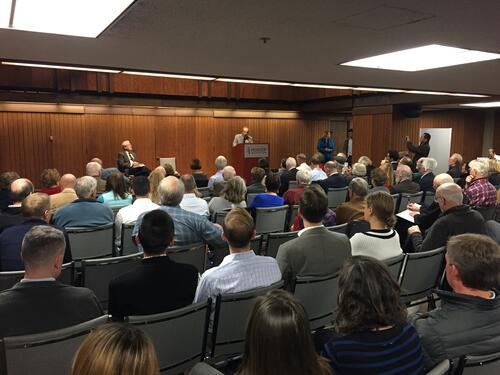
Perry made his comments in front of a crowd gathered at Stanford University to celebrate the launch of his new memoir “My Journey at the Nuclear Brink.”

“If they can buy or steal a nuclear bomb, or if they could buy or steal fissile material, they could probably make a bomb – a crude improvised bomb,” he said.

Even a crude nuclear weapon could have an explosive power equivalent to around fifteen thousand tons of TNT – similar to the bomb that destroyed the Japanese city of Hiroshima near the end of World War II.

Perry said there was evidence that Al Qaeda had actively tried to get nuclear weapons, and he said it was likely that ISIS was also pursuing its own nuclear strategy.

“The big difference between ISIS and Al Qaeda in that respect is that ISIS has access to huge amounts of resources through the oil that they now control,” Perry said.

“I believe that our primary objective in dealing with ISIS should be to stop that flow of money, stop the trading they’re doing in oil which is giving them the resources.”

U.S. warplanes reportedly destroyed 116 trucks in Eastern Syria on Monday that American officials said were being used to smuggle crude oil.

U.S. fighter jets dropped leaflets before the attack, warning the drivers to abandon their vehicles, according to a report in The New York Times.

The Russian Air Force also claimed its planes had struck around 500 oil tankers that were carrying oil from Syria to Iraq for processing.

Perry said that combating ISIS over the long run was a “hugely difficult problem” for Western powers.

“To really stop ISIS completely it would be a long and brutal and ugly fighting on the ground, which I don’t believe we’re going to want to do again,” he said.

“What we can do however, a more limited objective is stopping the resources they’re getting, stopping their access to this oil money. And that limits quite a bit what they can do…That can be done I think in more of a targeted and effective way, and without having to put armies on the ground to do it.”

Hero Image
isis flag reuters rtr4fed5
Smoke rises behind the Islamic State flag after a battle with Iraqi security forces and Shiite militia in the city of Saadiya in November, 2014.
Reuters
All News button
1
Authors
News Type
News
Date
Paragraphs

The deadly terrorist attacks in Paris last Friday that killed 129 people and wounded around 350 more signaled a significant change in strategy for the Islamic State in Iraq and Syria (ISIS), the radical jihadist organization that has claimed responsibility.

“It underscores that this threat is real and that ISIS is not going to be content to consolidate its power in Iraq and Syria,” said Joe Felter, a former Colonel in the U.S. Army Special Forces and senior research scholar Stanford’s Center for International Security and Cooperation (CISAC).

“They have demonstrated their ability to project power into foreign countries and conduct what I would call an “asymmetric strategic bombing capacity” in the form of these home-grown Western citizens who are willing to strap on suicide vests and blow up targets in support of ISIS directed objectives.

“They’re able to launch attacks with centralized planning and decentralized execution in a way that makes anticipating and interdicting them very difficult.”


French President François Hollande said that the attacks were “planned in Syria, organized in Belgium, perpetrated on our soil with French complicity.”

CISAC senior fellow Martha Crenshaw said the Paris attacks represented “a shift in strategy” for ISIS with the group “taking a more Al Qaeda-like stance and striking Western countries.”

However, she emphasized that the carefully planned nature of the coordinated strikes, where multiple teams carried out simultaneous attacks in three locations across downtown Paris, indicated that this new strategy had been secretly underway for some time.

“These attacks were planned a long time ago,” said Crenshaw, whose Mapping Militants Project includes more information on groups like ISIS.

“You shouldn’t think they’re reacting to very recent circumstances…It’s not like we bombed them one day and the next day they planned these attacks.”

Apocalyptic visions

ISIS has long advocated a plan of provoking the West into a larger confrontation that would lead to an apocalyptic victory for Islam, according to Abbas Milani, director of Iranian studies at Stanford and an affiliate at the Center for Democracy Development and the Rule of Law.

“There’s a lot of method to this madness,” Milani said.

“If you read their literature, they have always talked about creating this sort of mayhem.”

ISIS’s propaganda magazine Dabiq, which is available online in Arabic and English, is named after a village in Syria with important symbolism for jihadists.

“They claim that the prophet has predicted that if you can get the West to come and fight the Muslims at Dabiq, then Islam will conquer the world,” Milani said.

Unlike France’s earlier battles against extremists in Algeria, it cannot rely on a proxy state to take the fight to the terrorists, according to Crenshaw.

“When terrorism in France has its origins in Algeria, France could rely on the Algerian state to crack down on these groups,” she said.

“Now you’ve got a situation where the planners are in a country where you don’t have a reliable state to go in and get them for you and wrap up their networks.”

With French warplanes already bombing targets in the Syrian city of Raqqa, Felter warned against the limits of air power in the fight against ISIS.

“There’s a risk that as we ramp up the bombing campaign and increase civilian casualties, this does play into the narrative of these extremists,” he said.

“It’s a very difficult targeting process. ISIS has occupied urban areas full of non-combatants and civilians…It’s the ultimate human shield.”

Felter acknowledged that increasing the number of US ground forces sent to interdict ISIS in Iraq and Syria may ultimately be necessary, but also that this increased presence, if not managed carefully, could backfire.

“At some level, they want to bring Western military forces to occupy these lands, because that will help turn popular opinion against the West and aid in their propaganda and recruitment,” he said.

The fight against ISIS is not limited to the territories it claims in the Middle East. It must be a global effort and include increased international cooperation and information sharing across intelligence, law enforcement and other agencies around the world, Felter said.

ISIS wants to drive a wedge between Europeans and the growing Muslim communities in their countries, so recruiting French citizens to participate in the Paris attacks served a dual purpose, Milani said.

“Using French citizens helps them with logistics, but it also helps them in terms of their strategy in that it makes it difficult for Muslims to live in a non-caliphate context,” he said.

Failed states problem

In the wake of the attacks, European nations are working to create legislation that would toughen criminal penalties for citizens who travel abroad to fight with designated terrorist organizations such as ISIS, or strip them of their citizenship, according to CISAC affiliate Anja Dalgaard-Nielsen, a former executive director of the Danish Security and Intelligence Service.

Individuals who are seen as inciting people to travel to Syria and Iraq to join the jihad could also face tougher sanctions, she said.

The emergence of ISIS and its nihilistic theology is a symptom of broader underlying problems in the Middle East, which is grappling with failed and failing states across North Africa and in Syria, Iraq, Afghanistan and Pakistan, according to Milani.

“ISIS is the most militant and brutal manifestation of something deeper that’s going wrong,” he said.

“I honestly have never seen the Middle East as perilously close to complete chaos as it is now… [and] I don’t think we’ve seen the worst of it yet.”

Resources & links

Get more background on the Islamic State and its leaders from Martha Crenshaw’s Mapping Militants Project

Is There a Sunni Solution to ISIS? – The Atlantic | By Lisa Blaydes & Martha Crenshaw

Airstrikes Can Only Do So Much to Combat ISIS – New York Times | By Joe Felter

The Super Smart Way to Dismantle ISIS – The National Interest | By Eli Berman, Joe Felter & Jacob Shapiro

The Rise of ISIS and the Changing Landscape of the Middle East – Commonwealth Club of California | Abbas Milani

Hero Image
french soldiers patrol eiffel tower reuters rts6zju
Police patrol near the Eiffel Tower the day after a series of deadly attacks in Paris.
Reuters
All News button
1
Authors
News Type
News
Date
Paragraphs

The Freeman Spogli Institute for International Studies has welcomed five new senior military fellows, including three active duty lieutenant colonels from the U.S. Air Force and two from the U.S. Army, who will spend the next academic year at Stanford pursuing self-directed study of important national issues.

Former U.S. Secretary of Defense and CISAC faculty member Bill Perry created the program to give military officers the opportunity to take a deep dive into an area of strategic interest.

The fellows will be considering a diverse range of topics, from how to adapt Silicon Valley’s innovative work culture to the Army, to China’s actions in the South China Sea, and the effectiveness of U.S. economic sanctions against North Korea.

You can learn more about our fellows’ military backgrounds and the intended focus of their studies from the brief bios below.

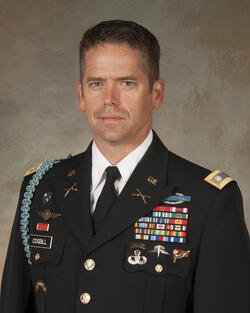
John Cogbill and Scott Maytan will be assigned to the Center for International Security and Cooperation.

John Chu, Ryan Blake and Jose Sumangil will be based at the Walter H. Shorenstein Asia-Pacific Research Center.


LTC John Cogbill

LTC John Cogbill was commissioned as an Infantry officer from the United States Military Academy in 1994 and has held a variety of positions in both conventional and special operations units. John’s first assignment was as a Platoon Leader and Executive Officer in the 82nd Airborne Division. John then served two years in the 1st Battalion, 75th Ranger Regiment as a Platoon Leader and Civil-Military Affairs Officer. Next, John served three years in Alaska as an Airborne Rifle Company Commander and the Aide-de-Camp to the Commanding General. After earning his MPA from the Harvard Kennedy School, John taught Economics in the Social Sciences Department at West Point. Following the Command and General Staff College, he spent two years as a Combined Arms Battalion Executive Officer in the 1st Cavalry Division. He then served as the Strategic Plans and Requirements Officer for the 75th Ranger Regiment. Most recently, John commanded the Reconnaissance and Surveillance Squadron for the U.S. Army Third Corps. John has deployed on three combat and two peacekeeping missions, including two tours in Iraq, one tour in Afghanistan, one tour in Haiti, and a recent tour in Kosovo. He will be exploring how the Army can encourage innovation and use emerging technologies to achieve and maintain a competitive advantage on the battlefield.


lt col scott maytan 5x7 Lt Col Scott Maytan, U.S. Air Force

Lt Col Scott Maytan was the commander of a B-52H operational bomb squadron, responsible for ensuring combat mission readiness for any worldwide nuclear or conventional tasking. Lt Col Maytan is a navigator with over 2500 flying hours, primarily in the B-52H, and is a graduate of both the Command and General Staff College (U.S. Army) and the U.S. Air Force Weapons School. He has served four operational assignments, as an advanced tactics instructor, and also a tour at the Pentagon where he developed Air Force positions concerning long-range strike and aircraft nuclear requirements. Lt Col Maytan has served three combat deployments for Operations Desert Fox (Southern Watch), Allied Force and Iraqi Freedom and has also deployed four times supporting USPACOM’s Continuous Bomber Presence mission. Maytan will be studying the “red-lines” that shape Western deterrence posture, and how strategic action and deterrence posture in one region affects others.


LTC John Chu, U.S. Army

LTC John Chu is an active duty officer in the United States Army. Chu has held a variety of leadership and staff positions in his 20 year career. Most recently, he served as the Chief of Intelligence Training at the Department of the Army. Chu has twice been deployed to Iraq and once to Bosnia, with multiple assignments to South Korea, Germany and Turkey. Born in Seoul, he grew up in California and graduated from West Point in 1995. At Stanford, Chu is researching the Korean armistice agreement and the United Nations mission to South Korea. He will also examine U.S. policy toward North Korea, particularly analyzing the “brink of war” tension and developing strategic deterrence measures to reduce risk of unwanted military escalation on the Korean Peninsula. For both research streams, Chu aims to produce analyses and recommendations that could inform a policy audience.


Lt Col Ryan Blake, U.S. Air Force

Lt Col Ryan Blake is an active duty officer in the United States Air Force. Blake was the commander of a flight test squadron where he was responsible for the flight test of new Air Force programs. He has over 2,400 flying hours in over 40 types of aircraft, and has held two operational F-15E assignments, including combat deployments in support of Operations Southern Watch, Iraqi Freedom and Enduring Freedom. He had also been positioned at the Pentagon in defense acquisition and the Office of Security Cooperation in Baghdad. At Stanford, Blake is researching the U.S. policy toward China and its relation to Northeast Asia. He aims to discover areas of cooperation between the U.S. and Chinese militaries.


Lt Col Jose “Ed” Sumangil, U.S. Air Force

Lt Col Jose “Ed” Sumangil is an active duty officer in the United States Air Force. During his career, Sumangil has served in a range of operational assignments, including joint staff officer at U.S. Strategic Command where he was a lead planner of the command’s space campaign. Before coming to Stanford, he was the commander of a B-1 squadron and led airmen through combat deployments in support of Operations Enduring Freedom, Inherent Resolve and Freedom’s Sentinel. At Stanford, Sumangil is examining China’s actions in the South China Sea and the Philippines arbitration case regarding Chinese actions there. He seeks to offer perspectives and policy and strategy options to maintain peace and stability in the South China Sea.


Hero Image
ennica hall exterior ws
All News button
1
Authors
News Type
News
Date
Paragraphs

U.S. Senator John McCain told a select group of Stanford undergraduate students that technological innovation had created both unparalleled opportunities for the United States as well as new national security risks, during a visit to Silicon Valley this week.

“This has changed the world,” Senator McCain told the students as he held up his smart phone.

“This is the biggest change in our ability to inform and educate than any invention since the printing press.”

However, McCain told students that he believed the United States needed to develop a clearer policy for responding to cyber attacks from foreign nations.

Image
img 3458
“You’ve got to accept a fundamental premise, that cyber attacks are an act of war…but that doesn’t mean you’re going to war in a conventional fashion,” he said.

“The people who are doing these cyber attacks have to realize that the costs will be higher than the benefits of the attack. Everybody has to know that there will be a price to pay for it.”

McCain called on the students, who included several computer science majors, to step up and defend the United States in cyber space.

“I would call on the people here to help us develop defensive capabilities, and frankly, offensive capabilities,” McCain said.

In the wide-ranging conversation, McCain fielded questions from students and shared his views on the conflict in Syria, the Iran nuclear deal, Russia’s imperial ambitions and the pullout of U.S. troops from Afghanistan.

“I study international security, and I feel that his dedication to national security and to veterans have been fundamental, and it was an honor to meet him and hear him talk about these issues,” said Chelsea Green.

The forty students who met with McCain were selected for their special interest in international affairs and politics, and included representatives from the Center for International Security and Cooperation’s honors program, Hoover Institution National Security Mentees and Stanford in Government student group.

International relations major Kayla Bonstrom said she was excited to meet the Senator from her home state of Arizona.

“He was very easy to talk to,” she said.

Bonstrom said McCain’s casual style, which included the occasional joke, helped put the students at ease.

“It was nice to see him in a different setting.”

Mathematical and computation science major Varun Gupta said he was touched by the empathy McCain showed when he shared his experiences visiting refugee camps in war zones.

[[{"fid":"220696","view_mode":"crop_870xauto","fields":{"format":"crop_870xauto","field_file_image_description[und][0][value]":"","field_file_image_alt_text[und][0][value]":"","field_file_image_title_text[und][0][value]":"U.S. Senator John McCain gives an impassioned presentation to students about American foreign policy, as CISAC faculty member Coit Blacker looks on.","field_credit[und][0][value]":"Rod Searcey","field_caption[und][0][value]":"","field_related_image_aspect[und][0][value]":"","thumbnails":"crop_870xauto"},"type":"media","attributes":{"title":"U.S. Senator John McCain gives an impassioned presentation to students about American foreign policy, as CISAC faculty member Coit Blacker looks on.","width":"870","style":"width: 400px; height: 267px; float: left; margin-right: 15px","class":"media-element file-crop-870xauto"}}]]“It was good to see his concern, his actual visceral concern for these issues,” Gupta said.

“It was really great to see the more human side.”

Other students were also impressed by McCain’s sincerity.

“He seems to sincerely believe in all of his views,” said Alexa Andaya, a political science major.

“You can tell when he says something he’s genuine about it.”

Matt Nussbaum, another political science major, said that while he disagreed with many of McCain’s hawkish positions on national security, he welcomed the opportunity to hear the opinions of such a seasoned veteran of foreign policy.

“A lot of times, we’re looking at the academic side of things, and I think that’s very interesting, but Senator McCain and other policy makers use the theory to create policy, so it’s useful to see what they think, how they think and why they think that way,” Nussbaum said.

McCain ended his talk by urging the students to get more involved in politics, whether they were “Democrat or Republican, libertarian or vegetarian.”

He told them that he believed the next presidential election was going to be the most important decision point for the country since 1980, when Republican Ronald Regan defeated Democratic incumbent Jimmy Carter.

“Pick the cause that you want to support, pick the candidate you want to support, and be engaged,” he said.

“It’s your future. You’re the ones that are going to live with the person that you choose to be president of the United States.”

Hero Image
img 3457 Rod Searcey
All News button
1
0
Affiliate
clark_rsd15_078_0514a.jpg PhD

David L. Clark is a retired Los Alamos National Laboratory (LANL) Fellow and Guest Scientist with the Laboratory’s Glenn T. Seaborg Institute for Actinide Science.  He was LANL’s Director of the National Security Education Center from 2013-2025.

His research interests are in the molecular and electronic structure of actinide materials, applications of synchrotron radiation to nuclear security, behavior of actinide and fission products in the environment, the aging effects in nuclear weapons materials, and the education of judges on the methods of science.  He is an international authority on the chemistry and physics of the actinides, and has published nearly 200 peer-reviewed publications, encyclopedia and book chapters. He is the co-Editor of the six volume Plutonium Handbook, portions of which were written while a CISAC Visiting Scholar in 2015.

Clark served as inaugural Director of the Los Alamos Glenn T. Seaborg Institute for Transactinium Science between 1997-2009. He has served the DOE as a technical advisor for environmental stewardship including the Rocky Flats cleanup and closure (1995-2005), closure of High-Level Waste tanks at the Savannah River Site (2011), and as a technical advisor to the DOE High Level Waste Corporate Board (2009-2011). He is a Fellow of the American Association for the Advancement of Science, and a Los Alamos Laboratory Fellow.  He is the recipient of two ACS national awards - the Nobel Laureate Signature Award (1988) and the Glenn Seaborg Award in Nuclear Chemistry (2017). He has also been honored with several Defense Programs Awards of Excellence.

He received a B.S. in chemistry in 1982 from the University of Washington, and a Ph.D. in 1986 from Indiana University. Clark was a postdoctoral fellow at the University of Oxford before joining Los Alamos National Laboratory as a J. Robert Oppenheimer Fellow in 1988. 

Laboratory Fellow Director, National Security Education Center Los Alamos National Laboratory
Date Label
Authors
News Type
News
Date
Paragraphs

Today’s landmark deal between six world powers and Iran, which would limit Iran’s nuclear program in exchange for lifting economic sanctions, was an important step toward stopping Iran from building a nuclear bomb.

However, the key challenge for the international community will be making sure Iran keeps its part of the bargain, according to Stanford experts.

“Both sides have made a series of compromises that will help Iran’s economy in exchange for constraining its nuclear capabilities – and that’s a deal worth making, in my view,” said Scott Sagan, the Caroline S.G. Munro professor of political science and senior fellow at the Center for International Security and Cooperation.

“Iran will still have a technical capability to develop nuclear weapons, given the technology and materials that they have, but under this deal it will both take them a much longer period of time and would require them to take actions that would be easily discerned by the International Atomic Energy Agency, so it constrains their break-out capabilities in important ways.”

[[{"fid":"219719","view_mode":"crop_870xauto","fields":{"format":"crop_870xauto","field_file_image_description[und][0][value]":"","field_file_image_alt_text[und][0][value]":"","field_file_image_title_text[und][0][value]":"Final plenary session at the United Nations Office in Vienna, Austria. Photo credit: U.S. State Department","field_credit[und][0][value]":"","field_caption[und][0][value]":"","field_related_image_aspect[und][0][value]":"","thumbnails":"crop_870xauto","pp_lightbox":false,"pp_description":false},"type":"media","attributes":{"title":"Final plenary session at the United Nations Office in Vienna, Austria. Photo credit: U.S. State Department","width":"870","style":"width: 400px; height: 266px; float: right; margin-left: 15px","class":"media-element file-crop-870xauto"}}]]The U.S.-led negotiations also included fellow United Nations Security Council members Britain, China, France, and Russia, as well as Germany – a group known collectively as as the "P5+1."

Sig Hecker, former Los Alamos National Laboratory director and senior fellow at Stanford’s Center for International Security and Cooperation, said the nuclear deal was “hard-won and is better than any other reasonably achievable alternative.”

“Iran agreed to considerably greater restrictions on its program than what I thought was possible before the Joint Plan of Action was signed in November 2013,” said Hecker.

Abbas Milani, director of Iranian studies at Stanford and an affiliate at the Center for Democracy Development and the Rule of Law, called it the “least bad deal” for both Iran and the international community.

“Nobody gets everything they want,” Milani said. “Every side gets some of what they want.”

Under the deal, Iran would be allowed to continue to enrich uranium for peaceful purposes in its energy and health industries.

But it would have to reduce the number of its centrifuges from 19,000 to 6,000, and cut its stockpile of low enriched uranium down from more than 20 thousand pounds to about 660 pounds.

“Reducing that stockpile actually lengthens the breakout time more than any other measure,” said Hecker.

These limits were designed to increase the “breakout time” it would take for Iran to produce enough fissile material to make a nuclear weapon from the current two to three months, to one year over a period of the next 10 years.

The agreement still faces a series of political hurdles before it gets implemented, and will face tough scrutiny from a Republican-controlled U.S. Congress, as well as the parliaments of European countries that were parties to the talks.

“I think it’s going to be hard for the U.S. Congress and [European] parliaments to kill the deal and be perceived as the ones who would rather have a war than give diplomacy a chance,” said Thomas Fingar, distinguished fellow at the Freeman Spogli Institute for International Studies.

[[{"fid":"219720","view_mode":"crop_870xauto","fields":{"format":"crop_870xauto","field_file_image_description[und][0][value]":"","field_file_image_alt_text[und][0][value]":"","field_file_image_title_text[und][0][value]":"The Iranian delegation attend the final plenary session in Vienna, Austria. Photo credit: U.S. State Department","field_credit[und][0][value]":"","field_caption[und][0][value]":"","field_related_image_aspect[und][0][value]":"","thumbnails":"crop_870xauto","pp_lightbox":false,"pp_description":false},"type":"media","attributes":{"title":"The Iranian delegation attend the final plenary session in Vienna, Austria. Photo credit: U.S. State Department","width":"870","style":"width: 400px; height: 268px; float: right; margin-left: 15px","class":"media-element file-crop-870xauto"}}]]If the deal survives the inevitable political challenges, inspectors from the International Atomic Energy Agency will be responsible for confirming that Iran is living up to its obligations.

“The key is going to be the effectiveness of the verification procedures and IAEA access,” Fingar said.

“There’s an element of trust, but a far more important part is the rigorous verification protocols.”

As soon as the IAEA confirms that Iran is abiding by the terms of the agreement, economic sanctions can be lifted.

Sagan warned that the international community should not be surprised if Iran pushed the limits of the agreement, and should be ready to reimpose economic sanctions if Iran violated the deal.

“We should anticipate that Iranian opponents to the agreement will try to stretch it and do things that are potential violations and that we have to call them on that, and not treat every problem that we see as unexpected,” said Sagan.

“We should anticipate such problems and be ready, if necessary, to reimpose sanctions. Having the ability to reimpose sanctions is the best way to deter the Iranians from engaging in such violations.”

But Hecker said the international community should focus on incentivizing Iran.

“The best hope is to make the civilian nuclear path so appealing – and then successful – that Tehran will not want to risk the political and economic consequences of that success by pursuing the bomb option,” he said.

Image
19067549804 85591212aa o
The negotiations were a diplomatic balancing act, with serious consequences for both sides of the negotiations if they failed to reach an agreement.

Iran faced the threat of military action if it continued to press forward with its nuclear program.

While Russia and China had both signaled that they were likely to abandon the sanctions regime if talks fell apart.

One of the key challenges to reaching an agreement was “finding a language that would allow both parties to declare victory”, according to Milani.

“Iran has clearly made some very substantive concessions, but Iran has also been allowed to keep enough of its infrastructure so that it can declare at least partial victory for the domestic political audience."

Now the scramble is on in Tehran to claim credit for the deal.

Reformists, led by current Iranian President Hassan Rouhani and former president Akbar Hashemi Rafsanjani, hope it will strengthen their hand as they head into the next election.

On the other side of the political spectrum, conservatives believe it could give them the edge in the battle to succeed Ayatollah Ali Khamenei as Iran’s Supreme Leader.

“They understand that whoever gets the credit for this will be in a much better position to determine the future leadership and future direction of Iran’s foreign policy,” said Milani.

It’s too early to tell what impact the agreement might have on Iran’s foreign policy, which is often at odds with U.S. interests in hot spots like Iraq, Syria, Yemen and Afghanistan. But Sagan said today’s deal was an important step in making sure that future conflicts with Iran don’t go nuclear.

“Hopefully those disagreements will be played out without the shadow of nuclear weapons hanging over the future, and that’s a good thing.”

Hero Image
19663913956 8ed26a22fe o
U.S. Secretary of State John Kerry speaks with Hossein Fereydoun, the brother of Iranian President Hassan Rouhani, and Iranian Foreign Minister Javad Zarif before announcing a historic nuclear agreement to reporters in Vienna, Austria.
U.S. State Department
All News button
1
Authors
News Type
News
Date
Paragraphs

Rigorous inspections, no cheating and continued talking can help generate a successful U.S.-Iranian nuclear deal, Stanford faculty experts say.

But the United States and the world community need to convince Iran it has more to lose than to gain from building a nuclear bomb, according to Siegfried Hecker, a research professor in the Department of Management Science and Engineering and a senior fellow at the Freeman Spogli Institute for International Studies.

On April 2, the United States, Iran and five other world powers agreed on "key parameters" for resolving a long-standing dispute over Iran's nuclear program. Aimed at curbing Iran's nuclear program in exchange for lifting of financial sanctions, the broad agreement charts the course for a possible final, detailed agreement by June 30.

Hecker said that even though Iran has already put in place all the requisite technical capabilities to build the bomb, it has not yet decided to exercise the option to build one.

The problem, he said, is that it takes rather small quantities of bomb fuel, highly enriched uranium or plutonium, to build a bomb, whereas commercial nuclear power production requires huge amounts of uranium and large enrichment capacity.

"In other words, even a small production capacity is useful for bombs, whereas large capacities are required for electricity. Hence, it is all but impossible to prevent Iran from reconstituting the capabilities to build the bomb should it decide to break the agreement," he wrote in an article for the Bulletin of Atomic Scientists.

Hecker said it is important is to have Iran agree to an "intrusive inspection and verification regime" so the international community can respond quickly should Iran "break out" with a nuclear weapon.

"Breakout time" measures the amount of time to build a nuclear weapon – the United States wants a year, while some say Iran is within a few months. It has been a key sticking point between Western and Iranian negotiators.

"There are lessons to be learned from what happened in North Korea – it 'broke out' in 2003, and the U.S. and international community did not respond adequately. Consequently, North Korea not only has the bomb today, but a rapidly growing nuclear arsenal," said Hecker, who recently wrote about the North Korean situation.

Hecker is an expert in plutonium science, global threat reduction and nuclear security who served as the director of the Los Alamos National Laboratory, where the first atomic bomb was created in 1945.

From a purely economic and technical standpoint, he said there is no need for Iran to have any enrichment capability or to build the type of reactor they chose for medical isotope production in their Arak facility.

"The enrichment services are readily available to Iran in the international market. However, insisting on zero enrichment or no centrifuges shatters Iran's pride and questions why the regime has spent billions of dollars pursuing what is really not needed to have civilian nuclear energy," he said.

The key objective for the next few years, he said, should the deal be formalized, is to convince Iran that it has "more to gain from keeping its end of the bargain than it would lose by exercising its hedge."

Inspections critical

Allen Weiner, director of the Stanford Program in International and Comparative Law and a senior lecturer at Stanford Law School, said the robustness of the inspection process and whether Iran decides to cheat are two big factors.

"If we stop and think about where we are starting from, it certainly seems that the agreed arrangement can't hurt. Without the agreement, if Iran concludes that it wishes to build nuclear weapons, it is doubtful that international actions can stop that," he said.

Weiner points out that Iran has weathered sanctions for nearly a decade and has continued to move closer to "breakout" capability. "Given that backdrop, the framework arrangement has the potential to help," he said.

If Iran's nuclear program spurs similar ones among its neighbors, the outlook is dire, said Weiner, a former U.S. State Department lawyer.

"A Middle East region with multiple nuclear-armed states would be a very dangerous place. The risk of nuclear confrontation would grow under such circumstances," he said, noting the especially acute tensions now between Shiite states like Iran and Sunni ones like Saudi Arabia and Egypt.

Weiner noted, "The greatest danger if multiple states in the region acquire nuclear weapons may be miscalculations or mistakes leading to the use of a nuclear weapon."

The length of the breakout period for Iran between a decision to build nuclear weapons and its ability to actually assemble such a weapon is seen as critical, according to Weiner: "That window presumably provides time for the international community to develop a response."

As for sticking points, for the United States the acceptance of the basic idea that Iran would retain a uranium enrichment capability was difficult, "although it was a pill the U.S. swallowed early in the negotiations," Weiner said.

Once the United States had agreed to this, it had to accept the risk of Iranian breakout, which makes the ultimate deal dependent on Iran's good faith, he said.

"It creates the grave fear that even if the agreement works, we are merely kicking the Iranian nuclear crisis down the road for 10 years," due to the time limits under the arrangement on the restrictions on the number of centrifuges that Iran may operate to enrich uranium, Weiner said.

For Iran, it was difficult to accept the reality that not all sanctions would be immediately lifted, he added. The country says it is only trying to exercise its rights to operate a peaceful civilian nuclear power program.

"Iran feels that it has accepted both substantive restrictions on its nuclear program and an intensive inspection regime that do not apply to other Nuclear Nonproliferation Treaty states, and that it should not continue to be singled out for sanctions, even partial ones, in order to earn the trust of the international community," he said.

Finally, the road ahead will be exceedingly difficult due to internal politics in both countries. Abbas Milani, the director of Iranian studies at Stanford and co-director of the Iran Democracy Project at the Hoover Institution, offers this perspective:

"While the people of Iran are rejoicing at what they think is a new beginning, and while Iranian President Hassan Rouhani and his men are congratulating Iran for its 'victory,' the conservative press has been blasting the agreement as defeatist and accusing the U.S. of publishing a faulty version of the agreement. In short, it is a happy moment, but a final resolution is yet to come."

Hero Image
unnamed2
Representatives from world powers and Iran gather in Lausanne, Switzerland, on Thursday after announcing a framework agreement on limiting Iran's nuclear capabilities.
Glen Johnson
All News button
1
News Type
News
Date
Paragraphs


In this talk sponsored by the Stanford Institute for Economic Policy Research, three CISAC scholars discuss the Islamic State, Iran and the Taliban and the threats they impose to American security. The talk is moderated by Brad Kapnick, a Partner at Katten & Temple, LLP, and SIEPR Advisory Board member. Joining him are Martha Crenshaw, a senior fellow at CISAC and the Freeman Spogli Institute for International Studies and professor, by courtesy, of political science; CISAC Senior Fellow Scott Sagan, the Caroline S.G. Munro Professor of Political Science; former U.S. Ambassador to Afghanistan Karl Eikenberry, the William J. Perry Fellow at CISAC and a consulting professor at the Freeman Spogli Institute.

This is an abbreviated version of the talk below. The full talk can be found here.


Hero Image
isis
Hashid Shaabi (Popular Mobilization) forces allied with Iraqi forces chant slogans against the Islamic State in Tikrit, March 30, 2015.
Reuters
All News button
1
Subscribe to Middle East and North Africa