Authors
Steven Pifer
News Type
Commentary
Date
Paragraphs

On Vladimir Putin’s order, the Russian army launched a new invasion of Ukraine in February.  That has inflicted tragedy on Ukrainians but, seven months later, has also proved a catastrophe for Russia.  By all appearances, Putin remains fixed on his war of choice, now betting the West’s will to support Ukraine will ebb with time.  The West should ensure that that becomes another one of his grievous miscalculations.

A War Gone Awry

On February 24, Russian forces attacked Ukraine from the north, east and south.  The assault vectors suggested they sought to occupy Kyiv and as much as the eastern two-thirds of Ukraine.  Staunch resistance drove the Russians back from the capital.  By early April, Russian forces had withdrawn from Kyiv and the north, though they occupied parts of southern Ukraine.  Moscow then proclaimed the downsized goal of taking Donbas, consisting of the Luhansk and Donetsk oblasts, parts of which Russian and Russian proxy forces had occupied since 2014.

After more than three months of grinding fighting, the Russian army held most of Luhansk oblast.  In July, the Russians turned their military efforts to Donetsk oblast but made scant progress.  Western experts begin speaking of the Russian army’s “culmination”—the point where the combination of casualties (particularly of experienced personnel), loss of equipment, troop exhaustion and low morale make it difficult for a force to sustain a coherent offensive.

After six months of fighting, the conflict seemed to have become a war of attrition.  However, the Ukrainians launched a counteroffensive in Kherson, aimed at driving Russian forces from the only area west of the Dnipro River that they occupied.  They then struck in the Kharkiv region, routing Russian forces and liberating more than 2000 square miles in the first two weeks of September.  While the Russian military continues to occupy large swathes of Ukraine, the tide of war has shifted in Kyiv’s favor, as poor leadership, tactics and logistics hamper Russian forces.

Growing Losses for Russia

The war has meant heavy losses for Russia, first and foremost in its military ranks.  In mid-August, Western intelligence estimated that 15,000-25,000 Russian soldiers had been killed in action and another 45,000-60,000 wounded (the Russians have not reported casualty numbers since March).  These totals have certainly grown over the past month.  The Russian military has also lost substantial amounts of equipment, including confirmed losses of 1100 tanks, 1200 infantry fighting vehicles and thousands of other items.  The Russian defense budget will require many years to replace that equipment, and the Russian army increasingly must make do with older weapons, such as T-62 tanks first produced five decades ago.  Russian arms exporters will likely find that the Russian brand has lost much of its luster with overseas customers.

Western sanctions are exacting a growing economic price.  While the Central Bank of Russia has managed the crisis well, inflation still ran at a hefty 14 percent in September.  In August, the Central Bank reported that the Russian economy had contracted by 4 percent since 2021.  A confidential study purportedly done for the Kremlin provided a grim outlook, projecting an “inertial” scenario of the economy’s contraction bottoming out in 2023 at 8.3 percent below its 2021 level.  The European Union’s coming embargo on most imports of Russian oil and the G7’s planned price cap could significantly cut the revenues that Moscow earns from oil exports.

The West’s ban on export of semiconductors and other high tech products affects both Russia’s defense and civilian manufacturing sectors, and the impact will grow with time.  Since the beginning of the war, more than 1000 multinational companies have exited Russia altogether or substantially curtailed operations there.  There is also brain drain, with tens of thousands of IT specialists reported to have left the country.

Russia has also incurred steep geopolitical costs.  NATO is reenergized, and almost all members are increasing their defense spending.  Putin and the Kremlin did not like the small multinational battlegroups that NATO deployed as trip-wire forces in the Baltic states in 2015; they will like even less the scaled-up contingents being deployed there now.  And the entry of Finland and Sweden into the Alliance will make the Baltic Sea, in effect, a NATO lake.

In sum, Putin’s war has cost Russia much.

Disaster and Dilemma

A series of miscalculations led Putin to this disaster.  The Kremlin apparently did not believe the Ukrainians would resist and expected a quick victory.  Some invading Russian units crossed the border with only two-three days of food rations.  The Kremlin overestimated the might of its military.  Anecdotal reports, such as one that T-80 tank reactive armor was filled with rubber instead of an explosive charge, suggest that corruption, endemic in Russia, has not left the defense sector untouched.  The Kremlin also apparently did not expect NATO’s sharp response, the decisions by Finland and Sweden to seek to join the Alliance, the Western flow of arms to Kyiv, or the scale of economic sanctions.

Russia itself is not yet in crisis.  The economy, while grappling with growing problems, has not broken down, and the Russian military retains formidable capabilities.  But the Kremlin faces a far more difficult situation than it imagined in January, and it will get worse.

Whether Putin fully grasps this is an open question.  On September 7, he said that “we [Russia] have not lost anything and will not lose anything,” a bizarre assessment that the many thousands of Russian families who have lost loved ones in Ukraine surely do not share.  Russian officials have indicated that Kremlin conditions for ending the war remain unchanged from the total capitulation they demanded at the start.  Following a September 13 phone call with Putin, German Chancellor Olaf Scholz noted “there was no indication that new attitudes are emerging.”

Putin faces limits in continuing the war, some self-imposed.  He termed the invasion a “special military operation” (calling it a “war” in Russia can lead to jail time), and he has sought to minimize the scale of the conflict in the eyes of the Russian public.  Despite heavy casualties, the Kremlin officials say they are “not discussing” mobilization.  Russia instead has scrapped the age limit for contract soldiers while scouring prisons for volunteers.  Calls outside the Kremlin have increased for a major mobilization.  However, that could alarm the broader Russian public, who will fear their sons will be drafted and sent to fight.  In any case, it would take considerable time to train new units and equip them with modern arms.

Putin’s Big Bet

The Ukrainian military may well rack up further gains before winter, when the pace of fighting should slow, but the war will continue for some time.  The question:  will the growing economic pain and agonizing flow of dead and injured soldiers home erode the Russian will to fight, or will a weak economy and lack of weapons and ammunition erode Ukraine’s ability to defend itself?

The West has a say in this.  If it continues to provide the arms and financial support the Ukrainians need, their military has the resolve to prevail and defeat the Russian invasion.  Putin is betting, however, that Western support will falter.  He hopes the rising price of energy and costs of assisting Ukraine will undermine European and U.S. support for Kyiv.

The West must stay the course and show Putin his bet is a loser.

All News button
1
Subtitle

On Vladimir Putin’s order, the Russian army launched a new invasion of Ukraine in February. That has inflicted tragedy on Ukrainians but, seven months later, has also proved a catastrophe for Russia.

Authors
Oriana Skylar Mastro
News Type
Commentary
Date
Paragraphs

This commentary was originally published by The Wall Street Journal.


A Russian invasion of Ukraine would be the most consequential use of military force in Europe since World War II and could put Moscow in a position to threaten U.S. allies in Europe. Many in the American foreign-policy establishment argue that the appropriate U.S. response to any such invasion is a major American troop deployment to the Continent. This would be a grave mistake.

The U.S. can no longer afford to spread its military across the world. The reason is simple: an increasingly aggressive China, the most powerful state to rise in the international system since the U.S. itself. By some measures, China’s economy is now the world’s largest. And it has built a military to match its economic heft. Twenty-five years ago, the Chinese military was backward and obsolete. But extraordinary increases in Beijing’s defense budget over more than two decades, and top political leaders’ razor-sharp focus, have transformed the People’s Liberation Army into one of the strongest militaries the world has ever seen.


Sign up for APARC newsletters to receive our experts' commentary and analysis.


China’s new military is capable not only of territorial defense but of projecting power. Besides boasting the largest navy in the world by ship count, China enjoys some capabilities, like certain types of hypersonic weapons, that even the U.S. hasn’t developed.

Most urgently, China poses an increasingly imminent threat to Taiwan. Xi Jinping has made clear that his platform of “national rejuvenation” can’t be successful until Taiwan unifies with the mainland—whether it wants to or not. The PLA is growing more confident in its ability to conquer Taiwan even if the U.S. intervenes. Given China’s military and economic strength, China’s leaders reasonably doubt that the U.S. or anyone else would mount a meaningful response to an invasion of Taiwan. To give a sense of his resolve, Mr. Xi warned that any “foreign forces” standing in China’s way would have “their heads . . . bashed bloody against a Great Wall of steel forged by over 1.4 billion Chinese people.”

If Taiwan falls into Chinese hands, the U.S. will find it harder to defend critical allies like Japan and the Philippines, while China will be able to project its naval, air and other forces close to the U.S. and its territories

The U.S. must defend Taiwan to retain its credibility as the leader of a coalition for a free and open Indo-Pacific. From a military perspective, Taiwan is a vital link in the first island chain of the Western Pacific. If Taiwan falls into Chinese hands, the U.S. will find it harder to defend critical allies like Japan and the Philippines, while China will be able to project its naval, air and other forces close to the U.S. and its territories. Taiwan is also an economic dynamo, the ninth-largest U.S. trading partner of goods with a near-monopoly on the most advanced semiconductor technology—to which the U.S. would most certainly lose access after a war.

The Biden administration this month ordered more than 6,000 additional U.S. troops deployed to Eastern Europe, with many more potentially on the way. These deployments would involve major additional uncounted commitments of air, space, naval and logistics forces needed to enable and protect them. These are precisely the kinds of forces needed to defend Taiwan. The critical assets—munitions, top-end aviation, submarines, and intelligence, surveillance and reconnaissance capabilities—that are needed to fight Russia or China are in short supply. For example, stealthy heavy bombers are the crown jewel of U.S. military power, but there are only 20 in the entire Air Force.

The U.S. has no hope of competing with China and ensuring Taiwan’s defense if it is distracted elsewhere. It is a delusion that the U.S. can, as Pentagon press secretary John Kirby said recently, “walk and chew gum at the same time” with respect to Russia and China. Sending more resources to Europe is the definition of getting distracted. Rather than increasing forces in Europe, the U.S. should be moving toward reductions.

To be blunt: Taiwan is more important than Ukraine. America’s European allies are in a better position to take on Russia than America’s Asian allies are to deal with China.

There is a viable alternative for Europe’s defense: The Europeans themselves can step up and do more for themselves, especially with regard to conventional arms. This is well within Europe’s capacity, as the combined economic power of the NATO states dwarfs that of Russia. NATO allies spend far more on their militaries than Russia. To aid its European allies, the U.S. can provide various forms of support, including lethal weapons, while continuing to remain committed to NATO’s defense, albeit in a more constrained fashion, by providing high-end and fungible military capabilities. The U.S. can also continue to extend its nuclear deterrent to NATO.

The U.S. should remain committed to NATO’s defense but husband its critical resources for the primary fight in Asia, and Taiwan in particular. Denying China the ability to dominate Asia is more important than anything that happens in Europe. To be blunt: Taiwan is more important than Ukraine. America’s European allies are in a better position to take on Russia than America’s Asian allies are to deal with China. The Chinese can’t be allowed to think that America’s distraction in Ukraine provides them with a window of opportunity to invade Taiwan. The U.S. needs to act accordingly, crisis or not.

Ms. Mastro is a center fellow at the Shorenstein Asia-Pacific Research Center, part of Stanford’s Freeman Spogli Institute for International Studies, and a nonresident senior fellow at the American Enterprise Institute. Mr. Colby is a principal at the Marathon Initiative and author of “The Strategy of Denial: American Defense in an Age of Great Power Conflict.”

Headshot of Oriana Skylar Mastro

Oriana Skylar Mastro

Center Fellow at the Freeman Spogli Institute for International Studies
Full Biography

Read More

President Xi and Kim Jong Un meet on a TV screen
Commentary

North Korea Is Becoming an Asset for China

Pyongyang’s Missiles Could Fracture America’s Alliances
North Korea Is Becoming an Asset for China
Chinese military propaganda depicting the Second Taiwan Strait Crisis of 1958.
News

Reassessing China’s Capabilities and Goals for Strategic Competition

On the World Class podcast, Oriana Skylar Mastro argues that in order to set effective policy toward China, the United States needs to better understand how and why China is projecting power.
Reassessing China’s Capabilities and Goals for Strategic Competition
Hero Image
All News button
1
Subtitle

Getting bogged down in Europe will impede the U.S.’s ability to compete with China in the Pacific.

Date Label
Authors
News Type
News
Date
Paragraphs

In 2015, Volodymyr Zelenskyy was at the height of a successful career as an entertainer. Though trained as a lawyer at the Kryvyi Rih Institute of Economics in Eastern Ukraine, the then 37 year old Zelenskyy was a successful comedian and public personality. As the star of the popular TV show, Servant of the People, he played a local history teacher who inadvertently becomes the president of Ukraine following a viral video rant about corruption.

No one watching comedic President Zelenskyy then could have possibly imagined the real-life plot twist that would follow. In an incredible act of life imitating art, in April 2019, Volodymyr Zelenskyy once again stood on stage in front of a cheering crowd, but this time as the actual president of Ukraine.

He won in a landslide election against incumbent president Petro Poroshenko on a platform of systemic change and progress using an almost exclusively virtual campaign. Speaking from his headquarters on election night, he affirmed the exuberance and hope of his supporters: “I can say as a citizen of Ukraine to all countries of the post-Soviet Union: Look at us — everything is possible.”

This same message shaped the theme of President Zelenskyy’s remarks at his historic address from the Freeman Spogli Institute for International Studies (FSI) at Stanford University on September 2. The first Ukrainian president to ever visit California, President Zelenskyy, First Lady Olena Zelenska and their delegation joined a group of FSI faculty members led by FSI Director Michael McFaul at an outdoor event held in the Encina Courtyard.

In his remarks, Zelenskyy drew inspiration from Steve Jobs’ famous "How to Live Before You Die" commencement address given at Stanford in 2005.

"This is one of the most famous speeches ever given at Stanford,” he said. “It's about believing in dreams and overcoming the impossible. This is the same as my story. I am just a common guy from a common family from a common industrial town in Eastern Ukraine. Yet here I am today at Stanford, because everything is possible."

He continued, “It is the same for Ukraine. Many people look at us and think that it will be impossible to achieve the goals we hope for. But we know that our critics are wrong. The people of our country love democracy and freedom and will not let threats take those things away. We know that anything is possible."

Looking to the future, Zelenskyy outlined the steps his administration is undertaking to bring increased digitization to Ukraine. These efforts include launching fully electronic passports, moving business and legal services online and expanding the scope of e-goverance. The hope is that this meld of new technology will help curb corruption while simultaneously creating more equitable opportunities and better access to public services for more Ukranians.

Speaking on the ambitious scope of these plans, the president acknowledged, “There will be resistance to the changes and innovations that we are going to make.” Nonetheless, he remains committed to the work ahead of strengthening democratic institutions in Ukraine and building on the progress that has already been made.  “We do not have a ‘Ukrainian Dream,’ yet,” he said. “But we have a ‘Ukrainian Goal’ and a ‘Ukrainian Mission’ to make the future we want for our country.” An edited recording of his remarks is below.

Keeping with Stanford tradition, Zelenskyy took questions from the audience after his prepared remarks. A variety of students and Stanford community members from Russia, Burma, Belarus and beyond had the opportunity to engage the president on a range of issues including U.S.-Ukraine relations, armament sales abroad and concerns over Russian aggression in Crimea and influence Eastern Ukraine. Of particular meaning was Zelensky’s affirmation and support for the democratic movement in Belarus led by Svaitlana Tsikhanouskaya, whom FSI hosted earlier this summer at a faculty roundtable.

Image
Tweet from Franak Viačorka

Students and faculty alike were appreciative of the president’s candor and good nature in addressing difficult topics.

Image
Tweet from Rose Gottemoeller
Image
Tweet from Graham Webster
Image
Tweet from Me Me Khant
Image
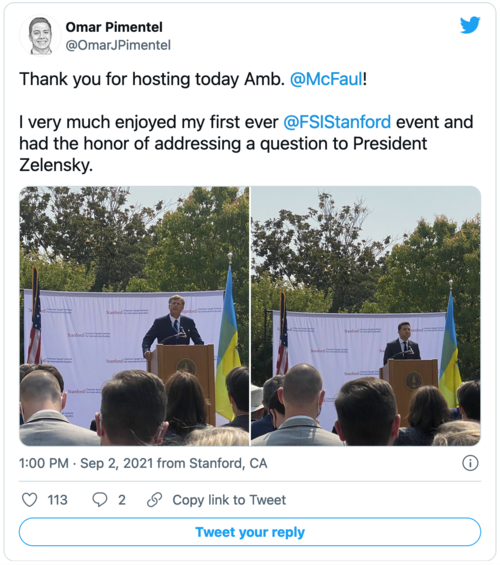
Tweet from Omar Pimentel

Following the formal remarks, President Zelenskyy and First Lady Zelenska had an opportunity to meet with Stanford President Marc Tessier-Lavigne in the Memorial Church Courtyard. Prior to leaving, the First Lady also sat down with leaders and students from Stanford's Office of Accessible Education (OAE), an area of interest she would like to support and better develop in Ukraine.

For FSI, the president’s visit was another affirmation of the special connection between Ukraine and the Stanford community. Since 2016, the Center on Democracy, Development and the Rule of Law has hosted the Ukrainian Emerging Leaders Program, which provides a 10-month academic training fellowship in support of mid-career practitioners working actively as policy-makers, legal professionals, entrepreneurs and leaders of civil society organizations in Ukraine.

Speaking to this shared history in his opening introductions, FSI Director Michael McFaul emphasized the crucial need for ongoing support and intellectual investment into Ukraine. “The fight for democracy and independence in Ukraine is one of the most important causes in the world today,” he affirmed. “Not just for Ukrainians, but for all who cherish the ideals of democracy, liberty and sovereignty.”

To President Zelenskyy, McFaul extended a future invitation: “You are always welcome back, either as president or in retirement as a professor.”

“With the classes you offer, I will think about it,” Zelenskyy replied with a smile.

Read More

Sviatlana Tsikhanouskaya discusses the future of democracy in Belarus with a roundtable of Stanford scholars.
News

Belarusian Leader Sviatlana Tsikhanouskaya Meets with Stanford Scholars for Roundtable on Democracy in Belarus

Democratic leader Sviatlana Tsikhanouskaya and her delegation joined an interdisciplinary panel of Stanford scholars and members of the Belarusian community to discuss the future of democracy in Belarus.
Belarusian Leader Sviatlana Tsikhanouskaya Meets with Stanford Scholars for Roundtable on Democracy in Belarus
All News button
1
Subtitle

President Zelenskyy outlined the steps his administration is undertaking to bring increased digitization to Ukraine, curb corruption and create more equitable access to public services for more Ukrainians.

Authors
News Type
News
Date
Paragraphs

On August 9, 2020 citizens in the Republic of Belarus went to the polls to vote for their next president. The incumbent was Alexander Lukashenko, a 67-year-old military officer who has kept an iron grip on the presidency for the entire 26 years Bealrus has held elections. But the challenger was an unexpected, new face. Sviatlana Tsikhanouskaya is a 38-year-old English teacher, mother and pro-democracy activist who stepped into a campaign following her husband's arrest and imprisonment in May 2020 for political dissension. In four short months, she galvanized the nation with a message of democracy, freedom and fair elections that reached across opposition factions and gained enough momentum to become a serious contender for the presidency.

On election day, projections estimated an initial win for Tsikhanouskaya at 60%. But when the country's Central Elections Commission announced the election results, Lukashenko carried 80% of the vote, and Tsikhanouskaya a mere 10%. Given the long history of election engineering in Belarus, the results were expected. But what happened next was not. Outraged by the fraud, Tsikhanouskaya's supporters poured into city centers in Brest and Minsk by the tens of thousands, instigating the largest public protests in the history of post-Soviet Belarus. Caught off-guard, the regime hit back with a ruthless wave of violence and political imprisonments, prompting the European Union, NATO and other countries to impose sanctions and condemn Lukashenko as an illegitimate leader.

While Tsikhanouskaya's presidential campaign ended last August, her role as a democratic leader in Eastern Europe has not. In the year since the election, she has traveled the globe to meet with lawmakers, policy experts and heads of state to speak out against the ongoing repression of Lukashenko's regime and advocate for support of Belarus by the international community. The Freeman Spogli Institute for International Studies (FSI) was honored to host Tsikhanouskaya and her delegation at Stanford for a roundtable discussion on the challenges that lay ahead in preparing Belarus for a democratic transition. Director Michael McFaul hosted the discussion, which brought together scholars from across FSI, the Hoover Institute and the Belarusian expatriate community. The full recording is below.

Rather than holding a typical press conference, Tsikhanouskaya's visit at FSI gave members of the Belarusian delegation an opportunity to engage in back-and-forth dialogue with an interdisciplinary panel of experts on governance, history and policy. Tsikhanouskaya and her senior advisors shared their perspectives on the challenges they are facing to build and maintain pro-democracy efforts, while Stanford scholars offered insights from their extensive research and scholarship.

Presidents, Protests and Precedent in Belarus


As leader of the delegation, Sviatlana Tsikhanouskaya gave an overview of the brutality of Lukashenko's regime and the lawlessness that has enveloped the country. But she also reaffirmed the commitment of everyday Belarusians to defending their independence and continuing the work of building new systems to push back against the dictatorship, and encouraged the support of the international democratic community.

"Belarusians are doing their homework. But we also understand that we need the assistance and help of other democratic countries," said Tsikhanouskaya. "That support is vital, because our struggle relates not just to Belarusians, but to all countries who share these common values."

Speaking to the work that Belarusians have already undertaken, Franak Viačorka, a senior advisor to Sviatlana Tsikhanouskaya, described how citizens are creating new means of protesting and organizing. Though they learned some tactics from recent protests in Hong Kong and classic theories by political scientists like Gene Sharp, organizers in Belarus quickly realized that they needed to innovate in order to keep ahead of Lukashenko's crack-downs. Today the opposition is a tech-driven movement that spreads awareness and support quickly through digital spaces and underground channels while avoiding large in-person gatherings that attract government brutality.

By Tanya Bayeva's assessment, these methods of organizing have been effective in capturing widespread support amongst people. A member of the Belarusian diaspora, Bayeva described the sense of empowerment she felt in coming together in a common cause with like-minded people.

"By coming out like this, people have started realizing that it is up to us, the people, and our individual willpower to make a difference," said Bayeva. "We are realizing that the king has no clothes, and that working together we can forward the process of democratization."

But there is still plenty of work ahead. In order to facilitate a more peaceful future transition to a democratic system, there will need to be frameworks in place to bridge the divide between old systems and new. Valery Kavaleuski, the representative on foreign affairs in Sviatlana Tsikhanouskaya's delegation, is focusing extensively on these issues, such as reconciliation processes and plans for future investments between Belarus and the European Union.

"These are political moves that reinforce hope among Belarusians and tells that that they are not alone and that when the change comes, they will have friends by their side to overcome the challenges of the transition period," said Kavaleuski.

Advice from Stanford Scholars: Focus on Processes and People


Responding to the Belarusian delegation's questions and comments, the faculty from FSI and the broader Stanford community offered insights and considerations from a variety of perspectives and disciplines on 'next steps' for the pro-democracy movement.

Francis Fukuyama, the Olivier Nomellini Senior Fellow at FSI and Mosbacher Director at the Center on Democracy, Development and the Rule of Law (CDDRL), cautioned against the impulse to immediately take down the state and bureaucratic systems of the existing regime. While dismantling the mechanisms from the old state may feel emotionally satisfying, examples from history such as post-Nazi Germany and post-invasion Iraq illustrate the crippling effect on efficiency, functionality and the ability of the new order to govern in a vacuum of bureaucratic expertise.

FSI's Deputy Director, Kathryn Stoner, gave similar advice in regard to drafting and implementing a new constitution and conventions.

"People care to a great degree [about a new constitution], but not to months and months of debate and politicians yelling at one another. People can't eat constitutions," said Stoner. "You have to demonstrate that your system is going to be better than what was. When things have not gone well in transitioning countries, it's been because people don't see concrete change. So have a constitutional convention, but make it fast."

Amr Hamzawy, a senior research scholar for the Middle East Initiative at the Center for Democracy, Development and the Rule of Law, also pointed to the importance of engaging the public and building alliances within both the old and new political systems. Based on his observations of the failed Egyptian and Tunisian efforts at democratic transition, he cautioned against discussions of impunity, arguing that while politically and morally symbolic, this practice often backfires and alienates important factions of the state apparatus which are vital for the function and success of a new government.

Hamzawy similarly encouraged carefully blending nationalism and populism to keep divisions within the public sector in check. Imbuing such narratives with pro-democracy rhetoric, he believes, can create a powerful tool for unifying the population around the new government and emerging national identity.  

The advice from the Europe Center's director, Anna Grzymala-Busse, succinctly brought together many of the points made by the faculty panel: "No post-transitional government can achieve all the promises they've made right away," said Grzymala-Busse. "So make the transition about processes rather than specific outcomes, about ensuring the losers are heard along with the winners, and about making sure all people can participate."

Additional participants in the roundtable discussion not noted above include Hanna Liubakova, a journalist and non-resident fellow at the Atlantic Council, Dmytro Kushneruk, the Consul General of Ukraine in San Francisco, and Stanford scholars Larry Diamond, David Holloway, Norman Naimark, Erik Jensen, Kiyoteru Tsutsui and John Dunlop.

Read More

All News button
1
Subtitle

Democratic leader Sviatlana Tsikhanouskaya and her delegation joined an interdisciplinary panel of Stanford scholars and members of the Belarusian community to discuss the future of democracy in Belarus.

-

CISAC will be canceling all public events and seminars until at least April 5th due to the ongoing developments associated with COVID-19.

------------------------------------------------------------------------------------------------------------------------------------------------------


About this Event: In this new Brookings Marshall Paper, Michael O’Hanlon argues that now is the time for Western nations to negotiate a new security architecture for neutral countries in eastern Europe to stabilize the region and reduce the risks of war with Russia. He believes NATO expansion has gone far enough. The core concept of this new security architecture would be one of permanent neutrality. The countries in question collectively make a broken-up arc, from Europe’s far north to its south: Finland and Sweden; Ukraine, Moldova, and Belarus; Georgia, Armenia, and Azerbaijan; and finally Cyprus plus Serbia, as well as possibly several other Balkan states. Discussion on the new framework should begin within NATO, followed by deliberation with the neutral countries themselves, and then formal negotiations with Russia.

The new security architecture would require that Russia, like NATO, commit to help uphold the security of Ukraine, Georgia, Moldova, and other states in the region. Russia would have to withdraw its troops from those countries in a verifiable manner; after that, corresponding sanctions on Russia would be lifted. The neutral countries would retain their rights to participate in multilateral security operations on a scale comparable to what has been the case in the past, including even those operations that might be led by NATO. They could think of and describe themselves as Western states (or anything else, for that matter). If the European Union and they so wished in the future, they could join the EU. They would have complete sovereignty and self-determination in every sense of the word. But NATO would decide not to invite them into the alliance as members. Ideally, these nations would endorse and promote this concept themselves as a more practical way to ensure their security than the current situation or any other plausible alternative.

Book Full Text


Speaker's Biography: Michael O'Hanlon is a senior fellow, and director of research, in Foreign Policy at the Brookings Institution, where he specializes in U.S. defense strategy, the use of military force, and American national security policy. He co-directs the Security and Strategy Team, the Defense Industrial Base working group, and the Africa Security Initiative within the Foreign Policy program, as well. He is an adjunct professor at Columbia, Georgetown, and Syracuse universities, and a member of the International Institute for Strategic Studies. O’Hanlon was also a member of the External Advisory Board at the Central Intelligence Agency from 2011-2012.

Michael E. O’Hanlon Director of Research, Foreign Policy Brookings Institution
Seminars
0
cro_fotka2.jpeg

Michal Smetana is an Associate Professor at the Institute of International Studies of the Faculty of Social Sciences, Charles University, Director of the Peace Research Center Prague (PRCP), and Head Researcher at the Experimental Lab for International Security Studies (ELISS). Previously, he was a Fulbright Scholar at the Center for International Security and Cooperation (CISAC), Stanford University, and a Visiting Research Fellow at the Stockholm International Peace Research Institute (SIPRI) and Peace Research Institute Frankfurt (PRIF). His main research interests lie at the intersection of security studies, international relations, and political psychology, with a specific focus on nuclear weapons in world politics, arms control and disarmament, contestation of international norms, and the use of experimental survey methodology to study public and elite attitudes towards foreign policy. His articles have been published in International Studies Quarterly, Security Studies, Journal of Conflict Resolution, International Affairs, Journal of Peace Research, International Studies Review, Contemporary Security Policy, Survival, Conflict Management and Peace Science, and many other scholarly and policy journals. He is the author of Nuclear Deviance. In addition to his academic work, he is frequently invited to talk about international security matters in the media and conducts policy analyses for NATO, the Czech Ministry of Foreign Affairs, and the Czech Ministry of Interior. 


Selected publications:

Michal Smetana. 2023. Microfoundations of Domestic Audience Costs in Nondemocratic Regimes: Experimental Evidence from Putin’s Russia. Journal of Peace Research. Forthcoming in 2023.

Ondrej Rosendorf, Michal Smetana, and Marek Vranka. 2023. “Algorithmic Aversion? Experimental Evidence on the Elasticity of Public Attitudes to ‘Killer Robots’” Security Studies. Forthcoming in 2023.

Michal Smetana, Marek Vranka, and Ondrej Rosendorf. 2023. “The “Commitment Trap” Revisited: Experimental Evidence on Ambiguous Nuclear Threats.” Journal of Experimental Political Science. First view: March 2023, 1–14.

Michal Smetana and Michal Onderco. 2023. “From Moscow with a Mushroom Cloud? Russian Public Attitudes to the Use of Nuclear Weapons in a Conflict with NATO.” Journal of Conflict Resolution. 67(2–3), 183–209.

Michal Smetana, Marek Vranka, and Ondrej Rosendorf. 2023. “The Lesser Evil? Experimental Evidence on the Strength of Nuclear and Chemical Weapon “Taboos.” Conflict Management and Peace Science. 40(1), 3–21.

Michal Onderco, Michal Smetana, and Tom Etienne. 2023. “Hawks in the making? European public views on nuclear weapons post-Ukraine.” Global Policy. 14(2), 305–317.

Michal Smetana and Michal Onderco. 2022. “Elite-Public Gaps in Attitudes to Nuclear Weapons: New Evidence from a Survey of German Citizens and Parliamentarians.” International Studies Quarterly. 66(2), 1–10.

Michal Smetana and Joseph O’Mahoney. 2022. “NPT as an Antifragile System: How Contestation Improves the Nonproliferation Regime.” Contemporary Security Policy. 43(1), 24–49.

Michal Onderco, Tom Etienne, and Michal Smetana. 2022. “Ideology and the Red Button: How Ideology Shapes Nuclear Weapons Use Preferences in Europe.” Foreign Policy Analysis. 18(4), 1–20.

Ondrej Rosendorf, Michal Smetana, and Marek Vranka. 2022. “Autonomous Weapons and Ethical Judgments: Experimental Evidence on Attitudes towards the Military Use of ‘Killer Robots.’” Peace and Conflict: Journal of Peace Psychology. 28(2), 177–183.

Ondrej Rosendorf, Michal Smetana, and Marek Vranka. 2021. “Disarming Arguments: Public Opinion and Nuclear Abolition.” Survival. 63(6), 183–200.

Michal Smetana and Carmen Wunderlich. 2021. “Forum: Nonuse of Nuclear Weapons in World Politics: Toward the Third Generation of ‘Nuclear Taboo’ Research.” International Studies Review. 23(3), 1072–1099.

Kamil Klosek, Vojtech Bahensky, Michal Smetana, and Jan Ludvik. 2021. “Frozen Conflicts in World Politics: A New Dataset.” Journal of Peace Research58(4), 849–858.

Michal Smetana, Michal Onderco, and Tom Etienne. 2021. “Do Germany and the Netherlands Want to Say Goodbye to US Nuclear Weapons?” Bulletin of the Atomic Scientists. 77(4), 215–221.

Michal Onderco and Michal Smetana. 2021. “German Views on US Nuclear Weapons in Europe: Public and Elite Perspectives.” European Security. 30(4), 630–648.

Michal Smetana and Marek Vranka. 2021. “How Moral Foundations Shape Public Approval of Nuclear, Chemical, and Conventional Strikes: New Evidence from Experimental Surveys.” International Interactions47(2), 374–390. 

Michal Onderco, Michal Smetana, Sico van der Meer, and Tom Etienne. 2021. “When do the Dutch Want to Join the Nuclear Ban Treaty? Findings of a Public Opinion Survey.” The Nonproliferation Review. 28(1–3), 149–163.

Hana Martinkova and Michal Smetana. 2020. “Dynamics of Norm Contestation in the Chemical Weapons Convention: The Case of ‘Non-lethal Agents.’” Politics. 40(4), 428–443.

Michal Smetana. 2020. “(De-)stigmatising the outsider: nuclear-armed India, United States, and the global nonproliferation order.” Journal of International Relations and Development. 23, 535–558.

Michal Smetana and Jan Ludvík. 2019. “Theorising Indirect Coercion: The Logic of Triangular Strategies.” International Relations. 33(3), 455–474.

Michal Smetana and Jan Ludvík. 2019. “Between War and Peace: A Dynamic Reconceptualization of ‘Frozen Conflicts.’” Asia-Europe Journal. 17(1), 1–14.

Sumit Ganguly, Michal Smetana, Sannia Abdullah, and Ales Karmazin. 2019. “India, Pakistan, and the Kashmir Dispute: Unpacking the Dynamics of South Asian Frozen Conflict.” Asia-Europe Journal17(1), 129–143.

Michal Smetana and Michal Onderco. 2018. “Bringing the Outsiders in: An Interactionist Perspective on Deviance and Normative Change.” Cambridge Review of International Affairs31(6), 516–536.

Michal Smetana. 2018. “A Nuclear Posture Review for the Third Nuclear Age.” The Washington Quarterly41(3), 137–157.

Michal Smetana2018. “The Prague Agenda: An Obituary?” New Perspectives: Interdisciplinary Journal of Central & East European Politics and International Relations. 26(1), 16–22.

Michal Smetana and Jan Ludvík. 2017. “Correspondence – Nuclear Proliferation, Preventive Strikes, and the Optimist-Pessimist Divide.” The Nonproliferation Review. 23(5–6), 535–536. 

Michal Smetana. 2016. “Stuck on Disarmament: The European Union and the 2015 NPT Review Conference.” International Affairs92(1), 137–152.

Michal Smetana and Ondrej Ditrych. 2015. “The More the Merrier: Time for a Multilateral Turn in Nuclear Disarmament.” Bulletin of the Atomic Scientists. 71(3), 30–37.

Affiliate
CV
Authors
Steven Pifer
News Type
Commentary
Date
Paragraphs

When the subject of extending the 2010 New Strategic Arms Reduction Treaty (New START) arises, National Security Advisor John Bolton suggests the 2002 Treaty of Moscow model as a possible alternative. The Russians, however, would never agree to that now. Moreover, the Treaty of Moscow was not good arms control. Trying to replace New START with something like it would be foolish.

Read the rest at Defense One

Hero Image
All News button
1
0
sergey_sanovich.jpg PhD

Sergey Sanovich is a Hoover Fellow at the Hoover Institution, Stanford University. Previously, he was a Postdoctoral Research Associate at the Center for Information Technology Policy (CITP) at Princeton University and a Cyber Fellow at the Center for International Security and Cooperation (CISAC) at Stanford University. Sanovich received his Ph.D. in political science from NYU and continues his collaboration with the Social Media and Political Participation Lab (CSMaP). His research is focused on disinformation and social media platforms governance; online censorship and propaganda by authoritarian regimes; and elections and partisanship in information autocracies. It was published and is forthcoming at the American Political Science Review, Comparative Politics, Research & Politics, Big Data, and as a lead chapter in an edited volume on disinformation from Oxford University Press. Sanovich has also contributed to several policy reports, particularly focusing on protection from disinformation, including “Securing American Elections,” which was issued at its launch by the Stanford Cyber Policy Center.

Affiliate
CV
Date Label
0
kristinvenbruusgaard_rsd17_076_0268a.jpg

Dr. Kristin Ven Bruusgaard is Director of the Norwegian Intelligence School. She served as the Deputy Leader of the 2021 Norwegian Government Defense Commission, providing advice on future Norwegian defense policy for the next 10-20 years. Previously she was a Postdoctoral Fellow (Assistant Professor) of Political Science at the University of Oslo, a Nuclear Security Postdoctoral Fellow and a Stanton Nuclear Security Predoctoral Fellow at the Center for International Security and Cooperation (CISAC), Stanford University, a Research Fellow at the Norwegian Institute for Defense Studies (IFS), and a senior security policy analyst in the Norwegian Armed Forces.

Her academic research focuses on Soviet and Russian nuclear strategy, nuclear and non-nuclear deterrence, crisis and deterrence dynamics in Europe and the Arctic/High North. She holds a Ph.D. in Defence Studies from King's College London and an MA in Security Studies from Georgetown University. She is a certified language officer in the Norwegian Army. Her work has been published in Foreign Affairs, Security Dialogue, Journal of Strategic Studies, Survival, War on the Rocks, Texas National Security Review, Parameters and Bulletin of Atomic Scientists and by Cambridge University Press. She was awarded the 2020 Amos Perlmutter Prize from the Journal of Strategic Studies for her article Russian Nuclear Strategy and Conventional Inferiority

Affiliate
CV
Date Label
0
AnnaPeczeli_rsd16_073_0247a.jpg Ph.D.

Dr. Anna Péczeli is a senior fellow at the Center for Global Security Research (CGSR) at Lawrence Livermore National Laboratory. She is also an affiliate at the Center for International Security and Cooperation (CISAC) at Stanford University, and an affiliate at the Institute for Strategic and Defense Studies (ISDS) at the National University of Public Service in Budapest, Hungary.

From 2019 to 2022, Anna was a postdoctoral research fellow at CGSR. Prior to that, she worked at Stanford University: in 2018-2019 she was a visiting postdoctoral research scholar at The Europe Center, and in 2016-2017 she was a Stanton nuclear security fellow at CISAC. In Hungary, she was a senior research fellow at ISDS, an assistant lecturer at Corvinus University of Budapest, and an adjunct fellow at the Hungarian Institute of International Affairs. During her PhD studies, she held a visiting research fellowship at the Peace Research Institute Frankfurt, and a visiting Fulbright fellowship at the Nuclear Information Project of the Federation of American Scientists in Washington, DC.

She earned a PhD degree in International Relations from Corvinus University of Budapest. Her research focuses on U.S. nuclear posture, in particular the changes and continuities in U.S. nuclear strategy since the end of the Cold War. Her research areas also include the future of arms control and strategic risk reduction in a multi-domain environment, extended nuclear deterrence in Europe, and NATO’s defense policy. Anna is a member of the CSIS Project on Nuclear Issues mid-career cadre, the European Defence and Security Network, the EU Non-Proliferation and Disarmament Consortium, and former chair of the Executive Board of the International Student/Young Pugwash group.

Affiliate
CV
Date Label
Subscribe to Eastern Europe