
error
- Could not retrieve the oEmbed resource.
FSI scholars produce research aimed at creating a safer world and examing the consequences of security policies on institutions and society. They look at longstanding issues including nuclear nonproliferation and the conflicts between countries like North and South Korea. But their research also examines new and emerging areas that transcend traditional borders – the drug war in Mexico and expanding terrorism networks. FSI researchers look at the changing methods of warfare with a focus on biosecurity and nuclear risk. They tackle cybersecurity with an eye toward privacy concerns and explore the implications of new actors like hackers.
Along with the changing face of conflict, terrorism and crime, FSI researchers study food security. They tackle the global problems of hunger, poverty and environmental degradation by generating knowledge and policy-relevant solutions.


At Stanford, US military commander underscores dialogue with China
News Type
News
Date
Paragraphs
The rise of China as a global and regional power has created areas where the interests of China and the United States overlap in competition, the senior U.S. military commander in the Pacific told a Stanford audience. But Admiral Samuel Locklear III, the commander of U.S. Pacific Command (USPACOM), rejected the traditional realpolitik argument, which predicts inevitable confrontation between the United States, a status quo power, and China, a rising power.
“Historians will say this will lead to conflict,” Locklear said, during an address at the Walter H. Shorenstein Asia-Pacific Research Center last Friday. “I don’t believe it has to.”
The United States and China have a “mutual skepticism of each other,” the Pacific Commander acknowledged, but he characterized the relationship as “collaborative, generally.”
He said the dangers of direct military confrontation between the two powers is low, but warned against Chinese tendencies to perceive the United States as engaged in an effort to ‘contain’ the expansion of China’s influence. Instead, Locklear urged China to work with the United States to build new security and economic structures in the region.
Economic interdependence between the countries makes it impossible for the two countries to avoid working together, he told the seminar, co-sponsored by the Center for International Security and Cooperation and the Freeman Spogli Institute for International Studies at Stanford University.
He said that China has also benefited from the security environment that the United States has helped shape and maintain in the region.
Locklear reminded the audience of the central importance of the vast area under his command, which stretches from the Indian subcontinent across the vast Pacific Ocean. More than nine out of 10 of the largest ports in the world are in the Asia-Pacific region, and over 70 percent of global trade passes through its waters. The U.S. rebalance to Asia, a policy pursued by the Obama administration as early as year 2009, largely happened because of the economic and political importance of that area.
The mutual interest in economic prosperity depends, however, on a stable security environment. Washington has an interest in maintaining the structure of security that has ensured peace for the last few decades. Beijing seeks to change the status quo, to build a regional system that reflects its growth as a power.
Locklear called on China to work with the United States and other nations in the region, such as Japan and Australia, as well as the countries of Southeast Asia, to take the current “patchwork quilt” of bilateral and multilateral alliances and build a basis to maintain economic interdependence and security. He pointed to the U.S.-led effort to form a Trans-Pacific Partnership as a 12-nation economic structure, which could eventually include China.
“We want China to be a net security contributor,” he said, “And my sense is that both the United States and the nations on the periphery of China are willing to allow China to do that – but with circumstances.” He said conditions for the United States included open access to shared domains in sea, air, space and cyberspace.
The Pacific Commander cautioned against the danger, however, of unintended conflict, fueled by territorial disputes and Chinese assertiveness that worries its neighbors. Locklear stressed the need for more dialogue, including among the militaries in the region, an effort that the U.S. Pacific Command is currently carrying out.
“There’s a trust deficit in Asia among the nations, as it relates in particular to China,” he said.
Relations have been so icy that the top political leaders of Japan and China didn’t meet for nearly two years, only breaking the divide for a 20-minute meeting at the Asia-Pacific Economic Summit (APEC) in Beijing last month.
Refusing to engage at the highest level has made it difficult for countries to work on solutions to shared problems. The region now sees a confluence of old and new challenges that could threaten global stability if ill-managed, said Locklear, who has led the U.S. military command in the Pacific since 2012.
For decades, China and Japan have been at odds about sovereignty claims over islands in the East China Sea. In the past, during the time of Deng Xiaoping’s rule in China, the two countries agreed to, as Deng reportedly put it, ‘kick the issue into the tall grass’ for future generations to deal with it. These disputes have resurfaced in recent years, threatening to trigger armed conflict between the air and naval forces of the two countries.
Locklear said he believed that China and Japan would avoid inadvertent escalation, thanks to improved communications and tight command and control over their forces. But he also warned that at least seven nations have conflicting claims in the South China Sea, which could easily escalate into direct conflict.
These situations, paired with an upsurge in Chinese military spending and the growing belief that the United States is a declining power, raise doubts about China’s intentions in the region. China’s Asian neighbors increasingly question the intensions of the world’s most populous nation, and second largest economy.
“Is it a return to the old days where you had basic tributary states? Is that the model that China is looking for? Or is it a 21st century model?”
Locklear said China and other nations in the Asia-Pacific, as well as the United States, need to work harder to form shared views and consensus, particularly among those who “own the guns.”
Dialogue and interactions among the militaries are crucial, especially those who are called upon to make quick decisions during a possible flashpoint, for instance an accidental clash of boats or planes.
“Trust really does fall in many ways to military leaders to get it right and to lead, to some degree, the politicians and the diplomats,” he said. Locklear spoke of a tangible example of collaboration in the Rim of the Pacific Exercise, also known as RIMPAC, hosted by USPACOM. Twenty-two countries participate in the world’s largest maritime warfare exercise in Hawaii, which this year included naval forces from China.
“Does it fix those friction points? No, it doesn’t.” But, Locklear concluded, “We hope that this kind of thing opens the door for future interaction.”
The audio file and transcript from the event can be accessed by clicking here.
Hero Image

Admiral Samuel Locklear III spoke about the future of the Asia-Pacific region at Stanford University.
Debbie Warren
All News button
1
FSI's McFaul & Eikenberry bring foreign policy to campus
News Type
News
Date
Paragraphs
Michael McFaul, the next director of the Freeman Spogli Institute for International Studies who recently returned from his position as U.S. Ambassador to Russia, joins Karl Eikenberry, the former U.S. Ambassador to Afghanistan and the William J. Perry Fellow in International Security at CISAC, to discuss the current state of foreign policy. The Nov. 11, 2014, talk was part of the fall course, "State of the Union," which examined major themes that contribute to the health, or disease, of the U.S. body politic.
Led by Rob Reich (Political Science), David Kennedy (History), and James Steyer (CEO, Common Sense Media), the course brought together distinguished analysts of American politics who noted that we live in an age of rising inequality, dazzling technological innovation, economic volatility, geopolitical uncertainty, and the accumulating impact of climate change. These conditions confront our political leaders and us as citizens of a democracy plagued by dysfunction.
Hero Image

All News button
1
Strategic Deterrence in the 21st Century
-
Due to the overwhelming response to this event and our seating limitations, registration is now closed.
Admiral Cecil D. Haney, a native of Washington, D.C. is a 1978 graduate of the United States Naval Academy.
His career as a submariner includes assignments aboard USS John C. Calhoun (SSBN 630), USS Frank Cable (AS 40), USS Hyman G. Rickover (SSN 709), USS Asheville (SSN 758), and Submarine Squadron 8, culminating in command of USS Honolulu (SSN 718).
Subsequent fleet command assignments include Submarine Squadron 1 from June 2002 to July 2004, and Submarine Group 2 from October 2006 to March 2008.
Admiral Haney's shore duty tours include administrative assistant for enlisted affairs at Naval Reactors; congressional appropriations liaison officer for the Office of the Secretary of Defense (Comptroller); Deputy Chief of Staff of Plans, Policies and Requirements, U.S. Pacific Fleet (N5N8); Director, Submarine Warfare Division (N87); Director, Naval Warfare Integration Group (N00X); Deputy Commander, U.S. Strategic Command and recently Commander, U.S. Pacific Fleet.
Admiral Haney holds Master's degrees in Engineering Acoustics and System Technology from the Naval Post Graduate School, and a Master's degree in National Security Strategy from the National Defense University.
Admiral Haney's decorations include the Navy Distinguished Service Medal (two awards), Defense Superior Service Medal (two awards), Legion of Merit (four awards), Navy Commendation Medal (three awards), Navy Achievement Medal (two awards), and various campaign and unit awards. In addition, he was the 1998 Vice Admiral James Bond Stockdale Leadership Award recipient.
Encina Hall, 2nd floor
Admiral Cecil D. Haney
Commander
Speaker
USSTRATCOM
Seminars
Afghanistan is not Iraq
News Type
Commentary
Date
Paragraphs
The recently manifested massive failure of America's intervention in Iraq has led outside observers to speculate that the ongoing rapid drawdown of international military forces in Afghanistan will lead to similar chaos in that country, Karl Eikenberry writes in this Foreign Policy commentary about the new Asia Foundation survey of the Afghan People.
Eikenberry notes that Ahmed Rashid, a commentator on Afghanistan security issues and author of the superb book Taliban, wrote in a recentNew York Times op-ed that the U.S. troop withdrawal plan formulated in 2009 "is proving catastrophically wrong now." Senators John McCain and Lindsey Graham warned two months ago: "If the President repeats his mistakes from Iraq and withdraws all U.S. troops from Afghanistan, based on a certain date on a calendar, we fear a similar failure will unfold ... as we have seen Iraq."
Eikenberry, the William J. Perry Fellow in International Security at CISAC and former U.S. Ambassador to Afghanistan, writes that the Asia Foundation's just-released 2014 Survey of the Afghan People indicates that while the Afghans do worry about the future of their country, they by no means share the deep pessimism of the foreign prophets of doom who assert that it is only a matter of time until the disaster on the Euphrates is repeated on the Kabul River. Comparing the attitudes of the Afghan and Iraqi people on key political, security, and economic issues helps explain why this is so.
Hero Image

Afghans celebrate their first international soccer match in a decade, 36 years after rival Pakistan played them in Kabul. Afghanistan thrashed its nuclear neighbor 3-0 on Aug. 20, 2013.
Jeremy Kelly, The Times
All News button
1
Cyber Initiative tackles Internet technology concerns
News Type
News
Date
Paragraphs
Stanford University today launched the Stanford Cyber Initiative to apply broad campus expertise to the diverse challenges and opportunities that cybersecurity, cyberspace and networked information pose to humanity. Information security has an expanding and deepening role in virtually every facet of our personal, social, governmental and economic lives. Yet the Internet is decentralized and vulnerable to malicious use. How does society protect its core values in the face of the promise and perils of digital information? And, how does society adapt to changing technologies? These are the type of questions that Stanford researchers will study, thanks to the jumpstart given by a $15 million grant from the William and Flora Hewlett Foundation. Stanford's initiative will be highly interdisciplinary in building a new policy framework for cyber issues. It will draw on the campus' experience with multidisciplinary, university-wide initiatives to focus on the core themes of trustworthiness, governance and the emergence of unexpected impacts of technological change over time. "Our increasing reliance on technology, combined with the unpredictable vulnerabilities of networked information, pose future challenges for all of society," said Stanford President John Hennessy. "We share the Hewlett Foundation’s goal to seek a robust understanding of how new technologies affect us all at the most fundamental human levels. Stanford has a long history of fostering interdisciplinary collaborations to find thoughtful and enlightened answers to these paramount questions." Building on Stanford strengths The Stanford Cyber Initiative will build upon the university's already extensive inquiry and research into Internet security. In doing so, Stanford has drawn on connections with industry and government by establishing, for example, a "cyber boot camp" for U.S. congressional staff (a Freeman Spogli Institute for International Studies/Hoover Institution collaboration,) a conference on the "ethics of data in civil society" and an ongoing "security conundrum" speaker series on cyber issues. The initiative will work with Stanford’s existing research hubs addressing cyber issues, including those in the Computer Security Lab in the Department of Computer Science, the Freeman Spogli Institute's Center for International Security and Cooperation, the Hoover Institution and the Law School's Center for Internet and Society. FSI's Center on Democracy, Development, and the Rule of Law will also play a key role in the initiative. The initiative will launch immediately and develop faculty seminars and conferences, organize working groups of faculty and students to tackle policy-relevant problems in information security, and provide support for internal research awards, teaching and curriculum development. Collaborations with industry and government are a vital part of the initiative. The Stanford Cyber Initiative includes roles for faculty and students across a wide swath of research disciplines – computer science, law, the social sciences, engineering, political science and education, among others. And it will also enlist Stanford alumni who are leaders in the policy and technology fields. For those seeking to participate, information is available on the Stanford Cyber Initiative website. A central hub "We are deeply grateful to the Hewlett Foundation for recognizing Stanford's ongoing work and future potential in this area. With the help of their generous grant, this initiative will grow into a central presence on campus that more broadly comprehends the possibilities and perils of networked information," said Stanford law Professor George Triantis, who will chair the steering committee for the initiative. The committee currently includes professors Jeremy Bailenson (communications,) Stephen Barley (management science and engineering,) Ian Morris (classics and history,) John Mitchell (computer science and electrical engineering,) Dan Boneh (computer science and electrical engineering,) Amy Zegart (Hoover Institution and CISAC) and Barbara van Schewick (law). Mariano-Florentino Cuéllar, the director of Stanford's Freeman Spogli Institute for International Studies and a Stanford law professor, is one of the founders of the initiative. "The Stanford initiative will create vast opportunities to advance knowledge about the future of cyberspace and cybersecurity," Cuéllar said. "Faculty and students will expand existing research efforts and conversations with the goal of building a safer, better world that balances humanity's concerns with the promise of new technologies." Cuéllar noted that crucial areas of examination include how to resolve trust and security problems endemic to networked information technologies, how to govern the Internet in a world where people often disagree about what they value, and how to anticipate unexpected developments in information technologies that could affect national security, intellectual property, civil liberties and society. Ann Arvin, Stanford's vice provost and dean of research, said, "Our scholars and students will examine pressing questions about how can we ensure security and protect privacy while continuing to foster an open, innovative and entrepreneurial culture and society. We want to better understand the short- and long-term consequences and implications of the pervasiveness of digital technology in our lives." In exploring this conundrum, the initiative will encourage collaborative focus across disciplines on the challenges of trustworthiness – for example, can individuals trust that information technologies will deliver on their promise and also avoid the hazards of deliberately hostile or antisocial actions? A central goal is to create a policy framework that can generate lasting solutions not only to existing problems but also to problems that may emerge in the future. 'Profound implications' The new program is supported through the Hewlett Foundation's Cyber Initiative, which has now committed $65 million over the next five years to the study of cybersecurity, the largest amount given to date by a private donor to this topic. "Choices we are making today about Internet governance and security have profound implications for the future," said Hewlett Foundation President Larry Kramer, a former dean of the Stanford Law School. "To make those choices well, it is imperative that they be made with some sense of what lies ahead and, still more important, of where we want to go." The other universities receiving Hewlett grants of $15 million each – the Massachusetts Institute of Technology and the University of California, Berkeley – will take a complementary approach in setting up the new centers based on their particular strengths and expertise. |
Hero Image

All News button
1
Gellman talks about Snowden revelations
News Type
News
Date
Paragraphs
Journalist Barton Gellman had left his job at The Washington Post and was working on a book about surveillance and privacy in America when he was contacted last year by someone using the code-name VERAX, or “truth teller” in Latin.
So began one of the most dramatic chapters in the history of modern American journalism – and government surveillance. In the spring of 2013, Gellman began having remote, encrypted exchanges with someone who clearly had inside knowledge of the NSA's global and domestic surveillance programs.
“He was trying to figure out whether he could trust me and ... I was trying to figure out if he was for real,” Gellman told a packed Stanford audience Monday night.
Last December, he traveled to Moscow to put a face to the code-name and determine whether the information he was providing was accurate.
“All extraordinary claims require extraordinary evidence – and he was providing that.," Gellman said of former NSA contractor Edward Snowden. "I was convinced fairly early on that I was dealing with something fairly serious.”
So Gellman went back to The Washington Post, where he had been on teams that won two Pulitzer Prizes for their coverage of the 9/11 terrorist attacks and the power and influence of Vice President Dick Cheney during the Bush administration.
“I went there because I trusted them and because I wanted their resources and their advice,” he told the audience of some 600 people at the CEMEX Auditorium on Monday. The Washington Post would go on to win the 2014 Pulitzer Prize for Public Service, shared with The Guardian US, for their reporting on the Snowden materials and the NSA.
Gellman today is a senior fellow at The Century Foundation and a visiting professional specialist and author-in-residence at Princeton’s Woodrow Wilson School of Public and International Affairs. He is the author of Angler: The Cheney Vice Presidency and is currently working on a book about the Snowden affair.
Snowden’s explosive disclosures about the National Security Agency’s intelligence-collection operations have ignited an intense debate about the appropriate balance between security and liberty in America.
In a special series this academic year at Stanford University, nationally prominent experts are exploring the critical issues raised by the NSA’s activities, including their impact on our security, privacy and civil liberties.
Amy Zegart, co-director of CISAC and a senior fellow at the Hoover Institution, launched the “Security Conundrum” series in October with its first speaker, Gen. Michael Hayden, the former director of the NSA and CIA who defended the government surveillance programs. The metadata collection “is something we would have never done on Sept. 9 or Sept. 10,” Hayden told Zegart during their conversation on Oct. 8. “But it seemed reasonable after Sept. 11. No one is doing this out of prurient interests. No – it was a logical response to the needs of the moment.”
Zegart, in introducing Gellman, said: “Tonight, we move from inside the NSA to inside the newsroom, which played a key role in revealing the NSA’s secret activities over the past year.”
All Photos by Rod Searcey
Image
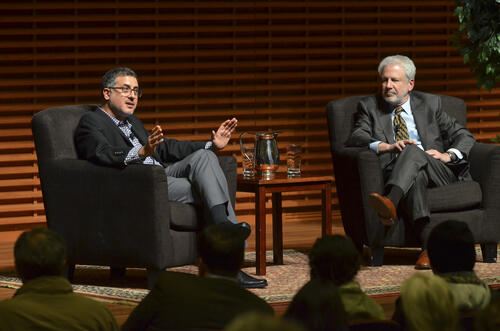
In the second lecture in the “Security Conundrum” series, Gellman was in conversation with Philip Taubman, former correspondent and Washington and Moscow bureau chief for The New York Times and a consulting professor with Stanford’s Center for International Security and Cooperation (CISAC). Taubman teaches the class Need to Know: The Tension Between a Free Press and National Security Decision Making.
Gellman recounted his dealings with Snowden and described how he and his editors weighed the Snowden materials. Few questions are more difficult for American journalists than determining how far a free press can venture in disclosing national security secrets without imperiling the nation’s security.
“I asked him very bluntly, `Why are you doing this?’” Gellman said of Snowden.
“He gave me very persuasive and consistent answers about his motives. Whatever you think of what he did or whether or not I should have published these stories, I would claim to you that all the evidence supports his claim that he had come across a dangerous accumulation of state power that we, the people, needed to know about.”
One of the first Snowden revelations, Gellman said, was the top-secret PRISM surveillance program, in which the NSA is allowed to tap into the servers of nine large U.S. Internet companies, including Google, Microsoft, Yahoo, Facebook and Skype. Snowden believed the extent of mass data collection about American citizens was far greater than what the public knew.
The Post reported that PRISM allows the U.S. intelligence community to gain access from the Silicon Valley firms to a wide range of digital information, including audio, video chats, photographs, emails and stored data that enable analysts to track foreign targets. The program does not require individual warrants, but instead operates under the broader authorization of the federal Foreign Intelligence Surveillance Act court.
Image
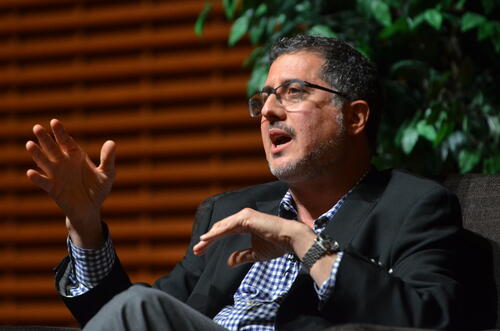
The FISA Court had also been ordering a subsidiary of Verizon Communications to turn over to the NSA logs tracking all of its customers’ telephone calls.
Gellman said Snowden asked for a guarantee the Post would publish the full text of a PowerPoint presentation that he had obtained describing the PRISM program. Gellman told him that his editors would not make any guarantees about what they would publish and in the end the paper only reproduced several slides so as not to harm national security.
Taubman asked Gellman what gives any journalist the right to publish classified documents and not hand those papers back to the NSA.
“I’m not accountable to anyone for my decisions about what is in the interest or not in the interest of the national security of the United States,” Gellman said. “What happens is the government tries to keep information a secret and I try to find it out – and then when that spillage happens, well, then we talk.”
In the case of PRISM, he sent emails to two “quite senior people” in the government and told them this was the type of email he only sends once every several years, when he is onto a big story they would want to know about. But he didn’t want to do anything over email, so when the senior officials called, Gellman gave them the title of the document about which he was going to write.
Image
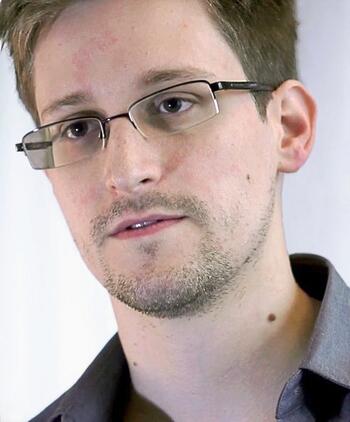
That started the negotiations with the government and The Washington Post. In the end, the paper only published several of the government’s PowerPoint slides that explained the PRISM program because they were concerned about harming national security.
“We had no interest in doing that; we only had an interest in writing about the public policy question on a program that had secretly expanded in ways that almost no one knew about,” Gellman said. “To the extent that it involves drawing new boundaries allowing the government to spy on its citizens and the citizens never get to know that – that is quite relevant to know when you’re trying to decide whether you like what your government is doing.”
In a statement responding to the PRISM revelations by the Post, Director of National Intelligence James Clapper said information collection under the program “is among the most important and valuable foreign intelligence information we collect, and is used to protect our nation from a wide variety of threats.”
Clapper called the Snowden leaks about the legal program “reprehensible and risks important protections for the security of Americans.”
Gellman said Snowden has turned down million-dollar book and movie deals and lives in “ascetic” asylum in Russia. Snowden told NBC News earlier this year that he was on his way from Hong Kong to Latin America, via Moscow, when his passport was confiscated and that Russia then granted him a one-year asylum.
“He is fascinating to me because he’s an unusual figure,” Gellman told Taubman, who had asked him what Snowden was like. He said the 31-year-old former systems administrator for the CIA did something most Americans would not: He gave up his personal freedom and changed the course of his life to make public the government surveillance programs that he believes are a danger to the American people.
“He described himself to me once as an indoor cat,” Gellman said. “He lives in a virtual world; there’s not a whole lot of difference for Snowden whether he’s living in Moscow or Hawaii – he’s is what I would call a net native. He has an ascetic personality; he doesn’t have or want very much stuff.”
Gellman added: “He is sort of Zen-like in his confidence that he has done the right thing.”
***
The Security Conundrum series is co-sponsored by CISAC, Hoover, and the Freeman Spogli Institute for International Studies, Stanford Continuing Studies, Stanford in Government and the Stanford Law School.
Other nationally prominent speakers will include Reggie Walton, the former presiding judge of the Foreign Intelligence Surveillance Court, and U.S. Sen. Dianne Feinstein, chairman of the Senate Select Committee on Intelligence.
Hero Image

All News button
1
Stanford scholars talk APEC 2014
News Type
Commentary
Date
Paragraphs
Asia-Pacific leaders recently met in Beijing at the annual APEC summit, and after two days of discussion, concluded with some significant pledges and remarkable moments. President Xi Jinping of China and Prime Minister Shinzo Abe of Japan held a landmark meeting, and the United States and China discussed two agreements that are both symbolic, and lay groundwork for regional progress, say Stanford scholars.
High-level intergovernmental meetings are often more theatre than substance, but this year the 21-member Asia-Pacific Economic Cooperation, the oldest trans-Pacific regional organization, delivered important messages and may spur actions by member governments.
“Any summit is a ‘hurry up, get this done’ motivator,” says Thomas Fingar, the Oksenberg-Rohlen Distinguished Fellow at the Freeman Spogli Institute for International Studies. “The head of state goes to the meeting – and generally speaking – he doesn’t want to arrive and say ‘my guys were asleep for the last year.’”
Fingar says the APEC summit prodded countries to work on “deliverables,” particularly the goals and projects on the agenda from previous meetings. He recently returned from Beijing, and shared his perspectives with students in the Asia-Pacific Scholars Program.
Writing for the East Asia Forum, Donald Emmerson, director of the Southeast Asia Program at the Walter H. Shorenstein Asia-Pacific Research Center, said many of the commitments declared at the APEC summit, and at the subsequent meetings of the G20 in Australia and the Association of Southeast Asian Nations in Myanmar, will have implications for global governance, particularly as China holds a more influential role in the region.
APEC countries account for over 40 percent of the world’s population and nearly half of global trade – and true to form, the grand vision of the summit is to advance regional economic integration.
Yet, “the ancillary things – things that went on in the margins – are in many ways more important,” Fingar says, referring to areas outside of the summit’s obvious focus, and what’s discussed on the sidelines of the public talks.
Image

Key outcomes from the 2014 gathering include:
- The leaders of Japan and China met for the first time since coming into office, afterward acknowledging that the two countries have “disagreements” in their official statements. Of the Xi-Abe meeting, Fingar says, “it helps clear the way for lower level bureaucrats to go to work on real issues."
- The United States and China announced a proposal to extend visas for students and businesspeople on both sides. While the immediate effects would be helpful, the change is symbolically superior. “You don’t give 5-10 year visas to adversaries,” he says, it shows that “‘we’re in [the relationship] for the long-term.’”
- China proposed the development of a new “Silk Road,” pledging $40 billion in resources toward infrastructure projects shared with South and Central Asian neighbors. “It’s tying the region together and creating economy-of-scale possibilities for other countries,” he says. “A real win-win situation.”
- The United States and China, the world’s two largest energy consumers, announced bilateral plans to cut carbon emissions over the next two decades. “It’s significant because those two countries must be the ones to lead the world in this area. Unless we are seen to be in basic agreement, others will hold back.”
- China codified the Asian Infrastructure Investment Bank (AIIB), a global financial institution intended as an alternative to institutions like the World Bank. “China has been frustrated with its role in existing international institutions,” Fingar says, explaining a likely motivation behind the AIIB’s creation.
Emmerson said the outcomes of the APEC summit from the U.S.-China standpoint were better than expected, speaking to McClatchy News. The visa and climate deals, as well as their commitment to lowering global tariffs on IT products, will lessen chances of conflict between the two countries.
However, the summit did leave some areas unsolved. One of the most important is the Trans-Pacific Partnership (TPP), a trade pact proposed by the United States that includes 11 others countries in the region, but does not yet include China.
Leaders “made positive noises” coming out of the TPP discussions, Fingar says, but nothing was passed. The gravity and complexity of trade-related issues, especially agriculture and intellectual property, is likely to blame for slow action.
Hero Image

Leaders pose for a group photo at the 22nd APEC Economic Leaders' Meeting in Beijing, China.
APEC/(Xinhua/Yao Dawei)
All News button
1