FSI researchers strive to understand how countries relate to one another, and what policies are needed to achieve global stability and prosperity. International relations experts focus on the challenging U.S.-Russian relationship, the alliance between the U.S. and Japan and the limitations of America’s counterinsurgency strategy in Afghanistan.
Foreign aid is also examined by scholars trying to understand whether money earmarked for health improvements reaches those who need it most. And FSI’s Walter H. Shorenstein Asia-Pacific Research Center has published on the need for strong South Korean leadership in dealing with its northern neighbor.
FSI researchers also look at the citizens who drive international relations, studying the effects of migration and how borders shape people’s lives. Meanwhile FSI students are very much involved in this area, working with the United Nations in Ethiopia to rethink refugee communities.
Trade is also a key component of international relations, with FSI approaching the topic from a slew of angles and states. The economy of trade is rife for study, with an APARC event on the implications of more open trade policies in Japan, and FSI researchers making sense of who would benefit from a free trade zone between the European Union and the United States.
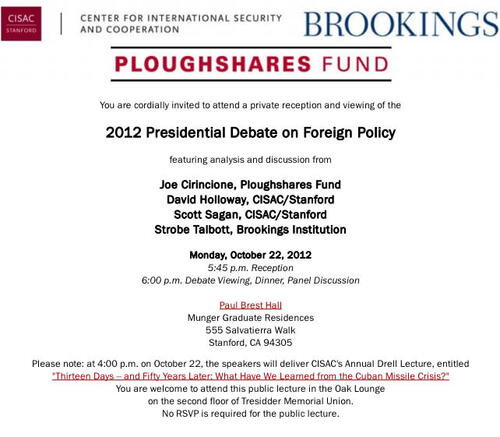
Reception and Dinner: 2012 Presidential Debate on Foreign Policy
|
Please note: at 4:00 p.m. on October 22, the speakers will deliver CISAC's Annual Drell Lecture, entitled You are welcome to attend this public lecture in the Oak Lounge |
Paul Brest Hall
Munger Graduate Residences
555 Salvatierra Walk
Stanford, CA 94305
Five foreign policy questions for Obama and Romney
President Obama and Mitt Romney meet for their third debate to discuss foreign policy on Monday, when moderator Bob Schieffer is sure to ask them about last month's terrorist attack in Libya and the nuclear capabilities of Iran.
In anticipation of the final match between the presidential candidates, researchers from five centers at Stanford’s Freeman Spogli Institute for International Studies ask the additional questions they want answered and explain what voters should keep in mind.
What can we learn from the Arab Spring about how to balance our values and our interests when people in authoritarian regimes rise up to demand freedom?
What to listen for: First, the candidates should address whether they believe the U.S. has a moral obligation to support other peoples’ aspirations for freedom and democracy. Second, they need to say how we should respond when longtime allies like Egypt’s Hosni Mubarak confront movements for democratic change.
And that leads to more specific questions pertaining to Arab states that the candidates need to answer: What price have we paid in terms of our moral standing in the region by tacitly accepting the savage repression by the monarchy in Bahrain of that country's movement for democracy and human rights? How much would they risk in terms of our strategic relationship with Bahrain and Saudi Arabia by denouncing and seeking to restrain this repression? What human rights and humanitarian obligations do we have in the Syrian crisis? And do we have a national interest in taking more concrete steps to assist the Syrian resistance? On the other hand, how can we assist the resistance in a way that does not empower Islamist extremists or draw us into another regional war?
Look for how the candidates will wrestle with difficult trade-offs, and whether either will rise above the partisan debate to recognize the enduring bipartisan commitment in the Congress to supporting democratic development abroad. And watch for some sign of where they stand on the spectrum between “idealism” and “realism” in American foreign policy. Will they see that pressing Arab states to move in the direction of democracy, and supporting other efforts around the world to build and sustain democracy, is positioning the United States on “the right side of history”?
~Larry Diamond, director of the Center on Democracy, Development, and the Rule of Law
What do you consider to be the greatest threats our country faces, and how would you address them in an environment of profound partisan divisions and tightly constrained budgets?
What to listen for: History teaches that some of the most effective presidential administrations understand America's external challenges but also recognize the interdependence between America's place in the world and its domestic situation.
Accordingly, Americans should expect their president to be deeply knowledgeable about the United States and its larger global context, but also possessed of the vision and determination to build the country's domestic strength.
The president should understand the threats posed by nuclear proliferation and terrorist organizations. The president should be ready to lead in managing the complex risks Americans face from potential pandemics, global warming, possible cyber attacks on a vulnerable infrastructure, and failing states.
Just as important, the president needs to be capable of leading an often-polarized legislative process and effectively addressing fiscal challenges such as the looming sequestration of budgets for the Department of Defense and other key agencies. The president needs to recognize that America's place in the world is at risk when the vast bulk of middle class students are performing at levels comparable to students in Estonia, Latvia and Bulgaria, and needs to be capable of engaging American citizens fully in addressing these shared domestic and international challenges.
~Mariano-Florentino Cuéllar, co-director of the Center for International Security and Cooperation
Should our government help American farmers cope with climate impacts on food production, and should this assistance be extended to other countries – particularly poor countries – whose food production is also threatened by climate variability and climate change?
What to listen for: Most representatives in Congress would like to eliminate government handouts, and many would also like to turn away from any discussion of climate change. Yet this year, U.S. taxpayers are set to pay up to $20 billion to farmers for crop insurance after extreme drought and heat conditions damaged yields in the Midwest.
With the 2012 farm bill stalled in Congress, the candidates need to be clear about whether they support government subsidized crop insurance for American farmers. They should also articulate their views on climate threats to food production in the U.S. and abroad.
Without a substantial crop insurance program, American farmers will face serious risks of income losses and loan defaults. And without foreign assistance for climate adaptation, the number of people going hungry could well exceed 15 percent of the world's population.
~Rosamond L. Naylor, director of the Center on Food Security and the Environment
What is your vision for the United States’ future relationship with Europe?
What to listen for: Between the end of World War II and the end of the Cold War, it was the United States and Europe that ensured world peace. But in recent years, it seems that “Europe” and “European” have become pejoratives in American political discourse. There’s been an uneasiness over whether we’re still friends and whether we still need each other. But of course we do.
Europe and the European Union share with the United States of America the most fundamental values, such as individual freedom, freedom of speech, freedom to live and work where you choose. There’s a shared respect of basic human rights. There are big differences with the Chinese, and big differences with the Russians. When you look around, it’s really the U.S. and Europe together with robust democracies such as Canada and Australia that have the strongest sense of shared values.
So the candidates should talk about what they would do as president to make sure those values are preserved and protected and how they would make the cooperation between the U.S. and Europe more effective and substantive as the world is confronting so many challenges like international terrorism, cyber security threats, human rights abuses, underdevelopment and bad governance.
~Amir Eshel, director of The Europe Center
Historical and territorial issues are bedeviling relations in East Asia, particularly among Japan, China, South Korea, and Southeast Asian countries. What should the United States do to try to reduce tensions and resolve these issues?
What to listen for: Far from easing as time passes, unresolved historical, territorial, and maritime issues in East Asia have worsened over the past few years. There have been naval clashes, major demonstrations, assaults on individuals, economic boycotts, and harsh diplomatic exchanges. If the present trend continues, military clashes – possibly involving American allies – are possible.
All of the issues are rooted in history. Many stem from Imperial Japan’s aggression a century ago, and some derive from China’s more assertive behavior toward its neighbors as it continues its dramatic economic and military growth. But almost all of problems are related in some way or another to decisions that the United States took—or did not take—in its leadership of the postwar settlement with Japan.
The United States’ response to the worsening situation so far has been to declare a strategic “rebalancing” toward East Asia, aimed largely at maintaining its military presence in the region during a time of increasing fiscal constraint at home. Meanwhile, the historic roots of the controversies go unaddressed.
The United States should no longer assume that the regional tensions will ease by themselves and rely on its military presence to manage the situation. It should conduct a major policy review, aimed at using its influence creatively and to the maximum to resolve the historical issues that threaten peace in the present day.
~David Straub, associate director of the Korea Studies Program at the Walter H. Shorentein Asia-Pacific Research Center
Compiled by Adam Gorlick.
Failing History
CISAC Faculty Member Amy Zegart outlines how the CIA's mindset has not changed since the Cuban Missile Crisis of October 1962. Fifty years since the crisis, the CIA and other intelligence agencies still operate in an organizational and psychological mindset that favors consensus and consistency. Zegart argues that these "invisible pressures" led to intelligence failures in Cuba in 1962 and Iraq in 2002, where dissenting opinions or internal disagreements were downplayed. The CIA and other intelligence agencies will continue making these mistakes until they recognize their flawed organizational mindset.
Illicit Transnational Actors and Security: Myths, Misconceptions, and Historical Lessons
CISAC Conference Room
Behavioral Advertising and Privacy Law Reboot - US and International Legal Trends and Best Practices for Internet, Cloud and E-Commerce Companies
5:30 pm - 6:30 pm: Registration/Reception (Manning Faculty Lounge, second floor breezeway fo Stanford Law School)
6:30 pm - 8:30 pm: Panel (Room 290)
An evening panel to discuss behavioral advertising and privacy law, including:
+ Evolving legal, technology and business practices
+ What companies and individuals need to know
+ How the international landscape differs from the U.S.
+ Long term trends and developments
+ Corporate best practices
Speakers:
Stanford Law School
Crown Building
Room 290
Stanford-UN collaboration rethinks refugee communities
U.N. Deputy High Commissioner for Refugees T. Alexander Aleinikoff estimates that in the last two years, the UNHCR has taken in an additional 2,000 refugees every day, making it one of the most challenging periods for the U.N. body in decades. Meanwhile, the traditional methods to shelter, protect and aid those refugees don’t always keep pace with growing demands and emerging technologies.
"Many of us work in ways we have worked for many years, where things that have worked in the past continue to work in the present. But, meanwhile, the world has moved on," Aleinikoff recently told a gathering of nongovernment organizations from around the world. The UNHCR, he said, is looking at mobile phone technology, solar power and lighting, fuel-efficient stoves, microcredit loans and stimulating refugee livelihoods.
The agency needed an incubator to test out some of these innovative ideas. So Aleinikoff turned to CISAC, calling on its security experts to collaborate with the UNHCR on a handful of prototypes that would better protect and support the more than 42 million refugees, internally displaced and stateless people worldwide.
The request has led to a multidisciplinary partnership between the UNHCR and CISAC, with students from across the Stanford campus, professors and NGOs, as well as physicians, architects and other professionals eager to volunteer their time and expertise.
“This really matters; it’s about real people,” said Mariano-Florentino Cuéllar, CISAC’s co-director and a Stanford Law School professor teaching a class to coincide with the project. “I like to think we are creating a network of people who will stay engaged. I’m looking for people who say: This is exciting, this is doable, this is important, and I want to be a part of this.”
Cuellar has found dozens. Students, professors at the Hassno-Platner Institute of Design – better known as the d.school – as well as Bay Area NGOs and Silicon Valley designers have signed on, attending workshops and brainstorming sessions with UNHCR officials and Stanford students from around the world.
Some of the Stanford professors include Paul H. Wise, a professor of pediatrics at the Stanford Medical School and a CISAC affiliated faculty member; Francis Fukuyama, a senior fellow at the Freeman Spogli Institute for International Studies and a specialist in international political economy; and Bernard Roth, a professor of mechanical engineering and one of the founders of the d.school.
“I’m curious to see how it’s all going to play out,” Paul Spiegel, deputy director of the Division of Program Support at the UNHCR and a senior fellow at the Harvard Humanitarian Initiative, recently told the Stanford Law School class during a Skype chat from Geneva. “For us at the UNHCR, the most interesting thing is the multidisciplinary nature of this project. This is something we’ve never done before. So this is very innovative and different.”
Two dozens students with majors ranging from engineering to computer science, international policy studies, law and public health are taking Cuéllar’s class, Rethinking Refugee Communities, co-taught by Leslie Witt of the global design consultancy, IDEO.
“I got involved in the project out of intellectual curiosity and because of the prospect of seeing our ideas applied in the field,” said Danny Buerkli, a second year master’s student in international policy studies. “While most of us are not experts in humanitarian policy, we have the luxury of time to reflect and rethink how UNHCR deals with refugee situations. The project is a great way of exploring design thinking, humanitarian policies and working with a large institutional client all at the same time.”
Some of the students are preparing for a visit to a UNHCR refugee camp in Jordan for Syrians fleeing the violence in their homeland. They want to see operations firsthand to better visualize what’s needed on the ground.
You can follow the project at CISAC’s Storify.com page.
Escalatory Models, Norms, Assurance, and Deterrence
The advent of ubiquitous networking and computation and deepening globalization since the 1990s has eroded traditional international security architectures by multiplying conflict surfaces and empowering new actors. This talk describes research in the context of track 1.5 dialogues with Russia and China that aims to develop shared frameworks for understanding escalatory models of cyber conflict, sources of instability, and feasible approaches for risk mitigation. It will argue that cyber has made deterrence much more complex, and now, increased information assurance and new legal or normative constraints on state behavior are likely necessary for effective cross-sectoral deterrence. Finally, it suggests three tasks for cyber norms or confidence and security building measures to attenuate instability.
John Mallery is a research scientist at the Computer Science & Artificial Intelligence Laboratory at the Massachusetts Institute of Technology (MIT). He is concerned with cyber policy and has been developing advanced architectural concepts for cyber security and transformational computing for the past decade. Since 2006, he organized a series of national workshops on technical and policy aspects of cyber.
CISAC Conference Room
Torture Creep
According to Amy Zegart, CISAC faculty member, Americans have become more hawkish on counterterrorism policy since Barack Obama took office. In a blog post for Foreign Policy, Zegart conducted an online poll and found that 25 percent of Americans would stop a terrorist attack by using a nuclear weapon. Support for harsh interrogation techniques and assassination have also increased since similar polls were conducted in 2005 and 2007.
The Threat that Leaves Nothing to Chance: A Narrative Approach to Nuclear War
Lynn Eden is Associate Director for Research at the Center for International Security and Cooperation, Freeman Spogli Institute for International Studies, Stanford University. Eden received her Ph.D. in sociology from the University of Michigan, held several pre- and post-doctoral fellowships, and taught in the history department at Carnegie Mellon before coming to Stanford.
In the area of international security, Eden has focused on U.S. foreign and military policy, arms control, the social construction of science and technology, and organizational issues regarding nuclear policy and homeland security. She co-edited, with Steven E. Miller, Nuclear Arguments: Understanding the Strategic Nuclear Arms and Arms Control Debates (Ithaca, N.Y.: Cornell University Press, 1989). She was an editor of The Oxford Companion to American Military History (New York: Oxford University Press, 2000), which takes a social and cultural perspective on war and peace in U.S. history. That volume was chosen as a Main Selection of the History Book Club.
Eden's book Whole World on Fire: Organizations, Knowledge, and Nuclear Weapons Devastation (Ithaca: Cornell University Press, 2004; New Delhi: Manas Publications, 2004) explores how and why the U.S. government--from World War II to the present--has greatly underestimated the damage caused by nuclear weapons by failing to predict damage from firestorms. It shows how well-funded and highly professional organizations, by focusing on what they do well and systematically excluding what they don't, may build a poor representation of the world--a self-reinforcing fallacy that can have serious consequences, from the sinking of the Titanic to not predicting the vulnerability of the World Trade Center to burning jet fuel. Whole World on Fire won the American Sociological Association's 2004 Robert K. Merton Award for best book in science, knowledge, and technology.
Eden has also written on life in small-town America. Her first book, Crisis in Watertown (Ann Arbor: University of Michigan Press, 1972), was her college senior thesis; it was a finalist for a National Book Award in 1973. Her second book, Witness in Philadelphia, with Florence Mars (Baton Rouge: Louisiana State University Press, 1977), about the murders of civil rights workers Schwerner, Chaney, and Goodman in the summer of 1964, was a Book of the Month Club Alternate Selection.
Reuben W. Hills Conference Room
Lynn Eden
Not in residence
Lynn Eden is a Senior Research Scholar Emeritus. She was a Senior Research Scholar at Stanford University's Center for International Security and Cooperation until January 2016, as well as was Associate Director for Research. Eden received her Ph.D. in sociology from the University of Michigan, held several pre- and post-doctoral fellowships, and taught in the history department at Carnegie Mellon before coming to Stanford.
In the area of international security, Eden has focused on U.S. foreign and military policy, arms control, the social construction of science and technology, and organizational issues regarding nuclear policy and homeland security. She co-edited, with Steven E. Miller, Nuclear Arguments: Understanding the Strategic Nuclear Arms and Arms Control Debates (Ithaca, N.Y.: Cornell University Press, 1989). She was an editor of The Oxford Companion to American Military History (New York: Oxford University Press, 2000), which takes a social and cultural perspective on war and peace in U.S. history. That volume was chosen as a Main Selection of the History Book Club.
Eden's book Whole World on Fire: Organizations, Knowledge, and Nuclear Weapons Devastation (Ithaca: Cornell University Press, 2004; New Delhi: Manas Publications, 2004) explores how and why the U.S. government--from World War II to the present--has greatly underestimated the damage caused by nuclear weapons by failing to predict damage from firestorms. It shows how well-funded and highly professional organizations, by focusing on what they do well and systematically excluding what they don't, may build a poor representation of the world--a self-reinforcing fallacy that can have serious consequences, from the sinking of the Titanic to not predicting the vulnerability of the World Trade Center to burning jet fuel. Whole World on Fire won the American Sociological Association's 2004 Robert K. Merton Award for best book in science, knowledge, and technology.
Eden has also written on life in small-town America. Her first book, Crisis in Watertown (Ann Arbor: University of Michigan Press, 1972), was her college senior thesis; it was a finalist for a National Book Award in 1973. Her second book, Witness in Philadelphia, with Florence Mars (Baton Rouge: Louisiana State University Press, 1977), about the murders of civil rights workers Schwerner, Chaney, and Goodman in the summer of 1964, was a Book of the Month Club Alternate Selection.