International Relations

FSI researchers strive to understand how countries relate to one another, and what policies are needed to achieve global stability and prosperity. International relations experts focus on the challenging U.S.-Russian relationship, the alliance between the U.S. and Japan and the limitations of America’s counterinsurgency strategy in Afghanistan.

Foreign aid is also examined by scholars trying to understand whether money earmarked for health improvements reaches those who need it most. And FSI’s Walter H. Shorenstein Asia-Pacific Research Center has published on the need for strong South Korean leadership in dealing with its northern neighbor.

FSI researchers also look at the citizens who drive international relations, studying the effects of migration and how borders shape people’s lives. Meanwhile FSI students are very much involved in this area, working with the United Nations in Ethiopia to rethink refugee communities.

Trade is also a key component of international relations, with FSI approaching the topic from a slew of angles and states. The economy of trade is rife for study, with an APARC event on the implications of more open trade policies in Japan, and FSI researchers making sense of who would benefit from a free trade zone between the European Union and the United States.

Authors
News Type
News
Date
Paragraphs

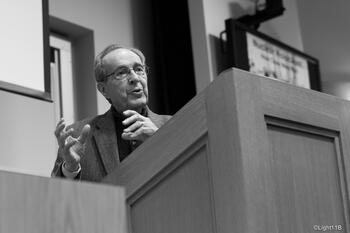
Rod Ewing will serve as co-director of the sciences for Stanford’s Center for International Security and Cooperation.

Ewing, a mineralogist and materials scientist, is the Frank Stanton Professor in Nuclear Security at CISAC and senior fellow at the Freeman Spogli Institute for International Studies. He begins his new position on Sept. 1, following David Relman, the previous co-director for the sciences. Amy Zegart is the CISAC co-director for the social sciences.

Ewing, whose research is focused on the properties of nuclear materials, leads the Reset Nuclear Waste Policy program at CISAC. He describes the center as a unique organization that “explicitly acknowledges” the role of science and the social sciences in formulating policy. 

“CISAC is a rare opportunity for political and social scientists, historians and scientists and engineers to work together on solving pressing problems. The fact that we have two co-directors reflects a serious intent to integrate knowledge from the widest range of perspectives in order to find policy solutions to important problems,” he said.

Scholarship, research

Ewing is the author or co-author of more than 750 research publications and the editor or co-editor of 18 monographs, proceedings volumes or special issues of journals. He has published widely in mineralogy, geochemistry, materials science, nuclear materials, physics and chemistry in more than 100 different journals. Ewing was granted a patent for the development of a highly durable material for the immobilization of excess weapons plutonium. He is also a founding editor of the magazine, Elements. In 2015, he won the Roebling Medal, the highest award of the Mineralogical Society of America for scientific eminence.

“My work on nuclear waste started out with a focus on technical issues, but over several decades, I realized that technical solutions were not enough.  I now focus on trying to understand why institutions – universities, national laboratories and federal agencies – fail to arrive at the technical solutions. I have been surprised to learn how little science has been applied to the nuclear waste problem – and how social issues have dominated the outcome,” Ewing said.

Expertise, policy

In particular, Ewing seeks to understand why so little information from experts rise through an organization and change accepted ‘truths.’

“I first saw this when I was a soldier in Vietnam and continue to see the same problem in many other areas, that a disconnect exists between the on-the-ground reality and policy,” said Ewing who served in the U.S. Army as an interpreter of Vietnamese attached to the 25th Infantry Division from 1969 to 1970.

“At the very highest levels, policies seem to be based on a hunch or a bias rather than an analysis of the problem. I have always wondered why this is so common – as it often leads a country or organization down a wrong and often dangerous path,” he added.

Born in Abilene, Texas, Ewing attended Texas Christian University (B.S., 1968, summa cum laude) and graduate school at Stanford University (M.S., 1972; Ph.D., 1974). He began his academic career as an assistant professor at the University of New Mexico (1974) rising to the rank of Regents’ Professor of Earth & Planetary Sciences in 1993.

From 1997 to 2013, Ewing was a professor at the University of Michigan, and in 2014, he joined Stanford.

MEDIA CONTACTS:

Rod Ewing, Center for International Security and Cooperation: (650) 725-8641, rewing1@stanford.edu

Clifton B. Parker, Center for International Security and Cooperation: (650) 725-6488, cbparker@stanford.edu


Hero Image
22150905629 d93af89e3e z
Rod Ewing will serve as co-director of the sciences for Stanford’s Center for International Security and Cooperation.
Courtesy of CISAC
All News button
1
0
bill_philips.jpg

Bill Phillips has vast experience in the US Intelligence Community with over 36 years as a professional intelligence officer, over 25 of which were as a CIA clandestine service officer. Among his many accomplishments, Bill served as CIA Chief of Station (COS) in Latin America and the Near East, and developed specialized Counterintelligence expertise. Bill has nationally recognized prowess in HUMINT and extensive knowledge of multiple foreign environments and cultures. He managed and led complex global, HUMINT, counterintelligence, counterterrorism and counternarcotics operations. He worked closely with senior US government officials, Congressional elements, FBI, and elements of the US military, and has substantive expertise in South Asia, the Caribbean and certain remote areas of Latin America. Bill was awarded CIA’s Distinguished Career Intelligence Medal, the National HUMINT Collector Award, the CIA’s Latin America Division Medal, Two Meritorious Unit Citations and numerous CIA Exceptional Performance Awards.

Bill also served as Director of the Office of Counterintelligence (CI) at Los Alamos National Laboratory from 2005-2010. Bill enhanced that program by focusing CI efforts on educating LANL’sstaff to the risks and threats posed by adversarial governments, criminal enterprises and terrorist organizations. Bill integrated disparate disciplines (collection, analysis, investigations, and cyber) to strengthen the lab’s CI program. A trusted member of the LANL leadership team, Bill collaborated with elements of the US Intelligence Community and FBI on highly sensitive CI investigations.

Currently, Bill is an independent consultant and has created intelligence related training programs, taught and advised clients in the IC. He especially enjoys mentoring and guiding individuals new to the intelligence field.

Bill received a B.A. in History from Howard University in 1972 and a J.D. from Rutgers University in 1975.

A longtime student of Ki Aikido and Zen, Bill has used aspects of these disciplines in his work as an intelligence professional, leader, teacher and mentor. While at CIA, Bill helped create a pilot course introducing intelligence officers to the stress relieving benefits and resilience potential of meditation. Bill is member of the Northern CaliforniaKi Society and on the Board of Directors of the Ki Research Institute.

Topics: Counterintelligence, Intelligence, National Security, U.S. Intra-agency communication, Race Relations, Leadership, Ki in Daily Life.

Affiliate
Date Label
0
rsd19_072_0386a.jpg

Asfandyar Mir is an affiliate with the Center for International Security and Cooperation, Stanford University. Previously he has held predoctoral and postdoctoral fellowships at the center. His research interests are in the international relations of South Asia, US counterterrorism policy, and political violence, with a regional focus on Afghanistan and Pakistan. His research has appeared in peer-reviewed journals of International Relations, such as International Security, International Studies Quarterly and Security Studies, and his commentary has appeared in Foreign Affairs, Foreign Policy, H-Diplo, Lawfare, Modern War Institute, Political Violence at a Glance, Politico, and the Washington Post.

Asfandyar received his PhD in political science from the University of Chicago and a masters and bachelors from Stanford University.

Affiliate
-

Abstract: Mainland China has undergone a rapid development of nuclear power during the last two decades. The reactors under construction or soon to be constructed there include some of the world's most advanced models. While the average age of the workforce in China’s nuclear industry is still in the early 30s, China has already become largely self-sufficient in reactor design and construction, as well as other aspects of the fuel cycle. They have made full use of western technology while adapting and improving it, and now have set up a “go global” policy for exporting nuclear technology including heavy components to the rest of the world that may seem to be a strong competition to the US nuclear power industry. 

The speaker has led some two-way educational exchange programs with China during the last 20 years, including training about 20 Chinese nuclear engineers at the University of Michigan (UM), and taking over 100 UM students to China’s nuclear power construction sites and research institutions as visitors or interns. He will share his observation and thoughts with the audience on why we should continue to collaborate with China in nuclear engineering education and research, and how such collaboration can be a win-win deal for both countries in terms of global nuclear safety, technological advancement and economics. 
 

Speaker Bio: Dr. Lumin Wang came to US from China in 1982 and received his PhD in Materials Science from the University of Wisconsin-Madison in 1988. He is a professor in the Department of Nuclear Engineering & Radiological Sciences and the Department of Materials Science & Engineering at the University of Michigan, Ann Arbor (UM). He worked at Argonne National Laboratory and University of New Mexico before joining UM in 1997. Professor Wang’s main research interests are on radiation tolerance of nuclear engineering materials and ion beam modification of materials. Professor Wang has published more than 400 SCI indexed research papers with an h-index above 50. Professor Wang has been serving on the International Committee of American Nuclear Society (ANS) since 2010. He has taken over 100 UM students to China to observe the development of nuclear power there seven summers in a row since 2010. Professor Wang was named as an outstanding nuclear engineering professor in 2008 and an international ambassador in 2013 by UM’s college of engineering. 

Lumin Wang Professor, Dept. of Nuclear Engineering & Radiological Sciences University of Michigan
Seminars
0
max_headshotupdated_1.png DPhil

Max Smeets is the Co-Director of Virtual Routes, and serves as Managing Editor of Binding Hook. He also holds research positions at ETH Zurich, the Royal United Services Institute (RUSI) and Stanford University’s Center for International Security and Cooperation. Max is the author of Ransom War: How Cyber Crime Became a Threat to National Security and No Shortcuts: Why States Struggle to Develop a Military Cyber Force.

Max received a BA in Economics, Politics and Statistics from University College Roosevelt, Utrecht University and an MPhil (Brasenose College) and DPhil (St. John’s College) in International Relations from the University of Oxford.

Affiliate
Date Label
0
kp_headshot_2023.jpeg

Dr. Kerry Ann Carter Persen is an expert in the intersection of technology and societal concerns, particularly countering violent extremism, dual use and emerging technologies, and misinformation. She currently works on Stripe’s Public Policy team and is a Security Fellow at the Truman National Security Project. 

Previously, Kerry has worked on the Global Policy team at Meta on AR/VR technologies and data privacy issues, at the Institute for the Future on misinformation and as a political consultant at RiceHadleyGates LLC, a strategic consulting firm led by former Secretary of State Condoleezza Rice, former National Security Advisor Stephen Hadley and former Secretary of Defense Robert Gates. She has also been a Fellow at Stanford's Center for International Security and Cooperation, a Minerva Fellow at the U.S. Institute for Peace, a Fellow at the Berkley Center for Religion, Peace & World Affairs at Georgetown University, and a Fulbright Fellow in Indonesia.

Kerry received her Ph.D. from the Department of Political Science at Stanford University, where her research was supported by the National Science Foundation, the Horowitz Foundation, and the National Consortium for the Study of Terrorism and Responses to Terrorism (START), among others. She graduated summa cum laude from Bowdoin College with a double major in Government and Economics.

Affiliate
0
kristinvenbruusgaard_rsd17_076_0268a.jpg

Dr. Kristin Ven Bruusgaard is Director of the Norwegian Intelligence School. She served as the Deputy Leader of the 2021 Norwegian Government Defense Commission, providing advice on future Norwegian defense policy for the next 10-20 years. Previously she was a Postdoctoral Fellow (Assistant Professor) of Political Science at the University of Oslo, a Nuclear Security Postdoctoral Fellow and a Stanton Nuclear Security Predoctoral Fellow at the Center for International Security and Cooperation (CISAC), Stanford University, a Research Fellow at the Norwegian Institute for Defense Studies (IFS), and a senior security policy analyst in the Norwegian Armed Forces.

Her academic research focuses on Soviet and Russian nuclear strategy, nuclear and non-nuclear deterrence, crisis and deterrence dynamics in Europe and the Arctic/High North. She holds a Ph.D. in Defence Studies from King's College London and an MA in Security Studies from Georgetown University. She is a certified language officer in the Norwegian Army. Her work has been published in Foreign Affairs, Security Dialogue, Journal of Strategic Studies, Survival, War on the Rocks, Texas National Security Review, Parameters and Bulletin of Atomic Scientists and by Cambridge University Press. She was awarded the 2020 Amos Perlmutter Prize from the Journal of Strategic Studies for her article Russian Nuclear Strategy and Conventional Inferiority

Affiliate
CV
Date Label
News Type
News
Date
Paragraphs

As cyber attacks escalate in magnitude – reflected in the 2016 Russian meddling in the U.S. election and the 2014 Sony Pictures hacking – the red alert has gone out to Washington D.C. to confront the issue.

At Stanford, Capitol Hill staffers are doing just that, thanks to the Congressional Cyber Boot Camp that takes place Aug. 14-16. The third installment of its kind since 2014, the workshop offered panel discussions, role-playing exercises, informational sessions, and networking opportunities -- all aimed at getting Congress on top of a fast-accelerating issue that has ramifications throughout the American domain.

This year’s event involved almost three dozen staffers hailing from U.S. Senate and House member offices and committees such as the U.S. Senate Select Committee on Intelligence, Homeland Security, Appropriations, Judiciary, Energy and Commerce. Top cyber and policy experts addressed them about some of the thorniest issues emerging in cyber realms -- and what it means for this country's political leadership and citizenry.

The boot camp was held at the Hoover Institution, a co-sponsor along with Stanford’s Center for International Security and Cooperation, the Freeman Spogli Institute for International Relations, the Stanford Cyber Initiative, and the Stuart Family Congressional Fellowship Program.

CISAC co-director Amy Zegart said, "The Congressional Cyber Boot Camp is our signature event because we’re connecting the worlds of public policy and cybersecurity in ways that help advance national security." Zegart, also the Davies Family Senior Fellow at Hoover, was a co-convener of the boot camp along with Herbert Lin, a CISAC  and Hoover senior fellow, and widely-known cybersecurity expert.

Zegart said the boot camp has grown so popular that a waiting list now exists. And, she points to policy impacts after just three years. For example, a legal counsel to U.S. Sen. John McCain, the chair of the Senate Armed Services Committee, attended a prior boot camp, which resulted in McCain visiting and reaching out to CISAC and the Hoover on cybersecurity issues over the past few years. A lot of those discussions are confidential, but that input had its roots in the boot camp and Stanford experts gather there.

“We created the cyber boot camp precisely because many Congressional staffers had told us this was the type of help they needed,” Zegart said.

In her introductory remarks to the group, Zegart said, “If we can help you, you can help our country.” The boot camp would be focused on, she said, encouraging “new knowledge” and building “new networks of people” in the field of cybersecurity.

Sean Kanuck, an affiliate with CISAC who served as the U.S.’ first national intelligence officer for cyber issues from 2011 to 2016, talked about reframing cybersecurity problems in his keynote address to the Stanford Congressional Cyber Boot Camp.

Exercises, networking

As Zegart said, cybersecurity is an urgent issue for policy makers like those at the boot camp, and last year’s presidential election and major hacking of corporations and security organizations attest to the increasing importance that Washington D.C. now places on it. Preparation is considered critical.

And so, this year’s camp included a simulation exercise with Congressional staffers assuming the roles of executives at a large, fictitious company (“Frizzle”) that is under a major cyberattack.

Each boot camp gets a new round of fresh Congressional faces. Last year, the Los Angeles Times published a story on the boot camp and all of the questions and issues that arose in such a scenario. For example, when should customers or authorities be informed, and what about retaliation? For most, cyber is a brave new world – and expert advice is appreciated – something that Stanford’s boot camp offers.

Evolving security threat

Cyber experts point out that nations are increasingly dependent on information and information technology for societal functions. This makes ensuring the security of information and information technology — against a broad spectrum of hackers, criminals, terrorists, and state actors – a top priority for any country. And it seems like every day, something new is introduced.

“Cybersecurity challenges are evolving at a rapid pace, and the cyber threat the nation faces today will be different from the one it faces tomorrow,” Zegart and Lin wrote in the workshop’s agenda.

Cybersecurity is not merely a technical matter, but a “multi-faceted enterprise” that requires drawing on computer science, economics, law, political science, psychology, and other disciplines, they noted.

The idea behind the boot camp is to help congressional staffers – those writing the nation’s policies on cybersecurity – use “multiple perspectives and disciplines” as they analyze and act on cybersecurity issues.

“The Stanford Cyber Boot Camp endeavors to give congressional staffers a conceptual framework to understand the threat environment of today and how it might evolve so that they are better able to anticipate and manage the problems of tomorrow,” Zegart and Lin said.

That seems to be happening on Capitol Hill, where staffers now know who to call for cyber advice.

Lin said he routinely receives calls from Congressional staffers who are alumni of the boot camp – they are seeking his feedback and guidance on cyber policy or legislation. Of course, those discussions are not for public disclosure, given the sensitivity. Lin was also asked to testify twice before Congress on cyber issues, and he was chosen by the Obama Administration to serve on the President’s Commission on Enhancing National Cybersecurity. He attests that the boot camp opened up the door for him being invited to that commission.

In December 2016, the White House cyber commission, with the help of experts like Lin, issued strong recommendations to upgrade the nation’s cybersecurity systems.

That’s the kind of policy impact the cyber boot camp seeks.

Topics and speakers

Themes covered at this week’s cyber camp:

• the role of offensive operations in cyberspace for improving the nation’s cybersecurity;

• why cyber defense is more difficult than offense;

• the role of market forces in enhancing or weakening cybersecurity;

• automotive cyber security; problems in applying existing law to accelerating technology;

• the economic, psychological, and organizational factors involved in cybersecurity;

• and the fundamental principles of cybersecurity.

Scheduled speakers included:

Condoleezza Rice, senior fellow at the Hoover Institution and former U.S. Secretary of State and National Security Advisor.

Michael McFaul, director and senior fellow at both FSI and the Hoover Institution.

• Marc Andreessen, co-founder and general partner of Andreessen Horowitz.

Toomas Hendrik Ilves, the former president of Estonia; and distinguished visiting fellow this past year at CISAC, Hoover, and FSI.

• Andy Grotto, CISAC fellow, Hoover research fellow, and former senior director for cybersecurity policy at the National Security Council.

• Joel Peterson, chairman of JetBlue Airways; professor at Stanford Graduate School of Business; and chairman at the Hoover Institution Board of Overseers.

The group also will take a walking tour of the Hoover Institution’s Library and Archives and a trip to the Tesla factory in Fremont.

Prior coverage of boot camps:

Stanford News story on 2014 event

CISAC story on 2014 event

CISAC video of 2014 event

Stanford News story on 2015 event

Hoover story on 2016 media boot camp

MEDIA CONTACT:

Clifton B. Parker, Center for International Security and Cooperation: (650) 725-6488, cbparker@stanford.edu


Hero Image
dsc 4824a
Sean Kanuck, center, an affiliate with CISAC who served as the U.S.’ first national intelligence officer for cyber issues from 2011 to 2016, talked about reframing cybersecurity problems in his keynote address to the Stanford Congressional Cyber Boot Camp.
Rod Searcey
All News button
1
News Type
News
Date
Paragraphs

In this CSPAN videoCISAC faculty member David Holloway and affiliates Karl Eikenberry, Thomas Fingar and Kathryn Stoner of the Freeman Spogli Institute for International Studies talk about the concept of "triangulation" between the U.S., China and Russia. Triangulation refers to whether the U.S., by improving relations with China, carves out a more favorable negotiating position with Russia (or, in the past, the Soviet Union), while improving relationships with both countries. The FSI scholars discussed whether this theme is still relevant in today’s world. They also talked about the Trump administration’s policies toward Russia, China and North Korea. The discussion, which took place July 27 at the Richard Nixon foundation and library, is 1 hour and 33 minutes in length. Click here for the Nixon foundation's video of this event.

Hero Image
img 4255
David Holloway, Thomas Fingar, Karl Eikenberry, and Kathryn Stoner talk at the Nixon library on CSPAN about the triangulation of the U.S., China, Russia relationships.
All News button
1
Authors
News Type
News
Date
Paragraphs

This Stanford news release describes research by CISAC's Scott Sagan on American public opinion toward the use of nuclear weapons during wartime. He found that views on nuclear weapons usage has not fundamentally changed since 1945, and many people would support the use of such weapons to kill millions of civilians if the U.S. found itself in a similar wartime situation. Sagan and his co-author used a survey experiment to recreate the situation that the United States faced in 1945 in the Hiroshima nuclear bombing with a hypothetical American war with Iran today.

The results showed little support for the so-called “nuclear taboo” thesis, or that the principle of “noncombatant immunity” – civilian protection from such weapons – has become a deeply held norm in America. The conclusions are stark and disturbing, Sagan said.

“These findings highlight the limited extent to which the U.S. public has accepted the principles of just war doctrine and suggest that public opinion is unlikely to be a serious constraint on any president contemplating the use of nuclear weapons in the crucible of war,” wrote Sagan and his co-author, Benjamin Valentino, a Dartmouth College professor of government.

 
Hero Image
gettyimages 692396962
Seven decades after the bombing of Hiroshima, Japan, most Americans in a Stanford study were willing to consider use of a nuclear weapon against civilians under some circumstances.
Image credit: andipantz / Getty Images
All News button
1
Subscribe to International Relations