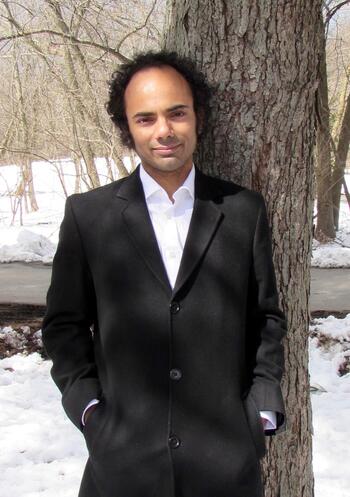
Brett McGurk, the former Special Presidential Envoy for the Global Coalition to Counter ISIL, has had a busy summer. Between working on a new book contract, travelling to international security conferences on two continents and prepping for his upcoming class — “Presidential Decision-Making in Wartime” — which will be taught this fall at Stanford, the Payne Distinguished Lecturer at the Center for International Security and Cooperation sat down with the Freeman Spogli Institute to reflect on what he’s learned about Middle Eastern politics this summer.
FSI: You recently attended a number of conferences focused on international security. Tell us a little about where you’ve been and the conferences you participated in.
Sure. I was recently at a conference in Beijing sponsored by the Carnegie Foundation for International Peace that focused on China in the Middle East. This was a good opportunity to reconnect with former officials and experts on China and also to discuss with Chinese officials and academics how Beijing views its emerging role in the Middle East region. This is an important topic, and we intend to develop it further here at Stanford FSI through a combination program with CISAC and the Shorenstein Asia-Pacific Research Center. I recently published an article in the Atlantic on some of the themes from Beijing.
I also attended the Oslo Forum in Norway, which brings together top diplomats from around the world engaged in mediating the most difficult conflicts. UN envoys from Syria and Libya, for example, participate, as do leaders working on Yemen and other seemingly intractable crises. The main takeaway from that important conference was that there is a window of opportunity right now for active U.S. diplomacy to help de-escalate what are in effect proxy wars between regional powers. Libya is increasingly a conflict between long-time U.S. allies, with Turkey and Qatar on one side and UAE and Egypt on the other side. Yemen is a humanitarian catastrophe and UN mediation has opened the door to ceasefires and a path for winding down the war, which some of our key allies now support.
Iran and extremists like al Qaeda and ISIS take advantage of proxy wars and vacuums – so it’s in our interests both from a humanitarian, geostrategic, and national security perspective to use diplomacy and other tools to end these conflicts. That was the focus of the Norway meetings.
In spectacular #Oslo today for the 2019 #OsloForum. Look forward to reconnecting with former counterparts and friends from around the globe, many trying largely on their own to mediate some of the world’s most intractable conflicts. @NorwayMFA pic.twitter.com/0DmTY7swW6
— Brett McGurk (@brett_mcgurk) June 18, 2019
To what extent did the U.S. participate in the Oslo Forum?
I was struck that the United States was largely absent. There were no U.S. officials at the Forum, for the first time as I can recall, and total lack of clarity on U.S. goals and objectives. On Syria, the top UN Envoy, Geir Pederson, attended as did a number of parties to the Syrian conflict, including from the Syrian Democratic Forces, which played a key role in defeating ISIS.
There is some hope that Syria is approaching a stage for a meaningful political settlement; I’ve expressed some skepticism on that, again, due largely to questionable U.S. intent and commitment and the facts on the ground and in the region, which leave Washington with few good options. The sooner we acknowledge that reality the better because the situation can still get much worse. My recent article in Foreign Affairs delves into those issues in some detail.
You were at the Herzliya Conference in Israel. Did Iran’s nuclear program dominate the agenda? What else was top of mind for the conference organizers, presenters, and people in attendance?
Yes, I attended the annual security conference sponsored by Israel’s Institute for Policy and Strategy. It’s become a go-to event for assessing the direction of Middle East politics and Israeli policies in a difficult part of the world. I used to attend as a sitting official and it was great to be there as a private citizen.
Flying from San Francisco to Tel Aviv for the annual @HerzliyaConf which has become a go-to event for thinkers and practitioners on the Middle East. Look forward to reconnecting with former colleagues and new friends. @FSIStanford @CarnegieMEC pic.twitter.com/0se7WvGCG1
— Brett McGurk (@brett_mcgurk) June 28, 2019
Much of the focus this year, of course, was on Iran – but also on the internal situation inside Israel, President Donald Trump’s much-delayed Middle East peace plan, and the rift I mentioned earlier between Egypt, Saudi Arabia, and UAE on one side, with Turkey and Qatar on the other side.
There was also an open question and significant discussion over whether current U.S. policies are worsening tensions in the region. Much of that will depend on whether the core White House assumption driving its Iran policy is correct. That assumption holds that maximum pressure against Iran will force Iran back to the negotiating table that Trump himself left and result in a better nuclear deal and more responsible Iranian behavior in the region. If that assumption is false, and Iran reacts to unilateral American pressure by forging stronger ties with China and Russia, restarting its illicit nuclear activities, and increasing its malign behavior in the region – then U.S. policy may have precisely the opposite effect than its stated intent. That would require Trump to either double down on pressure, to include military pressure, or back down from what is now a zero-sum bargaining position.
For more on Brett McGurk’s policy recommendations on Iranian nuclear ambitions, read his Op-Ed in Bloomberg News.
On stated U.S. intent, there was also quite a bit of discussion about U.S. objectives, given that Trump says one thing and his national security team says something else, often within the same 24-hour time span. This uncertainty, I would argue, is breeding more instability, not less.
There was an interesting “war game” conducted at the Herziliya Conference, which simulated direct negotiations between U.S. and Iranian officials. The game ended without producing an agreement. What do you make of that?
I participated in that war game. Having confronted the Iranians from the shadows and in direct face-to-face negotiations, I would say this simulation was fairly accurate and its findings important. My first conclusion was that it’s highly unlikely the Iranians are going to return to the table under the current circumstances and without some up-front concession (such as reinstating some waivers to allow limited export of oil) by the Trump administration. Nobody likes that answer, but it’s a realistic assessment of Iranian decision-making and important if the U.S. objective is truly – as Trump says – to get back to the negotiating table for a better nuclear deal.
I read recently that the Emir of Qatar, who visited Trump in the Oval Office in mid-July, told the president the same thing. So even our close friends in the region have this assessment. It means, if you want to get back to the negotiating table, then you need to create a pretext with some up-front steps, to be taken both from Washington and from Tehran. A creative package, for example, might offer some limited sanctions relief and also demand release of Americans held in Iranian prisons. Absent something like that, relying on pressure alone, there are unlikely to be any talks.
How did the simulated negotiations between the U.S. and Iran unfold?
Presuming you get to the stage of talks, which was the focus of the simulation, the position of the two sides are irreconcilable. Iran was willing to consider some amendments to the Joint Comprehensive Plan of Action – but from the U.S. side, that was insufficient. We demanded, as Secretary of State Mike Pompeo has demanded, a total abandonment of Iran’s enrichment program, defunding proxy militias throughout the region, cabining the ballistic missile program, and other measures. The talks totally broke down after a number of rounds, and risks of a conflict increased significantly. It’s better to have no talks than ill-prepared talks where the U.S. is not even clear on what it’s hoping to achieve or has demands that are known non-starters.
The only silver lining was that if the goal is a strengthened nuclear deal that truly blocks Iran’s path to a weapon in perpetuity, while allowing a civilian program, then it’s achievable. Trump has said that’s the goal. If so, there is a path. But that’s a far more limited goal than what has been discussed by his national security team. The more ambitious objectives are unlikely to be met, and without a realistic objective, the talks themselves are unlikely to get off the ground.
A more comprehensive approach for Iran: 1) Naval coalition to protect shipping; 2) On-ramp to strengthen nuke deal; 3) Diplomacy to de-escalate proxy wars; 4) Treat Iranian people as allies (end travel ban); 5) Keep focus on ISIS: don't leave Iraq/Syria. https://t.co/BBNVtbLEhn
— Brett McGurk (@brett_mcgurk) June 26, 2019
Have you participated in “war games” like this one before?
I don’t like the phrase “war game” because it suggests something trite like a game or reenactment; in fact, simulations like this are among the best tools we have to predict the future and prepare for contingencies in foreign policy. Even with all the tools and information available to a policy-maker at the most senior level, humans can’t predict the future. Well-run simulations alert you to policy adjustments that may be necessary. We used them quite a bit during the campaign to defeat ISIS and to good effect. A famous war game, SIGMA II, run out of the Pentagon in 1965 predicted perfectly what would happen if the U.S. pursued its graduated pressure campaign against North Vietnam – a quagmire that sucked in multiple U.S. divisions.
So these simulations are important. I hope the administration is conducting them on Iran, though I tend to doubt they are, at least not at the highest levels. Sound foreign policy depends on setting clear and achievable objectives, marshaling the resources for achieving them, and regularly testing assumptions to make adjustments as circumstances warrant.
I recently published an essay in Foreign Affairs on the misalignment of ends and means with respect to Trump’s foreign policies in Syria, Venezuela, and Iran. That’s generally a recipe for either a failed policy or unintended consequences that box presidents into decisions they don’t want to make: either double down on resources or ratchet back objectives.
Did you have a chance to reconnect with old friends from your many years as a U.S. diplomat in the Middle East?
I did, and I also caught up with a number of former colleagues still serving in the Trump administration. They are a dedicated group and doing all they can under difficult circumstances. I could not hide my enthusiasm for being out of Washington and out here at Stanford. Stanford is just an incredible place to think deeply and differently about the issues now confronting our nation and the world.
You start teaching in the Ford Dorsey Master’s in International Policy program in the fall quarter. Can you tell us a bit about your course?
Sure. In the fall I will teach “Presidential Decision-Making in Wartime.” It’s a course about how the most consequential decisions – war and peace – are made in reality, particularly since 9/11. We will dive into the essential laws of strategy such as setting clear objectives, aligning ends, ways, and means, and what happens when those essential laws are ignored. I hope it will give students the tools to ask the right questions if they are ever in the Situation Room with a chance to influence the course of history for the better.
Most debacles have this same basic flaw of ignoring what I call the iron law of strategy and alignment of ends, ways, and means. Even for students not heading towards a national security career, the tools and elements of strategic thinking are broadly applicable.


 FSI researchers strive to understand how countries relate to one another, and what policies are needed to achieve global stability and prosperity. International relations experts focus on the challenging U.S.-Russian relationship, the alliance between the U.S. and Japan and the limitations of America’s counterinsurgency strategy in Afghanistan.