Authors
News Type
News
Date
Paragraphs

In 2015, Volodymyr Zelenskyy was at the height of a successful career as an entertainer. Though trained as a lawyer at the Kryvyi Rih Institute of Economics in Eastern Ukraine, the then 37 year old Zelenskyy was a successful comedian and public personality. As the star of the popular TV show, Servant of the People, he played a local history teacher who inadvertently becomes the president of Ukraine following a viral video rant about corruption.

No one watching comedic President Zelenskyy then could have possibly imagined the real-life plot twist that would follow. In an incredible act of life imitating art, in April 2019, Volodymyr Zelenskyy once again stood on stage in front of a cheering crowd, but this time as the actual president of Ukraine.

He won in a landslide election against incumbent president Petro Poroshenko on a platform of systemic change and progress using an almost exclusively virtual campaign. Speaking from his headquarters on election night, he affirmed the exuberance and hope of his supporters: “I can say as a citizen of Ukraine to all countries of the post-Soviet Union: Look at us — everything is possible.”

This same message shaped the theme of President Zelenskyy’s remarks at his historic address from the Freeman Spogli Institute for International Studies (FSI) at Stanford University on September 2. The first Ukrainian president to ever visit California, President Zelenskyy, First Lady Olena Zelenska and their delegation joined a group of FSI faculty members led by FSI Director Michael McFaul at an outdoor event held in the Encina Courtyard.

In his remarks, Zelenskyy drew inspiration from Steve Jobs’ famous "How to Live Before You Die" commencement address given at Stanford in 2005.

"This is one of the most famous speeches ever given at Stanford,” he said. “It's about believing in dreams and overcoming the impossible. This is the same as my story. I am just a common guy from a common family from a common industrial town in Eastern Ukraine. Yet here I am today at Stanford, because everything is possible."

He continued, “It is the same for Ukraine. Many people look at us and think that it will be impossible to achieve the goals we hope for. But we know that our critics are wrong. The people of our country love democracy and freedom and will not let threats take those things away. We know that anything is possible."

Looking to the future, Zelenskyy outlined the steps his administration is undertaking to bring increased digitization to Ukraine. These efforts include launching fully electronic passports, moving business and legal services online and expanding the scope of e-goverance. The hope is that this meld of new technology will help curb corruption while simultaneously creating more equitable opportunities and better access to public services for more Ukranians.

Speaking on the ambitious scope of these plans, the president acknowledged, “There will be resistance to the changes and innovations that we are going to make.” Nonetheless, he remains committed to the work ahead of strengthening democratic institutions in Ukraine and building on the progress that has already been made.  “We do not have a ‘Ukrainian Dream,’ yet,” he said. “But we have a ‘Ukrainian Goal’ and a ‘Ukrainian Mission’ to make the future we want for our country.” An edited recording of his remarks is below.

Keeping with Stanford tradition, Zelenskyy took questions from the audience after his prepared remarks. A variety of students and Stanford community members from Russia, Burma, Belarus and beyond had the opportunity to engage the president on a range of issues including U.S.-Ukraine relations, armament sales abroad and concerns over Russian aggression in Crimea and influence Eastern Ukraine. Of particular meaning was Zelensky’s affirmation and support for the democratic movement in Belarus led by Svaitlana Tsikhanouskaya, whom FSI hosted earlier this summer at a faculty roundtable.

Image
Tweet from Franak Viačorka

Students and faculty alike were appreciative of the president’s candor and good nature in addressing difficult topics.

Image
Tweet from Rose Gottemoeller
Image
Tweet from Graham Webster
Image
Tweet from Me Me Khant
Image
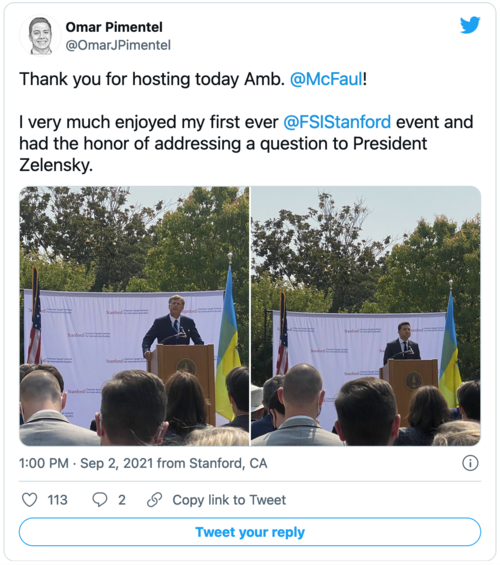
Tweet from Omar Pimentel

Following the formal remarks, President Zelenskyy and First Lady Zelenska had an opportunity to meet with Stanford President Marc Tessier-Lavigne in the Memorial Church Courtyard. Prior to leaving, the First Lady also sat down with leaders and students from Stanford's Office of Accessible Education (OAE), an area of interest she would like to support and better develop in Ukraine.

For FSI, the president’s visit was another affirmation of the special connection between Ukraine and the Stanford community. Since 2016, the Center on Democracy, Development and the Rule of Law has hosted the Ukrainian Emerging Leaders Program, which provides a 10-month academic training fellowship in support of mid-career practitioners working actively as policy-makers, legal professionals, entrepreneurs and leaders of civil society organizations in Ukraine.

Speaking to this shared history in his opening introductions, FSI Director Michael McFaul emphasized the crucial need for ongoing support and intellectual investment into Ukraine. “The fight for democracy and independence in Ukraine is one of the most important causes in the world today,” he affirmed. “Not just for Ukrainians, but for all who cherish the ideals of democracy, liberty and sovereignty.”

To President Zelenskyy, McFaul extended a future invitation: “You are always welcome back, either as president or in retirement as a professor.”

“With the classes you offer, I will think about it,” Zelenskyy replied with a smile.

Read More

Sviatlana Tsikhanouskaya discusses the future of democracy in Belarus with a roundtable of Stanford scholars.
News

Belarusian Leader Sviatlana Tsikhanouskaya Meets with Stanford Scholars for Roundtable on Democracy in Belarus

Democratic leader Sviatlana Tsikhanouskaya and her delegation joined an interdisciplinary panel of Stanford scholars and members of the Belarusian community to discuss the future of democracy in Belarus.
Belarusian Leader Sviatlana Tsikhanouskaya Meets with Stanford Scholars for Roundtable on Democracy in Belarus
Hero Image
President Volodymyr Zelenskyy of Ukraine speaks at the Freeman Spogli Institute for International Studies Rod Searcey
All News button
1
Subtitle

President Zelenskyy outlined the steps his administration is undertaking to bring increased digitization to Ukraine, curb corruption and create more equitable access to public services for more Ukrainians.

-

For fall quarter 2021, CISAC will be hosting hybrid events. Many events will offer limited-capacity in-person attendance for Stanford faculty, staff, fellows, visiting scholars, and students in accordance with Stanford’s health and safety guidelines, and be open to the public online via Zoom. All CISAC events are scheduled using the Pacific Time Zone. 

REGISTRATION


About the Event: Nuclear nonproliferation has been a pressing societal need since the development of nuclear weapons. Preventing the further spread of nuclear capabilities that could lead to a nuclear weapons program is a crucial mission that requires both technical and policy advances. Several international treaties have been put into place to curb the expansion of nuclear capabilities. Nevertheless, there are states that may be pursuing elements of an overt or covert nuclear weapons program. New science and technology developments are needed to verify the existing or proposed treaties in this area and to ensure that nuclear weapons are never used again.

In this presentation, I will discuss these challenges and some of the recent advances in science and technology that contribute to solving them. I will present our Consortium for Monitoring, Technology, and Verification (MTV), a consortium of 14 universities and 13 national laboratories working together on these issues. I will highlight research projects including our studies on the fundamental emissions from nuclear fission and the development of new detection systems for nuclear materials detection, localization, and characterization. These systems were shown to aid the International Atomic Energy Agency in its nuclear safeguards and verification activities that have direct relevance to nuclear security. I will also talk about our efforts in furthering diversity, equity, and inclusion, which are crucial for building teams that can successfully address these societal issues.


About the Speaker: Professor Sara Pozzi earned her M.S. and Ph.D. in nuclear engineering at the Polytechnic of Milan, Italy in 1997 and 2001, respectively. She is a Professor of Nuclear Engineering and Radiological Sciences and a Professor of Physics at the University of Michigan where she has graduated 25 Ph. D. students as advisor or co-advisor. Her research interests include the development of new methods for nuclear materials detection, identification, and characterization for nuclear nonproliferation, safeguards, and national security programs. She is the founding Director of the Consortium for Verification Technology (CVT) 2014-2019 and the Consortium for Monitoring, Technology, and Verification (MTV) 2019-2024, two large consortia of multiple universities and national laboratories working together to develop new technologies needed for nuclear treaty verification.

In 2018, Professor Pozzi was named the inaugural Director of Diversity, Equity, and Inclusion (DEI) for the UM College of Engineering. In this capacity, she heads the DEI implementation committee and works to ensure that the students, faculty, and staff are increasingly diverse, everyone is treated equally, and everyone is included.

She is the recipient of many awards, including the Institute of Nuclear Materials Management (INMM) Vince J DeVito Distinguished Service Award and the Department of Energy Outstanding Mentor Award, and is a Fellow of the American Nuclear Society, the INMM, and the IEEE.

Only those with an active Stanford ID with access to William J Perry Conference Room in Encina Hall may attend in person. This event will not be livestreamed.

Sara Pozzi Professor University of Michigan
Seminars
-

*For fall quarter 2021, CISAC will be hosting hybrid events. Many events will offer limited-capacity in-person attendance for Stanford faculty, staff, fellows, visiting scholars, and students in accordance with Stanford’s health and safety guidelines, and be open to the public online via Zoom. All CISAC events are scheduled using the Pacific Time Zone.


REGISTRATION


Seminar Recording

About the Event: According to the Theory of the Nuclear Revolution (TNR), nuclear weapons have stabilized relations between great powers, making deterrence easier than compellence. This view is currently under attack. Recent work has documented Washington’s competitive approach to arms control agreements and the fragility of the nuclear stalemate. However, these critiques have not explained how policymakers could hope to extract coercive benefits from nuclear weapons. This paper revisits this question using a game-theoretic model. It shows that if the compellent state is able to bolster the credibility of its threat through standard techniques, i.e. burning bridges, probabilistic threats, or the rationality of irrationality, then compellence may succeed. However, greater military capabilities bolster coercion by increasing the risk of disaster, with first-strike capabilities being especially destabilizing. TNR was correct to warn about the risks of nuclear competition.

View paper


About the Speaker: 

Alexandre Debs is Associate Professor of Political Science at Yale University. 

His research focuses on the causes of war, nuclear proliferation, and democratization, and it has appeared in top journals such as the American Political Science Review, the American Journal of Political Science, the Journal of PoliticsInternational Organization, and International Security. He wrote with Nuno Monteiro the book Nuclear Politics: The Strategic Causes of Proliferation (2017, Cambridge University Press).

Alexandre received a Ph.d. in Economics from M.I.T., an M.Phil. in Economic and Social History from the University of Oxford as a Rhodes scholar, and a B.Sc. in Economics and Mathematics from Universite de Montreal.

Virtual Only. This event will not be held in person.

​Alexandre Debs Associate Professor Yale University
Seminars
-

* Please note all CISAC events are scheduled using the Pacific Time Zone.

This event is hosted by the Hoover Institution and co-sponsored by CISAC.

Registration required to attend in person.

Event and Registration Link: https://www.hoover.org/events/spies-lies-and-algorithms

About the Event: Spying has never been more ubiquitous―or less understood. The world is drowning in spy movies, TV shows, and novels, but universities offer more courses on rock and roll than on the CIA and there are more congressional experts on powdered milk than espionage. This crisis in intelligence education is distorting public opinion, fueling conspiracy theories, and hurting intelligence policy. In Spies, Lies, and Algorithms, Amy Zegart separates fact from fiction as she offers an engaging and enlightening account of the past, present, and future of American espionage as it faces a revolution driven by digital technology.

Drawing on decades of research and hundreds of interviews with intelligence officials, Zegart provides a history of U.S. espionage, from George Washington’s Revolutionary War spies to today’s spy satellites; examines how fictional spies are influencing real officials; gives an overview of intelligence basics and life inside America’s intelligence agencies; explains the deadly cognitive biases that can mislead analysts; and explores the vexed issues of traitors, covert action, and congressional oversight. Most of all, Zegart describes how technology is empowering new enemies and opportunities, and creating powerful new players, such as private citizens who are successfully tracking nuclear threats using little more than Google Earth. And she shows why cyberspace is, in many ways, the ultimate cloak-and-dagger battleground, where nefarious actors employ deception, subterfuge, and advanced technology for theft, espionage, and information warfare.

Order Now


About the Speaker: 

Amy Zegart is the Morris Arnold and Nona Jean Cox Senior Fellow at the Hoover Institution and Professor of Political Science (by courtesy) at Stanford University. She is also a Senior Fellow at Stanford’s Freeman Spogli Institute for International Studies, Chair of Stanford’s Artificial Intelligence and International Security Steering Committee, and a contributing writer at The Atlantic. She specializes in U.S. intelligence, emerging technologies and national security, grand strategy, and global political risk management.

In person at Hauck Auditorium Hoover Institution and Livestreamed at https://www.hoover.org/events/spies-lies-and-algorithms

Seminars
-

SEMINAR RECORDING


All CISAC events are scheduled using the Pacific Time Zone. This event is part of the year-long initiative on “Ethics & Political Violence” jointly organized by the Center for International Security and Cooperation (CISAC) and The McCoy Family Center for Ethics in Society. This event is hosted by CISAC and is co-sponsored by Society for International Affairs at Stanford, McCoy Family Center for Ethics in Society, Center for South Asia.


About the Event: The dramatic scenes the world witnessed during the fall of Kabul in 2021 following the withdrawal of US and allied forces from Afghanistan nearly coincided with the twentieth anniversary of the 9/11 attacks by Al Qaeda and the subsequent US and allied invasion of Afghanistan. The United States committed trillions of dollars, dispatched soldiers, diplomats and spies across the globe, and made dramatic alterations to domestic and international law to combat terrorism. The material, humanitarian and normative consequences of two decades of war have been significant, both globally and in Afghanistan specifically. In this panel, Dr. Felter, Dr. Mir and Professor Zegart will assess U.S. responses during the global war on terror, identify unexpected outcomes and lessons learned, and ultimately weigh the costs and benefits of this two-decade struggle against terrorism.


About the Speakers: 

Joe Felter is a William J. Perry Fellow at the Center for International Security and Cooperation and research fellow at the Hoover Institution.  From 2017 to 2019, Felter served as US deputy assistant secretary of defense for South Asia, Southeast Asia, and Oceania. There he was the principal advisor for all policy matters pertaining to development and implementation of defense strategies and plans in the region and responsible for managing bilateral security relationships and guiding Department of Defense (DoD) engagement with multilateral institutions.  


Asfandyar Mir is a senior expert in the Asia Center at USIP. Previously, heheld various fellowships at the Center for International Security and Cooperation at Stanford University. His research interests include the international relations of South Asia, U.S. counterterrorism policy and political violence — with a regional focus on Afghanistan and Pakistan. Asfandyar Mir’s research has appeared in peer-reviewed journals, such as International Security, International Studies Quarterly and Security Studies. He received his doctorate in political science from the University of Chicago and a master’s and bachelor’s from Stanford University.


Amy Zegart is the Morris Arnold and Nona Jean Cox Senior Fellow at the Hoover Institution and Professor of Political Science (by courtesy) at Stanford University. She is also a Senior Fellow at Stanford’s Freeman Spogli Institute for International Studies, Chair of Stanford’s Artificial Intelligence and International Security Steering Committee, and a contributing writer at The Atlantic. She specializes in U.S. intelligence, emerging technologies and national security, grand strategy, and global political risk management.

Virtual to Public. Only those with an active Stanford ID with access to William J Perry Conference Room in Encina Hall may attend in person. 

0
rsd19_072_0386a.jpg

Asfandyar Mir is an affiliate with the Center for International Security and Cooperation, Stanford University. Previously he has held predoctoral and postdoctoral fellowships at the center. His research interests are in the international relations of South Asia, US counterterrorism policy, and political violence, with a regional focus on Afghanistan and Pakistan. His research has appeared in peer-reviewed journals of International Relations, such as International Security, International Studies Quarterly and Security Studies, and his commentary has appeared in Foreign Affairs, Foreign Policy, H-Diplo, Lawfare, Modern War Institute, Political Violence at a Glance, Politico, and the Washington Post.

Asfandyar received his PhD in political science from the University of Chicago and a masters and bachelors from Stanford University.

Affiliate

CISAC
Stanford University
Encina Hall, E216
Stanford, CA 94305-6165

(650) 725-9754 (650) 723-0089
0
Senior Fellow at the Freeman Spogli Institute for International Studies
Morris Arnold and Nona Jean Cox Senior Fellow at the Hoover Institution
Senior Fellow at the Stanford Institute for Human-Centered AI
Professor, by courtesy, of Political Science
amyzegart-9.jpg PhD

Dr. Amy Zegart is the Morris Arnold and Nona Jean Cox Senior Fellow at the Hoover Institution. The author of five books, she specializes in U.S. intelligence, emerging technologies, and national security. At Hoover, she leads the Technology Policy Accelerator and the Oster National Security Affairs Fellows Program. She also is an associate director and senior fellow at the Stanford Institute for Human-Centered AI; a senior fellow at the Freeman Spogli Institute; and professor of political science by courtesy, teaching 100 students each year about how emerging technologies are transforming espionage.

Her award-winning research includes the leading academic study of intelligence failures before 9/11: Spying Blind: The CIA, the FBI, and the Origins of 9/11 (Princeton, 2007) and the bestseller Spies, Lies, and Algorithms: The History and Future of American Intelligence (Princeton, 2022), which was nominated by Princeton University Press for the Pulitzer Prize. She also coauthored Political Risk: How Businesses and Organizations Can Anticipate Global Insecurity, with Condoleezza Rice (Twelve, 2018). Her op-eds and essays have appeared in Foreign Affairs, Politico, the New York Times, the Washington Post, and the Wall Street Journal.

Zegart has advised senior officials about intelligence and foreign policy for more than two decades. She served on the National Security Council staff and as a presidential campaign foreign policy advisor and has testified before numerous congressional committees. Before her academic career, she spent several years as a McKinsey & Company consultant.

Zegart received an AB in East Asian studies from Harvard and an MA and a PhD in political science from Stanford. She serves on the boards of the Council on Foreign Relations, Kratos Defense & Security Solutions, and the American Funds/Capital Group.

Date Label
Seminars
-

* Please note all CISAC events are scheduled using the Pacific Time Zone.


This event is co-sponsored by the Project on Russian Power and Purpose in the 21st Century and the Center for International Security and Cooperation.


Seminar Recording:  https://youtu.be/gDD68gqClt8


About the Event: Media and public discussions tend to understand Russian politics as a direct reflection of Vladimir Putin’s seeming omnipotence or Russia’s unique history and culture. Yet Russia is similar to other autocracies—and recognizing this illuminates the inherent limits to Putin’s power. Weak Strongman challenges the conventional wisdom about Putin’s Russia, highlighting the difficult trade-offs that confront the Kremlin on issues ranging from election fraud and repression to propaganda and foreign policy.

Drawing on three decades of his own on-the-ground experience and research as well as insights from a new generation of social scientists that have received little attention outside academia, Timothy Frye reveals how much we overlook about today’s Russia when we focus solely on Putin or Russian exceptionalism. Frye brings a new understanding to a host of crucial questions: How popular is Putin? Is Russian propaganda effective? Why are relations with the West so fraught? Can Russian cyber warriors really swing foreign elections? In answering these and other questions, Frye offers a highly accessible reassessment of Russian politics that highlights the challenges of governing Russia and the nature of modern autocracy.

Rich in personal anecdotes and cutting-edge social science, Weak Strongman offers the best evidence available about how Russia actually works.


Book Purchase: https://press.princeton.edu/books/hardcover/9780691212463/weak-strongman

Discount Code: FRYE 30%


About the Speaker: Timothy Frye is the Marshall D. Shulman Professor of Post-Soviet Foreign Policy at Columbia University and Co-Director of the International Center for the Study of Institutions and Development at the Higher School of Economics, Moscow. He is also the Editor of Post-Soviet Affairs.

Professor Frye received a B.A. in Russian language and literature from Middlebury College in 1986, an M.I.A. from Columbia's School of International and Public Affairs in 1992, and a Ph.D. from Columbia in 1997. He served as the Director of the Harriman Institute from 2009-2015 and as Chair of the Political Science Department from 2016-18.

Virtual Seminar

Timothy Frye Professor Columbia University
Seminars
Authors
Steven Pifer
News Type
Commentary
Date
Paragraphs

President Joe Biden is the first president since the Cold War to begin his term not seeking closer relations with Russia; there will be no “reset.” He has indicated instead that he will push back against Russian misbehavior while seeking to cooperate where doing so advances U.S. interests. In his first 100 days Mr. Biden has sought to distinguish his policy from that of Donald Trump, who seemed incapable of criticizing Vladimir Putin or Russian transgressions.

The first full day of his administration illustrated Mr. Biden’s approach. The White House said he would extend the New Strategic Arms Reduction Treaty (New START) for five years, essentially accepting an offer Mr. Putin had made more than a year earlier—but something that was very much in the interest of U.S. national security. White House officials also announced that Mr. Biden had asked for assessments of Russian actions such as interference in the 2020 presidential election and the Solar Winds cyber hack, promising that the administration would “hold Russia to account for its reckless and adversarial actions.”

Mr. Biden described his policy directly to Mr. Putin in a January 26 phone call. He discussed New START and strategic stability but also raised issues of concern, including Ukraine, election interference and Kremlin-opponent Alexey Navalny’s poisoning. The White House read-out of the call (there were several important Trump-Putin calls with no read-outs) noted that the president had also said that the United States would “act firmly in defense of its national interests in response to actions by Russia” that caused harm to America or its allies.

Anticipating relations with the Kremlin that will have major adversarial elements, the Biden administration has moved to shore up the trans-Atlantic relationship and repair the damage done during his predecessor’s four years. In a February 19 virtual appearance at the Munich Security Conference, the president reaffirmed the U.S. commitment to NATO and Article 5 (an attack against one shall be considered an attack against all), stressed the importance of collective efforts to meet the “threat from Russia,” and reached out to German Chancellor Angela Merkel, who often found herself the target of Mr. Trump’s ire. (The Biden administration also halted, and then reversed, Mr. Trump’s order to withdraw some 10,000 troops from Germany.)

As the intelligence community completed its assessment of election interference and other Russian actions, and with tensions rising due to the Russian military build-up around Ukraine, the Biden administration calibrated its response. It sanctioned a number of Russian entities and individuals on April 15. As a warning of what could come, the president issued an executive order authorizing sanctions for a broad range of potential Russian misdeeds, and the Treasury Department placed limits on purchasing Russian sovereign debt, though in a restrained manner that could later be ratcheted up and made considerably more painful.

The president foreshadowed the coming sanctions to Mr. Putin in an April 13 call in which he also reiterated the U.S. commitment to support Ukraine, a commitment that the administration has stressed publicly (if Mr. Putin was bothered by Mr. Biden’s “killer” comment in a mid-March press interview, he apparently said nothing during the call). In remarks to the press two days later, Mr. Biden noted that Washington could have imposed harsher penalties, but he had chosen proportionate measures. He added that he did not want an escalatory cycle with Moscow but sought “a stable, predictable relationship.”

Stable and predictable may be as good as it can get in the near term. In both of his calls with his Russian counterpart, Mr. Biden has raised areas—such as arms control and strategic stability—where U.S. and Russian interests should coincide. Secretary of State Tony Blinken and National Security Advisor Jake Sullivan have echoed these points. While virtually all Trump political appointees were let go when Mr. Biden took office, one notable exception was John Sullivan, the ambassador in Moscow. And the president proposed that he and Putin meet this summer.

The Biden administration believes that, even with U.S.-Russian relations at a post-Cold War nadir, the two countries can do business on certain questions where they have mutual interests. In addition to using arms control to manage their nuclear competition, the sides presumably share an interest in blunting the nuclear ambitions of Iran and North Korea. As U.S. and NATO military forces prepare to leave Afghanistan, neither Washington nor Moscow has anything to gain from chaos or a return of the Taliban to power.

The president thus has correctly laid out the possibility of some positive engagement along with measures holding Russia to account for misbehavior. His ability to pursue both of those tracks, however, will depend in part on Kremlin actions.

Arrested immediately on his return to Moscow in January, Mr. Navalny now is in dire health in a Russian prison. His death would spark an uproar in the West. More critically, while the menacing Russian military movements around Ukraine likely aim just to unnerve Kyiv and, at the same time, test Mr. Biden’s reaction (as well as that of the West more broadly), a Russian military incursion remains a distinct possibility.

Such an attack would provoke a deep crisis in relations between the West and Russia. Washington and its European partners almost certainly would respond with new and more punishing sanctions. And should that happen, a summer summit, as well as real effort to work together on selected issues where the countries’ interests converge, could get booted a long way down the road.

Originally for Brookings

Hero Image
President Biden walking Getty Images
All News button
1
Subtitle

President Joe Biden is the first president since the Cold War to begin his term not seeking closer relations with Russia; there will be no “reset.”

-

* Please note all CISAC events are scheduled using the Pacific Time Zone.


This event is co-sponsored by the Freeman Spogli Institute for International Studies and the Center for International Security and Cooperation.


Seminar Recording: https://youtu.be/s3MMxYH6bfU


About the Event: Rose Gottemoeller served as the US chief negotiator of the New START treaty. The first woman to lead a major nuclear arms negotiation, she played a critical role in creating US policy on arms control and ensuring that a deeply divided Congress came together to ratify the treaty to safeguard the future of all Americans.  

In her new book, Negotiating the New START Treaty, Gottemoeller gives an insider’s account of the negotiations between the US and Russian delegations in Geneva in 2009 and 2010.  

On May 21, at 1p Pacific, Gottemoeller will discuss her book, her years of high-level experience and her analysis of the complicated relationship between the US and Russia with Michael McFaul, director of the Freeman Spogli Institute for International Studies and the former US Ambassador to Russia.  

Gottemoeller and McFaul were in the trenches together during the negotiations--he in the White House, she in Geneva. In this online event, they will discuss the New START treaty and the key role it played in President Obama's nuclear policies. 

McFaul will interview Gottemoeller and moderate a Q&A with the audience. This event is co-sponsored by the Freeman Spogli Institute for International Studies and the Center for International Security and Cooperation. 


About the Speaker: Rose Gottemoeller is the Frank E. and Arthur W. Payne Distinguished Lecturer at Stanford University's Freeman Spogli Institute for International Studies and its Center for International Security and Cooperation.

Before joining Stanford Gottemoeller was the Deputy Secretary General of NATO from 2016 to 2019, where she helped to drive forward NATO’s adaptation to new security challenges in Europe and in the fight against terrorism.  Prior to NATO, she served for nearly five years as the Under Secretary for Arms Control and International Security at the U.S. Department of State, advising the Secretary of State on arms control, nonproliferation and political-military affairs. While Assistant Secretary of State for Arms Control, Verification and Compliance in 2009 and 2010, she was the chief U.S. negotiator of the New Strategic Arms Reduction Treaty (New START) with the Russian Federation.

Prior to her government service, she was a senior associate with the Carnegie Endowment for International Peace, with joint appointments to the Nonproliferation and Russia programs. She served as the Director of the Carnegie Moscow Center from 2006 to 2008, and is currently a nonresident fellow in Carnegie's Nuclear Policy Program. She is also a research fellow at the Hoover Institution. 

At Stanford, Gottemoeller teaches and mentors students in the Ford Dorsey Master’s in International Policy program and the CISAC Honors program; contribute to policy research and outreach activities; and convene workshops, seminars and other events relating to her areas of expertise, including nuclear security, Russian relations, the NATO alliance, EU cooperation and non-proliferation.

Virtual Seminar

Center for International Security and Cooperation
Encina Hall
616 Jane Stanford Way
Stanford University
Stanford, CA 94305-6165

0
William J. Perry Lecturer, Freeman Spogli Institute
Research Fellow at the Hoover Institution
dsg_gottemoeller.jpg

Rose Gottemoeller is the William J. Perry Lecturer at Stanford University's Freeman Spogli Institute for International Studies and Research Fellow at the Hoover Institute.

Before joining Stanford Gottemoeller was the Deputy Secretary General of NATO from 2016 to 2019, where she helped to drive forward NATO’s adaptation to new security challenges in Europe and in the fight against terrorism.  Prior to NATO, she served for nearly five years as the Under Secretary for Arms Control and International Security at the U.S. Department of State, advising the Secretary of State on arms control, nonproliferation and political-military affairs. While Assistant Secretary of State for Arms Control, Verification and Compliance in 2009 and 2010, she was the chief U.S. negotiator of the New Strategic Arms Reduction Treaty (New START) with the Russian Federation.

Prior to her government service, she was a senior associate with the Carnegie Endowment for International Peace, with joint appointments to the Nonproliferation and Russia programs. She served as the Director of the Carnegie Moscow Center from 2006 to 2008, and is currently a nonresident fellow in Carnegie's Nuclear Policy Program.  

At Stanford, Gottemoeller teaches and mentors students in the Ford Dorsey Master’s in International Policy program and the CISAC Honors program; contributes to policy research and outreach activities; and convenes workshops, seminars and other events relating to her areas of expertise, including nuclear security, Russian relations, the NATO alliance, EU cooperation and non-proliferation. 

Date Label
Seminars
-

* Please note all CISAC events are scheduled using the Pacific Time Zone.


Seminar Recording: https://youtu.be/zXMKvurtEw0


About the Event: Dan Baer, Senior Fellow at the Carnegie Endowment for International Peace, will join Rose Gottemoeller in a fireside chat to speak about the OSCE’s important role as an inclusive platform for security dialogue between the West and Russia and as a valuable instrument for practical cooperation on the ground to address common security challenges on the basis of shared commitments. The OSCE seeks to promote security in the larger context of relations among the states of North America, Europe and Eurasia, including Russia and all the states of the former Soviet Union and those European states that are not members of NATO or the EU.In an era of increasing challenges to multilateralism, this unique element of the Euroatlantic/Eurasian security architecture should be better recognized and utilized. While the OSCE emerged from the Cold War, today's challenges invite a reinvigoration its role as a diplomatic and operational platform. The US has long seen the OSCE as an important vehicle within the European security scene, and with the new administration’s commitment to multilateralism, it will be interesting to observe what role the US will take within the Organization on topics ranging from conventional arms control and confidence- and security-building measures to the security challenges of climate change and human rights. At the same time, while what were once Russian hopes that the OSCE would become a kind of alternative to NATO have dissipated, it is an open question whether Russia will choose to leverage the OSCE as one of the few remaining forums where Russia's engagement and cooperation with European and North American partners can deliver positive impacts on shared challenges.


About the Speaker: Dan Baer is a Senior Fellow at the Carnegie Endowment for International Peace. He served in Governor John Hickenlooper’s cabinet as executive director of the Colorado Department of Higher Education from 2018-2019. He was U.S. ambassador to the Organization for Security and Cooperation in Europe (OSCE) from 2013 to 2017.  Previously, he was a Deputy Assistant Secretary of State for Democracy, Human Rights, and Labor from 2009-2013.

Before his government service, Baer was an assistant professor at Georgetown’s McDonough School of Business, a Faculty Fellow at Harvard’s Safra Center for Ethics, and a project leader at The Boston Consulting Group. He has appeared on CNN, Fox, MSNBC, BBC, PBS Frontline, Al Jazeera, Sky, and The Colbert Report and his writing has appeared in The Washington Post, The Wall Street Journal, USA Today, Foreign Affairs, Politico, The Christian Science Monitor, Foreign Policy, The Chronicle of Higher Education, Westword, The Denver Post, and other publications. He holds a doctorate in International Relations from Oxford and a degree in Social Studies and African American Studies from Harvard. He lives in Denver and is married to Brian Walsh, an economist at The World Bank.

Virtual Seminar

Dan Baer Senior Fellow Carnegie Endowment for International Peace
Seminars
Subscribe to Russia and Eurasia