Authors
News Type
Q&As
Date
Paragraphs

This piece originally appeared at Safecast.
Image
csmp 01 2

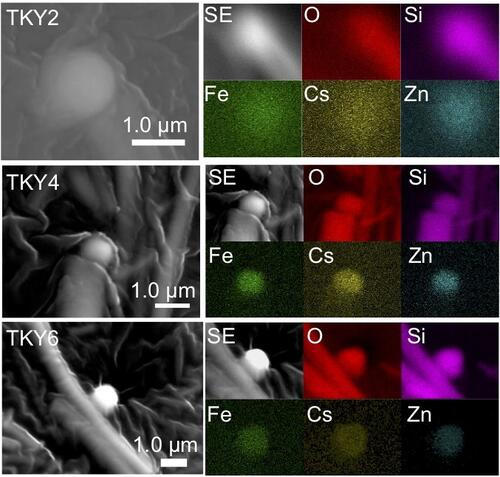
Image above: Secondary electron images from Utsunomiya et al. 2019, of CsMPs discovered in atmospheric particles trapped on a Tokyo air filter from March 15, 2011, with major constituent elements displayed. Via Safecast


An interesting paper  was recently published by a team headed by Dr. Satoshi Utsunomiya of Kyushu University on the subject of Fukushima-derived cesium-enriched microparticles (CsMPs). As many readers will know, several researchers have located and analyzed these microparticles, in which the cesium is often bonded within glass-like silicates and therefore generally significantly less soluble than other Cs chemical species in water, though technically not actually “insoluble.” After an accident like Fukushima, it is much more common to find cesium in water-soluble compounds like cesium hydroxide (CsOH), and predictions about how quickly the cesium will be dispersed through the environment, in soil, in watersheds, taken up by plants and animals, etc, are based primarily on this assumption. The discovery of sparingly-soluble Fukushima-derived cesium microparticles, first documented by Adachi et al in 2013, and since then confirmed by many others, has raised a number of questions. How abundant are they? Does their presence increase health risk to humans? How much do they reveal about the process of the accident itself? From the standpoint of researchers the microparticles are very intriguing.

Utsunomiya et al.’s paper is titled “Caesium fallout in Tokyo on 15th March, 2011 is dominated by highly radioactive, caesium-rich microparticles,” and as noted in a recent Scientific American article, it was originally accepted for publication in 2017 by Scientific Reports journal. Weeks before publication, however, Tokyo Metropolitan Industrial Technology Research Institute (TIRI), operated by the Tokyo Metropolitan Government, raised objections with Scientific Reports. However no questions about the quality of the science or the validity of the paper’s findings appear to have been brought forward. This in itself was highly irregular. Two years elapsed without resolution, and in March of this year Scientific Reports took the highly unusual step of withdrawing its offer to publish the paper, despite the lack of confirmed evidence that would warrant it. Utsunomiya and several co-authors decided that the best course of action was to place the study in the public domain by publishing it via arXiv, a highly respected pre-print website. The paper is now open and free to download

This study makes a valuable contribution to the body of scientific literature regarding the consequences of the Fukushima disaster in general and CsMPs in particular. I think it was a mistake for Scientific Reports not to publish it two years ago, especially considering the rapid pace of research into these particles and the tremendous interest in them. To summarize the findings briefly, the researchers analyzed air filter samples from March 15, 2011, in Setagaya, Tokyo, when the radioactive plume from Fukushima caused a noticeable peak in airborne radioactivity in the city. The researchers used radiographic imaging (placing the filters on a photographic plate) to identify any highly radioactive spots. Using these images as a guide they were able to isolate seven CsMPs, which they subjected to atomic-scale analysis using high-resolution electron microscopy (HRTEM) to identify their nano-scale structure and chemical composition. Based on these detailed measurements and quantitative analysis, the researchers concluded that 80-89% of the total cesium fallout in Tokyo that day was in the form of highly radioactive microparticles. The second half of the paper is devoted to estimates of how long such particles might be retained in the human lungs if inhaled, based on previous studies that reported the effects of inhalation of non-radioactive atmospheric particles, and some possible physical consequences. The paper is valuable for the quantitative analysis of the Tokyo particles alone, since it is one of few studies that deal with the issue for Tokyo specifically. Research into possible health consequences of the particles, meanwhile, has gained momentum while the paper remained unpublished, using approaches such as stochastic biokinetics, and DNA damage studies.  In a recent paper, Utsunomiya and colleagues produced estimates of the rate of dissolution of the particles inside the human lung, in pure water, and in seawater. A working group at the Japan Health Physics Society has also devoted attention to the issue, noting the need for further study of the risk from intake of these particles, particularly to the lung.  Likewise, others have been studying the particles to learn about the accident progression and possible consequences for decommissioning.

Why did Tokyo Metropolitan Industrial Technology Research Institute object to the paper’s publication? When we first heard that publication of the paper was being held up by Tokyo Metropolitan Government, we thought politically-motivated suppression was a likely explanation. Since then the public has learned that the actual complaint given to Scientific Reports stems from a chain of custody issue of the original air filter samples. We don’t want to speculate further about Tokyo’s motivation, because we have seen no direct evidence yet of political suppression in this case. But based on past occurrences with other government institutions, we would find it plausible. We will let readers know if TIRI responds to our inquiries.

We spoke with Dr. Utsunomiya and co-author Dr. Rodney Ewing recently. I was aware of their co-authorship of several strong papers on CsMPs, including Utsunomiya’s plenary talk at the Goldschmidt Conference in Yokohama in 2016, which I attended. I asked how this new arXiv paper fits in with their other papers, and where they think this research is heading next:


Satoshi Utsunomiya:

Thank you for asking. The Tokyo paper was actually our first paper regarding CsMPs. As I mentioned, the paper was accepted two years ago. There were no previous papers of ours on CsMPs that time. Currently we are working on several topics on CsMPs. I cannot reveal the content yet, as we are thinking about a press release for the next paper. But I think it is important to continue this kind of research, providing some insights for decommissioning at Fukushima Daiichi Nuclear Power Plant.

Azby Brown:

I didn’t realize that this was your first paper on the subject.  How does it relate to the one presented at the Goldschmidt Conference in Yokohama in 2016? “Cesium-Rich Micro-Particles Unveil the Explosive Events in the Fukushima Daiichi Nuclear Power Plant.” Didn’t that paper receive a prize?

SU:

My talk at Goldschmidt briefly covered the story described in the two papers that were accepted for publication at the same time. One was published in Scientific Reports. The other one was not published. There was no prize. It was a plenary talk.

AB:

I see. I recall that it received a lot of attention. Now it makes more sense to me.

Can you tell me a little bit about the specific characteristics and focus of your research, and how it differs from papers like Adachi 2013Abe 2014, etc? Generally speaking, that is. I’d like to help people understand the different aspects of the field.

SU:

Adachi reported the discovery of CsMPs. Abe demonstrated X-ray absorption analysis on the CsMPs. We focused on the nanotexture inside CsMPs. We are particularly interested in the detailed evidence remaining within the microparticle, which can provide useful information on the development of the chemical reactions during the meltdowns, because it is still difficult to directly analyze the materials inside the reactors. We, for the first time, succeeded in performing isotopic analysis on individual CsMPs. More specifically, the occurrence of uranium can directly tell the story of how the fuel melted. Our research has two directions: one is to understand the environmental impact of CsMPs, and the other is to provide useful information on the debris properties to help decommissioning at FDNPP. We are also interested in the implications for health.

AB:

Can you tell me a little bit about your working relationship? Satoshi went to the US to work in your lab, right Rod? When was that, and what were you working on?

Rod Ewing:

Satoshi and I have known each other since 2000, when he joined my research group as a post-doctoral fellow at the University of Michigan. He was a member of the research group until 2007. We collaborated on a wide range of topics that had to do with radioactive materials, such as the transport of plutonium at the Mayak site in Russia to the identification of uranium phases within C60 cages, so called buckyballs, that were formed and released from coal power plants. Once Satoshi returned to Japan to take his position at Kyushu University, we continued to collaborate, particularly on topics related to Fukushima Daiichi.

AB:

How did you both get interested in CsMPs?

RE:

Once discovered, CsMPs were clearly of high interest. They had not been noted in earlier reactor accidents. Satoshi is a master with the transmission electron microscope – exactly the tool/technique needed to study these particles.

AB:

For people who aren’t familiar with what’s involved in a research experiment like yours, can you describe the overall process? What were the technical challenges?

RE:

I would just emphasize that it is very difficult to find and characterize these particles. Considering the full literature and efforts by others as well as our team – the results are impressive. It is rare to have both the TEM characterization and the isotopic data.

SU:

As Rod mentioned, it is difficult to obtain both TEM and isotopic data from a few micron-sized spots. The isolation of CsMPs from soils is a time consuming process. But to date, many scientists have found and isolated CsMPs. The important thing is what information we can obtain from the analysis of CsMPs. We have been taking various approaches to elucidate the properties, environmental impact, and the role in releasing fissile actinides to the environment.    


As described above, many papers examining various aspects of Fukushima-derived cesium microparticles have been published since they were first identified in 2013. Even so, important aspects remain only partially documented and understood to date. Below is a partial list of relevant publications.

Papers mentioned in this article:

Caesium fallout in Tokyo on 15th March, 2011 is dominated by highly radioactive, caesium-rich microparticles

Utsunomiya, et al., 2019

https://arxiv.org/abs/1906.00212

—————————————————————-

Emission of spherical cesium-bearing particles from an early stage of the Fukushima nuclear accident

Adachi et al., 2013

http://www.nature.com/articles/srep02554

—————————————————————-

Detection of Uranium and Chemical State Analysis of Individual Radioactive Microparticles Emitted from the Fukushima Nuclear Accident Using Multiple Synchrotron Radiation X-ray Analyses

Abe et al., 2014

http://pubs.acs.org/doi/abs/10.1021/ac501998d

—————————————————————-

Dissolution of radioactive, cesium-rich microparticles released from the Fukushima Daiichi Nuclear Power Plant in simulated lung fluid, pure-water, and seawater

Suetake et al., 2019

https://doi.org/10.1016/j.chemosphere.2019.05.248

—————————————————————-

Development of a stochastic biokinetic method and its application to internal dose estimation for insoluble cesium-bearing particles

Manabe & Matsumoto, 2019

https://doi.org/10.1080/00223131.2018.1523756

—————————————————————-

DNA damage induction during localized chronic exposure to an insoluble radioactive microparticle

Matsuya et al., 2019

https://doi.org/10.1038/s41598-019-46874-6

—————————————————————-

Provenance of uranium particulate contained within Fukushima Daiichi Nuclear Power Plant Unit 1 ejecta material

Martin et al., 2019

https://www.nature.com/articles/s41467-019-10937-z

—————————————————————-

Internal doses from radionuclides and their health effects following the Fukushima accident

Ishikawa et al., 2018

https://iopscience.iop.org/article/10.1088/1361-6498/aadb4c


Related papers (by year of publication):

Characteristics Of Spherical Cs-Bearing Particles Collected During The Early Stage Of FDNPP Accident

Igarashi et al., 2014

http://www-pub.iaea.org/iaeameetings/cn224p/Session3/Igarashi.pdf

—————————————————————-

Radioactive Cs in the severely contaminated soils near the Fukushima Daiichi nuclear power plant

Kaneko et al., 2015

https://www.frontiersin.org/articles/10.3389/fenrg.2015.00037

—————————————————————-

First successful isolation of radioactive particles from soil near the Fukushima Daiichi Nuclear Power Plant

Satou et al., 2016

http://www.sciencedirect.com/science/article/pii/S2213305416300340

—————————————————————-

Internal structure of cesium-bearing radioactive microparticles released from Fukushima nuclear power plant

Yamaguchi et al., 2016

http://www.nature.com/articles/srep20548

—————————————————————-

Three-Year Retention Of Radioactive Caesium In The Body Of Tepco Workers Involved In The Fukushima Daiichi Nuclear Power Station Accident

Nakano et al., 2016

http://rpd.oxfordjournals.org/content/early/2016/03/14/rpd.ncw036

—————————————————————-

Monte Carlo Evaluation of Internal Dose and Distribution Imaging Due to Insoluble Radioactive Cs-Bearing Particles of Water Deposited Inside Lungs via Pulmonary Inhalation Using PHITS Code Combined with Voxel Phantom Data

Sakama, M. et al., 2016

https://link.springer.com/chapter/10.1007/978-4-431-55848-4_19

—————————————————————-

Radioactively-hot particles detected in dusts and soils from Northern Japan by combination of gamma spectrometry, autoradiography, and SEM/EDS analysis and implications in radiation risk assessment

Kaltofen & Gundersen, 2017

https://www.sciencedirect.com/science/article/pii/S0048969717317953?via%3Dihub

—————————————————————-

Caesium-rich micro-particles: A window into the meltdown events at the Fukushima Daiichi Nuclear Power Plant

Furuki et al., 2017

https://www.nature.com/articles/srep42731

—————————————————————-

Isotopic signature and nano-texture of cesium-rich micro-particles: Release of uranium and fission products from the Fukushima Daiichi Nuclear Power Plant

Imoto et al., 2017

https://www.nature.com/articles/s41598-017-05910-z

—————————————————————-

Uranium dioxides and debris fragments released to the environment with cesium-rich microparticles from the Fukushima Daiichi Nuclear Power Plant

Ochiai et al., 2018

https://pubs.acs.org/doi/abs/10.1021/acs.est.7b06309

—————————————————————-

Novel method of quantifying radioactive cesium-rich microparticles (CsMPs) in the environment from the Fukushima Daiichi nuclear power plant

Ikehara et al., 2018

https://pubs.acs.org/doi/full/10.1021/acs.est.7b06693

—————————————————————-

Formation of radioactive cesium microparticles originating from the Fukushima Daiichi Nuclear Power Plant accident: characteristics and perspectives

Ohnuki, Satou, and Utsunomiya, 2019

https://www.tandfonline.com/doi/abs/10.1080/00223131.2019.1595767


Hero Image
csmp 01 2
All News button
1
Paragraphs

Click here to view article


Abstract: To understand the chemical durability of highly radioactive cesium-rich microparticles (CsMPs) released from the Fukushima Daiichi Nuclear Power Plant in March 2011, we have, for the first time, performed systematic dissolution experiments with CsMPs isolated from Fukushima soils (one sample with 108 Bq and one sample with 57.8 Bq of 137Cs) using three types of solutions: simulated lung fluid, ultrapure water, and artificial sea water, at 25 and 37 °C for 1–63 days. The 137Cs was released rapidly within three days and then steady-state dissolution was achieved for each solution type. The steady-state 137Cs release rate at 25 °C was determined to be 4.7 × 103, 1.3 × 103, and 1. 3 × 103 Bq·m−2 s−1 for simulated lung fluid, ultrapure water, and artificial sea water, respectively. This indicates that the simulated lung fluid promotes the dissolution of CsMPs. The dissolution of CsMPs is similar to that of Si-based glass and is affected by the surface moisture conditions. In addition, the Cs release from the CsMPs is constrained by the rate-limiting dissolution of silicate matrix. Based on our results, CsMPs with ∼2 Bq, which can be potentially inhaled and deposited in the alveolar region, are completely dissolved after >35 years. Further, CsMPs could remain in the environment for several decades; as such, CsMPs are important factors contributing to the long-term impacts of radioactive Cs in the environment.

All Publications button
1
Publication Type
Journal Articles
Publication Date
Journal Publisher
Elsevier
Authors
Rodney C. Ewing
-

Abstract: My research investigates the formal institutionalization of inter-governmental cooperation among the three major Northeast Asian powers – China, Japan, and the Republic of Korea—in the face of a continued North Korean threat. How much of a shadow, if any, has North Korea’s nuclear weapons cast over the development of multilateralism in the region? Since 1999, the Northeast Asian region has seen intensifying institutionalization of cooperation among its major powers. In a region where the realist logic of state-centric nationalism, sovereignty, and balance of power still prevails, this new development of trilateral cooperation among the former and potential adversaries deserves serious scholarly investigation. What started as economic and functional cooperation, trilateral cooperation has since been substantially expanded to include political and security agendas at the highest level of government. What explains the emergence and endurance of trilateral cooperation and to what extent has containing the North Korean nuclear crisis shaped its institutional trajectory and outcomes? By examining the evolution of trilateral cooperation, I address some critical gaps in our understanding of formal institution building and the economic-security nexus in one of the most dynamic regions in the world.


Speaker's Biography: Yeajin Yoon is a 2018-2019 MacArthur Nuclear Security Pre-doctoral Fellow at CISAC and a doctoral candidate in the Blavatnik School of Government at the University of Oxford. Her dissertation examines the evolution of trilateral cooperation among the most militarily and economically dominant states in Northeast Asia, namely, China, Japan and the Republic of Korea, and considers when and how their relations become implicated in the North Korean nuclear crisis.


Prior to entering academia, Yeajin travelled extensively across Asia and worked with national governments, international organisations, and NGOs in the region. She led the development of the inaugural issue of the 'Oxford Government Review’ and helped facilitate a Track II dialogue on wartime history issues in Asia at Stanford University. Previously, she worked as a founding member of the Trilateral Cooperation Secretariat, the official intergovernmental organisation for China, Japan, and the Republic of Korea and managed a development fund focused on the ASEAN region at the Korean Foreign Ministry.


Yeajin received a Bachelor of Arts in Political Science with Honors from Stanford University and a Master of Public Policy degree from Oxford University.

Yeajin Yoon MacArthur Nuclear Security Pre-doctoral Fellow CISAC, Stanford University
Seminars
Paragraphs

Uneasy Partnerships presents the analysis and insights of practitioners and scholars who have shaped and examined China's interactions with key Northeast Asian partners. Using the same empirical approach employed in the companion volume, The New Great Game (Stanford University Press, 2016), this new text analyzes the perceptions, priorities, and policies of China and its partners to explain why dyadic relationships evolved as they have during China's "rise."

Synthesizing insights from an array of research, Uneasy Partnerships traces how the relationships that formed between China and its partner states—Japan, the Koreas, and Russia—resulted from the interplay of competing and compatible objectives, as well as from the influence of third-country ties. These findings are used to identify patterns and trends and to develop a framework that can be used to illuminate and explain Beijing's engagement with the rest of the world.

This book is part of the Studies of the Walter H. Shorenstein Asia-Pacific Research Center series at Stanford University Press.

All Publications button
1
Publication Type
Books
Publication Date
Journal Publisher
Stanford University Press
Authors
Thomas Fingar
-

Abstract: Throughout the Cold War, Japanese leaders and policymakers have generally been careful to reflect the public’s firm opposition to anti-nuclear sentiment. However, the turn of the 21st century has witnessed a remarkable shift in the political debate, with élites alluding to a nuclear option for Japan. This sudden proliferation of nuclear statements among Japanese élites in 2002 has been directly linked by Japan watchers to the breakout of the second North Korean nuclear crisis and the rapid buildup of China’s military capabilities. Is the Japanese perception of this double military threat in Northeast Asia really the main factor that triggered this shift in the nuclear debate? This paper argues that Japanese élites’ behavior rather indicates that the new threats in the regional strategic context is merely used as a pretext to solve a more deep-rooted and long-standing anxiety that stems from Japan’s own unsuccessful quest for a less reactive, and more proactive post-Cold War identity. 

About the speaker: Sayuri Romei is a Nuclear Security Predoctoral Fellow at CISAC for 2016-2017 and a doctoral candidate in international relations at Roma Tre University in Rome, Italy. Her dissertation focuses on the evolution of Japanese élites’ nuclear mentality in the postwar era, looking at its ambivalent nuclear history and exploring how the country’s nuclear latency was seen by the United States throughout the Cold War. She holds a BA in English Language and Literature from the University of Sorbonne Nouvelle Paris III, a BA in international relations from the University of Roma La Sapienza, and an MA in international relations from Roma Tre University. Her fellowship at CISAC is sponsored by the MacArthur Foundation.

Encina Hall, 2nd floor

Nuclear Security Predoctoral Fellow CISAC
Seminars
Authors
News Type
Commentary
Date
Paragraphs

If provoked, many Americans might well back nuclear attacks on foes like Iran and al Qaeda, according to new collaborative research from CISAC senior fellow Scott Sagan and Dartmouth professor Benjamin Valentino.

You can read more about their latest public opinion polling data, and its implications for the debate surrounding President Obama's upcoming visit to Hiroshima, in a column they co-authored for the Wall Street Journal.


Hero Image
Candles and paper lanterns float on the Motoyasu River in front of the Atomic Bomb Dome at the Peace Memorial Park, in memory of the victims of the bomb on the 62nd anniversary of the Hiroshima bomb, on August 6, 2007 in Hiroshima. Japan.
Junko Kimura / Getty Images
All News button
1
Paragraphs

This book—the culmination of a truly collaborative international and highly interdisciplinary effort—brings together Japanese and American political scientists, nuclear engineers, historians, and physicists to examine the Fukushima accident from a new and broad perspective.
  
It explains the complex interactions between nuclear safety risks (the causes and consequences of accidents) and nuclear security risks (the causes and consequences of sabotage or terrorist attacks), exposing the possible vulnerabilities all countries may have if they fail to learn from this accident.
  
The book further analyzes the lessons of Fukushima in comparative perspective, focusing on the politics of safety and emergency preparedness. It first compares the different policies and procedures adopted by various nuclear facilities in Japan and then discusses the lessons learned—and not learned—after major nuclear accidents and incidents in other countries in the past. The book's editors conclude that learning lessons across nations has proven to be very difficult, and they propose new policies to improve global learning after nuclear accidents or attacks.

Contributors to this volume include Nobumasa Akiyama, Edward D. BlandfordToshihiro Higuchi, Trevor Incerti (formerly a researcher at the Walter H. Shorenstein Asia-Pacific Research Center at Stanford University), Kenji E. KushidaPhillip Y. LipscyMichael May, Kaoru Naito (former President of the Nuclear Material Control Center), Scott D. SaganKazuto Suzuki, and Gregory D. Wyss, Distinguished Member of Technical Staff in the Security Systems Analysis Department at Sandia National Laboratories, Albuquerque, NM.

All Publications button
1
Publication Type
Books
Publication Date
Authors
Scott D. Sagan
News Type
News
Date
Paragraphs

It has been five years since the emergency sirens sounded at Japan's Fukushima Daiichi power plant following the massive 2011 earthquake and subsequent devastating tsunami. The partial meltdown of three reactors caused approximately 170,000 refugees to be displaced from their homes, and radiation releases and public outcry forced the Japanese government to temporarily shut down all of their nuclear power plants. The events at Fukushima Daiichi sent waves not only through Japan but also throughout the international nuclear industry. Rodney Ewing, Frank Stanton professor of nuclear security at Stanford's Center for International Security and Cooperation, outlines three key lessons to be taken from the tragedy at Fukushima.

Lesson One: Avoid characterizing the Fukushima tragedy as an 'accident'

One of the biggest lessons to be learned from Fukushima Daiichi revolves around the language used to describe nuclear disasters. In the media and in scientific papers, the event was frequently described as an accident, but this does not properly capture the cause of the event, which was a failure of the safety analysis.

As an example, Ewing points specifically to the domino chain of events that led to the partial meltdown at reactors 1 and 3. Following the powerful magnitude 9.0 earthquake, the power plant automatically shut down its reactors, as designed. Emergency generators immediately started in order to maintain circulation of coolant over the nuclear fuel, a critical process to avoid heating and eventual meltdown. But the tsunami that followed flooded the diesel engines that were supplying power, and so cooling could no longer be maintained.

"The Japanese people and government were certainly well acquainted with the possibility of tsunamis," said Ewing, the Frank Stanton Professor in Nuclear Security and senior fellow at the Center for International Security and Cooperation in the Freeman Spogli Institute. "Communities had alert systems. But somehow, this risk didn't manifest itself in the preparation and protection of the backup power for the Fukushima reactors. The backup power systems, the diesel generators for reactors 1 through 5, were low along the coast where they were flooded and failed. They could have been located farther back and higher, like they were at reactor 6. These were clearly failures in design, not an accident.

"This is why when I refer to the tragedy at Fukushima, it was not an accident," said Ewing, who is also a professor of geological sciences in Stanford's School of Earth, Energy & Environmental Sciences. "When some speak of such an event as an 'act of God,' this has the effect of avoiding the responsibility for the failed safety analysis. We need to use language that doesn't seek to place blame, but does establish cause and responsibility."

Lesson Two: Rethink the meaning of 'risk'

Shortly following the disaster at Fukushima, Tokyo Electric Power Company (TEPCO) received heavy criticism for its lack of planning and response. For Ewing, this criticism speaks to a larger issue: "We need to rethink what we mean by 'risk' when we perform risk assessments. Risk is more than the loss of life and property."

Reassessing risk also begins with changing our language, Ewing said. When we say a risk like an earthquake or tsunami is rare or unexpected, even when the geological record shows it has happened and will happen again, it greatly lessens the urgency with which we ought to act and prepare.

"It can be that the risk analysis works against safety, in the sense that if the risk analysis tells us that something's safe, then you don't take the necessary precautions," he said. "The Titanic had too few lifeboats because it was said to be 'unsinkable.' Fukushima is similar in that the assumption that the reactors were 'safe' during an earthquake led to the failure to consider the impact of a tsunami."

When evaluating risk, Ewing recommends that we carefully consider the way in which we frame the question of risk. For example, a typical risk assessment usually only considers the fate of a single reactor at a specific location. But perhaps that question should be asked in a different way. "You could ask, 'What if I have a string of reactors along the eastern coast of Japan? What is the risk of a tsunami hitting one of those reactors over their lifetime, say, 100 years?'" he said. "In this case, the probability of a reactor experiencing a tsunami is increased, particularly if one considers the geologic record for evidence of tsunamis."

Ewing acknowledges that incorporating geological hazards into a standard risk assessment has proved to be difficult because of the long recurrence intervals of damaging events. But ongoing research at Stanford Earth continues to analyze the seismic and tsunami risks around Japan and over the entire world. Professor Paul Segall and graduate student Andreas Mavrommatis analyze dense GPS networks and small repeating earthquakes to better understand unprecedented accelerating fault slip that took place in advance of the surprisingly large 2011 earthquake. Associate Professor Eric Dunham, graduate student Gabe Lotto and alum Jeremy Kozdon create mathematical models to better understand the relationships between fault motions, ocean floor properties and tsunami generation. And Assistant Professor Jenny Suckale is working to improve tsunami early warning messages that will allow populations in Indonesia to receive the specific information they need to prepare. This research, and more, helps quantify some of the geological risks that should have been considered.

Lesson Three: Nuclear energy is strongly linked to the future of renewables

In the five years since the tragedy at Fukushima, Ewing has seen a number of ripple effects throughout the nuclear industry that will have a great impact on the future of renewable energy resources.

In the United States, the Nuclear Regulatory Commission has required that all reactor sites reassess risks from natural disasters. This includes not only earthquakes and tsunamis, but also flooding risks, particularly in the central United States. But this reaction wasn't shared globally.

"In countries like Germany and Switzerland, the Fukushima tragedy was the last straw," Ewing said. "This was particularly true in Germany, where there has always been a strong public position against nuclear power and against geologic waste disposal. Politically, Germany announced that it will shut down its nuclear power plants."

In a region like Germany, which is far more seismically stable than Japan, this move away from nuclear power marks an important – and expensive – transition for global energy systems. During the recent 21st Conference of the Parties meeting in Paris, Germany and a large number of other countries pledged to reduce carbon emissions.

"To me, Germany is a wonderful experiment," Ewing said. "Germany is a very technologically advanced country that is going to try to do without nuclear energy while simultaneously reducing its carbon emissions. This will require a significant investment in renewable energy sources, and that will be costly. But it's a cost that many Germans seem willing to pay."

As recently as 10 years ago, nuclear energy was quickly gaining support as a carbon-free power source. While the costs of renewables such as solar and wind remain more expensive than some fossil fuels, the steady decline in their costs and the boom of natural gas combined with the tragedy at Fukushima has once again muddied the waters of many countries' energy future.

"The biggest need for the U.S. right now is to have a well-defined energy policy," Ewing said. "With an energy policy, we would have a clear picture of how our country will address its energy needs."


Hero Image
An International Atomic Energy Agency inspector examines Reactor Unit 3 at the Fukushima Daiichi Nuclear Power Plant on May 27, 2011.
An International Atomic Energy Agency inspector examines Reactor Unit 3 at the Fukushima Daiichi Nuclear Power Plant on May 27, 2011, to assess tsunami damage and study nuclear safety lessons that could be learned from the tragedy.
IAEA
All News button
1
-

- This event is jointly sponsored by the Center for International Security and Cooperation (CISAC) and the Walter H. Shorenstein Asia-Pacific Research Center (APARC) - 

Five years to the day after a massive earthquake and ensuing tsunami caused an accident at three of the reactors of the Fukushima Daiichi nuclear power plant in Fukushima, Japan, a panel of Stanford experts will convene in Encina Hall to reflect on the lessons learned from the disaster that unfolded starting on March 11, 2011. Panelists will include:

  • Steven Chu, 12th U.S. Secretary of Energy (2009-2013), Laureate of the 1997 Nobel Prize in Physics,  William R. Kenan, Jr., Professor of Physics and Professor of Molecular & Cellular Physiology in the Medical School at Stanford University - Focus: Perspective from the Department of Energy on the role of the department in helping mitigate the consequences and the lessons learned
  • Phillip Lipscy, Thomas Rohlen Center Fellow at the Freeman Spogli Institute for International Studies and Assistant Professor of Political Science at Stanford University - Focus: Fukushima in comparative perspective and how the Japanese nuclear power industry has reacted since the accident.
  • Scott Sagan, Caroline S.G. Munro Professor of Political Science, Mimi and Peter Haas University Fellow in Undergraduate Education, and Senior Fellow at the Center for International Security and Cooperation and the Freeman Spogli Institute at Stanford University. Focus: the effects of the accident on efforts to improve nuclear safety and security, based on the upcoming book Learning from a Disaster.
  • Takeo Hoshi, Senior Fellow at the Freeman Spogli Institute for International Studies (FSI) and director of APARC's Japan Program, will chair the session and act as moderator.

This event will also serve as a book launch for the book Learning from A Disaster: Improving Nuclear Safety and Security After Fukushima, co-edited by Edward Blandford, a former Stanton Nuclear Security Fellow at CISAC and Scott Sagan. the book is being published by Stanford University Press and will be available for purchase at the event. Pre-orders can be taken here.

Panel Discussions
Authors
News Type
News
Date
Paragraphs

Stanford nuclear experts said they were skeptical of North Korea’s claim that it had detonated a hydrogen bomb this week.

However, they said the test was an important step forward for North Korea’s nuclear program and would have a destabilizing effect on the entire region.

“I don’t believe it was a real hydrogen bomb, but my greatest concern is not so much whether or not they actually tested a hydrogen bomb, but rather that they tested at all,” said Siegfried Hecker, former director of Los Alamos National Laboratory and senior fellow at Stanford’s Center for International Security and Cooperation.

North Korean dictator Kim Jong-un has “a track record of exaggerated statements, hyperbole and outright lies,” according to Scott Sagan, Caroline S.G. Munro professor of Political Science.

“The propaganda machine in North Korea has made all sorts of claims about Kim Jong-un’s personal prowess and his history, and it is totally unsurprising that he might make exaggerated claims about North Korea’s military prowess,” Sagan said.

Former U.S. Secretary of Defense William J. Perry said he also doubted that North Korea had detonated a two-stage hydrogen bomb.

“Whether it’s a hydrogen bomb or not, it’s very dangerous, destabilizing development,” said Perry.

“It’s obvious they’re working to increase the capability and size of their nuclear arsenal and that represents a huge danger to the region and creates major instability and major concerns on the part of South Korea and Japan.”

Many North Korea watchers had been anticipating another nuclear test.

“We’ve thought that the North Koreans could test at any time – that the tunnels were ready, that they could do this at any time – so it would be a political decision, not a technical decision,” said Thomas Fingar, senior fellow at the Freeman Spogli Institute for International Studies.

Hecker said North Korea’s latest nuclear test would move the country closer to being able to miniaturize a nuclear warhead and mount it on a missile, extending the reach of their nuclear weapons.

“They will have achieved greater sophistication in their bomb design – that is the most worrisome aspect,” Hecker said.

“At this point, what makes their nuclear arsenal more dangerous is not so much explosive power of the bomb, but its size, weight and the ability to deliver it with missiles.”

On the diplomatic agenda, the U.S. and its allies will likely push for stronger sanctions in the wake of the tests, according to Kathleen Stephens, a former U.S. Ambassador to the Republic of Korea and William J. Perry fellow at Walter H. Shorenstein Asia-Pacific Research Center (APARC).

“In the UN the U.S., Japan and South Korea will likely look for another, and stronger, UN Security Council resolution, presumably with some efforts to attach to it some teeth and strengthen sanctions,” Stephens said.

The U.S. Congress is currently considering financial sanctions that would cut of all access to U.S. banks for any banks dealing with the North Koreans.

But financial sanctions would likely be less effective in dealing with North Korea than they had been with Iran, according to Fingar.

“It’s like hitting a masochist,” said Fingar.

“North Korea is relatively insulated from the external economy, where Iran wasn’t. Iran had a middle class, you could make sanctions hurt, they could have a real effect. You could make it hard for the North Koreans to buy luxury goods, but at the end of the day, is that going to bring down the regime?”

Financial sanctions against North Korea could have the unintended consequence of also hurting China, said David Straub, associate director of the Korea program at APARC.

“This could be problematic for China because many of the transactions that North Korea conducts would be going thorough Chinese banks, and the Chinese, understandably might not be happy about the US financial sanctions on them, in effect,” Straub said.

Perry recommended that the U.S. reinvigorate diplomatic talks with North Korea in collaboration with China, South Korea, Japan and Russia.

“I would not give up on negotiations with North Korea yet,” Perry said.

“What could have been done many years ago was following through on negotiations with North Korea at the turn of the Century, which were proceeding robustly in the last years of Clinton’s second term, but were abandoned by the Bush Administration...That was a geo-strategic error.”

But Hecker said those negotiations would be harder now.

“I have previously argued that we should focus on three “No’s” for three “Yes’s” – that is no more bombs, no better bombs (meaning no testing) and no export – in return for addressing the North’s security concerns, its energy shortage and its economic woes,” said Hecker.

“This could have worked when I first proposed it 2008 after one of my seven visits to North Korea. It will be more difficult now."

Hero Image
A protester burns banners depicting North Korean leader Kim Jong-un during an anti-North Korea rally in central Seoul, South Korea, January 7, 2016.
REUTERS/Kim Hong-Ji
All News button
1
Subscribe to Japan