Paragraphs

Summary

Climate change can reasonably be expected to increase the frequency and intensity of a variety of potentially disruptive environmental events-slowly at first, but then more quickly. It is prudent to expect to be surprised by the way in which these events may cascade, or have far-reaching effects. Over the coming decade, some climate-related events will produce consequences that exceed the capacity of affected societies or global systems to manage; these may have global security implications. Although focused on events outside the United States, Climate and Social Stress: Implications for Security Analysis recommends a range of research and policy actions to create a whole-of-government approach to increasing understanding of complex and contingent connections between climate and security, and to inform choices about adapting to and reducing vulnerability to climate change.

All Publications button
1
Publication Type
Policy Briefs
Publication Date
Journal Publisher
The National Academies Press
Authors
Thomas Fingar
Paragraphs

Description from Stanford University Press:

The impact of public law depends on how politicians secure control of public organizations, and how these organizations in turn are used to define national security. Governing Security explores this dynamic by investigating the surprising history of two major federal agencies that touch the lives of Americans every day: the Roosevelt-era Federal Security Agency (which became today's Department of Health and Human Services) and the more recently created Department of Homeland Security.

Through the stories of both organizations, Cuéllar offers a compelling account of crucial developments affecting the basic architecture of our nation. He shows how Americans end up choosing security goals not through an elaborate technical process, but in lively and overlapping settings involving conflict over agency autonomy, presidential power, and priorities for domestic and international risk regulation. Ultimately, as Cuéllar shows, the ongoing fights about the scope of national security reshape the very structure of government, particularly during—or in anticipation of—a national crisis.

All Publications button
1
Publication Type
Books
Publication Date
Journal Publisher
Stanford University Press
Authors
News Type
News
Date
Paragraphs

CISAC Co-director Siegfried Hecker has called on colleagues and friends to congratulate his co-director, Mariano-Florentino Cuéllar on being named to an endowed professorship at Stanford Law School. Cuéllar is now the Stanley Morrison Professor of Law, named for the late Stanford constitutional law professor. Hecker issued the following statement:

"A member of the Stanford faculty since 2001, Tino became my co-director at CISAC in September 2011. He is also a faculty affiliate of CDDRL and a senior fellow at FSI. The endowed professorship is a tribute to his extensive work in both the law and international security and cooperation. Tino has done much to take CISAC forward as a center that focuses not only on nuclear nonproliferation, arms control and counterterrorism, but one that also tackles cyber and biosecurity, as well as migration and transnational flows.

"His teaching and research focus on administrative law, executive power and how organizations implement critical regulatory, public safety, migration and international security responsibilities in a changing world.

"Tino has a new book coming out next month: “Governing Security: The Hidden Origins of American Security Agencies” (Stanford University Press). The book explores the history and impact of the Roosevelt-era Federal Security Agency (today the Department of Health and Human Services) and the Department of Homeland Security established after the 9/11 terrorist attacks.

"Tino has served in the Obama and Clinton administrations, most recently as Special Assistant to the President for Justice and Regulatory Policy in 2009-2010. In July 2010, President Obama appointed Tino to the Council of the Administrative Conference of the United States, an independent agency charged with recommending improvements to federal regulatory programs.

"The Stanley Morrison professorship was established in 1996 by Joan and Henry Wheeler to honor Morrison, who was a beloved professor at Stanford Law School for three decades, specializing in criminal, constitutional, tax and international law."

All News button
1
Authors
News Type
Q&As
Date
Paragraphs

As the U.S. presidential election swiftly approaches, many wonder what policy approach the next president - be it Barack Obama or Mitt Romney - will take with regard to China. Thomas Fingar, FSI’s Oksenberg-Rohlen Distinguished Fellow, considers how the outcome of the election could impact U.S.-China relations, and how the United States could focus its priorities in Asia.

Q. How does China see a Mitt Romney presidency?

Fingar: Conventional wisdom about China has long held that Beijing prefers Republicans to Democrats, primarily because Republicans are thought to be more interested in trade and less concerned about human rights. I'm not sure that particular characterization of Beijing's views was ever correct, but to the extent that it was, it is of decreasing importance and almost entirely absent now. The Chinese have been anxious about Governor Romney’s positions on China during the campaign, seeing his statements as excessive or unjustifiably critical and indicative of a determination to contain or constrain China's economic rise.

Beijing has expressed concern that Romney intends to act in ways that threaten China's continued rapid economic growth and undermine the communist-led regime. Such concerns were likely alleviated during the final debate when Romney said he views China as a potential partner, not an adversary. However, the Chinese will likely assume that Romney's call for more defense spending is aimed at containing China, since the United States’ only other declared security threat is Iran.


Q. Romney says he would label China a currency manipulator on “day one” of his presidency. Do presidents have the power to do such a thing? Could this trigger a trade war?

Fingar: Presidents can certainly announce rhetorical positions, but it is highly unlikely that such a declaration would lead to actions that could trigger a trade war. It could launch a political and bureaucratic process in which advocates with competing objectives and strategies would seek to fashion policy adjustments in order to achieve them. It would not, however, lead automatically to actions that would damage a relationship in which Americans, as well as the Chinese, have an enormously important stake.


Q. What positive or problematic developments could impact U.S.-China relations if Obama wins a second term?

Fingar: I anticipate many issues and problems, but no crises. The foundation for the relationship – interdependence and mutual benefit – is strong and growing stronger. That said, what happens in China will be important to the United States and command presidential attention. If China's economy continues to slow, it will slow recovery of the U.S. economy, both directly and by reducing Chinese purchases and sales to and from third countries that use earnings from sales to China to purchase goods and services from the United States. Continued deferral of resolving territorial disputes in the Sea of Japan and South China Sea will exacerbate perceptions that the United States should serve as a counterbalance to China, complicating U.S.-China relations. Another issue sure to be on the table is Chinese failure to honor World Trade Organization and intellectual property rights commitments.


Q. Obama’s rhetoric on China has become increasingly aggressive. Do you anticipate a tougher stand toward China if he is re-elected?

Fingar: Nothing that President Obama has said during the campaign suggests to me that he would make significant changes to U.S. policy toward China if he were re-elected. It would be a mistake to read too much into the number of times China is mentioned relative to other countries, as “China” is often used as a proxy for all foreign economic competition and the effects of globalization. Beijing should not take this personally; this is part of the price of becoming the world’s second-largest economy and having the biggest trade deficit with the United States. Far more important than such rhetoric are Obama’s and Romney’s references to seeking a partnership with China and the need for China to “play by the rules” with respect to WTO commitments, intellectual property rights and the treatment of foreign firms operating in China. I am confident Obama has no desire to make China into an enemy and no intention to contain or constrain China’s “rise.”


Q. Some doubt the Pentagon has the resources to deter Iran while pivoting to Asia. Which is more urgent for the new administration?

Fingar: The United States continues to have enormous military capabilities. Moreover, it counts as allies and partners most other major nations and military powers. Iran knows that, but threats to use military force are not likely to persuade Tehran to abandon the potential to acquire nuclear weapons. Indeed, such threats would likely bolster the arguments of people who claim Iran needs nuclear weapons to deter stronger and hostile adversaries.  Diplomacy, backed by international sanctions, and enlightened Iranian self-interest offer a far better path to deterring Iran from acquiring nuclear weapons.


Q. Do you expect the so-called Asia pivot to continue under the foreign policy team of the incoming president?

Fingar: East Asia is the most dynamic region in the world and the United States has many important interests and ties there. We are a Pacific power and a Pacific player and must remain heavily engaged in the region. The “pivot” toward Asia is a misnomer because it implies that we left and are now returning. We never left and never will. The “rebalancing” toward Asia is intended to reduce uncertainty about American intentions and to help prolong the period of peace and stability that has been critical to the achievement of prosperity and interdependence in the region. I hope the new administration, whoever wins, will redouble efforts to build a new, inclusive security arrangement for the region.

Hero Image
Obama Romney debate2012 logo
U.S. President Obama and Republican presidential nominee Mitt Romney take the stage prior to the first presidential debate in Denver, October 2012.
Reuters
All News button
1
News Type
News
Date
Paragraphs

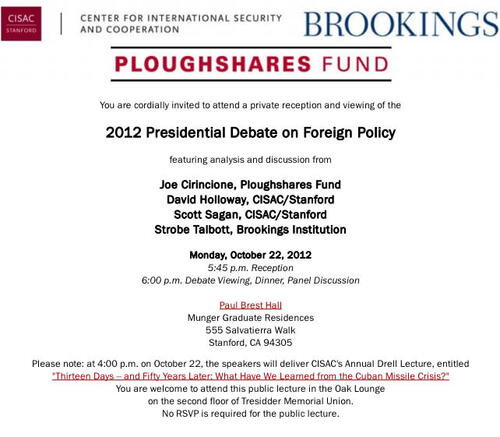
Fifty years ago, the Soviet Union and the United States stood on the brink of nuclear war. For thirteen days in October 1962, people around the world held their breath and hoped for a peaceful resolution to the Cuban Missile Crisis. CISAC convened a distinguished panel for the Oct. 22 event to discuss and debate the crisis from the perspectives of Moscow and Washington, and consider what history has taught us since those thirteen days in 1962. You can watch the full event here. And check out our Storify page on the event.


All News button
1
-


Please note: at 4:00 p.m. on October 22, the speakers will deliver CISAC's Annual Drell Lecture, entitled
"Thirteen Days -- and Fifty Years Later: What Have We Learned from the Cuban Missile Crisis?"

You are welcome to attend this public lecture in the Oak Lounge
on the second floor of Tresidder Memorial Union.
No RSVP is required for the public lecture.


Image

Paul Brest Hall
Munger Graduate Residences
555 Salvatierra Walk
Stanford, CA 94305

Conferences
News Type
Q&As
Date
Paragraphs

President Obama and Mitt Romney meet for their third debate to discuss foreign policy on Monday, when moderator Bob Schieffer is sure to ask them about last month's terrorist attack in Libya and the nuclear capabilities of Iran.

In anticipation of the final match between the presidential candidates, researchers from five centers at Stanford’s Freeman Spogli Institute for International Studies ask the additional questions they want answered and explain what voters should keep in mind.


What can we learn from the Arab Spring about how to balance our values and our interests when people in authoritarian regimes rise up to demand freedom?  

What to listen for: First, the candidates should address whether they believe the U.S. has a moral obligation to support other peoples’ aspirations for freedom and democracy. Second, they need to say how we should respond when longtime allies like Egypt’s Hosni Mubarak confront movements for democratic change.

And that leads to more specific questions pertaining to Arab states that the candidates need to answer: What price have we paid in terms of our moral standing in the region by tacitly accepting the savage repression by the monarchy in Bahrain of that country's movement for democracy and human rights?  How much would they risk in terms of our strategic relationship with Bahrain and Saudi Arabia by denouncing and seeking to restrain this repression? What human rights and humanitarian obligations do we have in the Syrian crisis?  And do we have a national interest in taking more concrete steps to assist the Syrian resistance?  On the other hand, how can we assist the resistance in a way that does not empower Islamist extremists or draw us into another regional war?  

Look for how the candidates will wrestle with difficult trade-offs, and whether either will rise above the partisan debate to recognize the enduring bipartisan commitment in the Congress to supporting democratic development abroad.  And watch for some sign of where they stand on the spectrum between “idealism” and “realism” in American foreign policy.  Will they see that pressing Arab states to move in the direction of democracy, and supporting other efforts around the world to build and sustain democracy, is positioning the United States on “the right side of history”?

~Larry Diamond, director of the Center on Democracy, Development, and the Rule of Law


What do you consider to be the greatest threats our country faces, and how would you address them in an environment of profound partisan divisions and tightly constrained budgets? 

What to listen for: History teaches that some of the most effective presidential administrations understand America's external challenges but also recognize the interdependence between America's place in the world and its domestic situation.

Accordingly, Americans should expect their president to be deeply knowledgeable about the United States and its larger global context, but also possessed of the vision and determination to build the country's domestic strength.

The president should understand the threats posed by nuclear proliferation and terrorist organizations. The president should be ready to lead in managing the complex risks Americans face from potential pandemics, global warming, possible cyber attacks on a vulnerable infrastructure, and failing states.

Just as important, the president needs to be capable of leading an often-polarized legislative process and effectively addressing fiscal challenges such as the looming sequestration of budgets for the Department of Defense and other key agencies. The president needs to recognize that America's place in the world is at risk when the vast bulk of middle class students are performing at levels comparable to students in Estonia, Latvia and Bulgaria, and needs to be capable of engaging American citizens fully in addressing these shared domestic and international challenges.

~Mariano-Florentino Cuéllar, co-director of the Center for International Security and Cooperation


Should our government help American farmers cope with climate impacts on food production, and should this assistance be extended to other countries – particularly poor countries – whose food production is also threatened by climate variability and climate change?

What to listen for: Most representatives in Congress would like to eliminate government handouts, and many would also like to turn away from any discussion of climate change. Yet this year, U.S. taxpayers are set to pay up to $20 billion to farmers for crop insurance after extreme drought and heat conditions damaged yields in the Midwest.

With the 2012 farm bill stalled in Congress, the candidates need to be clear about whether they support government subsidized crop insurance for American farmers. They should also articulate their views on climate threats to food production in the U.S. and abroad.

Without a substantial crop insurance program, American farmers will face serious risks of income losses and loan defaults. And without foreign assistance for climate adaptation, the number of people going hungry could well exceed 15 percent of the world's population. 

~Rosamond L. Naylor, director of the Center on Food Security and the Environment


What is your vision for the United States’ future relationship with Europe? 

What to listen for: Between the end of World War II and the end of the Cold War, it was the United States and Europe that ensured world peace. But in recent years, it seems that “Europe” and “European” have become pejoratives in American political discourse. There’s been an uneasiness over whether we’re still friends and whether we still need each other. But of course we do.

Europe and the European Union share with the United States of America the most fundamental values, such as individual freedom, freedom of speech, freedom to live and work where you choose. There’s a shared respect of basic human rights. There are big differences with the Chinese, and big differences with the Russians. When you look around, it’s really the U.S. and Europe together with robust democracies such as Canada and Australia that have the strongest sense of shared values.

So the candidates should talk about what they would do as president to make sure those values are preserved and protected and how they would make the cooperation between the U.S. and Europe more effective and substantive as the world is confronting so many challenges like international terrorism, cyber security threats, human rights abuses, underdevelopment and bad governance.

~Amir Eshel, director of The Europe Center


Historical and territorial issues are bedeviling relations in East Asia, particularly among Japan, China, South Korea, and Southeast Asian countries. What should the United States do to try to reduce tensions and resolve these issues?

What to listen for: Far from easing as time passes, unresolved historical, territorial, and maritime issues in East Asia have worsened over the past few years. There have been naval clashes, major demonstrations, assaults on individuals, economic boycotts, and harsh diplomatic exchanges. If the present trend continues, military clashes – possibly involving American allies – are possible.

All of the issues are rooted in history. Many stem from Imperial Japan’s aggression a century ago, and some derive from China’s more assertive behavior toward its neighbors as it continues its dramatic economic and military growth. But almost all of problems are related in some way or another to decisions that the United States took—or did not take—in its leadership of the postwar settlement with Japan.

The United States’ response to the worsening situation so far has been to declare a strategic “rebalancing” toward East Asia, aimed largely at maintaining its military presence in the region during a time of increasing fiscal constraint at home. Meanwhile, the historic roots of the controversies go unaddressed.

The United States should no longer assume that the regional tensions will ease by themselves and rely on its military presence to manage the situation. It should conduct a major policy review, aimed at using its influence creatively and to the maximum to resolve the historical issues that threaten peace in the present day.

~David Straub, associate director of the Korea Studies Program at the Walter H. Shorentein Asia-Pacific Research Center


Compiled by Adam Gorlick.

Hero Image
debatepic
President Obama and Mitt Romney speak during the second presidential debate on Oct. 16, 2012. Their third and final debate will focus on foreign policy.
Reuters
All News button
1
-

CISAC Conference Room

Not in residence

0
Senior Fellow at the Freeman Spogli Institute for International Studies, Emerita
Professor, by courtesy, of Political Science, Emerita
crenshaw_martha.jpg PhD

Martha Crenshaw is a senior fellow emerita at CISAC and FSI. She taught at Wesleyan University in Middletown, Connecticut, from 1974 to 2007.  She has published extensively on the subject of terrorism.  In 2011 Routledge published Explaining Terrorism, a collection of her previously published work.  A book co-authored with Gary LaFree titled Countering Terrorism was published by the Brookings Institution Press in 2017. She recently authored a report for the U.S. Institute of Peace, “Rethinking Transnational Terrorism:  An Integrated Approach”.


 She served on the Executive Board of Women in International Security and is a former President and Councilor of the International Society of Political Psychology (ISPP). In 2005-2006 she was a Guggenheim Fellow. She was a lead investigator with the National Consortium for the Study of Terrorism and the Response to Terrorism (START) at the University of Maryland from 2005 to 2017.  She is currently affiliated with the National Counterterrorism, Innovation, Technology, and Education (NCITE) Center, also a Center of Excellence for the Department of Homeland Security.  In 2009 the National Science Foundation/Department of Defense Minerva Initiative awarded her a grant for a research project on "mapping terrorist organizations," which is ongoing.  She has served on several committees of the National Academy of Sciences.  In 2015 she was elected a Corresponding Fellow of the British Academy.  She is the recipient of the International Studies Association International Security Studies Section Distinguished Scholar Award for 2016. Also in 2016 Ghent University awarded her an honorary doctorate.  She serves on the editorial boards of the journals International Security, Security Studies, Dynamics of Asymmetric Conflict, Orbis, and Terrorism and Political Violence.

Date Label
Martha Crenshaw Senior Fellow Speaker CISAC
Thomas Hegghammer Zukerman Fellow Commentator CISAC
Seminars
-

David Laitin is the James T. Watkins IV and Elise V. Watkins Professor of Political Science and an affiliated faculty member at CISAC. He has conducted field research in Somalia, Nigeria, Spain, and Estonia. His latest book is Identity in Formation: The Russian-Speaking Populations in the Near Abroad. He is currently working on a project in collaboration with James Fearon on civil wars in the past half-century. From that project, "Ethnicity, Insurgency, and Civil War" has appeared in the American Political Science Review. Laitin received his BA from Swarthmore College and his PhD from the University of California, Berkeley.

CISAC Conference Room

Department of Political Science
Stanford University
Encina Hall, W423
Stanford, CA 94305-6044

(650) 725-9556 (650) 723-1808
0
James T. Watkins IV and Elise V. Watkins Professor of Political Science
laitin.jpg PhD

David Laitin is the James T. Watkins IV and Elise V. Watkins Professor of Political Science and a co-director of the Immigration Policy Lab at Stanford. He has conducted field research in Somalia, Nigeria, Spain, Estonia and France. His principal research interest is on how culture – specifically, language and religion – guides political behavior. He is the author of “Why Muslim Integration Fails in Christian-heritage Societies” and a series of articles on immigrant integration, civil war and terrorism. Laitin received his BA from Swarthmore College and his PhD from the University of California, Berkeley.

Affiliated faculty at the Center for International Security and Cooperation
Affiliated faculty at The Europe Center
David Laitin James T. Watkins IV and Elise V. Watkins Professor of Political Science Speaker Stanford University
Benjamin Lessing Postdoctoral Fellow Commentator CISAC
Seminars

Not in residence

0
CISAC Affiliated Faculty Member
Professor (Emeritus) of Electrical Engineering
Hellman,_Martin.jpeg
Martin E. Hellman is professor emeritus of electrical engineering at Stanford, a recipient (joint with Whit Diffie) of the million dollar ACM Turing Award, a member of the National Academy of Engineering, and an inductee of the National Inventors Hall of Fame. He became a CISAC affiliated faculty member in October 2012.

Hellman is best known for his invention, with Whitfield Diffie and Ralph Merkle, of public key cryptography. In addition to many other uses, this technology forms the basis for secure transactions and cybersecurity on the Internet. He also has been a long-time contributor to the computer privacy debate, starting with the issue of DES key size in 1975 and continuing with service (1994-96) on the National Research Council's Committee to Study National Cryptographic Policy, whose main recommendations were implemented soon afterward.

Prof. Hellman also has a deep interest in the ethics of technological development. With Prof. Anatoly Gromyko of Moscow, he co-edited Breakthrough: Emerging New Thinking, a book published simultaneously in Russian and English in 1987 during the rapid change in Soviet-American relations (available as a free, 2.6 MB PDF download). In 1986, he and his wife of fifty years published, A New Map for Relationships: Creating True Love at Home & Peace on the Planet, a book that provides a “unified field theory” for successful relationships by illuminating the connections between nuclear war, conventional war, interpersonal war, and war within our own psyches (available as a free, 1.2 MB PDF download).
 
His current research is devoted to bringing a risk-informed framework to nuclear deterrence and critically examining the assumptions that underlie our national security.

Prof. Hellman was at IBM's Watson Research Center from 1968-69 and an assistant professor of EE at MIT from 1969-71. Returning to Stanford in 1971, he served on the regular faculty until becoming Professor Emeritus in 1996. He has authored over seventy technical papers, six US patents and a number of foreign equivalents.

More information on Professor Hellman is available on his EE Department website. His publications, many  of which can be downloaded in PDF, are on the publications page of that site.
Subscribe to The Americas