News Type
News
Date
Paragraphs

SCPKU hosted the International Diplomacy Lecture Series this fall which focused on driving discussions to better understand U.S. and cross-cultural diplomacy between the U.S., Asia, and China.  As part of the series, Karl Eikenberry's talk, "Post-Karzai Afghanistan," addressed how the new president and his administration will face a daunting set of security, governance, and economic challenges, even as the U.S.-led NATO coalition continues the drawdown of its combat forces.  Eikenberry was former U.S. Ambassador to Afghanistan and is currently at Stanford University's Freeman Spogli Institute for International Studies (FSI) as a William J. Perry Fellow in International Security at the Center for International Security and Cooperation and Distinguished Fellow at the Shorenstein Asia-Pacific Research Center.  Terry Lautz's lecture, "Cultural Diplomacy in East Asia and U.S. China Relations," evaluated China's soft power push and compared the practice of cultural diplomacy in East Asia and the United States.  Lautz is a Visiting Professor at Syracuse University and former Henry Luce Foundation Vice President.  Thomas Fingar's talk, "U.S. China Relations and the 'Re-Balance' to Asia," analyzed the origins and objectives of the Obama Administration's "Re-Balance" to Asia as well as questions and concerns raised by the China and others in the region. Fingar is the Oksenberg-Rohlen Distinguished Fellow at FSI at Stanford University.

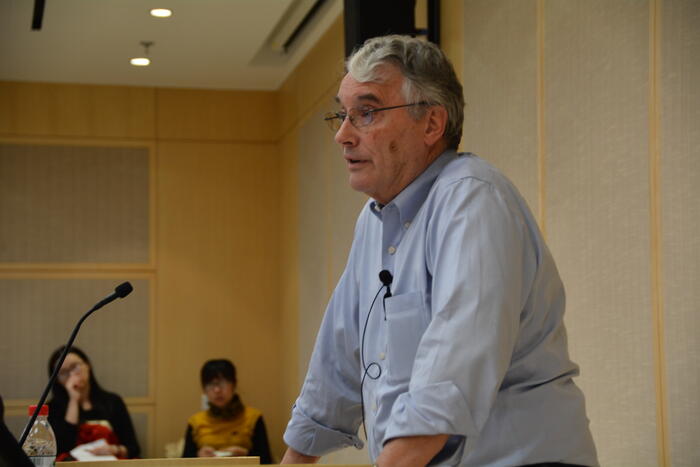
Thomas Fingar speaks at SCPKU as part of the International Diplomacy Lecture Series. Thomas Fingar speaks at SCPKU October 27, 2014, as part of the International Diplomacy Lecture Series.

Thomas Fingar speaks at SCPKU as part of the International Diplomacy Lecture Series.
Photo credit: SCPKU

Hero Image
thomas fingar 2
Thomas Fingar October 27 lecture, "US-China Relations and the Re-Balance to Asia."
SCPKU
All News button
1
Authors
News Type
News
Date
Paragraphs

The rise of China as a global and regional power has created areas where the interests of China and the United States overlap in competition, the senior U.S. military commander in the Pacific told a Stanford audience. But Admiral Samuel Locklear III, the commander of U.S. Pacific Command (USPACOM), rejected the traditional realpolitik argument, which predicts inevitable confrontation between the United States, a status quo power, and China, a rising power.

“Historians will say this will lead to conflict,” Locklear said, during an address at the Walter H. Shorenstein Asia-Pacific Research Center last Friday. “I don’t believe it has to.”

The United States and China have a “mutual skepticism of each other,” the Pacific Commander acknowledged, but he characterized the relationship as “collaborative, generally.”

He said the dangers of direct military confrontation between the two powers is low, but warned against Chinese tendencies to perceive the United States as engaged in an effort to ‘contain’ the expansion of China’s influence. Instead, Locklear urged China to work with the United States to build new security and economic structures in the region.

Economic interdependence between the countries makes it impossible for the two countries to avoid working together, he told the seminar, co-sponsored by the Center for International Security and Cooperation and the Freeman Spogli Institute for International Studies at Stanford University.

He said that China has also benefited from the security environment that the United States has helped shape and maintain in the region.

Locklear reminded the audience of the central importance of the vast area under his command, which stretches from the Indian subcontinent across the vast Pacific Ocean. More than nine out of 10 of the largest ports in the world are in the Asia-Pacific region, and over 70 percent of global trade passes through its waters. The U.S. rebalance to Asia, a policy pursued by the Obama administration as early as year 2009, largely happened because of the economic and political importance of that area.

The mutual interest in economic prosperity depends, however, on a stable security environment. Washington has an interest in maintaining the structure of security that has ensured peace for the last few decades. Beijing seeks to change the status quo, to build a regional system that reflects its growth as a power.

Locklear called on China to work with the United States and other nations in the region, such as Japan and Australia, as well as the countries of Southeast Asia, to take the current “patchwork quilt” of bilateral and multilateral alliances and build a basis to maintain economic interdependence and security. He pointed to the U.S.-led effort to form a Trans-Pacific Partnership as a 12-nation economic structure, which could eventually include China.

“We want China to be a net security contributor,” he said, “And my sense is that both the United States and the nations on the periphery of China are willing to allow China to do that – but with circumstances.” He said conditions for the United States included open access to shared domains in sea, air, space and cyberspace.

The Pacific Commander cautioned against the danger, however, of unintended conflict, fueled by territorial disputes and Chinese assertiveness that worries its neighbors. Locklear stressed the need for more dialogue, including among the militaries in the region, an effort that the U.S. Pacific Command is currently carrying out.

“There’s a trust deficit in Asia among the nations, as it relates in particular to China,” he said.

Relations have been so icy that the top political leaders of Japan and China didn’t meet for nearly two years, only breaking the divide for a 20-minute meeting at the Asia-Pacific Economic Summit (APEC) in Beijing last month.

Refusing to engage at the highest level has made it difficult for countries to work on solutions to shared problems. The region now sees a confluence of old and new challenges that could threaten global stability if ill-managed, said Locklear, who has led the U.S. military command in the Pacific since 2012.                 

For decades, China and Japan have been at odds about sovereignty claims over islands in the East China Sea. In the past, during the time of Deng Xiaoping’s rule in China, the two countries agreed to, as Deng reportedly put it, ‘kick the issue into the tall grass’ for future generations to deal with it. These disputes have resurfaced in recent years, threatening to trigger armed conflict between the air and naval forces of the two countries.

Locklear said he believed that China and Japan would avoid inadvertent escalation, thanks to improved communications and tight command and control over their forces. But he also warned  that at least seven nations have conflicting claims in the South China Sea, which could easily escalate into direct conflict.

These situations, paired with an upsurge in Chinese military spending and the growing belief that the United States is a declining power, raise doubts about China’s intentions in the region. China’s Asian neighbors increasingly question the intensions of the world’s most populous nation, and second largest economy.

“Is it a return to the old days where you had basic tributary states? Is that the model that China is looking for? Or is it a 21st century model?”

Locklear said China and other nations in the Asia-Pacific, as well as the United States, need to work harder to form shared views and consensus, particularly among those who “own the guns.”

Dialogue and interactions among the militaries are crucial, especially those who are called upon to make quick decisions during a possible flashpoint, for instance an accidental clash of boats or planes.

“Trust really does fall in many ways to military leaders to get it right and to lead, to some degree, the politicians and the diplomats,” he said. Locklear spoke of a tangible example of collaboration in the Rim of the Pacific Exercise, also known as RIMPAC, hosted by USPACOM. Twenty-two countries participate in the world’s largest maritime warfare exercise in Hawaii, which this year included naval forces from China.

“Does it fix those friction points? No, it doesn’t.” But, Locklear concluded, “We hope that this kind of thing opens the door for future interaction.”


The audio file and transcript from the event can be accessed by clicking here

Hero Image
locklear news article headline
Admiral Samuel Locklear III spoke about the future of the Asia-Pacific region at Stanford University.
Debbie Warren
All News button
1
News Type
News
Date
Paragraphs


Michael McFaul, the next director of the Freeman Spogli Institute for International Studies who recently returned from his position as U.S. Ambassador to Russia, joins Karl Eikenberry, the former U.S. Ambassador to Afghanistan and the William J. Perry Fellow in International Security at CISAC, to discuss the current state of foreign policy. The Nov. 11, 2014, talk was part of the fall course, "State of the Union,"  which examined major themes that contribute to the health, or disease, of the U.S. body politic.

Led by Rob Reich (Political Science), David Kennedy (History), and James Steyer (CEO, Common Sense Media), the course brought together distinguished analysts of American politics who noted that we live in an age of rising inequality, dazzling technological innovation, economic volatility, geopolitical uncertainty, and the accumulating impact of climate change. These conditions confront our political leaders and us as citizens of a democracy plagued by dysfunction.

Hero Image
screen shot 2014 11 24 at 12 34 43 pm
All News button
1
Authors
News Type
Commentary
Date
Paragraphs

Asia-Pacific leaders recently met in Beijing at the annual APEC summit, and after two days of discussion, concluded with some significant pledges and remarkable moments. President Xi Jinping of China and Prime Minister Shinzo Abe of Japan held a landmark meeting, and the United States and China discussed two agreements that are both symbolic, and lay groundwork for regional progress, say Stanford scholars.

High-level intergovernmental meetings are often more theatre than substance, but this year the 21-member Asia-Pacific Economic Cooperation, the oldest trans-Pacific regional organization, delivered important messages and may spur actions by member governments.

“Any summit is a ‘hurry up, get this done’ motivator,” says Thomas Fingar, the Oksenberg-Rohlen Distinguished Fellow at the Freeman Spogli Institute for International Studies. “The head of state goes to the meeting – and generally speaking – he doesn’t want to arrive and say ‘my guys were asleep for the last year.’”

Fingar says the APEC summit prodded countries to work on “deliverables,” particularly the goals and projects on the agenda from previous meetings. He recently returned from Beijing, and shared his perspectives with students in the Asia-Pacific Scholars Program.

Writing for the East Asia Forum, Donald Emmerson, director of the Southeast Asia Program at the Walter H. Shorenstein Asia-Pacific Research Center, said many of the commitments declared at the APEC summit, and at the subsequent meetings of the G20 in Australia and the Association of Southeast Asian Nations in Myanmar, will have implications for global governance, particularly as China holds a more influential role in the region.

APEC countries account for over 40 percent of the world’s population and nearly half of global trade – and true to form, the grand vision of the summit is to advance regional economic integration.

Yet, “the ancillary things – things that went on in the margins – are in many ways more important,” Fingar says, referring to areas outside of the summit’s obvious focus, and what’s discussed on the sidelines of the public talks.


Image
apec economic leaders meeting cropped


Key outcomes from the 2014 gathering include:

  • The leaders of Japan and China met for the first time since coming into office, afterward acknowledging that the two countries have “disagreements” in their official statements. Of the Xi-Abe meeting, Fingar says, “it helps clear the way for lower level bureaucrats to go to work on real issues."


  • The United States and China announced a proposal to extend visas for students and businesspeople on both sides. While the immediate effects would be helpful, the change is symbolically superior. “You don’t give 5-10 year visas to adversaries,” he says, it shows that “‘we’re in [the relationship] for the long-term.’”


  • China proposed the development of a new “Silk Road,” pledging $40 billion in resources toward infrastructure projects shared with South and Central Asian neighbors. “It’s tying the region together and creating economy-of-scale possibilities for other countries,” he says. “A real win-win situation.”


  • The United States and China, the world’s two largest energy consumers, announced bilateral plans to cut carbon emissions over the next two decades. “It’s significant because those two countries must be the ones to lead the world in this area. Unless we are seen to be in basic agreement, others will hold back.”


  • China codified the Asian Infrastructure Investment Bank (AIIB), a global financial institution intended as an alternative to institutions like the World Bank. “China has been frustrated with its role in existing international institutions,” Fingar says, explaining a likely motivation behind the AIIB’s creation.

Emmerson said the outcomes of the APEC summit from the U.S.-China standpoint were better than expected, speaking to McClatchy News. The visa and climate deals, as well as their commitment to lowering global tariffs on IT products, will lessen chances of conflict between the two countries. 

However, the summit did leave some areas unsolved. One of the most important is the Trans-Pacific Partnership (TPP), a trade pact proposed by the United States that includes 11 others countries in the region, but does not yet include China.

Leaders “made positive noises” coming out of the TPP discussions, Fingar says, but nothing was passed. The gravity and complexity of trade-related issues, especially agriculture and intellectual property, is likely to blame for slow action.

Hero Image
apec economic leaders meeting headline
Leaders pose for a group photo at the 22nd APEC Economic Leaders' Meeting in Beijing, China.
APEC/(Xinhua/Yao Dawei)
All News button
1
0
benvalentino.jpg PhD

Benjamin Valentino is a Professor of Government at Dartmouth College and Chair of the Government Department. His research interests include the causes and consequences of violent conflict and American foreign and security policies. At Dartmouth he teaches courses on international relations, international security, American foreign policy, the causes and prevention of genocide and serves as co-director the Government Department Honors Program. He is also the faculty coordinator for the War and Peace Studies Program at Dartmouth’s Dickey Center for International Understanding. Professor Valentino’s book, Final Solutions: Mass Killing and Genocide in the 20th Century, received the Edgar S. Furniss Book Award for making an exceptional contribution to the study of national and international security. His work has appeared in outlets such as The New York Times, The Wall Street Journal, Foreign Affairs, The American Political Science Review, Security Studies, International Organization, Public Opinion Quarterly, World Politics and The Journal of Politics. He is currently working on several research projects focusing on public opinion on the use of force and developing early warning models of large-scale violence against civilians.

Affiliate
CV
0
Affiliate
robert_kehler.png

*Please contact Tracy Hines (tmhines23@stanford.edu) for any inquires regarding General Kehler.

Prior to his retirement on January 1, 2014, General Kehler was the Commander of United States Strategic Command at Offutt Air Force Base, Nebraska.  In that role he was directly responsible to the Secretary of Defense and President for the plans and operations of all U. S. forces conducting global strategic deterrence, nuclear alert, global strike, space, cyberspace and associated operations.  While in command, he crafted and implemented critical elements of policies and plans to deter strategic attacks against the U.S. and its key allies and led a joint team of military members and civilians to 100% mission success in multiple, high-stakes global operations.  He also integrated Department of Defense (DOD) activities for global missile defense, combating weapons of mass destruction, and intelligence, surveillance, and reconnaissance.  His forces directly supported combat operations in Southwest Asia and North Africa.

General Kehler’s military career spanned almost thirty-nine years of service that included progressively important operational and staff assignments.  He commanded units at the squadron, group, wing, major command, and combatant command levels, and had a broad range of operational experience in Intercontinental Ballistic Missiles, space launch, space control, space surveillance and missile warning.  Before taking command of Strategic Command, General Kehler commanded Air Force Space Command (predecessor to U.S. Space Force) where he organized, trained, and equipped airmen conducting mission-ready nuclear missile, space, and cyberspace operations.  His command designed the Air Force’s inaugural blueprint, operating concept, organizational structure, and personnel program to meet emerging cyberspace challenges. 

His staff assignments included tours with the Air Staff, Strategic Air Command, Air Force Space Command, and the Joint Staff.  He was also assigned to the Secretary of the Air Force’s Office of Legislative Liaison where he was the point man on Capitol Hill for matters regarding the President’s ICBM Modernization Program.  As Director of the National Security Space Office, General Kehler integrated the activities of a number of DOD and Intelligence Community organizations on behalf of the Undersecretary of the Air Force and Director, National Reconnaissance Office. 

General Kehler entered the Air Force in 1975 as a Distinguished Graduate of the Pennsylvania State University R.O.T.C. program, has master’s degrees from the University of Oklahoma in Public Administration and the Naval War College in National Security and Strategic Studies, and completed executive level programs at Carnegie-Mellon University, Syracuse University, and Harvard University.

Since his retirement, General Kehler has continued to apply his expertise as a consultant, corporate director and trustee, and senior advisor and fellow to a number of prominent public, private, and educational institutions. He writes and speaks on matters of national security. Bob and his late wife have two adult sons and two grandsons. Time permitting, he enjoys playing the guitar and golf.

News Type
News
Date
Paragraphs


CISAC Senior Fellow Scott Sagan and Affiliated Faculty Member Allen Weiner of the Stanford Law School teach "Rules of War," a Thinking Matters course that investigates the legal rules that govern the resort to, and conduct of war, and study whether these rules affect the conduct of states and individuals. The class will confront various ethical, legal, and strategic problems as they make decisions about military intervention and policies regarding the threat and use of force in an international crisis. The class culminates in one of CISAC's signature simulations in which students are assigned roles within the presidential cabinet.


Hero Image
screen shot 2014 10 02 at 3 47 21 pm
All News button
1
0
Affiliate
mike_mcnerney.jpg JD

Mike McNerney is a cybersecurity executive and entrepreneur. He is currently a Senior Advisor at Resilience, a cyber risk company that offers solutions to companies worldwide. Prior to joining Resilience Mike was Co-founder and CEO of the network security startup Efflux Systems, later acquired by Arbor Networks, where he led product management for its threat intelligence business.

Previously, Mike served as a Cyber Policy Advisor in the Office of the Secretary of Defense, where he drafted and negotiated key pieces of federal legislation to develop cybersecurity programs as well as in the U.S. Department of State, where he pioneered economic development programs in the Middle East and Afghanistan.

Mike is the Chair & Co-founder of the Institute for Security & Technology and a Board member of VetsinTech. He is a a veteran of the United States Air Force and holds a B.A with majors in Economics and a Political Science from University of California, Davis, and a J.D. from American University, Washington College of Law.

Date Label
Subscribe to Asia-Pacific