News Type
News
Date
Paragraphs

Forty-eight national security and foreign policy leaders urged U.S. government and businesses to take action to fight climate change in a statement released by the Partnership for a Secure America. Thomas Fingar, a distinguished fellow in the Freeman Spogli Institute for International Studies, is a signatory. The statement can be accessed by clicking here.

Hero Image
5811865885 d45256bd02 o
A sergeant operates a sling on a UH-60 Blackhawk above a swollen Missouri River near North Sioux City, South Dakota. Flight crews are helping deliver sand bags to areas affected by flooding.
Flickr/U.S. Department of Defense
All News button
1
Authors
News Type
News
Date
Paragraphs

The Freeman Spogli Institute for International Studies has welcomed five new senior military fellows, including three active duty lieutenant colonels from the U.S. Air Force and two from the U.S. Army, who will spend the next academic year at Stanford pursuing self-directed study of important national issues.

Former U.S. Secretary of Defense and CISAC faculty member Bill Perry created the program to give military officers the opportunity to take a deep dive into an area of strategic interest.

The fellows will be considering a diverse range of topics, from how to adapt Silicon Valley’s innovative work culture to the Army, to China’s actions in the South China Sea, and the effectiveness of U.S. economic sanctions against North Korea.

You can learn more about our fellows’ military backgrounds and the intended focus of their studies from the brief bios below.

John Cogbill and Scott Maytan will be assigned to the Center for International Security and Cooperation.

John Chu, Ryan Blake and Jose Sumangil will be based at the Walter H. Shorenstein Asia-Pacific Research Center.


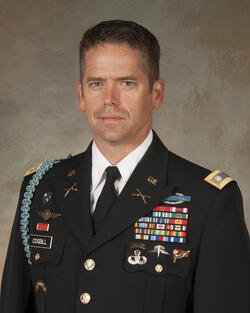
LTC John Cogbill

LTC John Cogbill was commissioned as an Infantry officer from the United States Military Academy in 1994 and has held a variety of positions in both conventional and special operations units. John’s first assignment was as a Platoon Leader and Executive Officer in the 82nd Airborne Division. John then served two years in the 1st Battalion, 75th Ranger Regiment as a Platoon Leader and Civil-Military Affairs Officer. Next, John served three years in Alaska as an Airborne Rifle Company Commander and the Aide-de-Camp to the Commanding General. After earning his MPA from the Harvard Kennedy School, John taught Economics in the Social Sciences Department at West Point. Following the Command and General Staff College, he spent two years as a Combined Arms Battalion Executive Officer in the 1st Cavalry Division. He then served as the Strategic Plans and Requirements Officer for the 75th Ranger Regiment. Most recently, John commanded the Reconnaissance and Surveillance Squadron for the U.S. Army Third Corps. John has deployed on three combat and two peacekeeping missions, including two tours in Iraq, one tour in Afghanistan, one tour in Haiti, and a recent tour in Kosovo. He will be exploring how the Army can encourage innovation and use emerging technologies to achieve and maintain a competitive advantage on the battlefield.


lt col scott maytan 5x7 Lt Col Scott Maytan, U.S. Air Force

Lt Col Scott Maytan was the commander of a B-52H operational bomb squadron, responsible for ensuring combat mission readiness for any worldwide nuclear or conventional tasking. Lt Col Maytan is a navigator with over 2500 flying hours, primarily in the B-52H, and is a graduate of both the Command and General Staff College (U.S. Army) and the U.S. Air Force Weapons School. He has served four operational assignments, as an advanced tactics instructor, and also a tour at the Pentagon where he developed Air Force positions concerning long-range strike and aircraft nuclear requirements. Lt Col Maytan has served three combat deployments for Operations Desert Fox (Southern Watch), Allied Force and Iraqi Freedom and has also deployed four times supporting USPACOM’s Continuous Bomber Presence mission. Maytan will be studying the “red-lines” that shape Western deterrence posture, and how strategic action and deterrence posture in one region affects others.


LTC John Chu, U.S. Army

LTC John Chu is an active duty officer in the United States Army. Chu has held a variety of leadership and staff positions in his 20 year career. Most recently, he served as the Chief of Intelligence Training at the Department of the Army. Chu has twice been deployed to Iraq and once to Bosnia, with multiple assignments to South Korea, Germany and Turkey. Born in Seoul, he grew up in California and graduated from West Point in 1995. At Stanford, Chu is researching the Korean armistice agreement and the United Nations mission to South Korea. He will also examine U.S. policy toward North Korea, particularly analyzing the “brink of war” tension and developing strategic deterrence measures to reduce risk of unwanted military escalation on the Korean Peninsula. For both research streams, Chu aims to produce analyses and recommendations that could inform a policy audience.


Lt Col Ryan Blake, U.S. Air Force

Lt Col Ryan Blake is an active duty officer in the United States Air Force. Blake was the commander of a flight test squadron where he was responsible for the flight test of new Air Force programs. He has over 2,400 flying hours in over 40 types of aircraft, and has held two operational F-15E assignments, including combat deployments in support of Operations Southern Watch, Iraqi Freedom and Enduring Freedom. He had also been positioned at the Pentagon in defense acquisition and the Office of Security Cooperation in Baghdad. At Stanford, Blake is researching the U.S. policy toward China and its relation to Northeast Asia. He aims to discover areas of cooperation between the U.S. and Chinese militaries.


Lt Col Jose “Ed” Sumangil, U.S. Air Force

Lt Col Jose “Ed” Sumangil is an active duty officer in the United States Air Force. During his career, Sumangil has served in a range of operational assignments, including joint staff officer at U.S. Strategic Command where he was a lead planner of the command’s space campaign. Before coming to Stanford, he was the commander of a B-1 squadron and led airmen through combat deployments in support of Operations Enduring Freedom, Inherent Resolve and Freedom’s Sentinel. At Stanford, Sumangil is examining China’s actions in the South China Sea and the Philippines arbitration case regarding Chinese actions there. He seeks to offer perspectives and policy and strategy options to maintain peace and stability in the South China Sea.


Hero Image
ennica hall exterior ws
All News button
1
News Type
Q&As
Date
Paragraphs

Chinese President Xi Jinping arrived in the United States last week for his first state visit. Maintaining a busy schedule, Xi met with President Obama at the White House, technology leaders in Seattle and the United Nations General Assembly in New York.

In Washington, Xi and Obama agreed to create a common vision toward a climate agreement at the Paris summit ‘COP21’ later this year and further establish shared norms in the area of cyberspace, according to a report from the White House.

Two Stanford scholars offer their analysis of Xi’s visit in a Q&A. Thomas Fingar discusses outcomes from the Chinese leader’s summit with Obama. Recently returning from Beijing, Karl Eikenberry offers his views on the media and reactions that occurred in China during the week preceding Xi’s visit.


Q&A: Thomas Fingar

Thomas Fingar is a China expert and a distinguished fellow at Stanford’s Freeman Spogli Institute for International Studies. He is a former deputy director of national intelligence for analysis and previously served as the director of the Office of Analysis for East Asia and the Pacific in the U.S. Department of State.


Coming out of the meeting, where do China and the United States stand on climate change?

China and the United States have declared a willingness to work together on climate change, further than in the past. At their meeting, Xi and Obama agreed to build upon agreements announced last November that proclaim a common vision for the upcoming Paris meeting on climate change. Taken together, these statements mark a dramatic reversal of the antagonism between China and the United States at the 2009 talks in Copenhagen. It sends a strong signal that China and the United States are prepared to cooperate.

Moreover, other countries should no longer fear that their own efforts will be negated by disagreement between the two largest producers of greenhouse gases. They can no longer excuse their own inaction by claims that any potential international agreement on climate change would be vetoed by either China or the United States. The message is — it’s time to get serious.

Was there any progress on cybersecurity issues?

Obama and Xi committed to mitigate malicious cyber activity from their national territory and to refrain from targeting critical infrastructure in peacetime. The former is more significant than the latter. But of course the proof of significance will be how—and how quickly—it is implemented.

However, what is worth noting is the restraint on cyber targeting of infrastructure declared by the United States and China. The two leaders agreed to bring that arena within the purview of the United Nations. It’s a step toward the establishment of an international control regime for cyberspace. Such a regime is badly needed and would be a concrete example of how the two countries can work bilaterally, and multilaterally, to update the global order and address 21st century challenges.

Would you say Xi's trip was a success?

We won’t know how important any of the agreements from Xi’s visit are until we see how they are implemented. Rather than carp about the failure to adopt detailed and binding commitments, however, we should recognize and applaud the fact that the state of U.S.-China relations is less fraught and more future-focused than pessimists maintain.

This is an excerpt of a larger piece written by Thomas Fingar.


Q&A: Karl Eikenberry

Karl Eikenberry is the director of the U.S.-Asia Security Initiative and a distinguished fellow at Stanford's Freeman Spogli Institute for International Studies. Eikenberry is a former U.S. ambassador to Afghanistan and, among other positions, served as defense attaché at the U.S. Embassy in Beijing.


How do the Chinese view Xi’s visit?

Chinese state media coverage was intense – far greater than had appeared in the United States Every detail of Xi’s itinerary and exhaustive analyses of the issues likely to be discussed between the two presidents dominated the news. Interestingly, the state media reporting tended to emphasize the hosting arrangements, supportive of President Xi’s desire to place China within the Asia-Pacific Region and globally on an equal footing with the United States.

Whereas U.S. Government leaders hope for specific security and economic agreements – so-called “deliverables” – with China during this visit, Xi and his team place more of a premium on being accorded respect. The Chinese media is an arm of the communist party, and reinforces the party’s goals in its reporting of major issues.

How important do Chinese leaders and the people consider the visit?

I was asked during an interview with Chinese television if this visit was as significant as that of Deng Xiaoping’s visit to the United States in 1979. That event had great historical meaning as it signaled Deng’s commitment to “open up” China after decades of relative isolation. President Xi’s visit can’t be compared with Deng’s in a historical sense. And yet, China has come along way since 1979.

When Deng visited the United States, China was a poor country. Now China is approaching middle-income country status and its GDP is the second largest in the world. President Xi was feted in Seattle this week by the captains of America’s IT industry and accompanied by China’s own IT captains. I expect Deng never could have imagined such a development even in his most optimistic moments.

China’s rapid growth over the past 35 years has been enabled by that country’s integration into the global economic and financial markets, and by an extended period of peace and stability in the Asia-Pacific region. The United States, in turn, has played a decisive role in ensuring these favorable conditions have existed.

Almost everyone I met during my recent Beijing trip expressed concern that Sino-American relations are becoming more punctuated by disputes, such as over maritime and cyber issues. China’s leaders and its people recognize that their country faces a daunting array of political, economic, and security problems that will be difficult to solve if world trade and stability in the Asia-Pacific region are disrupted, likely developments if the United States and China should ever enter into a period of confrontation. So I think that most Chinese are hoping that President Xi’s visit can help put U.S.-China relations on a more positive trajectory.

How would you critique Chinese media coverage of Xi’s visit?

I would give it mixed reviews. In terms of thoroughness, I give it good marks. Frankly, the average Chinese citizen – at least in urban areas – knows far more about this event than the average American citizen. On the other hand, China state media has a strong tendency to downplay America’s concerns about China’s policies – this is worrisome.

For example, I watched China Central Television (CCTV)’s coverage of National Security Advisor Susan Rice’s Sept. 21 speech on U.S.-China relations. The report showed all of the positive parts of Rice’s speech, but very few of her criticisms. This leads the Chinese people to have unrealistic expectations about Sino-American relations, and worse, to entirely blame the United States when inevitable setbacks occur.

There is also a bit of irony worth mentioning. President Xi agreed to provide answers to questions submitted by The Wall Street Journal. The questions were published in that newspaper on the eve of Xi’s trip. The next morning, I was watching CCTV and listened as a presenter read Xi’s answers verbatim. But I was perplexed, because I thought The Wall Street Journal’s website, like several other western publications, was blocked due to its tendency to occasionally restrict print news that the communist party deems unfit to print. I tried to connect online to The Wall Street Journal and quickly discovered the site was indeed blocked. CCTV, apparently, had not gotten the word.  

Hero Image
rtx1shy5
China's President Xi Jinping and U.S. President Barack Obama arrive for a joint news conference at the White House on Sept. 25, 2015.
Reuters/Gary Cameron
All News button
1
0
Affiliate
clark_rsd15_078_0514a.jpg PhD

David L. Clark is a retired Los Alamos National Laboratory (LANL) Fellow and Guest Scientist with the Laboratory’s Glenn T. Seaborg Institute for Actinide Science.  He was LANL’s Director of the National Security Education Center from 2013-2025.

His research interests are in the molecular and electronic structure of actinide materials, applications of synchrotron radiation to nuclear security, behavior of actinide and fission products in the environment, the aging effects in nuclear weapons materials, and the education of judges on the methods of science.  He is an international authority on the chemistry and physics of the actinides, and has published nearly 200 peer-reviewed publications, encyclopedia and book chapters. He is the co-Editor of the six volume Plutonium Handbook, portions of which were written while a CISAC Visiting Scholar in 2015.

Clark served as inaugural Director of the Los Alamos Glenn T. Seaborg Institute for Transactinium Science between 1997-2009. He has served the DOE as a technical advisor for environmental stewardship including the Rocky Flats cleanup and closure (1995-2005), closure of High-Level Waste tanks at the Savannah River Site (2011), and as a technical advisor to the DOE High Level Waste Corporate Board (2009-2011). He is a Fellow of the American Association for the Advancement of Science, and a Los Alamos Laboratory Fellow.  He is the recipient of two ACS national awards - the Nobel Laureate Signature Award (1988) and the Glenn Seaborg Award in Nuclear Chemistry (2017). He has also been honored with several Defense Programs Awards of Excellence.

He received a B.S. in chemistry in 1982 from the University of Washington, and a Ph.D. in 1986 from Indiana University. Clark was a postdoctoral fellow at the University of Oxford before joining Los Alamos National Laboratory as a J. Robert Oppenheimer Fellow in 1988. 

Laboratory Fellow Director, National Security Education Center Los Alamos National Laboratory
Date Label
Paragraphs

From its inception, the Non-Aligned Movement (NAM) considered itself to be a moderating force in the Cold War and in the post-colonial world.  In September 1961, in the wake of the Belgrade Conference and at the height of the Berlin crisis, it dispatched emergency missions to Washington and Moscow, with Sukarno and Keita journeying to Washington and Nehru and Nkrumah flying to Moscow.  Yet, by the decade's end, the movement had moved away from that mission.  Paying particular attention to key turning points of the mid-1960s such as the 1964 Congo crisis and the Americanisation of the Vietnam War, this paper interprets the abandonment of cold war mediation as a product of the Vietnam War, rising anti-colonial sentiment, and organised non-alignment's corresponding shift toward a more militant stance on the world stage. This shift helped to foster a newly antagonistic relationship between the United States and the NAM.

All Publications button
1
Publication Type
Journal Articles
Publication Date
Journal Publisher
The International History Review
Authors
Robert Rakove
News Type
News
Date
Paragraphs

Stanford University’s Walter H. Shorenstein Asia-Pacific Research Center (APARC) is launching a U.S.-Asia Security Initiative spearheaded by a former top American diplomat to deepen dialogue on contemporary Asia-Pacific security issues and to further bridge American and Asian academics, government officials and industry leaders.

A new and uncertain multipolar system is emerging in Asia. The United States is and will remain a global power, but it is evident the post-Cold War international order is increasingly under strain. There is a pressing need for research about how developments in the Asia-Pacific region impact U.S. interests, and what the optimal strategies are to respond. Led by Karl Eikenberry, who served as U.S. ambassador to Afghanistan from 2009 to 2011, the initiative will look beyond simplistic notions of nations engaging harmoniously or competing against each other and explore a range of policy options.

Combining expertise from across Stanford University, the initiative will gather faculty and researchers from the Freeman Spogli Institute for International Studies (FSI), and take place under the auspices of Shorenstein APARC, a center focused on interdisciplinary research on contemporary issues of international cooperation, governance and security in the Asia-Pacific region.

Eikenberry, an Oksenberg-Rohlen Distinguished Fellow at Shorenstein APARC, retired from the U.S. Army as a lieutenant general after 35 years of service before taking the role as ambassador. At Stanford, he has returned to an early and longstanding interest in Asia, contributing to an urgent discussion about how the United States should respond regionally and globally to an increasingly strong China. The initiative is founded on the premise that there is a role for an institution that not only fosters groundbreaking research, but also serves to convene academic and governmental expertise from across the Asia-Pacific region in a dialogue aiming to inform policy and strategy.

“As China rises and Japan seeks a greater defense role in Asia, a number of questions are raised over the United States’ role in the region. This creates a great impetus for stakeholders to gather and develop an understanding of today’s perplexing security issues,” Eikenberry said.

“It’s an honor to lead this Stanford initiative and make possible opportunities for students, scholars, peers and leaders across the world.”

Before arriving at Stanford, Eikenberry’s Asia-related postings included assistant army, and later, defense attaché at the U.S. Embassy Beijing, operational assignments in the Republic of Korea and Hawaii, Director for Strategic Plans and Policy at U.S. Pacific Command, Senior Country Director for China at the Office of the Secretary of Defense, and two senior command tours in Afghanistan. He is a graduate of the U.S. Military Academy, holds master’s degrees from Harvard University and Stanford University, and has an advanced degree in Chinese history from Nanjing University.

The three-year initiative will build synergies with existing activities at Stanford, drawing scholars, government officials and industry leaders to engage at conferences and public seminars on important U.S.-Asia security themes. Understanding that inquiry is enlivened through interdisciplinary dialogue, participants will share best practices across multiple fields including diplomacy, military strategy and environmental risk.

“I can’t think of a better person to drive this initiative – Karl has a profound understanding of the economic, diplomatic and military complexities in the region. I have every confidence that it will develop into a robust, established project under his leadership,” said Gi-Wook Shin, director of Shorenstein APARC.

Launching July 1, 2015, the initiative aims to bolster local, national and global networks through several foundational components, including a core working group of experts from Stanford and peer institutions to provide new perspectives on U.S. policies in Asia; educational opportunities for Stanford students; and public programs that will bring intellectual and strategic leaders to Stanford to enrich the conversation on Asia-Pacific security.

The initiative seeks to operate as a focal point for academic scholarship on the west coast of the United States and offer practical steps that stakeholders can take to strengthen the security architecture and U.S. alliance commitments in the region. Outcomes from the initiative’s activities will include publications and policy reports, many of which will be offered open access online.

“As the Asia-Pacific region continues to rise, we see new threats but also greater opportunity to work together,” said Michael McFaul, director of FSI. “Stanford and FSI excel in offering practical solutions to policy challenges and can play a role in identifying strategies aimed at maintaining peace and stability in the region.”


Initiative inquires: Charlotte Lee, Shorenstein APARC, cplee@stanford.edu, (650) 725-6445

Media inquires: Lisa Griswold, Communications and Outreach Coordinator, Shorenstein APARC, lisagris@stanford.edu, (650) 736-0656

Hero Image
usnavy flickr uspacificfleet
In Sasebo, Japan, members from the maritime forces of India, Japan and the United States observe a trilateral naval field exercise in July 2014.
Flickr/U.S. Pacific Fleet
All News button
1
Authors
News Type
Q&As
Date
Paragraphs


On April 22, 2015, the Wall Street Journal published the article “China Warns North Korean Threat is Rising,” reporting on estimates from Chinese and American nuclear experts of the DPRK nuclear arsenal. The article quotes CISAC’s Siegfried Hecker, director of the Nuclear Risk Reduction Project, on his assessment of the North Korean nuclear crisis and presents the estimates of Dr. Hecker’s Chinese counterparts. In the following Q&A, Hecker, who has been an authority in the United States on technical assessments of the progress of the North Korean nuclear program — having visited North Korea seven times since 2004 and having been granted unprecedented access to North Korea’s Yongbyon nuclear facilities — discusses the information presented in the Wall Street Journal article and provides insight both on the nature of technical estimates of the DPRK nuclear arsenal as well as on the critical takeaways from these assessments.

What was the nature of the meeting referenced in the Wall Street Journal article in which China’s estimates were presented?

This meeting was an off-the-record, non-governmental, non-official dialogue on U.S. – China security issues. The discussion on North Korea’s nuclear program was one of many security topics discussed. Both Chinese and American experts made presentations. The headline of the WSJ article is misleading – it is not “China” that made these estimates, but Chinese nuclear experts.

Have you conferred with Chinese nuclear experts about the North Korean nuclear program before the referenced meeting?

As part of my Nuclear Risk Reduction project at Stanford University, I have conferred regularly with nuclear and policy experts in China and Russia, as well as American experts and officials, of course. We have done so since January in 2004, when I first visited the Yongbyon Nuclear Center and returned through Beijing (the normal transit in and out of Pyongyang).

On that trip, North Korean nuclear officials showed me plutonium metal that they had reprocessed from the spent fuel rods that were stored since the beginning of the Agreed Framework in 1994. When the Agreed Framework fell apart in late 2002, Pyongyang expelled the international inspectors and withdrew from the Nonproliferation Treaty.  I believed they showed me their nuclear facilities and the plutonium to try to convince Washington that they had the bomb.

How did these visits inform your assessment of the DPRK nuclear program?

I visited North Korea seven times in total, with four of those visits to the Yongbyon Nuclear Center. After each of these visits, I compared observations and analyses with Chinese nuclear experts. During the first few visits, the Chinese experts and Chinese international relations scholars were quite skeptical of North Korea’s nuclear capabilities. I believe that my observations helped to inform their subsequent analysis since Chinese experts did not have access to Yongbyon at the time.

So what precipitated the change in the perception of your Chinese colleagues of North Korea’s nuclear capabilities?

During the first few years of discussion, my estimates of North Korea’s capabilities exceeded those of Chinese experts.  However, during my most recent visit to Yongbyon in November 2010, North Korean nuclear officials showed me their newly constructed uranium enrichment facility, housing 2,000 modern centrifuges, and the beginning of the construction of an experimental light water reactor. Overhead imagery shows that the exterior of the reactor is essentially complete, that the size of the centrifuge hall has been doubled, and that significant additional construction has occurred in the fuel fabrication complex, where the centrifuge facility is housed.

Pyongyang’s move to augment their limited plutonium production in the 5 MW-electric reactor (at most one bomb’s worth of plutonium per year) with enriched uranium changed the game.

Changed the game, how?

It opened the second path to the bomb and made it difficult to assess North Korea’s nuclear capabilities. Unlike the reactor production of plutonium, centrifuges are easy to hide. So, post-2010 it became more difficult to make accurate estimates, but all of us believed that North Korea enhanced its nuclear capacity significantly.

I published my most recent estimates in an article in the Bulletin of the Atomic Scientists along with a brief history of North Korea’s nuclear build-up. The latest estimates by Chinese nuclear experts now exceed mine. I believe that we base our estimates on the same open-source data.

If you base your estimates on the same information, what accounts for the discrepancies between your assessments and the estimates from your Chinese colleagues?

Developing these estimates is not an exact science. There are huge uncertainties in estimating the enrichment capacity that is likely present at covert sites. One particular problem is the difficulty in assessing how much indigenous capacity North Korea has to make the key materials and components for centrifuges. To demonstrate the great uncertainties, the WSJ article cites a recent report by David Albright of the Institute of Science and International Security that shows the possible range of bomb-fuel capacity in 2020 to vary from 20 to 100 bombs. The Chinese experts’ and my estimates fall within that range.

The Wall Street Journal article reported that American officials recently stated that North Korea possesses an intercontinental ballistic missile with sufficient range to reach the United States. Is the threat of nuclear attack on the United States from North Korea imminent?

I view the threat to the United States posed by an untested missile, the so-called KN-08, with a hypothetical miniaturized nuclear warhead as unrealistic any time in the near future. The KN-08 has not been tested to our knowledge. I believe North Korea would require more long-range missile tests and more nuclear tests to pose a direct threat to the United States.

With the international community’s attention directed toward the U.S.-Iran nuclear deal, what are your thoughts on the analogy made in the article between the Iran Nuclear Deal and the 1994 Agreed Framework with North Korea?

I don’t concur with the analogy of the failings of the Agreed Framework to the potential Iran deal. It is true that North Korea continued to develop uranium enrichment capabilities during the Agreed Framework. However, without the Agreed Framework, North Korea could have produced a nuclear arsenal as large as they have today 10 years earlier. And, by terminating the Agreed Framework, Washington traded the threat of uranium bombs that was at least 10 more years away for plutonium bombs that were built within a year.

Then what is the critical takeaway from your and your Chinese colleagues’ assessments of North Korea’s nuclear capabilities?

The real tragedy, in my opinion, is that whereas in 2003 North Korea likely had no nuclear weapons, it appears to have a rapidly expanding arsenal today. During the past 12 years we have witnessed the North Korean program grow from having the option for a bomb in 2003, to having a handful of bombs five years later, to having an expanding nuclear arsenal now.

Why does an expanding arsenal matter?

I believe it has made Pyongyang increasingly reliant on its nuclear weapons for regime survival and has dimmed the prospect of a denuclearized Korean peninsula. Such an arsenal may instill Pyongyang’s leadership with a false sense of confidence and almost certainly expands what it may think are its tactical and strategic options. The potential for miscalculations and accidents increases, and the consequences will be greater if it has more bombs and more sophisticated bombs with greater reach.


Hero Image
sig photo
All News button
1
Paragraphs

This paper addresses the factors motivating Chinese conventional arms sales and speculates on means to influence them. The author describes the history of China's weapons exports and examines various supply- and demand-side reasons for such transfers. In developing both explanations, the author tries to identify recurring pattems in the global arms trade. The paper concludes that if China manages to sustain its extraordinary rate of development, it will demand a larger role in shaping the international order and that there will be an increased use of arms transfers to realize security, versus strictly economic objectives.

All Publications button
1
Publication Type
Journal Articles
Publication Date
Journal Publisher
Institute for National Strategic Studies
Authors
Subscribe to Asia-Pacific