Authors
News Type
News
Date
Paragraphs

In 2015, Volodymyr Zelenskyy was at the height of a successful career as an entertainer. Though trained as a lawyer at the Kryvyi Rih Institute of Economics in Eastern Ukraine, the then 37 year old Zelenskyy was a successful comedian and public personality. As the star of the popular TV show, Servant of the People, he played a local history teacher who inadvertently becomes the president of Ukraine following a viral video rant about corruption.

No one watching comedic President Zelenskyy then could have possibly imagined the real-life plot twist that would follow. In an incredible act of life imitating art, in April 2019, Volodymyr Zelenskyy once again stood on stage in front of a cheering crowd, but this time as the actual president of Ukraine.

He won in a landslide election against incumbent president Petro Poroshenko on a platform of systemic change and progress using an almost exclusively virtual campaign. Speaking from his headquarters on election night, he affirmed the exuberance and hope of his supporters: “I can say as a citizen of Ukraine to all countries of the post-Soviet Union: Look at us — everything is possible.”

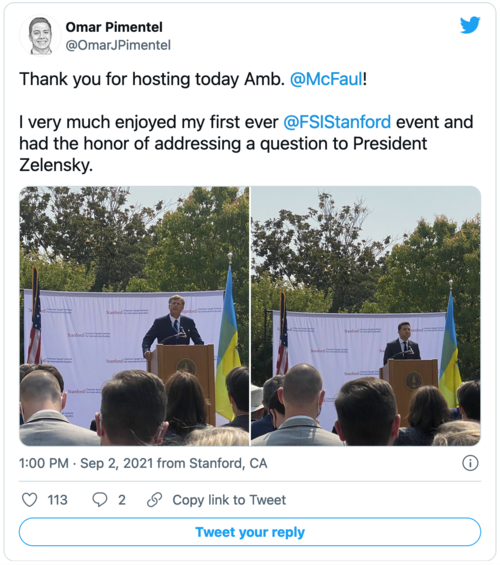
This same message shaped the theme of President Zelenskyy’s remarks at his historic address from the Freeman Spogli Institute for International Studies (FSI) at Stanford University on September 2. The first Ukrainian president to ever visit California, President Zelenskyy, First Lady Olena Zelenska and their delegation joined a group of FSI faculty members led by FSI Director Michael McFaul at an outdoor event held in the Encina Courtyard.

In his remarks, Zelenskyy drew inspiration from Steve Jobs’ famous "How to Live Before You Die" commencement address given at Stanford in 2005.

"This is one of the most famous speeches ever given at Stanford,” he said. “It's about believing in dreams and overcoming the impossible. This is the same as my story. I am just a common guy from a common family from a common industrial town in Eastern Ukraine. Yet here I am today at Stanford, because everything is possible."

He continued, “It is the same for Ukraine. Many people look at us and think that it will be impossible to achieve the goals we hope for. But we know that our critics are wrong. The people of our country love democracy and freedom and will not let threats take those things away. We know that anything is possible."

Looking to the future, Zelenskyy outlined the steps his administration is undertaking to bring increased digitization to Ukraine. These efforts include launching fully electronic passports, moving business and legal services online and expanding the scope of e-goverance. The hope is that this meld of new technology will help curb corruption while simultaneously creating more equitable opportunities and better access to public services for more Ukranians.

Speaking on the ambitious scope of these plans, the president acknowledged, “There will be resistance to the changes and innovations that we are going to make.” Nonetheless, he remains committed to the work ahead of strengthening democratic institutions in Ukraine and building on the progress that has already been made.  “We do not have a ‘Ukrainian Dream,’ yet,” he said. “But we have a ‘Ukrainian Goal’ and a ‘Ukrainian Mission’ to make the future we want for our country.” An edited recording of his remarks is below.

Keeping with Stanford tradition, Zelenskyy took questions from the audience after his prepared remarks. A variety of students and Stanford community members from Russia, Burma, Belarus and beyond had the opportunity to engage the president on a range of issues including U.S.-Ukraine relations, armament sales abroad and concerns over Russian aggression in Crimea and influence Eastern Ukraine. Of particular meaning was Zelensky’s affirmation and support for the democratic movement in Belarus led by Svaitlana Tsikhanouskaya, whom FSI hosted earlier this summer at a faculty roundtable.

Image
Tweet from Franak Viačorka

Students and faculty alike were appreciative of the president’s candor and good nature in addressing difficult topics.

Image
Tweet from Rose Gottemoeller
Image
Tweet from Graham Webster
Image
Tweet from Me Me Khant
Image
Tweet from Omar Pimentel

Following the formal remarks, President Zelenskyy and First Lady Zelenska had an opportunity to meet with Stanford President Marc Tessier-Lavigne in the Memorial Church Courtyard. Prior to leaving, the First Lady also sat down with leaders and students from Stanford's Office of Accessible Education (OAE), an area of interest she would like to support and better develop in Ukraine.

For FSI, the president’s visit was another affirmation of the special connection between Ukraine and the Stanford community. Since 2016, the Center on Democracy, Development and the Rule of Law has hosted the Ukrainian Emerging Leaders Program, which provides a 10-month academic training fellowship in support of mid-career practitioners working actively as policy-makers, legal professionals, entrepreneurs and leaders of civil society organizations in Ukraine.

Speaking to this shared history in his opening introductions, FSI Director Michael McFaul emphasized the crucial need for ongoing support and intellectual investment into Ukraine. “The fight for democracy and independence in Ukraine is one of the most important causes in the world today,” he affirmed. “Not just for Ukrainians, but for all who cherish the ideals of democracy, liberty and sovereignty.”

To President Zelenskyy, McFaul extended a future invitation: “You are always welcome back, either as president or in retirement as a professor.”

“With the classes you offer, I will think about it,” Zelenskyy replied with a smile.

Read More

Sviatlana Tsikhanouskaya discusses the future of democracy in Belarus with a roundtable of Stanford scholars.
News

Belarusian Leader Sviatlana Tsikhanouskaya Meets with Stanford Scholars for Roundtable on Democracy in Belarus

Democratic leader Sviatlana Tsikhanouskaya and her delegation joined an interdisciplinary panel of Stanford scholars and members of the Belarusian community to discuss the future of democracy in Belarus.
Belarusian Leader Sviatlana Tsikhanouskaya Meets with Stanford Scholars for Roundtable on Democracy in Belarus
Hero Image
President Volodymyr Zelenskyy of Ukraine speaks at the Freeman Spogli Institute for International Studies Rod Searcey
All News button
1
Subtitle

President Zelenskyy outlined the steps his administration is undertaking to bring increased digitization to Ukraine, curb corruption and create more equitable access to public services for more Ukrainians.

Authors
News Type
News
Date
Paragraphs

On August 9, 2020 citizens in the Republic of Belarus went to the polls to vote for their next president. The incumbent was Alexander Lukashenko, a 67-year-old military officer who has kept an iron grip on the presidency for the entire 26 years Bealrus has held elections. But the challenger was an unexpected, new face. Sviatlana Tsikhanouskaya is a 38-year-old English teacher, mother and pro-democracy activist who stepped into a campaign following her husband's arrest and imprisonment in May 2020 for political dissension. In four short months, she galvanized the nation with a message of democracy, freedom and fair elections that reached across opposition factions and gained enough momentum to become a serious contender for the presidency.

On election day, projections estimated an initial win for Tsikhanouskaya at 60%. But when the country's Central Elections Commission announced the election results, Lukashenko carried 80% of the vote, and Tsikhanouskaya a mere 10%. Given the long history of election engineering in Belarus, the results were expected. But what happened next was not. Outraged by the fraud, Tsikhanouskaya's supporters poured into city centers in Brest and Minsk by the tens of thousands, instigating the largest public protests in the history of post-Soviet Belarus. Caught off-guard, the regime hit back with a ruthless wave of violence and political imprisonments, prompting the European Union, NATO and other countries to impose sanctions and condemn Lukashenko as an illegitimate leader.

While Tsikhanouskaya's presidential campaign ended last August, her role as a democratic leader in Eastern Europe has not. In the year since the election, she has traveled the globe to meet with lawmakers, policy experts and heads of state to speak out against the ongoing repression of Lukashenko's regime and advocate for support of Belarus by the international community. The Freeman Spogli Institute for International Studies (FSI) was honored to host Tsikhanouskaya and her delegation at Stanford for a roundtable discussion on the challenges that lay ahead in preparing Belarus for a democratic transition. Director Michael McFaul hosted the discussion, which brought together scholars from across FSI, the Hoover Institute and the Belarusian expatriate community. The full recording is below.

Rather than holding a typical press conference, Tsikhanouskaya's visit at FSI gave members of the Belarusian delegation an opportunity to engage in back-and-forth dialogue with an interdisciplinary panel of experts on governance, history and policy. Tsikhanouskaya and her senior advisors shared their perspectives on the challenges they are facing to build and maintain pro-democracy efforts, while Stanford scholars offered insights from their extensive research and scholarship.

Presidents, Protests and Precedent in Belarus


As leader of the delegation, Sviatlana Tsikhanouskaya gave an overview of the brutality of Lukashenko's regime and the lawlessness that has enveloped the country. But she also reaffirmed the commitment of everyday Belarusians to defending their independence and continuing the work of building new systems to push back against the dictatorship, and encouraged the support of the international democratic community.

"Belarusians are doing their homework. But we also understand that we need the assistance and help of other democratic countries," said Tsikhanouskaya. "That support is vital, because our struggle relates not just to Belarusians, but to all countries who share these common values."

Speaking to the work that Belarusians have already undertaken, Franak Viačorka, a senior advisor to Sviatlana Tsikhanouskaya, described how citizens are creating new means of protesting and organizing. Though they learned some tactics from recent protests in Hong Kong and classic theories by political scientists like Gene Sharp, organizers in Belarus quickly realized that they needed to innovate in order to keep ahead of Lukashenko's crack-downs. Today the opposition is a tech-driven movement that spreads awareness and support quickly through digital spaces and underground channels while avoiding large in-person gatherings that attract government brutality.

By Tanya Bayeva's assessment, these methods of organizing have been effective in capturing widespread support amongst people. A member of the Belarusian diaspora, Bayeva described the sense of empowerment she felt in coming together in a common cause with like-minded people.

"By coming out like this, people have started realizing that it is up to us, the people, and our individual willpower to make a difference," said Bayeva. "We are realizing that the king has no clothes, and that working together we can forward the process of democratization."

But there is still plenty of work ahead. In order to facilitate a more peaceful future transition to a democratic system, there will need to be frameworks in place to bridge the divide between old systems and new. Valery Kavaleuski, the representative on foreign affairs in Sviatlana Tsikhanouskaya's delegation, is focusing extensively on these issues, such as reconciliation processes and plans for future investments between Belarus and the European Union.

"These are political moves that reinforce hope among Belarusians and tells that that they are not alone and that when the change comes, they will have friends by their side to overcome the challenges of the transition period," said Kavaleuski.

Advice from Stanford Scholars: Focus on Processes and People


Responding to the Belarusian delegation's questions and comments, the faculty from FSI and the broader Stanford community offered insights and considerations from a variety of perspectives and disciplines on 'next steps' for the pro-democracy movement.

Francis Fukuyama, the Olivier Nomellini Senior Fellow at FSI and Mosbacher Director at the Center on Democracy, Development and the Rule of Law (CDDRL), cautioned against the impulse to immediately take down the state and bureaucratic systems of the existing regime. While dismantling the mechanisms from the old state may feel emotionally satisfying, examples from history such as post-Nazi Germany and post-invasion Iraq illustrate the crippling effect on efficiency, functionality and the ability of the new order to govern in a vacuum of bureaucratic expertise.

FSI's Deputy Director, Kathryn Stoner, gave similar advice in regard to drafting and implementing a new constitution and conventions.

"People care to a great degree [about a new constitution], but not to months and months of debate and politicians yelling at one another. People can't eat constitutions," said Stoner. "You have to demonstrate that your system is going to be better than what was. When things have not gone well in transitioning countries, it's been because people don't see concrete change. So have a constitutional convention, but make it fast."

Amr Hamzawy, a senior research scholar for the Middle East Initiative at the Center for Democracy, Development and the Rule of Law, also pointed to the importance of engaging the public and building alliances within both the old and new political systems. Based on his observations of the failed Egyptian and Tunisian efforts at democratic transition, he cautioned against discussions of impunity, arguing that while politically and morally symbolic, this practice often backfires and alienates important factions of the state apparatus which are vital for the function and success of a new government.

Hamzawy similarly encouraged carefully blending nationalism and populism to keep divisions within the public sector in check. Imbuing such narratives with pro-democracy rhetoric, he believes, can create a powerful tool for unifying the population around the new government and emerging national identity.  

The advice from the Europe Center's director, Anna Grzymala-Busse, succinctly brought together many of the points made by the faculty panel: "No post-transitional government can achieve all the promises they've made right away," said Grzymala-Busse. "So make the transition about processes rather than specific outcomes, about ensuring the losers are heard along with the winners, and about making sure all people can participate."

Additional participants in the roundtable discussion not noted above include Hanna Liubakova, a journalist and non-resident fellow at the Atlantic Council, Dmytro Kushneruk, the Consul General of Ukraine in San Francisco, and Stanford scholars Larry Diamond, David Holloway, Norman Naimark, Erik Jensen, Kiyoteru Tsutsui and John Dunlop.

Read More

Hero Image
Sviatlana Tsikhanouskaya discusses the future of democracy in Belarus with a roundtable of Stanford scholars.
Sviatlana Tsikhanouskaya, Michael McFaul, Franak Viačorka, and Francis Fukuyama participate in a roundtable discussion on democracy in Belarus.
Office of Sviatlana Tsikhanouskaya
All News button
1
Subtitle

Democratic leader Sviatlana Tsikhanouskaya and her delegation joined an interdisciplinary panel of Stanford scholars and members of the Belarusian community to discuss the future of democracy in Belarus.

Authors
Steven Pifer
News Type
Commentary
Date
Paragraphs

President Volodymyr Zelensky reportedly will soon travel to Paris to meet with French President Emmanuel Macron. That is a trip very much worth making. After German Chancellor Angela Merkel steps down this fall, Zelensky may find himself more dependent on Macron, both in the Normandy format and for leadership in the European Union regarding the conflict that Russia has inflicted on his country.

The sooner Zelensky gets to Paris, the better.

First, he could ask Macron to call explicitly on Vladimir Putin to deescalate the tensions Russia has caused by its large and continuing build-up of military forces near Ukraine.

On April 3, the German and French foreign ministries issued a statement calling for restraint on “all sides”—a wrongly balanced appeal given that Russian actions provoked the crisis.  Merkel corrected this on April 8, when she spoke with Putin and “demanded that this [Russian] build-up be unwound in order to de-escalate the situation.” Macron has yet to speak in such clear terms.

Second, Zelensky should strengthen Macron’s understanding of the conflict and Ukraine’s position.  The Germans and French have for six years sought to broker a settlement between the Ukrainians and Russians in the Normandy format, with Merkel playing the lead role.  Later this year, when she steps down, the leadership of that process may well pass from Berlin to Paris.

Ukrainians often express frustration with the Normandy format and the Minsk II agreement that it produced in February 2015.  The terms of the agreement were never fully implemented, and thousands of Ukrainians have since died.  Berlin and Paris have not found the key to getting Russian and Russian proxy forces to leave Donbas, to say nothing of occupied Crimea.  (In fairness, it is not clear that anyone could have.)

However, the Normandy process has kept the two large continental European powers engaged in trying to resolve the conflict. That is to Kyiv’s advantage. The Minsk II agreement has provided the basis for sustaining European Union sanctions on Russia, sanctions that have proven far more resilient than many would have predicted when EU member states first approved them in 2014.

Merkel and German diplomats deserve credit for maintaining EU unity on sanctions, despite calls from some member states to move back toward business as usual with Moscow.  She has taken a greater interest in the Russia-Ukraine conflict than Macron or his predecessor.  That reflects in part her background, having been raised in the German Democratic Republic, her understanding of Russia, and her command of Russian.

But Merkel steps down this fall after 16 years as chancellor. While the German election is still more than five months off, most predictions suggest one of two coalitions will result: a combination of the Christian Democratic Union/Christian Socialist Union and Greens Party, or a grouping of the Greens, the Social Democratic Party, and Free Democratic Party.

In the first combination, the likely candidates for chancellor are Armin Laschet and Markus Soeder.  Both come from what was West Germany.  Neither has real experience with or appears to have shown particular interest in the Russia-Ukraine conflict.  Either might question the investment that Merkel put into the Normandy discussions, given that they have not succeeded and offer little pay-off in terms of German domestic politics.

In the second combination, the chancellor likely would come from the Greens.  That could bode well for Kyiv, as the Greens are skeptical about Russia, criticize Moscow’s human rights record, and oppose the Nord Stream 2 gas pipeline.  However, the Greens have been out of government since 2005, and they might need time to get up to speed.

If the new German chancellor is uninterested in or needs time to engage in a meaningful manner, leadership within the Normandy format will move to Paris, something the Kremlin likely would welcome.  Macron has taken a less harsh tone on Russian misbehavior.  He has sought to regenerate links with Moscow.  For example, before the 2019 G7 summit in France, he hosted Putin for a bilateral meeting, seemingly seeking to make Paris a bridge between Moscow and the rest of the G7.

A pro-Russian tilt, even a small one, in the duo heading up the Normandy format process is hardly in Kyiv’s interest.  Zelensky needs to make his strongest possible case to Macron as regards the realities of the Russia-Ukraine conflict, for continuing to steward the Normandy format with Merkel’s steadiness, and for not succumbing to Putin’s blandishments, which would come at Ukraine’s expense.


Originally for Kyiv Post

Hero Image
Ukraine's President Volodymyr Zelenskiy (L) and French President Emmanuel Macron
AFP
All News button
1
Subtitle

President Volodymyr Zelensky reportedly will soon travel to Paris to meet with French President Emmanuel Macron. That is a trip very much worth making.

Authors
Steven Pifer
News Type
Commentary
Date
Paragraphs

Nord Stream 2 is an almost-finished natural gas pipeline from Russia to Germany. The Biden administration opposes it and has come under congressional pressure to invoke sanctions to prevent its completion, in large part because the pipeline seems a geopolitical project targeted at Ukraine. The German government, however, regards the pipeline as a “commercial project” and appears committed to its completion, perhaps in the next few months. U.S. sanctions applied on Russian entities to date have failed to stop Nord Stream 2, raising the question of whether the U.S. government would sanction German and other European companies for servicing or certifying the pipeline. Such sanctions would provoke controversy with Germany at a time when both Berlin and the Biden administration seek to rebuild good relations. The two sides have work to do if they wish to avoid Nord Stream 2 becoming a major point of U.S.-German contention.

Read the rest at Brookings

Hero Image
Banner of Nord Stream Getty Images
All News button
1
Subtitle

Nord Stream 2 is an almost-finished natural gas pipeline from Russia to Germany. The Biden administration opposes it and has come under congressional pressure to invoke sanctions to prevent its completion, in large part because the pipeline seems a geopolitical project targeted at Ukraine.

Authors
Steven Pifer
News Type
Commentary
Date
Paragraphs

BERLIN — Over the past week, Russia has reinforced its military presence on the Crimean peninsula, moved military units close to the Russia-Ukraine border and announced military “readiness checks.” Most likely, this is just a ploy to unnerve the government in Kyiv and test the West’s reaction. 

But it could be something worse. If the Kremlin is weighing the costs and benefits of a military assault on Ukraine, Europe and the United States should ensure that Moscow does not miscalculate because it underestimates the costs. 

Read the rest at Politico

Hero Image
Destroyed tank Getty Images
All News button
1
Subtitle

Europe and the United States must ensure that Moscow does not underestimate the costs of a military assault.

Division of Infectious Disease and Geographic Med

300 Pasteur Drive, L134, MC 5107

Stanford, CA 94305

650-723-6661
0
Professor of Medicine
dw_iba_highres.jpg MD

Dean Winslow, MD is Professor of Medicine with appointments in the Divisions of Hospital Medicine and Infectious Diseases and is a Senior Fellow (courtesy) at CISAC/Freeman Spogli Institute. He has served on the Stanford faculty since 1998 and served from 2003-2008 as Co-Director of Stanford's Infectious Diseases Fellowship Training Program. He was in private practice in Wilmington, Delaware where he started the state’s first multidisciplinary clinic for HIV patients in 1985. In 1988 he joined the DuPont Company where he worked both as a bench scientist on HIV drug resistance then later designed the clinical trials supporting FDA approval of efavirenz. In 1999 he became Vice President of Regulatory Affairs at Visible Genetics Inc. and led the FDA clearance of the TRUGENE HIV-1 drug resistance test. Dr. Winslow joined the staff at Santa Clara Valley Medical Center in 2003, where he served as Chief of the Division of AIDS Medicine and later as Chair of the Department of Medicine. In 2015 he was appointed Academic Physician-In-Chief at Stanford/ValleyCare and Vice Chair of the Department of Medicine. He was a Resident Fellow in Robinson House 2013-2017 and was visiting faculty at Oxford University in 2017. He was Lead Physician for the US Antarctic Program of the National Science Foundation 2019-2020 based at McMurdo Station, Antarctica. In 2021 he took leave from Stanford to lead the US COVID-19 Testing and Diagnostic Working Group. He served as CDC Senior Advisor to Operation ALLIES WELCOME and Chief Medical Officer for the Southwest Border Migrant Health Task Force before returning to Stanford in July 2022.

Dr. Winslow is a Master of the American College of Physicians, Fellow of the Royal College of Physicians, the Infectious Diseases Society of America, and the Pediatric Infectious Diseases Society. He is the author of 87 papers. He is,a member of the IDSA Sepsis Task Force, and previously served as Chair of the Standards and Practice Guidelines Committee.

Colonel Winslow entered the Air National Guard in 1980 and was a Distinguished Graduate of the USAF School of Aerospace Medicine. He served as Commander of the 159th Medical Group 1992-1995 and was State Air Surgeon, Delaware Air National Guard 1995-2011. He served as ANG Assistant to the Commander, 59th Medical Wing, Joint Base San Antonio 2011-2014. Colonel Winslow deployed to the Middle East six times from 2003-2011 as a flight surgeon supporting combat operations in Iraq and Afghanistan. From Jan-April 2003 Colonel Winslow was the flight surgeon responsible for combat rescue operations from Tikrit to northern Iraq. In 2005 he coordinated military public health in Louisiana in the aftermath of Hurricane Katrina. In 2006 Colonel Winslow served as an ER physician at the United States Air Force 447th EMEDS (combat hospital) in Baghdad and in 2008 he served as hospital commander during the Iraq surge. He is a 2007 graduate of Air War College. He served as an infectious disease consultant to the USAF Surgeon General. In 2017 Dr. Winslow was nominated by the President to serve as Assistant Secretary of Defense for Health Affairs. He has 1150 military flying hours including 431 combat hours and 263 combat sorties. He has extensive operational experience in fighter, tactical airlift, and combat rescue missions. He holds an FAA Airline Transport Pilot license.

Since 2006 Dr. Winslow has arranged medical care in the U.S. for 28 Iraqi children who have complicated medical conditions for which care is not available in Iraq. In 2015, Dr. Winslow and his wife, Dr. Julie Parsonnet, created The Eagle Fund of the Silicon Valley Community Foundation, which provides aid to middle eastern and central American refugees. In 2018 he co-founded Scrubs Addressing the Firearms Epidemic (SAFE), which unites health care professionals to address gun violence in the US as a public health issue and to advocate for education, research, and evidence-backed policy to reduce gun violenc

CV
Authors
Austin Cooper
News Type
News
Date
Paragraphs

In January, the French historian Benjamin Stora filed a report commissioned by the French President Emmanuel Macron aimed at “reconciliation of memories between France and Algeria,” which France ruled as the jewel of its colonial empire for more than 130 years.

Read the rest at Bulletin of the Atomic Scientists

Hero Image
Director of nuclear experiment center, General Jean Thiry, pressing a button to trigger the explosion of the third French atomic bomb at the Reggane test site in the Algerian Sahara, December 27, 1960
AFP/Getty Images
All News button
1
Subtitle

French President Emmanuel Macron commissioned a report aimed at “reconciliation of memories between France and Algeria,” which France ruled as the jewel of its colonial empire for more than 130 years. The Stora Report addressed several scars from the Algerian War for Independence and still comes up short of a clear path toward nuclear reconciliation.

-

Seminar Recording: https://youtu.be/7uGcI3qswDw


About the Event: As relations between the West and Russia have sharply deteriorated in recent years, Germany has taken a leading role in shaping Europe's policy response, particularly that of the European Union.  That has included a tougher approach toward Kremlin misbehavior, such as various economic and other sanctions.  At the same time, Berlin has sought to keep an open line of communication with Moscow.

Amb. Thomas Bagger will discuss how Berlin views the challenge posed by Russia and how the West should respond.


About the Speaker: Thomas Bagger holds the rank of ambassador and is Diplomatic and Foreign Policy Advisor to the President of the Federal Republic of Germany.  He joined the German diplomatic service in 1992 and has served abroad in Prague, Ankara and Washington.  Before taking up his current position, he headed the Foreign Ministry's Policy Planning Office.    

Thomas Bagger Ambassador Federal Republic of Germany
Seminars
-

* Please note all CISAC events are scheduled using the Pacific Time Zone.


Seminar Recording: https://youtu.be/iqrz3Y3VmZ8


About the Event: Since the start of the Trump era, the United States and the Western world has finally begun to wake up to the threat of online warfare and the attacks from Russia. The question no one seems to be able to answer is: what can the West do about it? 

Central and Eastern European states, however, have been aware of the threat for years. Nina Jankowicz has advised these governments on the front lines of the information war. The lessons she learnt from that fight, and from her attempts to get US congress to act, make for essential reading. 

How to Lose the Information War takes the reader on a journey through five Western governments' responses to Russian information warfare tactics - all of which have failed. She journeys into the campaigns the Russian operatives run, and shows how we can better understand the motivations behind these attacks and how to beat them. Above all, this book shows what is at stake: the future of civil discourse and democracy, and the value of truth itself.


Book Purchase:  https://www.bloomsbury.com/us/how-to-lose-the-information-war-9781838607685/

Discount Code: NINAJ30


About the Speaker: Nina Jankowicz studies the intersection of democracy and technology in Central and Eastern Europe. She is the author of How To Lose the Information War: Russia, Fake News, and the Future of Conflict (Bloomsbury/IBTauris). Ms. Jankowicz has advised the Ukrainian government on strategic communications under the auspices of a Fulbright-Clinton Public Policy Fellowship. Her writing has been published by The New York Times, The Washington Post, The Atlantic, and others. She has testified before Congress on multiple occasions and is a frequent television and radio commentator on disinformation and Russian and Eastern European affairs. Prior to her Fulbright grant in Ukraine, Ms. Jankowicz managed democracy assistance programs to Russia and Belarus at the National Democratic Institute for International Affairs. She received her MA in Russian, Eurasian, and East European Studies from Georgetown University's School of Foreign Service, and her BA from Bryn Mawr

Virtual Seminar

Nina Jankowicz Disinformation Fellow Wilson Center
Seminars
Subscribe to Europe