Authors
David Holloway
News Type
Commentary
Date
Paragraphs

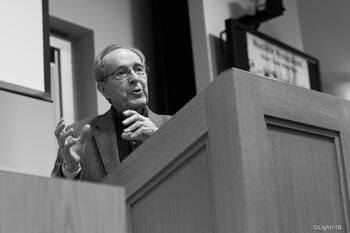
The following are remarks by Professor David Holloway at the Sid Drell Symposium on Fundamental Physics given at SLAC on 12 January 2018.


I want to thank the organizers for inviting me to speak at this conference. It’s a particular pleasure for me as a historian and political scientist to be a speaker at a symposium on Fundamental Physics. More seriously it is an honor for me to speak at a symposium in memory of Sid Drell, with whom I had the privilege to work for over thirty years. Sid agreed with Einstein that politics was much harder to study than physics. “The laws of physics stay the same,” he said. “The laws of politics change. And besides, you are supping with the Devil.”

Sakharov

My topic is Sid’s friendship with Andrei Sakharov, whom Sid greatly admired and more than once referred to as a saint. Sakharov was born in Moscow in 1921, five years before Sid. He died in 1989. I don’t want to go through Sakharov’s life, but I do want to mention a couple of things to provide context for Sid’s meetings with him and for their friendship. Sakharov’s mentor, Igor Tamm – a Nobel Prize-wining physicist – drew Sakharov into work on the design of thermonuclear weapons in 1948. From 1950 to 1968 Sakharov lived and worked in Arzamas-16 (now Sarov), the Soviet equivalent of Los Alamos. He played a key role in the development of Soviet thermonuclear weapons.

In 1968 Sakharov was removed from secret work after an essay he had written – Reflections on Progress, Peaceful Coexistence, and Intellectual Freedom – was published abroad. In the opening paragraph Sakharov states that his views were formed in the milieu of the scientific-technical intelligentsia, which was very worried about the future of humankind. Their concern, he continued, was all the stronger because what he called "the scientific method of directing politics, economics, art, education, and military affairs" had not yet become a reality. What did he mean by the "scientific method" in this context? His answer: "We consider 'scientific' that method which is based on a profound study of facts, theories, views, presupposing unprejudiced and open discussion, which is dispassionate in its conclusions." In other words, Sakharov wanted open discussion of important policy issues – something that did not happen in the Soviet Union.

Image
Drell, Yelena Bonner, and Sakharov, c.1976

In his essay Sakharov expressed ideas he had been coming to for some time, but the immediate stimulus to his writing the essay appears to have been that he was refused permission to publish an article about ABM systems. He (and other senior scientists at Arzamas-16) had come to the conclusion that “creating ABM defenses against massed attacks is not realistic, while for individual missiles it is difficult but possible.” Sakharov had written to Mikhail Suslov, an ideologically rigid Politburo member, whom he had met, expressing this view and asking for permission to publish an article on ABM systems. Suslov had denied him permission.

The publication of the essay abroad converted Sakharov from a scientist engaged in secret work into a world-famous figure. The essay sold 18 million copies in one year (it was printed in full in many newspapers).

I mention this episode and this essay to show that Sakharov, like Sid, was interested not only in physics but also profoundly interested in the application of science to policy, something that Sid had begun to do, starting in 1960 with Panofsky’s encouragement. It was the publication of the essay abroad that got Sakharov expelled from secret work. It is only then that he began to turn his attention to the defense of human rights in the Soviet Union, especially after 1970, when he met Elena Bonner, whom he married in 1972. In 1975 he was awarded the Nobel Peace Prize for his work for human rights. In his 1968 essay he had seen intellectual freedom as crucial for progress – how else could we deal with environmental degradation and the danger of thermonuclear war? In his Nobel lecture, Peace, Progress, and Human Rights, he named over one hundred of the political prisoners being held in the Soviet Union. He also made the general point that peace, progress, and human rights were indissolubly linked. For progress to be beneficial and peace secure, human rights (freedom of conscience, freedom of assembly, freedom of expression etc.) had to be protected. Thus the rights of the individual were intimately linked to our capacity to deal with global problems facing the human race.

Sid and Sakharov meet

In the early 1970s Sakharov was under intense pressure to curtail his activities, This came from the authorities and also from fellow members of the Academy of Sciences. That was the state of affairs in 1974 when he and Sid had their first meeting, which took place in Moscow, at a small conference on composite nucleon structure. Sid recalled “what I considered a great compliment to me, he apparently knew enough about me through whomever to sit down next to me at the meeting.” In his memoirs Sakharov writes of this meeting that Sid was a “young man,” “already a very well-known physicist.” They exchanged notes because Sakharov’s English was very poor and Sid’s Russian even worse. They could both get along a little bit in German. Sakharov then asked Sid about people in the West and invited Sid (and Viki Weisskopf) to dinner at his apartment on Chkalov Street (ulitsa Chkalova) where they met Elena Bonner and Bonner’s daughter Tanya Yankelevich, who was probably the person who made the conversation possible. 

At that first meeting Sid and Sakharov formed a bond. They met again two years later at a High Energy International Meeting in Tbilisi. Sakharov and Bonner were both there. Sid spent a week with them, forming a close and warm rapport.

Sid maintained a steady correspondence with both Sakharov and Bonner. In the late 1970s much of this correspondence had to do with the repression of human rights in the Soviet Union and the persecution of physicists (and others). Sid was particularly helpful to Elena Bonner’s children in Boston, Efrem and Tanya Yankelevich. He also did what he could to keep Sakharov’s name – and his plight – in the news. He made sure Sakharov’s papers were published in the West; he helped to organize conferences on Sakharov, and to keep Sakharov’s name in the public mind. He was not alone in this – there was an organization called SOS (Sakharov, Orlov, and Shcharansky) founded at Berkeley – but he was one of a few, and he was persistent.

There is a touching letter from Sakharov to Sid in June 1981:

“Dear Sidney, I want to write to you this time not an ‘open’ but a most ordinary letter, to thank you from the bottom of my heart. Lusia [Elena Bonner] and I feel all the time that in that infinitely distant world to which our children have been mislaid and where they now live, there are some (very few) people who have not forgotten them or us, and you are one of them.” And then Sakharov writes, perhaps rather slyly in view of Sid’s liking for Madras jackets: “I sense that almost physically, seeing you in my mind’s eye in your check suit (although perhaps you now dress differently.)”

In 1978 Sid wrote N.N. Bogoliubov to explain that he would not take part in a Dubna-sponsored symposium on Elementary Particle Theory because of the way the physicist Yuri Orlov was being treated. Orlov had been condemned to seven years in the GULAG for documenting Soviet infringements of human rights, contrary to Soviet commitments in the Helsinki Final Act of 1975. Sid told Bogoliubov that he was very sorry to miss what would doubtless be a stimulating symposium and that he hoped the conditions would soon return for normal scientific collaboration.

The “Open Letter”

 Sakharov was arrested in January 1980 and exiled to Gorkii for criticizing the Soviet intervention in Afghanistan. Gorkii was a closed city; foreigners could not travel there. Up to that point Sakharov had been able to use the prestige he had won by his role in nuclear weapons development to avoid arrest, though he had been under considerable social and political pressure from the authorities. In Gorkii he was cut off from Moscow, though Elena Bonner was able, at least initially, to travel back and forth from Gorkii to Moscow.

In 1982 Sid was invited by the Soviet government to visit Moscow to talk to high-level government and military officials about arms control. He made it a condition that he be allowed to see Bonner; and in fact he did so in a meeting arranged by the American Embassy. Sid gave her papers and copies of recent speeches he had made about arms control to take back to Gorkii.

Among those papers was a lecture Sid had given at Grace Cathedral and also recent Congressional testimony. Those statements prompted Sakharov to write one of his most important papers: “On the Danger of Thermonuclear War – an open letter to Dr. Sidney Drell,” which was published in the Summer 1983 issue of Foreign Affairs. The paper caused a great stir, because it intervened on a particular issue in an American debate about strategic weapons policy. Sakharov expressed qualified support for deployment by the US of the heavy MX ICBM.

Sid replied in a letter to Sakharov, pointing out the many areas of agreement between them that Sakharov had discussed in his letter: the dangers and the scale of disaster of nuclear war, which would be an act of suicide with no winners; the sole purpose of nuclear weapons being to deter nuclear aggression; the importance of parity in conventional arms in order not to feel driven to a nuclear “first use” policy; the grave dangers of escalation once the nuclear threshold was crossed; the overriding importance of arms negotiations and reductions; and the unlikelihood that a “star wars” ABM system would be practical.

Sid justified his opposition to the MX by noting that the silo-based system would be vulnerable to destruction in a Soviet first strike and therefore was essentially a first-strike weapon itself, because it would have to be used first if it were to be used at all.

In his memoirs Sakharov wrote: “I consider [Drell] a friend. For many years Drell was an advisor to the US government on questions of nuclear policy and disarmament. In a series of articles and presentations in recent years he has formulated his position on these questions. I fully share Drell’s basic principled positions, but I can’t completely agree with those assertions relating to recent actions, to assessments of the existing military and political situation, to the ways of attaining the goal of all reasonable people of eliminating the danger of nuclear war.” Then, in a note added in October 1983, he wrote that after reading Sid’s response he thought their differences were not so great after all.

After 1986

Through the years of Sakharov’s exile to Gorkii Sid kept up his activities on Sakharov’s behalf. In January 1986 he wrote an eloquent letter to Mikhail Gorbachev, who had become General Secretary in March the year before, urging him to allow Sakharov to return to Moscow from Gorkii. Gorbachev allowed Sakharov to come back to Moscow in December 1986. That Sid’s letter played a role in this decision seems unlikely, but the campaign for Sakharov in which Sid played such a large part surely was an important factor in Gorbachev’s decision, for it kept Sakharov in the public eye and meant that Gorbachev had to make a decision. Sid visited Moscow in the summer of 1987, seeing Sakharov for the first time in eleven years.

Sid made the comment that if you met Sakharov you would know he was an extraordinary person. Thanks to Sid, I had the opportunity to spend an evening with Sakharov in Moscow in June 1987, and my impression confirms Sid’s judgment. I talked to Sakharov about his role in the nuclear weapons program. I remember as I approached his front door thinking, “What am I doing here? This man has very important things to do in Russian public life. Why am I bothering him with my historical research?” Within a minute of his opening the door that feeling was gone. His personal charm made me feel totally at ease and he seemed very happy to talk about his life at Arzamas-16. Two impressions from that meeting: first, Sakharov did not speak quickly. If you asked a question, you could sense his mind turning like a searchlight and illuminating the issue you had brought up. Second, he had a clear, but detached, understanding of his own importance in Soviet history. I recalled at the time that one of the characteristics the Catholic Church looks for in a candidate for sainthood is the person’s awareness of their own holiness, but that awareness should be devoid of all arrogance. Humility does not mean denying one’s own gifts or role in life, but it does mean not taking the credit for oneself.

Drell, Sakharov, and Panofsky at Stanford,1989 Drell, Sakharov, and Panofsky at Stanford,1989

In August 1989 Sakharov and Bonner visited Stanford. There was a physics meeting, I think, but what I remember is the talk Sakharov and Elena Bonner gave at CISAC, in Galvez House. 1989 was a tempestuous year in Soviet politics. Sakharov had been elected in March to the new Congress of People’s Deputies and at the first session of the Congress he had been the focal point of several tumultuous debates. He and Elena Bonner talked about that and discussed three broader issues: the constitutional issue; the question of nationalities; and the question of property. It was an extraordinary session. Four months later Sakharov died in his sleep in his apartment, a huge loss for the Soviet Union and the world.

Conclusion

The friendship between Sid and Sakharov was a genuine and close one, though they did not meet often. But they had maintained a correspondence during the difficult years between 1976 and 1987, and Sid had done whatever he could to help Sakharov and his family. The two men were in some ways alike. Physicists of course, and theoretical physicists. They had similar views on nuclear weapons. They were both greatly interested in the implications of new technologies.

The main similarity that strikes me, however, is their integrity. They both took their ethical responsibilities seriously. They thought about what was right, but once they decided what that was, they stuck with it, even if it looked like stubbornness to others. They had a commitment to do what they thought was right, and that was especially important when you engaged in policy or in politics – for then, in Sid’s words, you were “supping with the Devil.” The situations in which Sid and Sakharov found themselves were of course very different, but I think that integrity was there in both of them. Sid greatly admired Sakharov’s moral courage – he saw it as heroic, tantamount to sainthood. And my sense is that Sakharov recognized the same quality in Sid.

I want to end by reading from a poem by Boris Pasternak, which I think captures that quality. It was written in 1956 and addressed to himself. But it can be applied to physicists too. Sakharov organized his obituary of his mentor, Igor Tamm, around this poem. And I hope you will agree that the qualities Sakharov admired in Tamm are qualities we saw in Sid too. It is a short poem, and I will read only part of it, in my own (inadequate) translation.

It’s not becoming to be famous,

For that is not what lifts us up.

So do not build yourself an archive

Or pore over your manuscripts.


To be creative, give of yourself.

Don’t seek sensation, or success.

It’s shameful, when you don’t signify,

To be on everybody’s lips.


But live your life without imposture,

And live it so that, in the end,

You hear the summons of the future

And draw love in from far and wide.


…….


And never for a single moment

Renounce your true self, or pretend.

But be alive, alive and only

Alive and only, to the end.


Boris Pasternak 1956


All News button
1
0
eichensehr_uva_outdoor_headshot_1.jpeg

Kristen Eichensehr is a professor at Harvard Law School. She writes and teaches about foreign relations, national security, cybersecurity, and international law. Her recent work addresses national security screening of investments, separation of powers in the national security state, the attribution of state-sponsored cyberattacks, and the interaction of the Supreme Court’s major questions doctrine with U.S. international agreements.

Eichensehr is a member of the U.S. State Department’s Advisory Committee on International Law, and she serves as an adviser on the Restatement (Fourth) of the Foreign Relations Law of the United States. She also serves on the editorial boards of Just Security and the Journal of National Security Law & Policy. Eichensehr received the 2018 Mike Lewis Prize for National Security Law Scholarship for her article “Courts, Congress, and the Conduct of Foreign Relations,” and her article on “National Security Creep in Corporate Transactions” (with Cathy Hwang) was selected as one of the best corporate and securities articles of 2023 by Corporate Practice Commentator.

Prior to entering academia, Eichensehr clerked for Justices Sandra Day O’Connor and Sonia Sotomayor of the Supreme Court of the United States and for then-Judge Merrick B. Garland of the U.S. Court of Appeals for the D.C. Circuit. She also served as special assistant to the legal adviser of the U.S. Department of State and practiced at Covington & Burling in Washington, D.C.

Affiliate
Date Label
Authors
News Type
News
Date
Paragraphs

The Center for International Security and Cooperation now has more than 46 podcasts, dating all the way back to Oct. 19, 2016. Listen to them on the CISAC page on the iTunes website. Simply mouse over the title and click play. Open iTunes to download and subscribe to CISAC podcasts. Seminars and events at CISAC are routinely audiotaped for use as podcasts. Also, the Freeman Spogli Institute for International Relations offers the World Class podcast series, featuring scholars and experts from FSI, CISAC and beyond.

Hero Image
gettyimages 513740370
Getty Images/Blackzheep
All News button
1
Authors
News Type
News
Date
Paragraphs

CISAC's Siegfried Hecker this week won the Dwight D. Eisenhower award from the American Nuclear Society. He received the honor, along with former Senator Richard Lugar (R-IN) and former Senator Sam Nunn (D-GA), for his "historic achievements in the advancement of nuclear nonproliferation, arms control, and peaceful uses of nuclear energy." The annoucement from the American Nuclear Society noted:

"Dr. Siegfried Hecker, an international expert in plutonium metallurgy, is being recognized for his nuclear non–proliferation efforts during and following his tenure as the Director of the Los Alamos National Laboratory. Dr. Hecker was part of a historic visit by a U.S. delegation to Sarov, Russia, known as Arazamas-16 during the Cold War.  This was the first visit to the closed city by the U.S., and it laid the foundation for a series of programs aimed at securing nuclear materials in Russia and all of its former republics. Dr. Hecker’s current research at Stanford University’s Center for International Security and Cooperation is focused on reducing the risks of nuclear terrorism worldwide, the nuclear challenges in India, North Korea, Pakistan, and the nuclear aspirations of Iran."

Hero Image
26183981372 1cabdb35f7 k
Courtesy of CISAC
All News button
1
News Type
News
Date
Paragraphs

CISAC co-director Amy Zegart wrote the following essay in the Oct. 25 online edition of The Atlantic:

Pity the professionals. In the past month, President Trump has sideswiped certification of the Iran nuclear deal, sandbagged his own secretary of state’s diplomatic efforts with North Korea, and even provoked the ever-careful Senate Foreign Relations Committee Chairman, Bob Corker, to uncork his deepest fears in a series of bombshell interviews. “The volatility, is you know, to anyone who has been around, is to a degree alarming,” Corker told the Times earlier this month, revealing that many in the administration were working overtime to keep the president from “the path to World War III.” He doubled down on those comments a few weeks later, declaring that Trump, among other things, was “taking us on a path to combat” with North Korea and should “leave it to the professionals for a while.”

The professionals sure have their hands full. So far, the Trump Doctrine in foreign policy appears to consist of three elements: baiting adversaries, rattling allies, and scaring the crap out of Congress. The administration has injected strategic instability into world politics, undermining alliances and institutions, hastening bad trends, and igniting festering crises across the globe. “America first” looks increasingly like “America alone.” The indispensable nation is becoming the unreliable one. Even without a nuclear disaster, the damage inflicted by the Trump presidency won’t be undone for years, if ever.

But it’s also important to understand that today’s foreign-policy challenges— whether it’s Iran’s hegemonic ambitions in the Middle East, North Korea’s breakneck nuclear breakout, China’s rise, Russia’s nihilism, Europe’s populism and fragmentation, Syria’s civil war, or transnational terrorism and cyber threats—did not start with Trump. This is the most challenging foreign-policy environment any White House has confronted in modern history.

Three swirling complexities explain why.

Threat complexity

Take a look at any of the annual threat assessments issued by the Director of National Intelligence over the past few years. They will make your head spin. They are filled with rising states, declining states, weak states, rogue states, terrorists, hackers, and more. Bad actors don’t just threaten physical space these days. Adversaries are working on ways to cripple America in cyberspace and even outer space—by compromising all those satellite systems on which its digital society depends. In this threat landscape, the number, identity, magnitude, and velocity of dangers facing America are all wildly uncertain. Exactly how many principal adversaries does the United States have? Who are they and what do they want? What could they do to us? How are these threats changing and how can we keep up without spending ourselves into oblivion or leaving ourselves vulnerable to other nasty surprises? These are fundamental questions. There are no consensus answers. Uncertainty is what fuels America’s foreign-policy anxieties today.

The Cold War was different. Then, certainty was what fueled American foreign-policy anxieties. It was clear to all that the U.S. faced a single principal adversary. The Soviet Union had territory on a map and soldiers in uniforms. Thanks to U.S. intelligence, Soviet intentions and capabilities were fairly well understood. The threat landscape was deadly but slower-moving: Communists never met a five-year plan they didn’t like. And while superpower nuclear dangers were terrifying, they were also constraining in a helpful but insane sort of way. In 1961, President Kennedy invoked the specter of a “nuclear sword of Damocles, hanging by the slenderest of threads” over the earth. Every American foreign-policy decision had to consider the question: What would Moscow think of that? Today, the nuclear sword of Damocles is still hanging—indeed, China, India, Pakistan, and North Korea have all successfully tested nuclear devices since 1961—but no singular threat guides U.S. foreign policy as the Soviet Union once did.

Organizational complexity

As threats have grown more complex, organizational arrangements to deal with them have, too. Coordinating Soviet policy was one thing. Developing coherent U.S. foreign policy in the face of so much uncertainty across so many issues is quite another. Little wonder special advisers, envoys, commissions, boards, initiatives, czars, and new agencies have been growing like mushrooms. This may not sound so bad. But it is. Every new agency or czar or special arrangement says, “the regular process here ain’t working.” The crux of the problem is that bureaucracies are notoriously hard to kill or change. Ronald Reagan famously quipped that bureaucracy is the closest thing to immortal life on earth. Whenever a crisis hits, the natural response is to add a new organization and stir. But if today’s chief challenge is developing coherent, coordinated policy in the face of complexity, creating more organizations to coordinate doesn’t get you very far. Over time, the whole bureaucratic universe just keeps growing bigger, filled with obsolete organizations alongside new organizations; fragmented jurisdictions, overlapping jurisdictions, and unclear jurisdictions; and silos so specialized that nobody can see across all the key issues easily.

Cognitive complexity

Humans are not superhuman. Research finds that most people can remember at most seven items at a time, fewer as they grow older. Even the biggest brains have limits. In 2001, Peter Pronovost of Johns Hopkins noticed that highly trained medical teams at the university’s medical center were screwing up insertions of central line catheters, causing infections in critically ill patients at alarming rates. Why? Because they often forgot one of just five simple steps (like washing their hands) before starting the procedure. (Pronovost instituted a checklist that has since become widely used and is credited with saving thousands of lives.)

In foreign policy, too, the stakes are high and humans are frequently overloaded by complexity, resulting in catastrophic errors that nobody ever intended. One of the chief findings of the 9/11 Commission, for example, was that many inside the FBI simply didn’t know or couldn’t remember all the legal requirements and rules for sharing intelligence and law-enforcement information. Even the Bureau’s own 1995 guidelines were “almost immediately misunderstood and misapplied,” the commission concluded. As a result, clues to the terror plot emerged weeks before 9/11 but were marooned in different parts of the bureaucracy.

In 1935, an advanced bomber nicknamed “the Flying Fortress” crashed during a test flight. The Army Air Corps investigation found that the machine worked fine. The problem was the human. The airplane was so sophisticated, flying required the pilot to remember too many things, and he forgot one of them: unlocking the rudder and elevator controls during takeoff. It was “too much airplane for one man to fly,” one reporter later wrote. That crash sparked the invention of pilot checklists which have been used for nearly a century, transforming global aviation.

U.S. foreign policy is becoming too much airplane for one person to fly. “The professionals” surrounding Trump—Secretaries James Mattis and Rex Tillerson, Chief of Staff John Kelly, National-Security Adviser H.R. McMaster, and others—are trying to keep the whole thing from crashing with a pilot who has never flown before. Let’s hope they can.

America’s approach to the world is a complicated mess, for reasons that predate the current president.

Amy Zegart is co-director of the Center for International Security and Cooperation and professor of political science, by courtesy. She is also the Davies Family Senior Fellow at the Hoover Institution and directs the Cyber Policy Program. She wrote this essay as a contributing editor to The Atlantic.


Hero Image
gettyimages 600691942
Getty Images/tzahiV
All News button
1
Authors
News Type
News
Date
Paragraphs

Deep policy discussions between journalists and top Stanford scholars highlighted a recent media roundtable at the Hoover Institution.

The event drew about 30 members of the national media from a variety of print and broadcast outlets, including CNN, CBS, The New York Times, Wall Street Journal, MSNBC, The Washington Post, and Politico.  The two-day media roundtable on Oct. 15-16 was titled, “Outside the Beltway.”

Over the course of the two-day conference, participants engaged in robust discussions with Hoover Institution fellows and Freeman Spogli Institute for International Studies scholars, including former U.S. Secretary of State and Hoover and FSI senior fellow Condoleeza Rice, who kicked off the event with a foreign policy conversation.

Drones and cybersecurity, for example, were topics of conversation for Amy Zegart and Herb Lin from the Center for International Security and Cooperation (CISAC).

Drones and new warfare

Zegart said, “New technology is being used in ways never imagined ... The question is, could drones be next?”

Drones are possible “coercion tools,” more effective than people would believe, Zegart said. “We need to figure out how the logic works with coercion, in regard to states.”

How do you get others to back down without a fight? You need to issue a costly threat, she said. For example, “trip-wire” forces of more than 20,000 in South Korea represent such a credible threat to North Korea. “Low-cost is low credibility,” or “cheap talk,” on the other hand.

Drones lower the cost of coercion, Zegart said. One point is that such strikes have huge public support, as the risk of U.S. casualties are very low, according to polls – 62 percent favor such drone strikes.

Zegart said drones could shift the “relative costs” of war and are better able to sustain military action over a lengthy time frame. They also affect the “psychology of punishment.” Hovering over a target for long periods of time, decapitation strikes against regime leaders, and the constant state of “near-ambush” changes the character of war and for a military campaign to stay the course.

“Certainty of punishment is a very powerful way to change the behavior of the adversary,” moreso than “severity of punishment, said Zegart, who has affirmed these conclusions through surveys with foreign military officers. That research also showed that domestic political support for military reaction is the most popular reason for making threats credible. But a deeper dive into such issues is urged, she added.

“We’re really behind the curve in figuring out how to make military threats credible in the world,” said Zegart. “Lots of questions remain.”

Hacking, information attacks

Lin spoke about the recent Equifax data hacking, among other topics.

He said, “The harm we all feel is both tangible and intangible” in regard to such hacks. In other words, there is both material threat and a peace of mind threat, he explained.

The “Internet-of-Things” is another looming problem, Lin said. In the future, liability issues will factor into how all these devices are connected and who is responsible in case of misdeeds, he said.

In the case of health care, confidentiality is a critical societal goal, but hacking creates numerous scenarios: “Would you prefer your blood type posted online or changed in your medical records,” Lin said, explaining the different ways information misuse may affect people.

On the global security front, “cyber war” takes advantage of the flaws of information technology (IT), and “information warfare” takes advantage of the virtues of IT, he noted. Such efforts begin to level the playing field between international actors and agencies.

“You give large megaphones to small players,” Lin said.

In Russia, information warfare is actually studied as a theory of warfare. And the results show that it works – it’s easier to destroy democratic  values online than create or reinforce them, Lin said. For example, Russia’s meddling in the 2016 elect stoked political polarization in America.

One media member asked Lin how the U.S. could prevent Russia from using cyber and information warfare in upcoming U.S. elections.

Lin said, “It’s not clear to me that the U.S. government is really going to be willing to do anything,” but some public pressure may move entities like media companies to respond more effectively.

And Zegart noted, “The Russians are still here.” They are present right now in any number of settings, from social media to traditional media and in public spheres, for example, she said.

“Attacking brains” was how Zegart described Russia’s goal. For American social media companies, she suggested, “Think about battleground states” and focus on “triaging” these areas.

WWII, Russia

The media also heard presentations from Hoover's Kori Schake on defense policy; Hoover's Victor Davis Hanson on “The Second World Wars,” his new book; Hoover's Michael Auslin on the Asian century; Hoover and FSI's Michael McFaul discussed the U.S-Russia relationship; and Hoover and FSI's Larry Diamond on democracy in the world order.

McFaul spoke about the hot spots in the relationship between the U.S. and Russian governments, his time as the U.S. ambassador to Russia during the Obama administration, and his suggested approaches to today’s engagement with Russia. He noted how Russia's President Vladimir Putin has prevailed on many recent occasions against the best interests of the U.S. One instance is Syria and how complicated that issue was for foreign policy makers during his tenure.

"The objective we sought to achieve -- the end of the civil war -- our policies did not achieve," said McFaul, who urges stronger U.S. action against Russian cyber attacks on the U.S. electoral process, now and into the future.

Hanson said that people today often fail to appreciate the deadly scope of the WWII conflict. For example, he pointed out that more people died in that conflict than any in human history, with 27,000 people dying every day in WWII. It was also the first time that more civilians were killed than soldiers. Of all the six major powers involved in the conflict, Japan killed about 10 people for every person they lost.

Lessons from WWII? “Things change very quickly in a war,” Hanson said. In 1942, it looked like the Axis powers had the upper hand; the next year, the Allies were surging. Also, a country should rely on a formidable deterrence strategy to discourage would-be attackers.

Once you lose it, “deterrence is very, very hard to recapture,” Hanson said.

MEDIA CONTACTS:

Clifton B. Parker, Center for International Security and Cooperation: (650) 725-6488, cbparker@stanford.edu


Hero Image
dsc 2978a
Amy Zegart, right and Herb Lin talk about drone strikes and cybersecurity at the Hoover Institution media roundtable on Oct. 16. | Rod Searcey
All News button
1
Authors
News Type
News
Date
Paragraphs

If the U.S. abandoned the Iran nuclear deal, it would harm America’s credibility on nonproliferation issues and make it more difficult to solve the North Korean crisis, Stanford scholars say.

The Trump administration is soon expected to “decertify” or send the Iran nuclear agreement to Congress for reconsideration. Signed in 2015, the nuclear deal framework is between Iran and what is known as the “P5+1” group of world powers: the United States, United Kingdom, France, China, Russia and Germany.

Advocates of the deal say it helped avert a possible war with Iran and a Middle Eastern nuclear arms race. Critics say it will only delay Iran’s march toward a nuclear bomb. The agreement aims to limit Iran’s ability to create nuclear weapons; in return, Iran received relief from economic penalties and sanctions.

The Stanford News Service spoke with two experts about the deal.

If the U.S. cancels the Iran nuclear deal, could Iran follow a similar path that North Korea has taken? 

Hecker: An important lesson the Trump administration should learn is from what happened in October 2002 when the Bush administration couldn’t wait to walk away from the Clinton administration’s “Agreed Framework” deal with Pyongyang. That led to North Korea withdrawing from the Nuclear Nonproliferation Treaty, expelling the international inspectors and building a nuclear bomb. Walking away from the Iran deal now could similarly open the doors for Tehran to build a nuclear bomb.

How might this change our relationships with other countries and nuclear powers?

Hecker: The other parties that signed the Iran deal are all strongly in favor of keeping the deal, so it will leave the U.S. even more isolated than it has already become. It is not clear what the effect would be in Israel where Prime Minister Benjamin Netanyahu opposes the deal, but where many voices favor it.

Are the inspection standards in this deal rigorous? 

Hecker: The deal has more stringent inspection regimes and rights than previous nuclear agreements. Some in the U.S. call for even more intrusive inspections, such as to defense sites, that essentially no country is willing to have inspected. I think the agreement was able to get more than I ever thought possible.

How is the deal perceived in Iran?

Milani: I think the critical point to know is that there is not one voice or view that reflects the hopes and aspirations of Iran. The radical conservatives among the clergy and the Islamic Revolutionary Guard Corps were critical of the deal. They condemned it as the most “shameful” agreement in modern Iranian history. They lambasted Foreign Minister Mohammad Javad Zarif and President Hassan Rouhani for having made far too many concessions. Ali Khamenei, the Supreme Leader, tried to keep a safe distance from the deal – lest he antagonize his badly needed and shrinking radical conservative base – and yet, at every major turn, endorsed it.

For the regime, faced with calamitous economic challenges, having the deal and ending the sanctions was an existential must. For the same reason, the vast majority of Iranians, facing the drudgeries of a dying economy, favored the deal. They also hoped that the deal would usher in new relations with the world and the U.S. – a possible harbinger for a more free Iran.

How would Iran likely react to a strict enforcement approach often urged by the Trump administration?

Milani: It is not clear what the Trump administration means by a more “strict enforcement.” The agreement has placed fairly rigorous limits on Iran’s nuclear activity given the unique abilities of the International Atomic Energy Agency (IAEA) to monitor the program. Might Iran cheat? It might, but no “strict” enforcement can eliminate such a possibility.

There are, moreover, areas that have by all accounts been consciously left ambiguous in the deal. Is, for example, Iran required to curtail its missile program or contain its regional activities? Iran is adamant that these provisions were never part of the deal. Finally, the Trump administration’s notion that Iran is not abiding by the “spirit” of the deal is hard to enforce. One side’s perceived spirit might be deemed by the other side as nothing but wishful thinking.

Are there ways the deal could be strengthened and Iran’s regional ambitions checked?

Milani: There surely are ways to strengthen any deal.  The first step is, by clear indication, that all sides will abide by it. The U.S. is now the only country in the agreement that has indicated its desire to abrogate the deal. You can’t strengthen a deal you no longer are a part of.

It will be a bonanza for the radical conservatives if the U.S. unilaterally walks away from the deal. Khamenei’s mantra that the U.S. can never be trusted will be confirmed, Iran will harvest the economic benefits of the end of sanctions and radical conservatives will be able to blame their own failed management on U.S. sanctions.

MEDIA CONTACTS

Siegfried Hecker, Center for International Security and Cooperation: (650) 725-6468, shecker@stanford.edu

Abbas Milani, Iranian Studies: (650) 721-4052, amilani@stanford.edu

Clifton B. Parker, Center for International Security and Cooperation: (650) 725-6488, cbparker@stanford.edu

Read this story on the Stanford News Service web site.

Hero Image
gettyimages 489871004
CISAC's Siegfried Hecker says the other signatories to the Iran deal are all strongly in favor of keeping it, so abandoning the agreement will leave the U.S. even more isolated than it has already become. | liorpt / Getty Images
All News button
1
Authors
News Type
News
Date
Paragraphs

At 90, William J. Perry has seen a lot in this world.

Maybe, in fact, too much. When it comes to nuclear warfare and annihilation, few people alive have contemplated such tragic outcomes quite like Perry, a senior fellow at the Center for International Security and Cooperation (CISAC), a former U.S. secretary of defense, and one of the world’s top nuclear weapons experts.

Perry, who becomes a nonagenarian on Oct. 11, has been called America’s “nuclear conscience.” He has sometimes referred to himself as a “prophet of doom,” and certainly not in a congratulatory sense, but more as a scientist on a mission. A brilliant mathematician who's worked with nearly every administration since Eisenhower, Perry's been up-close to nuclear weapons and near-miss crises for the last several decades.

Today, Perry is devoted to education on the subject of nuclear weapons – he understands exactly how much horror they would wreak on humanity and beyond.

And while no one would call Perry a crusader type (he is pragmatic, modest and private), there’s no doubt he’s on an energetic crusade for a nuclear-free world. Reaching young minds – those who will inherit the leadership of this world – is his calculus in the formula of world peace.

So, Perry reaches out in ways that resonant with youth. Last year created a series of virtual lectures, "Living at the Nuclear Brink," known as a MOOC, or massive open online course. His new online course, "The Threat of Nuclear Terrorism," launches Oct. 17.  

“Nuclear weapons may seem like 20th century history, but the choices we make about these weapons in the 21st century will decide your future in truly fundamental ways,” Perry wrote in the earlier course's introduction.

Conversations with conscience

An engineer and policy maker, Perry has academic affiliations that range widely across the Stanford campus. He is the Michael and Barbara Berberian Professor (emeritus), a senior fellow at the Freeman Spogli Institute for International Studies, and a senior fellow at the Hoover Institution. He's always in demand for a panel discussion or speaker event.

On Nov. 1, he's the featured subject of a CISAC event, "A Conversation with William J. Perry: Assessing Nuclear Risk in a New Era." That talk will include a Perry discussion with CISAC co-director Amy Zegart and another panel discussion, led by CISAC co-director Rod Ewing, with scholars Siegfried Hecker, David Holloway and Scott Sagan.

Perry's been known to participate in “Ask Me Anything” chats on Reddit, a place popular with youth. He connects with all types of audiences, conveying in direct encounters the exact nature of the nuclear dangers now facing civilization, and what can be done to reduce those dangers. This mission to educate led him to write a memoir, My Journey at the Nuclear Brink, all the while giving countless media interviews and delivering major speeches before major think tanks, nongovernmental organizations and policymakers.

One core Perry message is that U.S. foreign policies do not reflect the existing danger of nuclear threats -- the reason is that this risk isn’t widely recognized across society. And young people need to understand this dynamic that creates a distorted, too complacent view of a very real nuclear weapons problem throughout the world.

Perry, with the help of both his daughter, Robin Perry, his son, David Perry, granddaughter, Lisa Perry, and grandson Patrick Allen, established the William J. Perry Project, which informs the public about the role of nuclear weapons in today's world, while urging the elimination of these weapons.

It’s a family on a mission, and the Perrys believe the only way to avoid nuclear war is by directly contemplating the scenario in a personal, direct sense through learning and education.

"We're really just out there trying to reach a generation that isn't engaged on this issue right now," said Lisa Perry in an article on the Perry Project web site. She is the digital media manager for the project. "It's something we learned in history class. There was no conversation about what's happening now."

As her grandfather explained, "The dangers will never go away as long as we have nuclear weapons. But we should take every action to lower the dangers, and I think it can be done."

Early entrepreneurship days

Perry was born in Vandergrift, Pennsylvania, in 1927, the year that Charles Lindbergh completed the first solo flight across the Atlantic.

As a child, Perry fell in love with math. Math for him represented analytical discipline and the beauty of overcoming challenge. By solving math problems, one can master not only numerical problems, but other seemingly all-too difficult challenges. The key, as Perry discovered, was breaking down the larger problem into smaller parts. This evolved complexity into simplicity, which is more easily understood. Perry went on to cultivate this problem-solving mindset the rest of his life.

Image
13890188286 6fd142cd4b k
Perry saw the world as a young man – he left college at 18 to enlist in the U.S. Army, serving in the army of occupation of Japan. There he witnessed firsthand the devastating aftermath of the conventional and nuclear bombings in Japan. Those experiences in Japan shaped his perspectives forever on issues like arms control and national security.

After his military service, Perry received his B.S. (1949) and M.A. (1950) degrees from Stanford, and a Ph.D. in mathematics from Pennsylvania State University in 1957. He chose a career in defense electronics, and became one of the Silicon Valley’s early entrepreneurs, founding a company that pioneered digital technologies to analyze the Soviet nuclear missile arsenal. And so, he was often asked to counsel the federal government on national security.

In October 1962 during the Cuban missile crisis, Perry received an urgent request from the U.S. government to help analyze U-2 photos of the Soviet installation of nuclear-armed missiles in Cuba. Perry later recollected that he thought the world could end during that crisis, and that those days might well be his last.

From 1977 to 1981 during the Carter administration, Perry served as the Pentagon’s undersecretary of defense for research and engineering, where he oversaw weapon systems and research. After leaving the Pentagon in 1981 to work in the private sector, Perry became a Stanford engineering professor and a co-director of the Preventive Defense Project at Stanford's Center for International Security and Cooperation (CISAC).

He was the co-director of CISAC from 1988 to 1993. Today, he is the Michael and Barbara Berberian Professor emeritus at Stanford, with a joint appointment at the Freeman Spogli Institute for International Studies and the School of Engineering. He is also a senior fellow at the Hoover Institution.

In 1994, President Bill Clinton tapped Perry to become the 19th U.S. Secretary of Defense. However, it was not so easy for the White House to recruit him.

Perry treasured his privacy so much that he originally turned down the job of defense secretary. Only when Clinton and Al Gore assured him that his family’s privacy could be maintained, he finally accepted the offer. With the Cold War having ended a fear years earlier, he found it would become a historic time to serve as America’s defense secretary.

Years later he recalled standing with his Russian and Ukrainian counterparts as their teams destroyed missile silos in the former Soviet Union. By the end of the 1980s, Perry thought the world had survived the horrific prospect of nuclear annihilation – and that it was behind everyone, left in the ashes of the Cold War.

Not so fast. Welcome to 2017.

Beyond doomsday

Today, Perry believes, the world is arguably more dangerous than ever before. His view is supported by The Bulletin of Atomic Scientists, which announced in January 2017 that the Doomsday clock now stands at two-and-a-half minutes to midnight, suggesting that existential threats now pose a greater danger to humanity than they have at any time since the height of the Cold War.

In fact, in 2016, Perry warned that the Doomsday clock should stand at five minutes to midnight for nuclear war – but only one minute to midnight for the threat of nuclear terrorism. He said during that press conference that the clock now issued a “more dangerous, more ominous forecast than two thirds of the years during the Cold War.”

As a result, Perry’s profile has risen higher than ever as the world confronts increasingly unsettling nuclear threats like a war between the U.S. and North Korea, reckless nuclear rhetoric by state leaders, and the possibility that terrorists may use nukes.

On North Korea in particular, Perry has urged a return to deterrence on the part of the United States:

“The threat to use nuclear weapons has always been tied to deterrence or extended deterrence; historical U.S. policy is that the use of nuclear weapons would only be in response to the first use of nuclear weapons against the United States or an ally covered by our extended deterrence,” he said in a statement.

With North Korea, Perry notes that the U.S. should not make empty threats, because empty threats weaken America’s credibility and reduce the ability to actually take strong action. “As Theodore Roosevelt said, ‘Speak softly but carry a big stick,’” he said.

During the early Cold War, he said, when the Soviets used “shrill” language, U.S. presidents like Eisenhower merely responded in tempered, moderate tones. “Just as in those tense times, today’s crisis also calls for measured language,” Perry said.

On top of this, Perry said the U.S. and Russians seem to be “sleepwalking into this new nuclear arms race,” and that while a new Cold War and arms race may look different than the prior one in U.S.-Soviet history, they are both dangerous and “totally unnecessary.”

Whether on the North Korean peninsula or elsewhere, a miscalculation could be catastrophic, Perry warns. That’s one reason he joined other former "Cold Warriors" like George Schulz, Henry Kissinger and Sam Nunn to write an op-ed in the Wall Street Journal in 2007. They argued that the goal of U.S. nuclear policy should be not merely the reduction and control of atomic arms, but the ultimate elimination of all nuclear weapons everywhere.

What type of world does Perry dream about in his brightest visions? One without nuclear weapons. He believes collective humanity must “delegitimize” nuclear war as an acceptable risk of modern civilization. A safer world, one that requires great purpose, persistence, and patience to make a reality, is possible, if people understand the threats and take action to reduce them, Perry has said.

“This global threat requires unified global action,” Perry wrote in July 2017 in support of a new United Nations treaty banning the use of nuclear weapons.

Education and knowledge – that’s how Perry believes humanity can safely evolve past its nuclear phase.

MEDIA CONTACT:

Clifton B. Parker, Center for International Security and Cooperation: (650) 725-6488, cbparker@stanford.edu


Hero Image
9151555321 239e92093f k
William J. Perry talks with Stanford students in 2013. Perry, who turns 90 on Oct. 11, has been called America’s “nuclear conscience." The Stanford professor emeritus has led a decades-long educational effort to teach people, especially the young, about nuclear dangers. | Courtesy of CISAC
All News button
1
Authors
News Type
News
Date
Paragraphs

Sunday’s referendum vote in Catalonia, a northeast region of Spain seeking independence, was marred with violence as police forces from the Spanish government, which deemed the referendum illegal, clashed with Catalonians attempting to vote.

From 2011 to 2016, Francois Diaz-Maurin, a visiting scholar at Stanford University’s Center for International Security and Cooperation, lived and studied in Barcelona, Catalonia’s largest city. He offers his perspective on the events that unfolded over the weekend, why the Spanish government reacted so severely and what effects Catalonia’s quest for independence may have on Europe.

What are Catalonia’s motivations for independence?

The Catalonian pro-independence movement has historic, cultural and economic roots. Historically, pro-independence Catalans want to recover their sovereignty that was lost during the War of the Spanish Succession, a major European conflict of the early 18th century.

Culturally, there is a popular slogan: “Catalonia is not Spain.” Catalonia really has a very different culture from Spain. It has its own language, celebrations, traditions and historic references – which were all prohibited under Francisco Franco’s dictatorship (1939-1975). After the Catalan self-determination referendum was shockingly repressed by the Spanish police, it seems that Catalonia and Spain do not even share the same definition of democracy.

The independence of Catalonia also has some pragmatic motivations. Catalonia, one of the wealthiest regions in Spain, wants to be able to take full control of its economy. Indeed, after almost a decade of political gridlock – Spain’s Prime Minister Mariano Rajoy still does not have a majority at the Parliament after two elections. With a wave of austerity measures and multiple cases of corruption affecting Spain’s ruling party, the right-wing Partido Popular, Catalonia is looking for a way out of the economic and political crises.

Why was the reaction from the Spanish government so severe?

Although the Catalan independence referendum was considered anticonstitutional under Spanish law, what happened was an absolute shock. It gives a very sad image of a so-called advanced democracy. We should have been counting the ballots, not the numbers of people having received urgent care at hospitals – about 1,000 people, according to the Catalan government.

Yet, what is behind the Spanish brutality is much more trivial than it appears. In a situation of stalled political process, Rajoy, who has long lost legitimacy in Catalonia where the Partido Popular is not well-represented, could risk his seat if Catalonia becomes an independent state. So, in my view, the harsh reaction of the Spanish government is at the crossroad between a long tradition of brutality and the fear of one to lose power.

Rajoy said that the rule of law was still reigning in Spain, which remained unified, and called for opening negotiations. But negotiating was never an option for the Spanish government, which refused to discuss the possibility of a referendum. That is no longer an option for the Catalan government after this violation of its sovereignty and fundamental rights of its people.

Despite all the troubles, yesterday’s Catalan referendum resulted in more than 2.2 million citizens – out of 5.3 million voters – voting at 90 percent in favor of the independence, although 770,000 ballots could not be counted due to the Spanish police operations, which seized and destroyed ballot boxes, according to news reports. Catalonia government’s President Carles Puigdemont said in a communiqué that an independent state in the form of a republic will be proclaimed after approval of the referendum’s results by the Catalonian Parliament.

What impacts could these events have on Europe in terms of other regions following Catalonia’s actions?

The situation of Catalonia has always been intertwined with the history of Europe, and there is no surprise that the current situation in Catalonia is getting much attention from outside of Spain. So, one can expect that the referendum in Catalonia will certainly reinforce the pro-independence movements in other regions of Europe, such as Scotland, Basque Country, Flanders, Belgium, and Veneto, Italy. Yet, the repression of the Spanish government also poses some dilemma.

The Catalan referendum has some deeper implications as far as the definition of democracy. The Catalans’ fundamental rights were violated by the same institutions that should be protecting their fellow citizens. Of course, this happens in numerous countries every day with some complacency. But those countries do not pretend to be the flagships of democracy. That makes a big difference.

What happened in Catalonia clearly does not show the best image of Europe as a unified community. Only very few state officials and foreign observers from Europe condemned the repression of the Spanish government, despite the fact that it clearly violated the European charter of fundamental rights. What we are seeing is clearly the end of the European model as we know it. In days like the one we just have witnessed we clearly see that democracy is much more fragile than it seems. What we take for granted such as the right to deliberate over a political project can encounter the brutality of dictatorial regimes.

Milenko Martinovich is the deputy director for social science communications in the Stanford News Service. He wrote this story for the Stanford News Service.

Francois Diaz-Maurin also wrote this story on Catalonia for the Freeman Spogli Institute's Medium site. 

Hero Image
catalonia 2 795x530
Catalan demonstrators participating at a rally for the independence of Catalonia in Barcelona on Sept. 11. | DinoGeromella/Getty Images
All News button
1
Authors
News Type
News
Date
Paragraphs

Colin Kahl, a top national security expert and veteran White House advisor, has been named to a new senior fellowship at Stanford.

Starting in January 2018, Kahl will be the inaugural Steven C. Házy Senior Fellow, an endowed faculty chair at Stanford's Freeman Spogli Institute for International Studies (FSI). He will be affiliated with the Center for International Security and Cooperation (CISAC). 

Kahl most recently was an associate professor in the Security Studies Program at Georgetown University’s Edmund A. Walsh School of Foreign Service. From 2014 to 2017, he was deputy assistant to the U.S. president and national security advisor to the vice president. In that position, he served as a senior advisor to President Obama and Vice President Biden on all matters related to U.S. foreign policy and national security affairs, and represented the Office of the Vice President as a standing member of the National Security Council Deputies’ Committee. 

Michael McFaul, director of FSI, said, “Professor Colin Kahl is a terrific hire for FSI and Stanford University as a whole. Very few scholars in the United States have both deep scholarly interests and credentials as well as experience and expertise in policymaking. Colin is that rare professor who truly bridges the gap between theory and policy. We are very lucky to have him at Stanford. "

Amy Zegart, co-director at CISAC, said, “Colin Kahl is a tremendous addition to CISAC in every way – a distinguished scholar and educator who has served in senior policy positions at one of the most challenging junctures in U.S. foreign policy. His wide-ranging work spans nuclear risk reduction, U.S. grand strategy, and Middle Eastern politics, and promises to enhance and enrich nearly everything we do at CISAC.”

Kahl said his Stanford plans include conducting research on a range of contemporary international security challenges, including writing a book examining American grand strategy in the Middle East after 9/11. He is also doing research on the implications of emerging technologies for strategic stability and nuclear rivalry. 

For Kahl, joining Stanford is both an intellectual opportunity and a homecoming of sorts.

“Stanford is one of the top universities in world,” Kahl wrote in an email, “with a diverse faculty in the social sciences and natural sciences working at the cutting edge of international affairs and national security. I can think of no better intellectual community to be part of. I also grew up in the Bay Area, so this is a great opportunity to come home.”

National, global security

Many of the issues dominating national security conversations over the past few decades continue to matter today, Kahl said.

“These include nuclear proliferation, threats from international terrorist organizations and other transnational actors, and the competition between the United States and rising global and regional powers,” he said.

Kahl noted that in a “globalized, hyper-connected world,” other critical issues are becoming increasingly important. This includes climate change and environmental sustainability, and the social, economic, and security implications of the digital revolution. It is time to for a scholarly examination of cyber, big data, robotics, A.I., autonomous systems, 3-D printing, and synthetic biology, for example.

“No university in the world is better positioned to help policy makers understand these challenges and craft creative solutions than Stanford,” he added.

From February 2009 to December 2011, Kahl was the deputy assistant secretary of defense for the Middle East at the Pentagon. In this capacity, he served as the senior policy advisor to the U.S. defense secretary for Egypt, Iran, Iraq, Israel, the Palestinian territories, Saudi Arabia, Syria, Yemen, and six other countries in the Levant and Persian Gulf region.

In June 2011, Kahl was awarded the Secretary of Defense Medal for Outstanding Public Service by Defense Secretary Robert Gates. In 2007-2009 and 2012-2014, he was a senior fellow at the Center for a New American Security, a nonpartisan Washington, DC-based think tank.

Publications, research

Kahl wrote the 2006 book, States, Scarcity, and Civil Strife in the Developing World, and has published articles in Foreign Affairs, Foreign Policy, International Security, the Los Angeles Times, Middle East Policy, the New Republic, the New York Times, Politico, and the Washington Post, for example.

He has analyzed the causes and consequences of violent civil and ethnic conflict in developing countries, as well as U.S. intervention practices in those conflicts, with a particular focus on the Middle East.

From 2000 to 2007, Kahl was an assistant professor of political science at the University of Minnesota. In 2005-2006, he served as a Council on Foreign Relations International Affairs Fellow in the Office of the Secretary of Defense, where he worked on issues related to counterinsurgency, counterterrorism, and responses to failed states.

Kahl received his bachelor’s degree in political science from the University of Michigan in 1993, and his doctorate in political science from Columbia University in 2000.

Donor background

The gift for the position was made by Christine and Steven F. Hazy in honor of their son, Steven C. Hazy, who was a CISAC honors student and is now a vice president at Aviation Capital Group, one of the largest commercial aircraft leasing firms in the world. A leader in the aviation industry, Steven F. is the founder of two Los Angeles-based air leasing companies.  In addition to many civic leadership roles in Los Angeles and Washington DC, Christine is a current Stanford trustee and former co-chair of The Stanford Challenge. 

It was CISAC core faculty member Scott D. Sagan's engaging and productive mentorship of their son that inspired the family to establish the new senior fellowship. Steven received his bachelor’s degree from Stanford in International Relations in 2004 and his MBA from the Stanford Graduate School of Business in 2011. Steven serves on the FSI Council.

MEDIA CONTACTS:

Clifton B. Parker, Center for International Security and Cooperation: (650) 725-6488, cbparker@stanford.edu

Hero Image
img 3363
Colin Kahl, second from the right, talks with President Barack Obama, far left, Vice President Joe Biden, second from the left, U.S. Secretary of State John Kerry, middle, and National Security Advisor Susan Rice, far right. | Courtesty of Colin Kahl
All News button
1
Subscribe to Europe