Terrorism
Authors
News Type
News
Date
Paragraphs

CISAC's Honors Program in International Studies recently awarded three prizes to some of its students, instead of the traditional two. “At the end of the year we award prizes to three of the thesis writers. It’s always a hard decision to make because they are all really good,” said FSI Senior Fellow and Honors Co-director Martha Crenshaw.

Taylor Grossman, Patrick Cirenza, and Teo Lamiot were awarded the Firestone Medal for Excellence in Undergraduate Research, the William J. Perry Prize, and the John Holland Slusser World Peace Prize, respectively. They presented their work in front of faculty, advisors, and friends at a packed seminar in early June.

The Perry Prize, named after former Defense Secretary and current FSI Senior Fellow William Perry, is awarded to a student for excellence in policy-relevant research in international security studies. Cirenza’s thesis, “An Evaluation of the Analogy between Nuclear and Cyber Deterrence,” examined whether cyber weapons can be accurately understood by comparing them to nuclear weapons.
Image
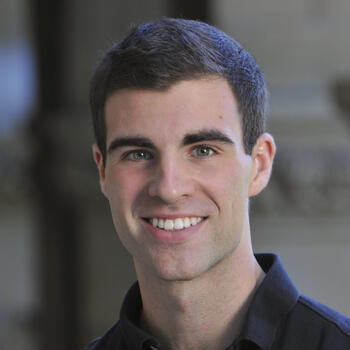
Patrick Cirenza

“My thesis topic definitely evolved over time,” Cirenza said. “I really did not know that much about cyber weapons. I initially wanted to look at non-state actors in cyber space and I asked Professor Scott Sagan about that and he asked what I knew about cyber and the reality was I really did not know anything. But I still really wanted to study it and at the time I was in Condoleezza Rice’s seminar and she suggested examining the analogy between nuclear and cyber weapons, which was being used a lot at the time. I went through several different topics and ultimately landed on deterrence.”

Cirenza was advised by FSI Senior Fellow Coit Blacker, who co-directs the honors program with Crenshaw, and by consulting professor Phil Taubman. Next fall he will attend Cambridge for a one year M.Phil program in international relations. After that he hopes to join the Marine Corps infantry.

“I never wanted a desk job in my twenties and I think it’s the best way to serve my country at this time,” he said.

The newly created Slusser Prize goes to the thesis that best contributes to the development of “permanent world peace.” Lamiot’s thesis, “When Blue Helmets Do Battle: Civilian Protection in the Democratic Republic of the Congo” examined whether the use of force against rebel groups in the DRC by UN peacekeepers had any effect on atrocities committed against civilians. He was advised by FSI Senior Fellow Stephen Stedman, who formerly served as Assistant Secretary-General and Special Advisor to the Secretary-General of the United Nations.

Lamiot started formulating his thesis topic when he was working in the U.S. embassy in the DRC. “I worked in the unit that is tasked with monitoring the conflict in the eastern part of the country. Part of my work was investigating a massacre that had taken place in that region about a month before I arrived in country. The massacre was of interest to the U.S. government because the Congolese and U.N. peacekeeping forces stationed nearby did not respond to the massacre despite knowing that it was going on,” he recounted.

Image
Teo Lamiot

“This sparked my interest and, at first, I wanted to answer the question why do peacekeepers use force in some cases but not in others, but I ultimately decided on answering what happens when they do use force. I’m hoping that my argument that in some cases using force has positive effects and decreases rebel violence against civilians informs these decision-makers on the ground when they are choosing what to do.”

After graduation Lamiot will be on a Center for Democracy, Development, and Rule of Law fellowship in Uganda doing development work. “I’ll likely be working on democratic and political development. I’m trying to learn something about how outside actors can try to bring about these development outcomes in foreign countries.”

The Firestone Medal is a Stanford-wide prize awarded to the top ten percent of all honors theses in social science, science, and engineering. Grossman, who will also graduate with a B.A. Political Science, wrote hers on homeland security and the evolution of terrorism advisory systems. She was advised by CISAC Co-Director Amy Zegart.

“I really wanted to look at effectiveness of communication and intelligence sharing, but in a way that I could actually see government information. That led me to public warning systems for terrorism where there is a lot of public information available. Not a lot has been written on how effective they are, how they operate, or how they have evolved,” Grossman said.

Image
Taylor Grossman

After graduation she plans on joining the Hoover Institution as a research assistant.

“I feel like I majored in CISAC. Ever since I took the class ‘The Face of Battle’ with Professor Scott Sagan and Colonel Joe Felter, I’ve been hooked on international security and the issues CISAC focuses on. I think the honors program has been the defining part of my undergraduate career. It was really rewarding and challenging and I’m glad I did it.”

Grossman and Cirenza were also elected to the Phi Beta Kappa Society in May 2015, as was Geo Saba, a political science major. Phi Beta Kappa is a nationwide society honoring students for the excellence and breadth of their undergraduate scholarly accomplishments.

Additionally, the Stanford Alumni Association (SAA) selected Cirenza, Grossman, and Akshai Baskaran, who majored in chemical engineering, to receive an Award of Excellence. 

Congratulations to all graduates of the Class of 2015: Akshai Baskaran, Patrick Cirenza, Kelsey Dayton, Taylor Grossman, Sean Hiroshima, Annie Kapnick, Sarah Kunis, Teo Lamiot, Austin Lewis, Sam Rebo, Geo Saba, Eliza Thompson, and Adrienne von Schulthess.

Hero Image
Honors Class of 2015
Program co-directors Martha Crenshaw (front) and Coit Blacker (right), along with T.A. Shiri Krebs (far left) are on hand to congratulate the CISAC Honors Class of 2015
Rod Searcey
All News button
1
Authors
News Type
News
Date
Paragraphs

U.S. Sen. Dianne Feinstein (D-Calif.) told a Stanford audience Thursday that mass surveillance programs are designed to find possible terrorists, not snoop on American citizens.

She pointed to the rise of groups like ISIS – now in 12 countries, she said – and the gruesome spectacles of their brand of terrorism as proof that the world is more dangerous than ever.

"I don't think during my lifetime I've ever seen the degree of evil that is out there in the world today," said Feinstein, noting mass murders and beheadings of innocent civilians, including children. "These [surveillance] programs aim to protect this country, pure and simple. They're not aimed to go after Americans."

Feinstein was the final speaker in the yearlong series titled "The Security Conundrum." She spoke in a colloquy format with Stanford's Philip Taubman, consulting professor at Stanford's Center for International Security and Cooperation (CISAC) and former Washington bureau chief of the New York Times. 

Sen. Dianne Feinstein was the final speaker in the yearlong series titled 'The Security Conundrum.' 

Image

The discussion comes during a national debate on how to strike the right balance between security and liberty when technology now makes it possible for the government to collect phone and email data on citizens. With the USA Freedom Act expiring on June 1, Congress is considering legislation to reform the National Security Agency's mass surveillance program.

"We recognize that some reform is in order," said Feinstein, who plans to fly back to Washington for a rare Sunday Senate session on the expiring law.

"The big reform is that the data would be held by the phone companies and not the NSA," she said. If red flags resulted in queries, then warrants would have to be approved.

She took issue with descriptions of those programs as "mass surveillance." In 2013, warrants were sought in just 12 cases out of 288 queries about possible suspects. She said it is a selective process to find a suspect who raises enough concerns to trigger a query.

Feinstein's talk, titled "Congressional Oversight and the Intelligence Community," was held at CEMEX Auditorium.

Feinstein served as chair of the Senate Select Committee on Intelligence from 2009 to 2014 and is now the ranking minority member. She played a leading role in the Senate investigation of the Central Intelligence Agency detention and interrogation program following the terrorist attacks of Sept. 11, 2001.

'Miscarriages of justice'

Taubman asked Feinstein if she was worried that the surveillance programs could track law-abiding citizens, like more primitive efforts in the 1960s and '70s that targeted political and civil rights groups. Feinstein acknowledged that abuses happened in the past, but that congressional oversight of the programs – as is the case today – is essential to a fair process.

In particular, Feinstein decried the government's interrogation process of terrorism suspects at Guantanamo Bay that resulted in claims of torture. Her committee reviewed considerable intelligence data on that issue. "We found there were terrible miscarriages of justice," she said.

She described intelligence agencies as akin to "presidents" in the power they wield. "How do you make these agencies follow the law?" she asked. The only way is to "get in deep enough and close enough" to make it impossible for them to tell an "untruth" in a congressional hearing, she said.

Taubman suggested that it's extremely hard for a few dozen congressional staffers and members to oversee large agencies that employ thousands of people. "You're outgunned," he said.

Feinstein replied that "we have to look beyond the hearing." She said bipartisanship and a focus on producing effective legislation that addresses real problems is critical. "That's the nature of what we do."

She added that no other country in the world has an intelligence committee with as strong an oversight function as does the United States. China and Russia, for example, have growing intelligence agencies but no one watching them.

Feinstein agreed with Taubman that too much secrecy is detrimental to a democratic society. She said she wished she would have held more open, public meetings while in charge of the intelligence committee.

Feinstein expects that renewing the legislation will depend on perhaps three votes in the Senate. "It's possible. If not, the law ends at midnight and that creates a chink in our armor. There's no question in my mind," she said.

Feinstein said there is a "backup" bill that is similar to the USA Freedom Act, but she would prefer to reform the original legislation.

Taubman asked her if the surveillance efforts were actually preventing terrorist acts.

Feinstein said that people are arrested every week under the program, and that relevant information also goes to other countries to help them.

But more than ever, she noted, it's the private sector – not the government – that is extremely enterprising in collecting vast amounts of data from people, such as how they use their cellphones or surf the web.

CIA, China an issue

A California Democrat and Stanford graduate, Feinstein has served in the U.S. Senate since 1993.

When asked why she continues to work as a public servant, she said that 9/11 was a pivotal point in her life. That tragic event and flawed intelligence regarding the justification for the war in Iraq convinced her that a senior position on the intelligence committee would give her a way to help protect her country and fellow citizens.

Taubman expressed amazement that the CIA was actually spying on Feinstein's committee during its review of the hostage intelligence data.

"It was a real dust-up, there's no question about. I think it was a real violation of the separation of powers," she said.

On other issues, such as the rise of China, Feinstein said that country is now practicing "soft power" and flexing its muscles in the South China Sea. Plus, China is "eating our lunch" in regard to cybersecurity.

"I am very worried," she said. "I do not see China as a necessary enemy, but it seems to be going the opposite direction now."

In addition to CISAC, sponsors of "The Security Conundrum" series included the Freeman Spogli Institute for International Studies, the Hoover InstitutionStanford Continuing StudiesStanford in Government and Stanford Law School.

The series "was designed to be an open inquiry in the ongoing debate on how to balance security and liberty," said Amy Zegart, co-director of CISAC and a senior fellow at the Hoover Institution.

This year the series has also included Gen. Michael Hayden, the former director of the National Security Agency and the CIA; journalist Barton Gellman; and former U.S. Sen. Mark Udall.

Hero Image
camera logo 0
All News button
1
Authors
News Type
News
Date
Paragraphs

What is it about terrorism that makes it so difficult to study and counteract through U.S. government policy? That’s the central question CISAC Senior Fellow Martha Crenshaw hopes to answer in an upcoming book she is co-authoring with Gary LaFree, Director of the National Center for the Study of Terrorism and Responses to Terrorism (START), where Crenshaw serves as lead investigator. at the University of Maryland. 

The idea for the book stems from Crenshaw’s long career in grappling with terrorism and observing how governments struggle to combat it. She has been writing and thinking about terrorism since the 1970s and is currently conducting a multi-year project mapping the evolution of violent extremist groups. However, the difficulties inherent in the topic have not much changed for academics and policymakers.

The problems start with defining terrorism, something that has bedeviled both researchers and policymakers for decades, Crenshaw told a Stanford audience in CISAC. 

“We are still arguing about what terrorism means. But even if you agree on a definition, then applying it to the real world remains difficult,” she said.

Beyond semantics, the study of terrorism faces a series of hurdles inherent to the topic. An overarching social theory of the causes of terrorism remains elusive, and there is no agreement on whether terrorism actually works. 

Additionally, academics have used many different levels of analyses–individual, organizational, cultural, economic, and others–but have yet to agree on which analyses bear more fruit.

Despite what you might gather from what’s said in the media, terrorism events are actually very rare. Terrorist attacks that kill large amounts of people are even more rare. “9/11 was a black swan, a highly consequential event but only a one-of-a-kind. We show why it’s the case that terrorism is very rare and therefore makes it very hard to predict any kind of trends,” Crenshaw said.

Most of the information available is about attacks that actually happened. But there are many more plots, about ten times more, than actual attacks. Crenshaw said she and her research assistants have used news media and government documents to identify failed and foiled plots against the United States, European Union, and NATO countries plus Australia and New Zealand. The plots have been coded in a dataset that she will analyze.  

There are additional obstacles in the way of researchers and policymakers. 

Attributing responsibility for attacks is difficult, which hampers research and government responses. “How do you know who to respond against? The concept of terrorism is mixed in with insurgency. It’s hard to think of a policy that targets one but not the other,” Crenshaw said. Terrorist organizations are very small and the boundaries between groups are extremely porous. Yet, there is not a preponderance of lone wolves.

Sometimes, the U.S. government obstructs research. Crenshaw lamented the over-classification of government documents, and drew particular attention to the designation “For Official Use Only”, which is not a classification but a designation that seems to depend on the agency using it. 

“If you are analyzing illegal forms of violence there are three sources of information: governments, victims, and terrorists. Victims are difficult to find. Self-reporting is even harder and usually unfeasible. And governments are very secretive. We would like to see more transparency and openness on their part,” she said.

“I think what is being done here is really important when it comes to the question of why it’s so hard to find policy solutions for terrorism,” said Betsy Cooper, a Law and International Security Postdoctoral Fellow at CISAC, who offered commentary on the book draft to the seminar. “A lot of what is in the chapter about the state of counter-terrorism research is very important.” 

“I learned a lot especially about the automation in the global terrorism database and it poses some interesting questions. Is something terrorism because we say it is or can we use objective criteria regardless of whether you see it as something else?” 

Hero Image
gunpicture
All News button
1
Paragraphs

This is a letter response to an article by Eric Schlosser on a break-in at the Y-12 nuclear facility. The letter argues that security vulnerability should not be translated into an exaggerated threat of nuclear terrorism, fear of which has had serious negative effects on American democracy and poses a more immediate threat than that of a nuclear terrorist attack.

All Publications button
1
Publication Type
Commentary
Publication Date
Authors
Leonard Weiss
News Type
News
Date
Paragraphs


In this talk sponsored by the Stanford Institute for Economic Policy Research, three CISAC scholars discuss the Islamic State, Iran and the Taliban and the threats they impose to American security. The talk is moderated by Brad Kapnick, a Partner at Katten & Temple, LLP, and SIEPR Advisory Board member. Joining him are Martha Crenshaw, a senior fellow at CISAC and the Freeman Spogli Institute for International Studies and professor, by courtesy, of political science; CISAC Senior Fellow Scott Sagan, the Caroline S.G. Munro Professor of Political Science; former U.S. Ambassador to Afghanistan Karl Eikenberry, the William J. Perry Fellow at CISAC and a consulting professor at the Freeman Spogli Institute.

This is an abbreviated version of the talk below. The full talk can be found here.


Hero Image
isis
Hashid Shaabi (Popular Mobilization) forces allied with Iraqi forces chant slogans against the Islamic State in Tikrit, March 30, 2015.
Reuters
All News button
1
-

Abstract: The purpose of this book project is to explain what it is about terrorism that makes it inherently difficult for the American government to formulate an effective counterterrorism policy. Why is terrorism such an intractable problem?  What are the obstacles to developing a consistent and coherent counterterrorism strategy?  The barriers that we identify flow from the issue itself, not the particular political predispositions of individual policy makers or flawed organizational processes.  We also find that scholars and policy makers face similar difficulties – the study of terrorism is often confused and contentious, and the study of counterterrorism can be even more frustrating.  

The book is co-authored by Martha Crenshaw and  Gary LaFree, Director of the National Center for the Study of Terrorism and Responses to Terrorism (START) at the University of Maryland, as well as professor in the Department of Criminology and Criminal Justice.


About the Speaker: Martha Crenshaw is a senior fellow at CISAC and FSI and a professor of political science by courtesy at Stanford. She was the Colin and Nancy Campbell Professor of Global Issues and Democratic Thought and professor of government at Wesleyan University in Middletown, Conn., where she taught from 1974 to 2007. She has written extensively on the issue of political terrorism; her first article, "The Concept of Revolutionary Terrorism," was published in the Journal of Conflict Resolution in 1972. Her recent work includes “Trajectories of terrorism: Attack patterns of foreign groups that have targeted the United States, 1970–2004,” in Criminology & Public Policy, 8, 3 (August 2009) (with Gary LaFree and Sue-Ming Yang), “The Obama Administration and Counterterrorism,” in Obama in Office: the First Two Years, ed. James Thurber (Paradigm Publishers, 2011), and “Will Threats Deter Nuclear Terrorism?” in Deterring Terrorism: Theory and Practice, ed. Andreas Wenger and Alex Wilner (Stanford University Press, 2012). She is also the editor of The Consequences of Counterterrorism (Russell Sage Foundation, 2010). In 2011 Routledge published Explaining Terrorism, a collection of her previously published work.

She served on the Executive Board of Women in International Security and is a former President and Councilor of the International Society of Political Psychology (ISPP). She coordinated the working group on political explanations of terrorism for the 2005 Club de Madrid International Summit on Democracy, Terrorism and Security. In 2005-2006 she was a Guggenheim Fellow. Since 2005 she has been a lead investigator with the National Center for the Study of Terrorism and the Response to Terrorism (START) at the University of Maryland, funded by the Department of Homeland Security. In 2009 she was awarded a grant from the National Science Foundation/Department of Defense Minerva Initiative for a project on "mapping terrorist organizations." She serves on the editorial boards of the journals International Security, Political Psychology, Security Studies, Dynamics of Asymmetric Conflict, and Terrorism and Political Violence. She is currently a member of the Committee on Evaluating the Effectiveness of the Global Nuclear Detection Architecture of the National Academies of Science.


Encina Hall (2nd floor)

Not in residence

0
Senior Fellow at the Freeman Spogli Institute for International Studies, Emerita
Professor, by courtesy, of Political Science, Emerita
crenshaw_martha.jpg PhD

Martha Crenshaw is a senior fellow emerita at CISAC and FSI. She taught at Wesleyan University in Middletown, Connecticut, from 1974 to 2007.  She has published extensively on the subject of terrorism.  In 2011 Routledge published Explaining Terrorism, a collection of her previously published work.  A book co-authored with Gary LaFree titled Countering Terrorism was published by the Brookings Institution Press in 2017. She recently authored a report for the U.S. Institute of Peace, “Rethinking Transnational Terrorism:  An Integrated Approach”.


 She served on the Executive Board of Women in International Security and is a former President and Councilor of the International Society of Political Psychology (ISPP). In 2005-2006 she was a Guggenheim Fellow. She was a lead investigator with the National Consortium for the Study of Terrorism and the Response to Terrorism (START) at the University of Maryland from 2005 to 2017.  She is currently affiliated with the National Counterterrorism, Innovation, Technology, and Education (NCITE) Center, also a Center of Excellence for the Department of Homeland Security.  In 2009 the National Science Foundation/Department of Defense Minerva Initiative awarded her a grant for a research project on "mapping terrorist organizations," which is ongoing.  She has served on several committees of the National Academy of Sciences.  In 2015 she was elected a Corresponding Fellow of the British Academy.  She is the recipient of the International Studies Association International Security Studies Section Distinguished Scholar Award for 2016. Also in 2016 Ghent University awarded her an honorary doctorate.  She serves on the editorial boards of the journals International Security, Security Studies, Dynamics of Asymmetric Conflict, Orbis, and Terrorism and Political Violence.

Date Label
Martha Crenshaw Senior Fellow at the Freeman Spogli Institute for International Studies Professor, by courtesy, of Political Science Speaker Stanford University
Seminars
-

Abstract: Adjudication of national security poses complex challenges for courts. In Judicial Review of National Security, David Scharia explains how the Supreme Court of Israel developed unconventional judicial review tools and practices that allowed it to provide judicial guidance to the Executive in real-time. In this book, he argues that courts could play a much more dominant role in reviewing national security, and demonstrates the importance of intensive real-time inter-branch dialogue with the Executive, as a tool used by the Israeli Court to provide such review. This book aims to show that if one Supreme Court was able to provide rigorous judicial review of national security in real-time, then we should reconsider the conventional wisdom regarding the limits of judicial review of national security. 

About the Speaker: Dr. David Scharia (PhD, LLM) heads the Legal and Criminal Justice Group at the United Nations Security Council Counter Terrorism Committee Executive Directorate (CTED). Before joining the United Nations, Dr. Scharia worked at the Supreme Court division in the Attorney General office in Israel where he was lead attorney in major counter-terrorism cases. Dr. Scharia served as a Member of the experts’ forum on "Democracy and Terrorism” established by Israel leading think-tank the Israel Democratic Institute. He was National Security Scholar-in-Residence at Columbia Law School and currently serves as a member of the professional board of the International Institute for Counter Terrorism (ICT). Dr. Scharia is a renowned expert on law and terrorism and the author of two books.  

Encina Hall (2nd floor)

David Scharia Coordinator of the Legal and Criminal Justice Group at the United Nations Security Council Counter Terrorism Committee Executive Directorate (CTED) Speaker United Nations Security Council
Seminars
Paragraphs

Fear of nuclear weapons is rational, but its extension to terrorism has been a vehicle for fear-mongering that is unjustified by available data. The debate on nuclear terrorism tends to distract from events that raise the risk of nuclear war, the consequences of which would far exceed the results of terrorist attacks. And the historical record shows that the war risk is real. The Cuban Missile Crisis and other confrontations have demonstrated that miscalculation, misinterpretation, and misinformation could lead to a "close call" regarding nuclear war. Although there has been much commentary on the interest that Osama bin Laden, when he was alive, reportedly expressed in obtaining nuclear weapons, evidence of any terrorist group working seriously toward the theft of nuclear weapons or the acquisition of such weapons by other means is virtually nonexistent. The acquisition of nuclear weapons by terrorists requires significant time, planning, resources, and expertise, with no guarantees that an acquired device would work. It requires putting aside at least some aspects of a group’s more immediate activities and goals for an attempted operation that no terrorist group has accomplished. While absence of evidence does not mean evidence of absence, it is reasonable to conclude that the fear of nuclear terrorism has swamped realistic consideration of the threat.

All Publications button
1
Publication Type
Journal Articles
Publication Date
Journal Publisher
Bulletin of the Atomic Scientists
Authors
Leonard Weiss
Number
Volume 71, Issue 2
Paragraphs

What’s sometimes referred to as the global jihadist “movement” is actually extremely fractured, CISAC's terrorism expert Martha Crenshaw writes in this commentary in The Atlantic. It’s united by a general set of shared ideological beliefs, but divided organizationally and sometimes doctrinally. Whether to fight the “near enemy” (local regimes) or the “far enemy” (such as the United States and the West), for example, has been contentious since the 1990s, when Osama bin Laden declared war on the United States.

Crenshaw, who founded the Mapping Militant Organizations project at CISAC, says rivalry among like-minded militant groups is as common as cooperation. Identities and allegiances shift. Groups align and re-align according to changing expectations about the future of the conflicts they’re involved in, as well as a host of other factors, such as competition for resources, leadership transitions, and the defection of adherents to rival groups that appear to be on the ascendant.

All Publications button
1
Publication Type
Commentary
Publication Date
Journal Publisher
The Atlantic
Authors
Martha Crenshaw
-

Abstract: Imagine two guys. Second-generation Muslim-American Ahmad feels threatened by the ‘corrupting influences’ within his suburban factory town, detests his mother’s ‘western’ ways, and seeks out a radical imam for guidance. In contrast, Palestinian-born Mike worked as an Intel engineer, married an American Christian, and played company softball in his spare time. If only one is a terrorist, it is easy to pick out which one. Right? Wrong. Maher “Mike” Hawash served a six-year sentence for conspiring to aid the Taliban. Ahmad Mulloy is the fictional protagonist of John Updike’s novel, Terrorist.

It is easy to assume that terrorists are poorly integrated or disconnected from society. But this talk argues that such assumptions about the ‘typical terrorist’ are not only wrong, but dangerous. I argue that better immigrant integration will not stop terrorism – because most terrorists are just as well, if not better, integrated into western societies than other immigrants. Further, policies that exacerbate differences between immigrants and the native-born actually may facilitate radicalization of new terrorists; they provide new fuel for the argument that immigrants, and especially Muslims, are being disproportionately targeted.

About the Speaker: Betsy Cooper is a Law and International Security Postdoctoral Fellow with CISAC, working on projects related to state immigration policy. Dr. Cooper recently finished serving as a Yale Public Interest Fellow, working with the Department of Homeland Security's Office of Policy on Comprehensive Immigration Reform and related issues. She is a 2012 graduate of Yale Law School, after which she clerked for Judge William Fletcher on the Ninth Circuit Court of Appeals. Dr. Cooper is the author of over twenty manuscripts and articles on US and European immigration and refugee policy, and has consulted for Atlantic Philanthropies (Dublin, Ireland), the Prime Minister's Strategy Unit in London, the World Bank, and a number of immigration think tanks. In addition to her law degree, Betsy holds a DPhil in Politics from Oxford University, an M.Sc. in Forced Migration from Oxford University, and a B.A. in Industrial and Labor Relations from Cornell University.

Encina Hall (2nd floor)

0
Affiliate
betsy_cooper_headshot.png

Betsy Cooper is the founding Director of the Aspen Policy Academy. A cybersecurity expert, Dr. Cooper joined the Aspen Institute after serving as the Executive Director of the Berkeley Center for Long-Term Cybersecurity at the University of California, Berkeley. 

Previously, Dr. Cooper served at the U.S. Department of Homeland Security as an attorney advisor to the Deputy General Counsel and as a policy counselor in the Office of Policy. She has worked for over a decade in homeland security consulting, managing projects for Atlantic Philanthropies in Dublin, the Prime Minister’s Strategy Unit in London, and the World Bank, and other organizations. 

In addition, Dr. Cooper has clerked for Berkeley Law professor and Judge William Fletcher on the Ninth Circuit Court of Appeals. She completed a postdoctoral fellowship at Stanford’s Center for International Security and Cooperation (where she currently is a nonresident affiliate), as well as a Yale Public Interest Fellowship. Dr. Cooper has written more than twenty manuscripts and articles on U.S. and European homeland security policy. She is also a Senior Advisor at Albright Stonebridge Group. 

Dr. Cooper earned a J.D. from Yale University, a D.Phil. in Politics from Oxford University, an M.Sc. in Forced Migration from Oxford University, and a B.A. in Industrial and Labor Relations from Cornell University. She speaks advanced French. She is based in the San Francisco Bay Area.

Date Label
Betsy Cooper Law and International Security Postdoctoral Fellow, CISAC Speaker CISAC
Seminars
Subscribe to Terrorism