
Reagan, Gorbachev and What Reykjavik Started
Reagan, Gorbachev and What Reykjavik Started
Discussions in Höfði House in fact produced important breakthroughs that were later developed by U.S. and Soviet negotiators at talks in Geneva. They fueled the start of what became a “golden age” of arms control.

Forty years ago, on October 12, 1986, President Ronald Reagan and Soviet leader Mikhail Gorbachev glumly emerged from their second day of arms control discussions at Höfði House near Reykjavik. They had come close to a landmark agreement on eliminating nuclear weapons but fell short in the end. One could see failure and disappointment in the faces of both men.
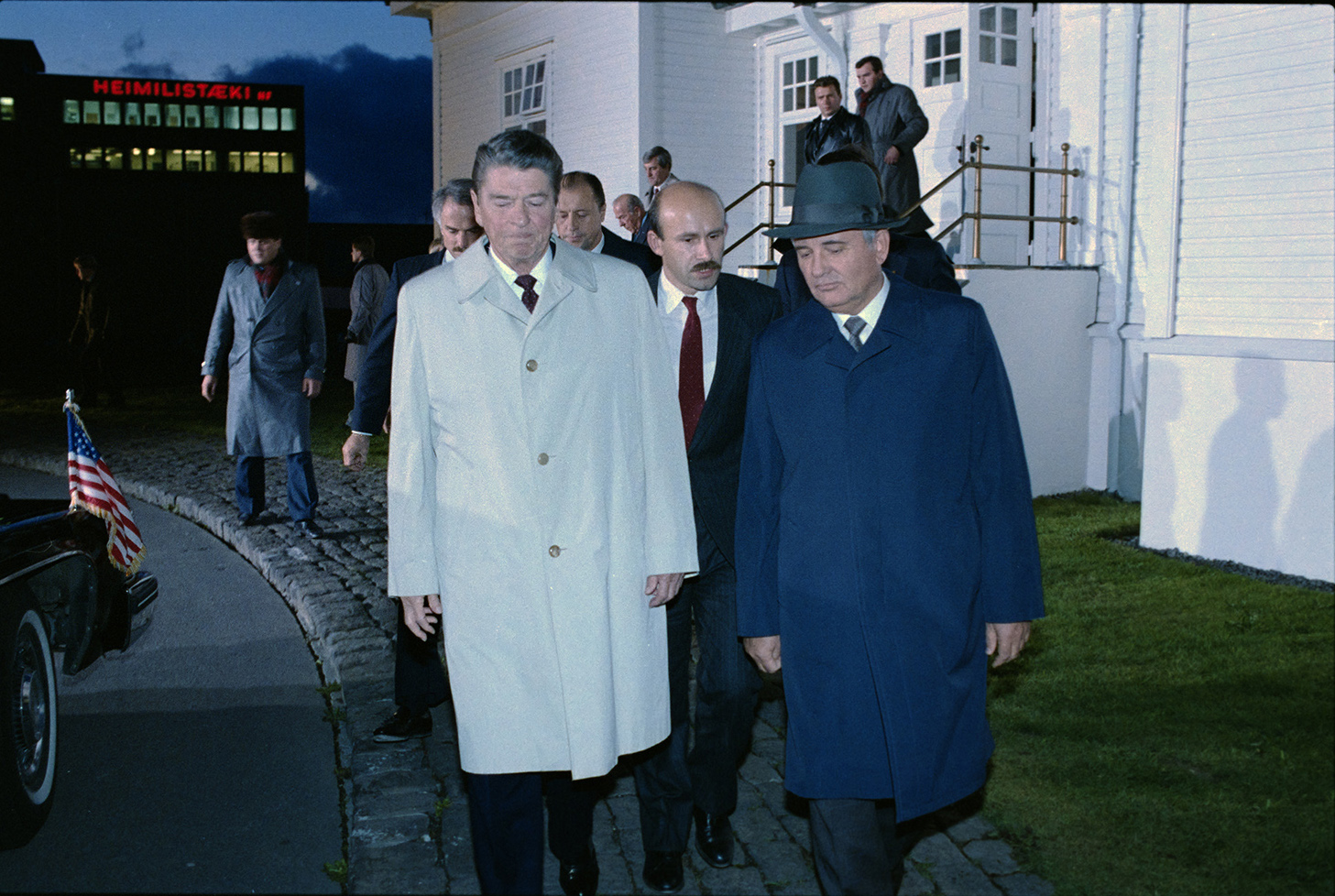
However, the discussions in Höfði House in fact produced important breakthroughs that were later developed by U.S. and Soviet negotiators at talks in Geneva. They fueled the start of what became a “golden age” of arms control.
Arms Control Possible?
The early years of the 1980s offered little reason for optimism about arms control. Détente had broken down, Soviet deployment of the SS-20 intermediate-range ballistic missile had exacerbated a major European nuclear imbalance, and the 1979 Strategic Arms Limitation Treaty (SALT II) remained unratified. Moreover, Reagan in 1981 launched a U.S. military build-up, believing the United States lagged behind the Soviets.
U.S. and Soviet negotiators began talks on intermediate-range nuclear forces (INF) and strategic offensive arms (START) in Geneva in 1981 with limited prospects for success. In the INF negotiations, Washington proposed a zero-zero outcome: the Soviets would eliminate all their SS-20 and older intermediate-range missiles, in return for which the United States would not deploy new ground-launched cruise and Pershing II ballistic missiles. Soviet negotiators instead proposed to prohibit U.S. missile deployments and lock in a Soviet advantage at the intermediate-range level.
Things did not develop much better in the START negotiations. The original U.S. proposal focused on intercontinental ballistic missiles and submarine-launched ballistic missiles but left heavy bombers, an area of U.S. advantage, unconstrained. Soviet negotiators rejected that, accepting only that the subject was reduction, not limitation, of strategic offensive arms.
Neither negotiation had made any real progress by November 1983, when the first U.S. ground-launched cruise and Pershing II ballistic missiles arrived in Britain and West Germany. The Soviets walked out of the INF negotiations, then broke off the START talks as well.
The two countries only agreed to resume negotiations in early 1985, with the INF and START talks joined by a third group on defense and space weapons. Work proceeded in the three sets of talks with the ice beginning to break a bit in August 1986. Then came Reykjavik.
Reykjavik Launches a “Golden Age”
In Reykjavik, Gorbachev brought some dramatic new proposals, which were first discussed by the two leaders and then taken up by their accompanying officials. In their discussions, Reagan and Gorbachev went further, reaching an agreement in principle on a plan under which the United States and Soviet Union would eliminate all their nuclear weapons over a ten-year period. However, differences over the development and testing of strategic missile defenses foiled the agreement on nuclear arms. The grim faces of the two leaders as they exited Höfði House suggested the meeting had been a bust.
That was not the case. In side talks, U.S. and Soviet negotiators discussed a zero-zero outcome for intermediate-range missiles in Europe. The sides agreed on limits on strategic delivery vehicles and strategic warheads that would result 30-40 percent reductions by each. Reykjavik gave an important impulse to U.S.-Soviet negotiations.
In December 1987, just fourteen months after Reykjavik, Reagan and Gorbachev signed the INF treaty banning all U.S. and Soviet ground-launched cruise and ballistic missiles with a range between 500 and 5,500 kilometers under very intrusive verification measures. By June 1991, the two countries had destroyed some 2,700 missiles.
In 1988, the United States and Soviet Union agreed to a joint verification experiment, allowing monitors to be present during an underground nuclear test of the other side. Data from the experiment cleared up questions and allowed the 1974 Threshold Test Ban Treaty to enter into force. It limited the countries to nuclear tests with a yield of no more than 150 kilotons.
Negotiations on conventional forces recorded dramatic progress in 1990. NATO and Warsaw Pact members signed the Conventional Armed Forces in Europe Treaty, which constrained tanks and other categories of military equipment. In the following years, the signatories destroyed more than 50,000 pieces of equipment. The Conference on Security and Cooperation in Europe that same year produced the Vienna Document on Confidence- and Security-Building Measures, such as pre-notification of military exercises and the possibility for observation. The Open Skies Treaty, allowing observation flights by unarmed aircraft over the territory of the signatories, was concluded in 1992.
While Reykjavik resolved the major START limits, debates over ancillary issues meant that the START I Treaty was concluded only in August 1991. It entered into force in 1994. Unilateral initiatives by the United States and Soviet Union (then Russia) in autumn 1991 and early 1992 led to the elimination of many thousands of U.S. and former Soviet nuclear warheads. In January 1993, the United States and Russia concluded the START II Treaty, which would further reduce U.S. and Russian strategic nuclear forces, though it never entered into force.
Conclusion of the 1996 Comprehensive Test Ban Treaty, banning all nuclear tests, built on earlier test moratoria adopted by the Soviet Union, United States and others. It was the last major achievement of the 1986-96 arms control “golden age.” (Unfortunately, the CTBT has not yet entered into force.)
Those ten years produced significant arms control progress. Among other things, the total number of global nuclear warheads declined from more than 70,000 in 1986 to some 12,000 today.
Reagan and Gorbachev deserve great credit for launching the era. Reagan had seemed the epitome of the Cold War warrior during his first term but became greatly interested in reducing nuclear arms in his second. Gorbachev, hoping to modernize the Soviet Union, challenged officials in Moscow to show why so many nuclear weapons were necessary for the country’s security.
Is Arms Control Dead Now?
Today, things look bleak on the arms control front. No legal limits constrain the number of U.S. and Russian nuclear weapons. Almost all nuclear-armed states are increasing the size of their active stockpiles. No talks are taking place between Washington, Moscow and Beijing about how they might limit nuclear forces or address related issues such as missile defense.
The situation looks similar to that in the early 1980s. But things then changed quickly. The calendar needed just four years to go from the collapse of negotiations to signature of a landmark treaty banning an entire class of U.S. and Soviet missiles. Such a swing could happen again, which is reason for government officials and outside experts to keep thinking about how nuclear arms and related weapons might be brought under control and reduced.
U.S.-Soviet nuclear arms negotiations got their start in the late 1960s when both Washington and Moscow seemed to recognize that, if Side A built up its nuclear forces and Side B did the same, neither would achieve a net increase in security. Perhaps officials in Washington, Moscow, Beijing and other nuclear-armed capitals will at some point come to that same realization and pursue its logical implications, just as Reagan and Gorbachev did.