
Health Policy Forum: The Possible Peril of Engineered `Mirror Life’
Health Policy Forum: The Possible Peril of Engineered `Mirror Life’
Stanford experts discuss the high-stakes scientific, ethical and regulatory challenges behind an emerging science known as “mirror life.”

Proteins and nucleic acids—molecules crucial to all natural life—are “single handed” and interact with other biomolecules of only the correct handedness, like a glove that only fits one hand. Our genetic material, DNA and RNA, is created from right-handed building blocks, while proteins are made from left-handed amino acids.
Some researchers recently proposed creating life from synthetic mirror-image molecules—ones with the opposite handedness—motivated by curiosity and questions about the origin of life. This would be an extraordinary departure from anything we know, and if such an organism escaped from the laboratory, the consequences could range from widespread fatal infections in humans to irreversible ecological damage across the planet. Mirror organisms might infect animals and plants and invade natural microbial communities because they would be impervious to most natural defenses and immune systems.
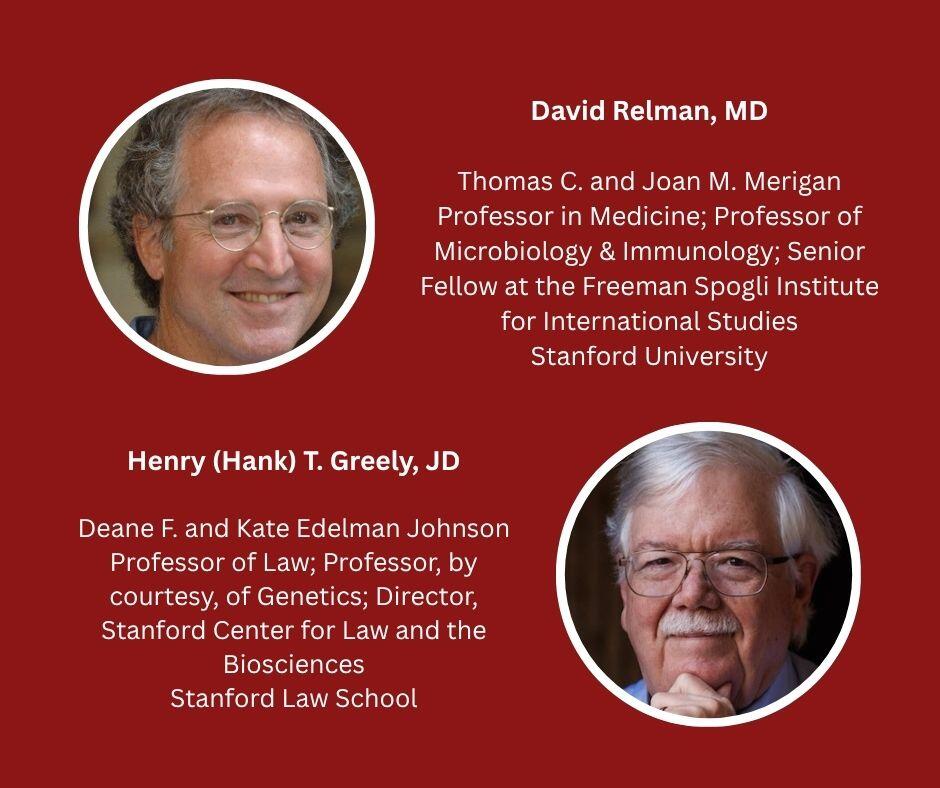
While such “mirror life” is unlikely for at least a decade and would require substantial funding and major breakthroughs, it’s the kind of risk we should anticipate now, according to David Relman, MD, a professor of medicine and of microbiology and immunology and a senior fellow at the Freeman Spogli Institute for International Studies.
“For me, it was two years of gradually coming to grips with the possibility that, now, for the first time, there was something that could conceivably threaten much of life on the planet,” said Relman, a founding member of the National Science Advisory Board for Biosecurity and a former senior advisor in the Office of Pandemic Preparedness and Response Policy at the White House.
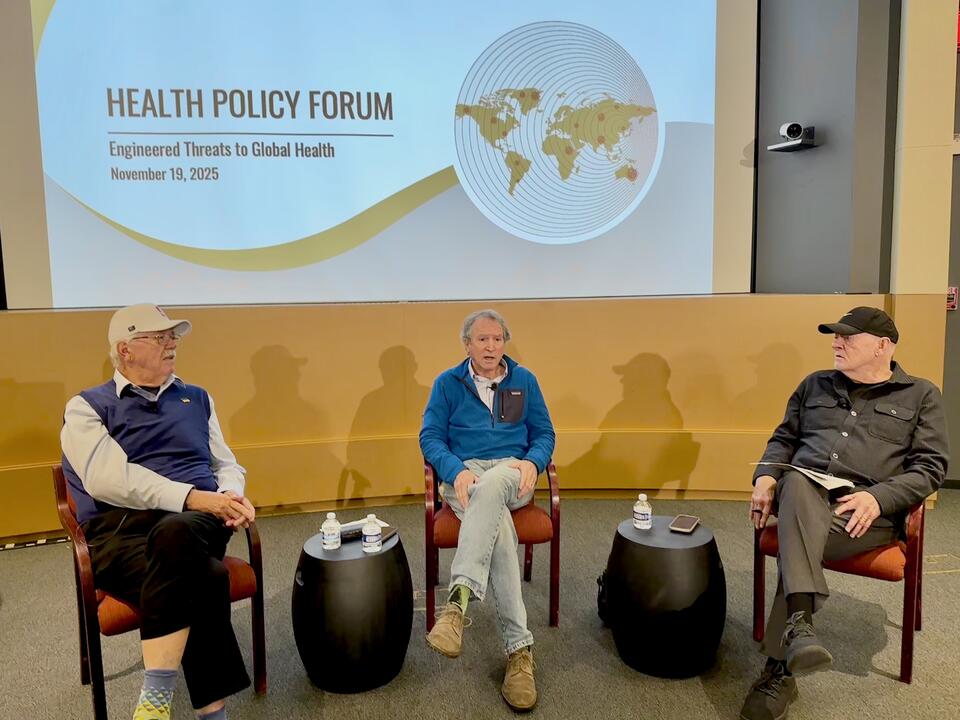
Relman was a headliner at the recent Stanford Health Policy Forum: Engineered Threats to Global Health, in conversation with Hank Greely, JD, a law professor who focuses on ethical, legal, and social issues in the biosciences and director of the Center for Law and the Biosciences at Stanford Law School. The talk was moderated by Paul Costello, an adjunct professor in the Stanford Department of Medicine.
Relman came at the biological conundrum from a scientific perspective, while Greely tackled the legal and ethical implications.
Relman told the policy forum that scientists working on the issue, “realized after several years that we were unable to disprove the possibility that what we had been talking about was something that could plausibly threaten a great deal of life on this planet. And as much as we hoped that there might be a fatal flaw in our logic—we could not find one.”
He joined more than a hundred other scientists from around the world at the Institut Pasteur in Paris this summer for the first conference on the feasibility and potential risks of mirror bacteria. They held a publicly streamed symposium on the science, with Relman speaking about how mirror bacteria might interact with human and nonhuman hosts.
And last December, Relman and 37 other scientists penned a policy statement in Science magazine that concluded mirror bacteria could “broadly evade many immune defenses of humans, animals and plants” and called for a ban on research that had the goal of creating mirror bacteria.
Relman said the article was intended to raise the issue with a broader audience and to make it clear that the scientists who had proposed the creation of this mirror form of life were now advocating for its ban.
“The same scientists who were calling for a moratorium on the very work that they had once been so enthusiastic about, to us, would also seem to be a message to the public that scientists were willing to take ownership of their ideas and the implications of their ideas—and even to declare that what they had thought was a good idea was in fact probably a very bad idea,” he said.
Containing the Risks
Greely agrees there’s a potential risk to mirror life and that a moratorium on its creation is a good idea, although he’s focused on the uncertainties.
“I’ve been working in bioscience for about 35 years and one thing I’ve learned is that it’s almost always more complicated than we think it’s going to be,” he said. “Life is extraordinarily complex, so I’m not convinced—and I don’t think David is convinced—that this would be the end of all life on Earth. But I am convinced that there is a significant enough risk that we should do something about it.”
Both he and Relman believe an international group, such as the United Nations or other groups of nations, could oversee recommendations and regulations of mirror biology. When human genome editing became a reality, for example, Greely said international and national bodies, such as the WHO, the U.S. National Academy of Sciences, and UK’s Royal Society, issued a series of guidelines. Their counsel has largely held.
Unfortunately, Greely said, this may not be the moment for regulating mirror life.
“We are in the era of chemtrails,” he said. “We are in the era of Bill Gates microchips in vaccines. We are in the era when any conspiracy theory seems to be enthusiastically adopted by at least a third of the country.”
When asked whether the federal government was paying attention to the issue, Relman noted that the Congressional Research Service issued a short report on mirror life earlier this year. While it reviewed the scientists’ call for a moratorium on the practice, it stopped short of endorsing that recommendation.
The White House did, however, issue an executive order on May 5 calling for improved safety and security of biological research and for relevant federal agencies to implement strategies to govern, limit, and track dangerous “gain-of-function” research. This research typically involves modifying existing pathogens to better understand their risks and strengthen public health defenses.
Meanwhile, this past July, the International Bioethics Committee of the United Nations Educational, Scientific, and Cultural Organization (UNESCO) called for a precautionary global moratorium on creating mirror cells.
No Reason to Panic
Relman assured the forum audience that no one individual could create a fully self-replicating and robust form of mirror life on their own today because the technical hurdles remain too costly and too difficult. We are likely years away from such an invention, even with the enabling power of artificial intelligence.
“This is to emphasize the opportunity that we have now to discuss, design, and implement policies that will prevent the creation of mirror life,” he said. “We’re now in a window of time when we don’t have to worry that having disclosed this risk to the broader world will now inspire a group somewhere to go and make it by next week.”
Greely said binding law on mirror life may be even more complicated than the science itself due to the lack of worldwide cooperation and trust, as well as enforcement mechanisms. International treaties, for example, take years to adopt.
“That side of the problem is even harder than the biology,” Greely said. “I will say though, I don’t think we should panic, in part because it’s at least several years away—and in part because panic is the world’s least useful emotion. We do need to take clear, thoughtful steps, which I think David and his group have been doing.”